

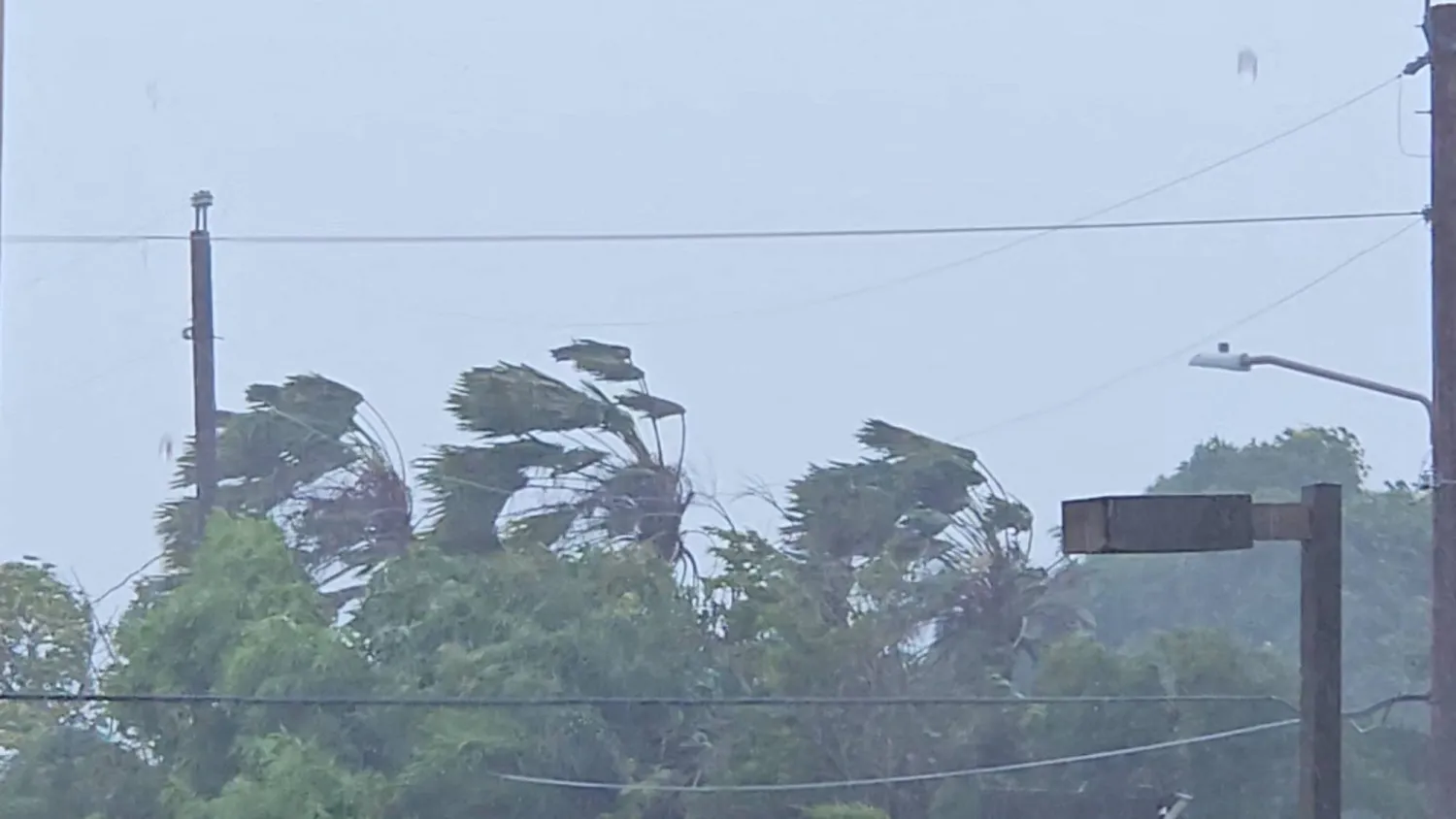

Super Typhoon Sinlaku Pounds Remote US Islands in the Pacific Ocean with Ferocious Winds

Trees sway in strong winds as Super Typhoon Sinlaku approaches, in Saipan, Northern Mariana Islands, US, April 14, 2026 in this screengrab obtained from a social media video. (Jhon Aaron Borinaga via Facebook/via Reuters)
TT

Super Typhoon Sinlaku Pounds Remote US Islands in the Pacific Ocean with Ferocious Winds

Trees sway in strong winds as Super Typhoon Sinlaku approaches, in Saipan, Northern Mariana Islands, US, April 14, 2026 in this screengrab obtained from a social media video. (Jhon Aaron Borinaga via Facebook/via Reuters)

A super typhoon steadily battered a pair of remote US islands in the Pacific Ocean with ferocious winds and relentless rains, shredding tin roofs and forcing residents to take cover from flying tree limbs.

Super Typhoon Sinlaku pounded the Northern Mariana Islands for hours before daybreak Wednesday, slowing just to inflict more damage across the islands of Tinian and Saipan, home to nearly 50,000 people.

In the village Susupe on Saipan, the wind tore the roof off a commercial building and broke tree branches. A blue sedan lay on its side.

Resident Dong Min Lee shot some video of a car sitting on top of two others in his apartment building’s parking lot below. The winds also tore off part of his balcony railing.

"I hope people will take an interest and help. The damage is really huge here," Lee said in a Facebook message.

Preliminary reports include a lot of flooding, uprooted trees and downed power lines, said Jaden Sanchez, spokesperson for the Saipan mayor’s office. There were no reports of deaths, he said.

Authorities were advising residents to remain indoors and away from strong winds, but Mayor Ramon "RB" Jose Blas Camacho was out in the community assessing the damage, Sanchez said.

The typhoon — the strongest tropical cyclone on Earth this year — was packing sustained winds of up to 150 mph (240 kph) when it made landfall on the islands, the National Weather Service said.

Tropical force winds and torrential rainfall also led to flash flooding on Guam, a US territory to the south with several US military installations and about 170,000 residents, the weather service said. Earlier, it hit the outer islands and atolls of Chuuk in the Federated States of Micronesia.

The American Red Cross and its partners were sheltering more than 1,000 residents across Guam and the Northern Marians, agency spokesperson Stephanie Fox said.

Winds at 75 mph (121 kph) or greater were expected to continue through Wednesday afternoon as the eye of the storm was moving northwest of Saipan and Tinian, said Ken Kleeschulte, acting science and operations officer for the National Weather Service on Guam.

Even as winds slowly subside to about 50 mph (80 kph), they will remain too strong for people to safely go outside for at least a day and a half, he said.

Sinlaku will start to curve toward sparsely populated volcanic islands in the far northern Marianas, he said.

Still recovering from a 2018 typhoon In Guam, where Typhoon Mawar knocked out power for days in 2023, US military officials warned personnel to shelter in place. The military controls about one-third of the land on Guam, a critical hub for US forces in the Pacific.

Tourism-dependent Saipan — the site of one of World War II’s bloodiest battles in the Pacific — was still recovering from 2018’s Super Typhoon Yutu when the COVID-19 pandemic hit, Hunter said. The economy has yet to rebound, he said.

Yutu destroyed 85% of the Saipan campus of Northern Marianas College, said the school's president, Galvin Deleon Guerrero. The institution secured $100 million in grant funding to rebuild.

"Just as we were finally beginning to recover and rebuild, we get hit with this," he said. "Climate change is real."

He said he worries about people still suffering from the post-traumatic stress of Yutu.

"We are an incredibly resilient people," he said, noting that he’s Chamorro, the Indigenous people of the Mariana Islands. "But just because we’re resilient doesn’t mean that we should be subjected to this on this frequent basis."

Disaster declaration President Donald Trump approved emergency disaster declarations ahead of the latest storm for Guam and the Mariana Islands. The Federal Emergency Management Agency said it was coordinating support across multiple agencies, dispatching nearly 100 FEMA staff as well as other personnel.

Super typhoons are the equivalent of Category 4 or 5 hurricanes in the Atlantic, with winds of at least 150 mph (240 kph). There have been more than 300 super typhoons identified over the past 80 years by the Joint Typhoon Warning Center in Guam.

Typhoons are "very common" in the Pacific, but the peak season is similar to the Atlantic hurricane season, which runs from summer to fall, said Jason Nicholls, AccuWeather’s lead international forecaster.

"As we’ve seen this year, you can get tropical systems in the West Pacific any time of year," Nicholls said. "But getting them in April is a little unusual."



Back on Earth, Artemis II Crew Still Finding their Footing

HOUSTON, TEXAS - APRIL 16: Artemis II Commander Reid Wiseman, Pilot Victor Glover, Mission Specialist Christina Koch, and Mission Specialist Jeremy Hansen speak during a press conference at the NASA Johnson Space Center on April 16, 2026 in Houston, Texas. Danielle Villasana/Getty Images/AFP
TT

Back on Earth, Artemis II Crew Still Finding their Footing

HOUSTON, TEXAS - APRIL 16: Artemis II Commander Reid Wiseman, Pilot Victor Glover, Mission Specialist Christina Koch, and Mission Specialist Jeremy Hansen speak during a press conference at the NASA Johnson Space Center on April 16, 2026 in Houston, Texas. Danielle Villasana/Getty Images/AFP

Nearly a week after their Pacific splashdown, the astronauts who crewed the Artemis II mission that flew around the Moon told reporters Thursday they have yet to fully grasp the magnitude of the moment.

"It's been a week of medical testing, physical testing, doctors, science objectives," mission commander Reid Wiseman said during a press conference at NASA's Johnson Space Center in Houston.

"We have not had that decompression," he added.

The 50-year-old led fellow Americans Victor Glover and Christina Koch, and Canadian crewmate Jeremy Hansen, on a mission that took them farther into space than anyone has ever gone before.

Adjusting to life on Earth is taking a beat, AFP reported.

"Tomorrow will be one week, and I just was trying to live in a little hole for one week, been off social media, not on the news. So, no, I don't know," Glover, who piloted the mission, told reporters.

Nonetheless, he said his children and neighbors have clued him in to the excitement.

Artemis II was the first crewed mission to venture to the Moon's orbit since 1972, and the only one in history to include a woman, or a Black astronaut, or a non-American. Their voyage was broadcast live by US space agency NASA, and the media coverage of the launch and return to Earth was watched by millions of people.

For Koch, waking up to the reality means remembering gravity has taken hold.

"In the first few days, I thought I was floating. I truly thought I was floating, and I had to convince myself I wasn't," Koch said.

Their mission lasted almost 10 days, but NASA has ambitions to return to the Moon for longer visits to establish a base in preparation for future missions to Mars.

The United States is targeting a lunar landing in 2028, before the end of President Donald Trump's term and a deadline set by rivals in China.


Hidden Cave, Hippo Bones Under Welsh Castle May Rewrite History

Previous small-scale excavations at Pembroke Castle have already uncovered evidence of early humans and animals. PHOTO: UNIVERSITY OF ABERDEEN
TT

Hidden Cave, Hippo Bones Under Welsh Castle May Rewrite History

Previous small-scale excavations at Pembroke Castle have already uncovered evidence of early humans and animals. PHOTO: UNIVERSITY OF ABERDEEN

A prehistoric hidden cave and hippo bones found beneath a Welsh castle could transform understanding of ancient life in Britain, researchers said Thursday, calling the site a "once-in-a-lifetime discovery".

Previous small-scale excavations at Pembroke Castle have already uncovered evidence of early humans and animals, including a now extinct hippopotamus that roamed Wales 120,000 years ago.

A major five-year archaeological project led by the University of Aberdeen will investigate the "enormous" cave, accessed via a spiral staircase from the 11th Century castle, AFP reported.

"There is no other site like it in Britain -- it is a once-in-a-lifetime discovery," said Rob Dinnis, who will lead the project.

The cave, previously thought to have been emptied by the Victorians, is now described as "one of the most important prehistoric archives in Britain".

"Despite the limited work done so far, we can already say that Wogan Cavern is a truly remarkable site," Dinnis said in a statement.

"Not only is there extremely rare evidence for early Homo sapiens, there are also hints at even earlier human occupation, probably by Neanderthals."

"We have also found hippo bones, which probably date to the last interglacial period, around 120,000 years ago," he added.

Earlier finds have revealed bones of mammoth, woolly rhinoceros, reindeer and wild horse, alongside stone tools and evidence of human occupation across multiple periods.

With larger-scale excavation due to resume in May, the researchers hope to gain "insights into past climate change, extinct species, and the multiple periods when humans called the cave their home".

They said the site could chart a long sequence of human activity, from hunter-gatherers after the last Ice Age around 11,500 years ago to some of Britain's earliest Homo sapiens between 45,000 and 35,000 years ago, and possibly even earlier Neanderthal presence.

"Wogan Cavern provides a unique chance to use all the scientific techniques now available to archaeologists," said professor Kate Britton of the University of Aberdeen.

"Because the bones are well preserved, we can learn a lot about past environments and ecosystems," she added.

At Pembroke Castle, staff say the discovery adds a new dimension to the site's long history as a medieval fortress and birthplace of Henry VII in 1457.

"This is incredibly exciting news for everyone at the castle," said castle manager Jon Williams.

"We are thrilled that work on this wonderful cave will continue."


Massive Asteroid Set to Pass ‘Close’ to Earth

The rare asteroid is expected to “safely pass” within 20,000 miles of Earth in 2029 (Shutterstock)
TT

Massive Asteroid Set to Pass ‘Close’ to Earth

The rare asteroid is expected to “safely pass” within 20,000 miles of Earth in 2029 (Shutterstock)

An asteroid named after a god of chaos is heading toward Earth — but there is no need to panic just yet, according to The Independent.

The massive rock is arriving for a historic flyby rather than a disaster, according to NASA. The encounter is still a few years away, but when it finally arrives, it will be so close that spotting it won’t even require a telescope.

Known as 99942 Apophis, the rare asteroid is expected to “safely pass” within 20,000 miles of Earth in 2029, representing one of the closest approaches ever recorded for a celestial object of this size.

“Even though Apophis does not pose any immediate risk to Earth, an asteroid of its size passing so close to our planet is a very rare event,” NASA astronomers stated. “Scientists across the globe are excited to use this opportunity to study Apophis in detail.”

At roughly 1,115 feet wide, the asteroid will pass closer to Earth than the satellites orbiting in geosynchronous altitude, according to NASA.

It will be the closest approach of an asteroid of this size that humans have ever been aware of in advance, according to the European Space Agency.

The rare timing of the flyby — falling on Friday, April 13, in many parts of the world, has already sparked a mix of excitement and superstition across social media.

The asteroid was named after the ancient Egyptian god of evil and destruction. The name was proposed by its discoverers — astronomers Roy Tucker, David Tholen and Fabrizio Bernardi of the Kitt Peak National Observatory near Tucson, Arizona — because Apophis is the Greek name for the Egyptian god known as Apep.

NASA reports that an asteroid of this scale passes this close to Earth only once every few thousand years on average, making it a potentially unprecedented event in recorded human history.