


Trump Says Steep Copper Tariffs in Store as He Broadens His Trade War

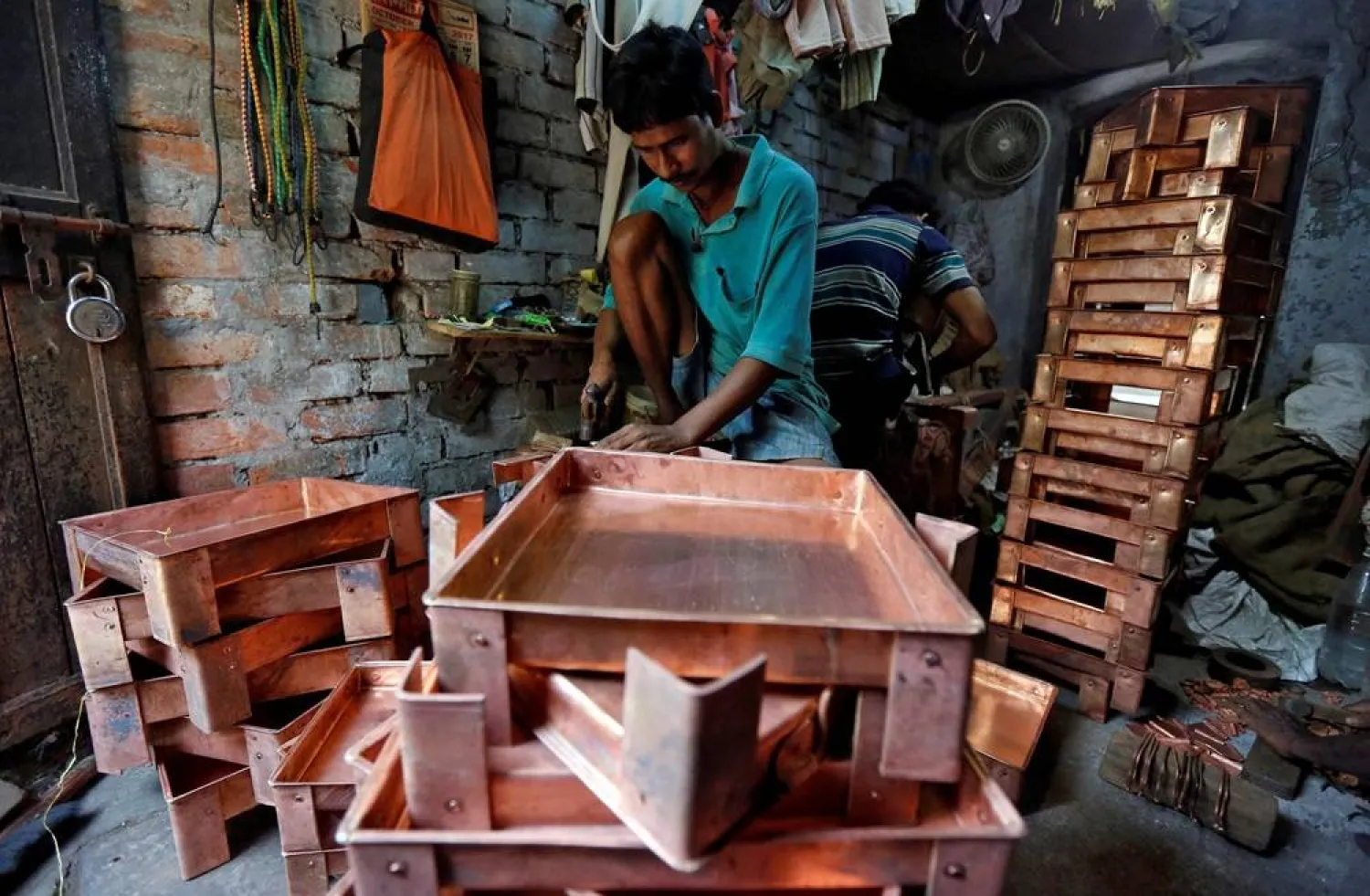
A worker makes copper trays inside a workshop in Kolkata, India, October 26, 2017. Picture taken October 26, 2017. (Reuters)
TT

Trump Says Steep Copper Tariffs in Store as He Broadens His Trade War

A worker makes copper trays inside a workshop in Kolkata, India, October 26, 2017. Picture taken October 26, 2017. (Reuters)

US President Donald Trump on Tuesday said he would impose a 50% tariff on imported copper and soon introduce long-threatened levies on semiconductors and pharmaceuticals, broadening his trade war that has rattled markets worldwide.

One day after he pressured 14 trading partners, including powerhouse US suppliers like South Korea and Japan, with sharply higher tariffs, Trump reiterated his threat of 10% tariffs on products from Brazil, India and other members of the BRICS group of countries.

He also said trade talks have been going well with the European Union and China, though he added he is only days away from sending a tariff letter to the EU.

Trump's remarks, made during a White House cabinet meeting, could inject further instability into a global economy that has been shaken by the tariffs he has imposed or threatened on imports to the world's largest consumer market.

US copper futures jumped more than 10% after Trump's announcement of new duties on a metal that is critical to electric vehicles, military hardware, the power grid and many consumer goods. They would join duties already in place for steel, aluminum and automobile imports, though it was unclear when the new tariffs might take effect.

US pharmaceutical stocks also slid following Trump's threat of 200% tariffs on drug imports, which he said could be delayed by about a year.

Other countries, meanwhile, said they would try to soften the impact of Trump's threatened duties after he pushed back a Wednesday deadline to August 1.

Trump's administration promised "90 deals in 90 days" after he unveiled an array of country-specific duties in early April. So far only two agreements have been reached, with the United Kingdom and Vietnam. Trump has said a deal with India is close.

Trump said countries have been clamoring to negotiate.

"It's about time the United States of America started collecting money from countries that were ripping us off ... and laughing behind our back at how stupid we were," he said.

Trading partners across the globe say it has been difficult to negotiate even framework agreements with the US given the haphazard way new tariffs are announced, complicating their internal discussions about concessions.

HIGHEST LEVELS SINCE 1934

Following Trump's announcement of higher tariffs for imports from the 14 countries, US research group Yale Budget Lab estimated consumers face an effective US tariff rate of 17.6%, up from 15.8% previously and the highest in nine decades.

Trump's administration has been touting those tariffs as a significant revenue source. Treasury Secretary Scott Bessent said Washington has taken in about $100 billion so far and could collect $300 billion by the end of the year.

The United States has taken in about $80 billion annually in tariff revenue in recent years.

The S&P 500 finished slightly lower on Tuesday, a day after Wall Street markets sold off sharply following Trump's new tariffs announcement.

Trump said he will "probably" tell the European Union within two days what rate it can expect for its exports to the US, adding that the 27-member bloc had been treating his administration "very nicely" in trade talks.

The EU, the largest bilateral trade partner of the US, aims to strike a deal before August 1 with concessions for key export industries such as aircraft, medical equipment and spirits, according to EU sources. Brussels is also considering an arrangement that would protect European automakers with large US production facilities.

However, German Finance Minister Lars Klingbeil warned that the EU was prepared to retaliate if necessary.

"If we don't reach a fair trade deal with the US, the EU is ready to take counter measures," he said in the lower house of parliament. Japan, which faces a possible 25% tariff, wants concessions for its large automobile industry and will not sacrifice its agriculture sector, a powerful domestic lobby, for the sake of an early deal, top trade negotiator Ryosei Akazawa said on Tuesday.

South Korea, which also faces a possible 25% tariff, said it planned to intensify trade talks over the coming weeks "to reach a mutually beneficial result."

Washington and Beijing agreed to a trade framework in June, but with many of the details still unclear, traders and investors are watching to see if it unravels before a separate, US-imposed August 12 deadline or leads to a lasting detente.

"We have had a really good relationship with China lately, and we're getting along with them very well. They've been very fair on our trade deal, honestly," Trump said, adding that he has been speaking regularly with Chinese President Xi Jinping.

Trump said the United States would impose tariffs of 25% on goods from Tunisia, Malaysia and Kazakhstan; 30% on South Africa and Bosnia and Herzegovina; 32% on Indonesia; 35% on Serbia and Bangladesh; 36% on Cambodia and Thailand; and 40% on Laos and Myanmar.

Cambodia hailed as a big success a reduction in the tariff rate from 49% to 36% and said it was seeking to negotiate a further cut. The tariffs have been an issue for Cambodia's garments and footwear sector, the biggest driver of its economy.

The US is also the main export market for Bangladesh's ready-made garments industry, which accounts for more than 80% of its export earnings and employs 4 million people.

Mawani Signs 3 MoUs with Global Shipping Lines to Support Saudi Exports

Mawani Signs 3 MoUs with Global Shipping Lines to Support Saudi Exports
TT

Mawani Signs 3 MoUs with Global Shipping Lines to Support Saudi Exports

Mawani Signs 3 MoUs with Global Shipping Lines to Support Saudi Exports

The Saudi Ports Authority (Mawani) signed on Tuesday three memoranda of understanding (MoUs) with major international shipping lines: MSC, Maersk, and CMA CGM.

The agreements were signed on the sidelines of the Made in Saudi Expo 2025 and in partnership with the Saudi Export Development Authority (Saudi Exports).

The memoranda aim to support national exports and Saudi exporters by boosting access to global markets through an integrated logistics services ecosystem that connects the Kingdom’s ports with international destinations via leading global shipping lines.

The initiative provides exporters with broader opportunities for expansion and growth, while reinforcing international confidence in the quality of Saudi products by ensuring fast, efficient, and reliable delivery.

The MoUs establish a strategic framework for cooperation among the signatories to deliver innovative and integrated logistics solutions, facilitate the export of Saudi products, and boost the availability of empty containers at the Kingdom’s ports to ensure sufficient inventory levels that meet exporters’ needs.

They aim to expand joint initiatives that contribute to increasing Saudi exports in line with the goals of Saudi Vision 2030. This includes organizing workshops, conferences, and exhibitions to raise awareness, bolster exporters’ capabilities, measure satisfaction with logistics services, and promote national exports globally.

The MoUs seek to improve Saudi exporters’ access to new markets by providing advanced and efficient logistics solutions through Jeddah Islamic Port, King Abdulaziz Port in Dammam, and Jubail Commercial Port, alongside efforts to further automate port operations.


Saudi Arabia, Syria Discuss Industrial Investment Partnerships

Saudi Minister of Industry and Mineral Resources Bandar Alkhorayef during Tuesday's meeting. (SPA)
TT

Saudi Arabia, Syria Discuss Industrial Investment Partnerships

Saudi Minister of Industry and Mineral Resources Bandar Alkhorayef during Tuesday's meeting. (SPA)

Saudi Minister of Industry and Mineral Resources Bandar Alkhorayef held talks in Riyadh on Tuesday with Syrian Minister of Economy and Industry Nedal Al-Shaar on ways to strengthen economic relations and develop industrial investment partnerships between their countries.

Alkhorayef praised Syria’s participation as Guest of Honor in the third edition of the Made in Saudi Expo, noting that this reflects the depth of fraternal relations and the shared economic ties between the two countries.

The officials discussed aspects of industrial cooperation and the opportunities for Syria to benefit from the Kingdom’s expertise and successful experience in developing its industrial sector.

They addressed prominent export opportunities that can support trade growth, strengthen industrial and economic integration between Saudi Arabia and Syria, and advance their developmental goals and shared interests.

Separately, Alkhorayef revealed that the Kingdom’s non-oil exports reached SAR307 billion in the first half of this year, marking the highest semiannual growth on record. 

He made the announcement during his participation in a dialogue session with Al-Shaar on the sidelines of the Made in Saudi Expo 2025. 

Alkhorayef explained that Saudi Vision 2030, through its initiatives, has driven record performance and sustained growth in non-oil exports over the past few years by unlocking national industrial capabilities, boosting the quality of Saudi products, and expanding their access to global markets. 

He highlighted opportunities for cooperation between Saudi Arabia and Syria in developing industrial cities, enabling Damascus to benefit from the Kingdom’s successful experience in export development and local content support, thereby contributing to its economic growth. 

Alkhorayef underlined the level of efficiency, skill, and craftsmanship demonstrated by Syrian investors in the Kingdom’s industrial sector, hoping that the industrial sector would become a key pillar of Syria’s economic advancement. 

He also addressed trade development between the two countries, noting that Saudi non-oil exports to Syria totaled SAR1.2 billion in the first nine months of 2025. 


Saudi Inflation Slows to Nine-Month Low in November

 People enjoy sitting outdoors as the summer heat eases in Riyadh (AFP). 
 People enjoy sitting outdoors as the summer heat eases in Riyadh (AFP). 
TT

Saudi Inflation Slows to Nine-Month Low in November

 People enjoy sitting outdoors as the summer heat eases in Riyadh (AFP). 
 People enjoy sitting outdoors as the summer heat eases in Riyadh (AFP). 

Saudi Arabia’s annual inflation rate slowed to 1.9 percent in November 2025, its lowest level in nine months, down from 2.2 percent in October, driven by easing housing costs and lower prices for food and beverages.

On a monthly basis, inflation remained broadly stable, edging up 0.1 percent compared with October.

According to data released on Monday by the Saudi General Authority for Statistics (GASTAT), the housing, water, electricity, gas and other fuels category rose 4.3 percent year on year in November, down from 4.5 percent in October. Within that category, actual housing rents increased 5.4 percent, slowing from 5.7 percent a month earlier.

Prices in the food and beverages category rose 1.3 percent, reflecting a 1.6 percent increase in the prices of fresh, chilled and frozen meat. The transport category climbed 1.5 percent, driven by a 6.4 percent rise in passenger transport services.

The personal care, social protection and miscellaneous goods and services category recorded the largest annual increase, up 6.6 percent, supported by a 19.9 percent surge in prices of other personal products, influenced by a 21.6 percent rise in jewelry and watch prices.

Prices for insurance and financial services increased 5.1 percent, led by an 8.4 percent rise in insurance costs. The recreation, sports and culture category rose 1.3 percent, reflecting a 2.1 percent increase in holiday package prices.

In contrast, prices for furniture, household equipment and routine household maintenance declined 0.3 percent. The restaurants and accommodation services category also fell 0.5 percent, as accommodation service prices decreased 2.3 percent.

GASTAT noted that the Consumer Price Index (CPI) measures changes in prices paid by consumers for a fixed basket of 582 items, while the Wholesale Price Index (WPI) tracks price movements of goods at the pre-retail stage for a fixed basket of 343 items.
