


Saudi Investment Delegation Concludes Visit to Syria with Deals Worth Nearly $6.4 Billion

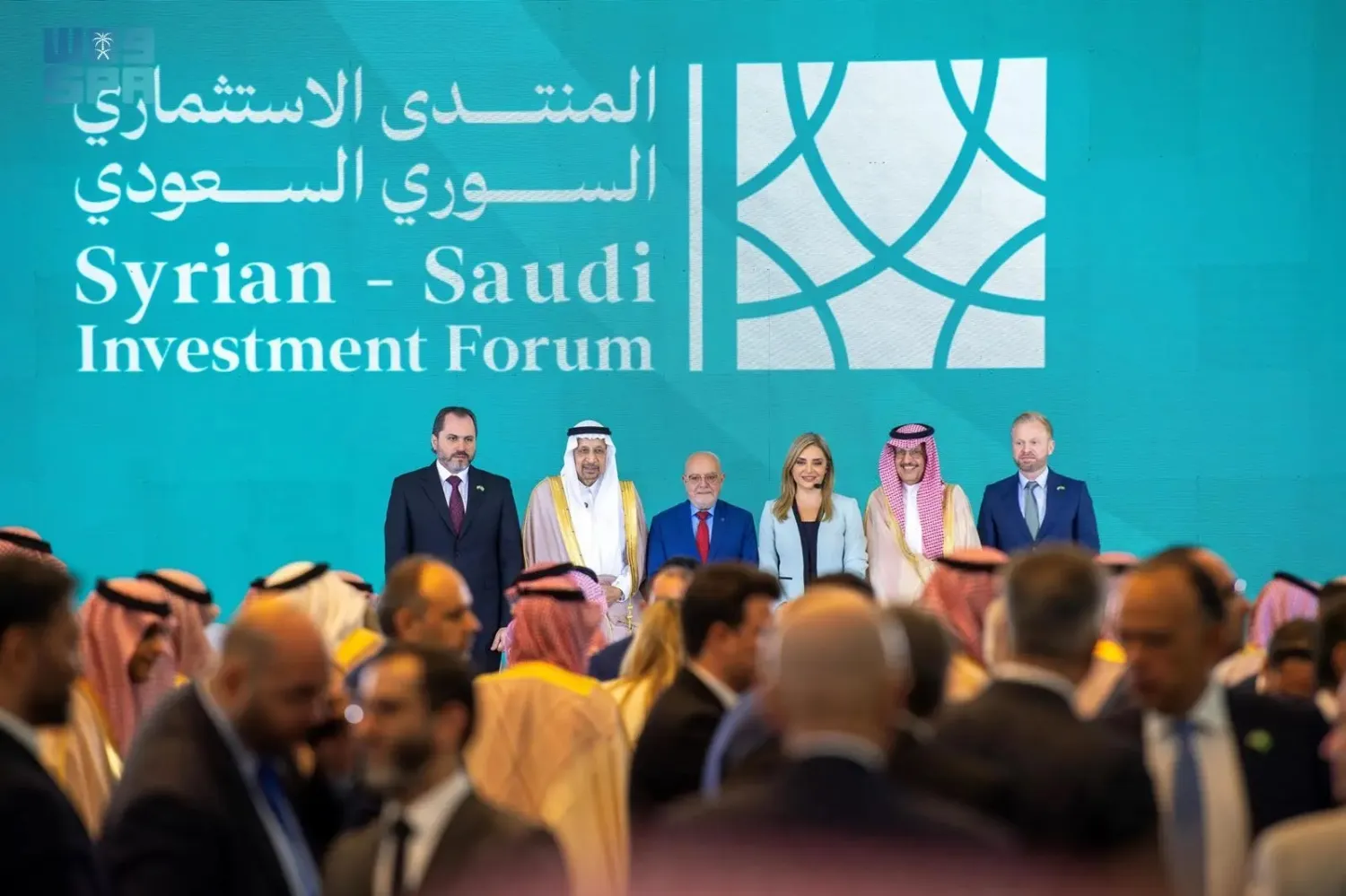
Officials are seen at the Syrian-Saudi Investment Forum in Damascus. (SPA)
TT

Saudi Investment Delegation Concludes Visit to Syria with Deals Worth Nearly $6.4 Billion

Officials are seen at the Syrian-Saudi Investment Forum in Damascus. (SPA)

Saudi Arabia announced $6.4 billion of investments in Syria on Thursday, reflecting the Kingdom's deepening ties with interim President Ahmed al-Sharaa's government as it seeks to rebuild Syria after a 14-year civil war.   

The deals were unveiled by Saudi Investment Minister Khalid Al-Falih at the Syrian-Saudi Investment Forum in Damascus.   

Al-Falih said his visit to Syria came at the directives of Prince Mohammed bin Salman, Crown Prince and Prime Minister, calling the trip "confirmation of the Kingdom's firm and supportive stance towards sisterly Syria".   

The investment deals included $2.93 billion for real estate and infrastructure projects and about $1.07 billion for the telecommunications and information technology sector, Al-Falih said.   

Businesses involved in the plans include telecommunications firms the Saudi Telecom Company (STC) and GO Telecom, digital security company Elm, cybersecurity firm Cipher, and Classera, an education technology company.   

Al-Falih said 47 agreements would be signed over the course of the conference, with more than 100 companies participating.   

Al-Falih also announced the establishment of a Saudi-Syrian Business Council at the event, which had been scheduled for June but was delayed due to the conflict between Iran and Israel.   

On the sidelines of the forum, a ministerial session was held featuring Al-Falih, Syrian Minister of Economy and Industry Dr. Mohammad Nidal Al-Shaar, Syrian Minister of Tourism Mazen Al-Salhani, and Saudi-Syrian Business Council and ACWA Power chairman Mohammad Abunayyan. 

The session highlighted the growing historical economic ties between Saudi Arabia and Syria and the support of the Saudi government, led by King Salman and Crown Prince Mohammed, to provide all means of support and facilitation that contribute to Syria’s prosperity and recovery. 

The session addressed the role of Saudi businessmen and leading companies in helping in Syria’s reconstruction and economic revival through partnerships, consultations, and urgent, effective efforts to develop promising economic sectors. 

During the forum, Al-Badia Cement Company announced investments exceeding $200 million to expand its grinding and packaging lines and power generation plant, increasing production capacity to more than 5 million tons of cement annually.  

The company also pledged to explore partnership opportunities with the Syrian government to improve the performance of state-owned cement factories and support market stability. 

As part of the visit, Al-Falih held a meeting with several Syrian ministers, who discussed ways to boost cooperation in support of comprehensive development between the two nations. 

The visit also included field tours to several Saudi investment projects in Syria. Al-Falih laid the foundation stone for Al-Fayhaa Cement Factory, with an estimated investment of SAR 100 million and an annual production capacity of 150,000 tons. The project aims to support local Syrian content and facilitate knowledge transfer. 

He also laid the foundation stone for the Al-Jawhara Commercial Tower in Damascus, a Saudi-Syrian project with a built-up area of 25,000 square meters and an investment exceeding SAR 375 million. The tower will include office spaces, retail shops, and hotel units. 

Riyadh has been a key ally of Sharaa's government, which came to power after longtime ruler Bashar al-Assad was toppled in December, using its diplomatic influence to persuade US President Donald Trump to lift sanctions.   

Companies, many from Gulf states and Türkiye, have expressed interest in rebuilding Syria's power generation capacity, roads, ports and other damaged infrastructure.   

Syria has signed a $7-billion power deal with Qatar and an $800-million agreement with UAE-based port company DP World in recent months. US energy firms are also set to draw up a master plan for the country's energy sector.   

In April, Saudi Arabia and Qatar announced they would pay off Syria's World Bank arrears, opening up the possibility of new lending. 


Trump Says He Will Raise US Global Tariff Rate from 10% to 15%

US President Donald Trump speaks during a press briefing at the White House, following the Supreme Court's ruling that Trump had exceeded his authority when he imposed tariffs, in Washington, DC, US, February 20, 2026. (Reuters)
TT

Trump Says He Will Raise US Global Tariff Rate from 10% to 15%

US President Donald Trump speaks during a press briefing at the White House, following the Supreme Court's ruling that Trump had exceeded his authority when he imposed tariffs, in Washington, DC, US, February 20, 2026. (Reuters)

President Donald Trump said on Saturday he will raise temporary tariffs on almost all US imports from 10% to 15%, the maximum level allowed under the law, after the US Supreme Court struck down his previous tariff program as invalid.

Trump had immediately announced a 10% across-the-board tariff on Friday after the court's decision, which ‌found the president ‌had exceeded his authority when ‌he ⁠imposed an array ⁠of higher rates under an economic emergency law.

The new levies are grounded in a separate law, known as Section 122, that allows tariffs up to 15% but requires congressional approval to extend them after 150 days.

In a ⁠social media post on Saturday, ‌Trump said he ‌would use that period to work on issuing other "legally ‌permissible" tariffs. The administration intends to rely ‌on two other statutes that permit import taxes on specific products or countries based on investigations into national security or unfair trade practices.

"I, as President of ‌the United States of America, will be, effective immediately, raising the 10% ⁠Worldwide ⁠Tariff on Countries, many of which have been 'ripping' the US off for decades, without retribution (until I came along!), to the fully allowed, and legally tested, 15% level," he wrote in a Truth Social post.

Trump has shown little sign of backing off his global trade war in the hours since the court's 6-3 decision, attacking individual justices in personal terms and insisting he retained the power to impose tariffs as he sees fit.


Asian Economies Weigh Impact of Fresh Trump Tariff Moves, Confusion

 Shoppers crowd for the upcoming Chinese Lunar New Year celebrations at the Dihua Street market in Taipei, Taiwan, Sunday, Feb. 15, 202. (AP)
Shoppers crowd for the upcoming Chinese Lunar New Year celebrations at the Dihua Street market in Taipei, Taiwan, Sunday, Feb. 15, 202. (AP)
TT

Asian Economies Weigh Impact of Fresh Trump Tariff Moves, Confusion

 Shoppers crowd for the upcoming Chinese Lunar New Year celebrations at the Dihua Street market in Taipei, Taiwan, Sunday, Feb. 15, 202. (AP)
Shoppers crowd for the upcoming Chinese Lunar New Year celebrations at the Dihua Street market in Taipei, Taiwan, Sunday, Feb. 15, 202. (AP)

US trading partners in Asia started weighing fresh uncertainties on Saturday after President Donald Trump vowed to impose a new tariff on imports, hours after the Supreme Court struck down many of the sweeping levies he used to launch a global trade war.

The court's ruling invalidated a number of tariffs that the Trump administration had imposed on Asian export powerhouses from China and South Korea to Japan and Taiwan, the world's largest chip maker and a key player in tech supply chains.

Within hours, Trump said he would impose a new 10% duty on US imports from all countries starting on Tuesday for an initial 150 days under a different law, prompting analysts to warn that more measures could follow, threatening more confusion for businesses and investors.

In Japan, a government spokesman said Tokyo "will carefully examine the content of this ruling and ‌the Trump administration's response ‌to it, and respond appropriately."

China, which is preparing to host Trump in ‌late ⁠March, has yet to ⁠formally comment or launch any counter moves with the country on an extended holiday. But a senior financial official in China-ruled Hong Kong described the US situation as a "fiasco".

Christopher Hui, Hong Kong's secretary for financial services and the treasury, Trump's new levy served to underscore Hong Kong's "unique trade advantages", Hui said.

"This shows the stability of Hong Kong's policies and our certainty ... it shows global investors the importance of predictability," Hui said at a media briefing on Saturday when asked how the new US tariff's would affect the city's economy.

Hong Kong operates as a separate customs territory from mainland China, a ⁠status that has shielded it from direct exposure to US tariffs targeting Chinese goods.

While ‌Washington has imposed duties on mainland exports, Hong Kong-made products have ‌generally faced lower tariff rates, allowing the city to maintain trade flows even as Sino-US tensions escalated.

Before the Supreme Court's ruling, Trump's ‌tariff push had strained Washington's diplomatic relations across Asia, particularly for export-reliant economies integrated into US-bound supply chains.

Friday's ruling ‌concerns only the tariffs launched by Trump on the basis of the International Emergency Economic Powers Act, or IEEPA, intended for national emergencies.

Trade policy monitor Global Trade Alert estimated that by itself, the ruling cuts the trade-weighted average US tariff almost in half from 15.4% to 8.3%.

For those countries on higher US tariff levels, the change is more dramatic. For China, Brazil and ‌India, it will mean double-digit percentage point cuts, albeit to still-high levels.

In Taiwan, the government said it was monitoring the situation closely, noting that the US government ⁠had yet to determine how ⁠to fully implement its trade deals with many countries.

"While the initial impact on Taiwan appears limited, the government will closely monitor developments and maintain close communication with the US to understand specific implementation details and respond appropriately," a cabinet statement said.

Taiwan has signed two recent deals with the US - one was a Memorandum of Understanding last month that committed Taiwan to invest $250 billion and the second was signed this month to lowering reciprocal tariffs.

Analysts say the Supreme Court's ruling against Trump's more aggressive tariff measures may offer little relief for the global economy. They warned of looming confusion as trading nations brace for moves by Trump to find other means of using levies to circumvent the ruling.

Thailand's Trade Policy and Strategy Office head Nantapong Chiralerspong said the ruling might even benefit its exports as uncertainty drove a fresh round of "front loading", where shippers race to move goods to the US, fearing even higher tariffs.

In corporate disclosures tracked by Reuters, firms across the Asia-Pacific region reported financial hits, supply shifts and withdrawals as levies escalated through 2025 and early 2026.


Brazil, India Eye Critical Minerals Deal as Leaders Meet

Brazil's President Luiz Inacio Lula da Silva (L) and Indian Prime Minister Narendra Modi are expected to discuss efforts to increase trade links. Ludovic MARIN / AFP/File
TT

Brazil, India Eye Critical Minerals Deal as Leaders Meet

Brazil's President Luiz Inacio Lula da Silva (L) and Indian Prime Minister Narendra Modi are expected to discuss efforts to increase trade links. Ludovic MARIN / AFP/File

India's Prime Minister Narendra Modi and Brazilian President Luiz Inacio Lula da Silva are set to meet in New Delhi on Saturday, seeking to boost cooperation on critical minerals and rare earths.

Brazil has the world's second-largest reserves of these elements, which are used in everything from electric vehicles, solar panels and smartphones to jet engines and guided missiles.

India, seeking to cut its dependence on top exporter China, has been expanding domestic production and recycling while scouting for new suppliers.

Lula, heading a delegation of more than a dozen ministers as well as business leaders, arrived in New Delhi on Wednesday for a global summit, reported AFP.

Officials have said that in talks with Modi on Saturday, the two leaders are expected to sign a memorandum on critical minerals and discuss efforts to increase trade links.

The world's most populous nation is already the 10th largest market for Brazilian exports, with bilateral trade topping $15 billion in 2025.

The two countries have set a trade target of $20 billion to be achieved by 2030.

With China holding a near-monopoly on rare earths production, some countries are seeking alternative sources.

Rishabh Jain, an expert with the Delhi-based Council on Energy, Environment and Water think tank, said India's growing cooperation with Brazil on critical minerals complements recent supply chain engagements with the United States, France and the European Union.

While these partnerships grant India access to advanced technologies, finance and high-end processing capabilities, "Global South alliances are critical for securing diversified, on-ground resource access and shaping emerging rules of global trade", Jain told AFP.

- 'Challenges' -

Modi and Lula are also expected to discuss global economic headwinds and strains on multilateral trade systems after both of their countries were hit by US tariffs in 2025, prompting the two leaders to call for stronger cooperation.

Washington has since pledged to roll back duties on Indian goods under a trade deal announced earlier this month.

"Lula and Modi will have the opportunity to exchange views on... the challenges to multilateralism and international trade," said Brazilian diplomat Susan Kleebank, the secretary for Asia and the Pacific.

Brazil is India's biggest partner in Latin America.

Key Brazilian exports to India include sugar, crude oil, vegetable oils, cotton and iron ore.

Demand for iron ore has been driven by rapid infrastructure expansion and industrial growth in India, which is on track to become the world's fourth largest economy.

Brazilian firms are also expanding in the country, with Embraer and Adani Group announcing plans last month to build aircraft in India.

Lula addressed the AI Impact summit in Delhi on Thursday, calling for a multilateral and inclusive global governance framework for artificial intelligence.

He will travel on to South Korea for meetings with President Lee Jae Myung and to attend a business forum.
