


Al-Falih: Syrian-Saudi Investment Forum Reflects Kingdom’s Strong Support for Syria’s Economic Growth

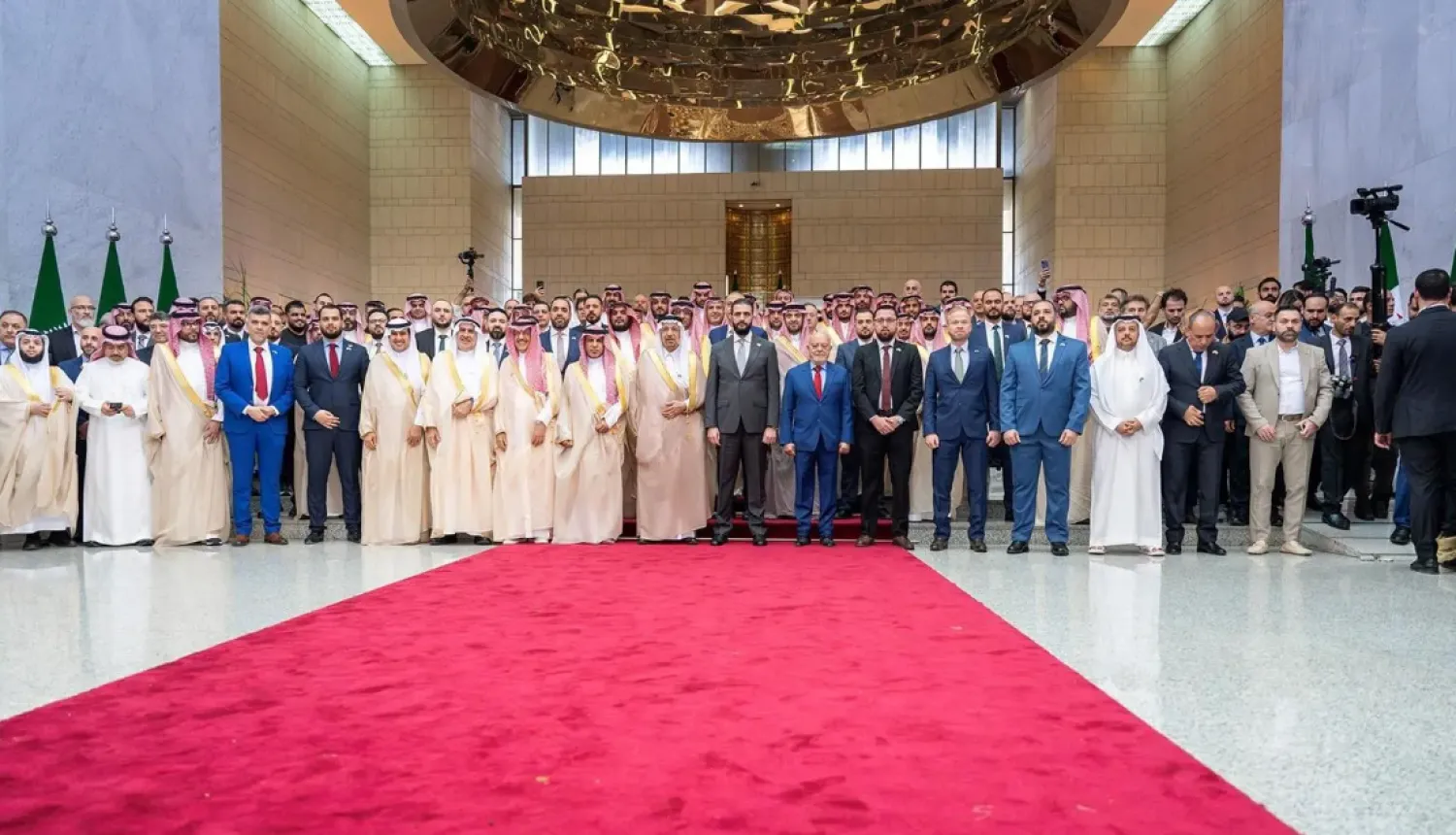
The Syrian-Saudi Investment Forum kicked off in Damascus - SPA
TT

Al-Falih: Syrian-Saudi Investment Forum Reflects Kingdom’s Strong Support for Syria’s Economic Growth

The Syrian-Saudi Investment Forum kicked off in Damascus - SPA

Under the patronage of Syrian President Ahmed al-Sharaa, the Syrian-Saudi Investment Forum kicked off on Thursday in Damascus, attended by various ministers and officials from both countries.

Saudi Minister of Investment Khalid Al-Falih delivered the opening speech, expressing gratitude for the hospitality extended by Syria and its people since their arrival, SPA reported.

He conveyed greetings from Custodian of the Two Holy Mosques King Salman bin Abdulaziz Al Saud and Prince Mohammed bin Salman bin Abdulaziz Al Saud, Crown Prince and Prime Minister, along with hopes for security and prosperity for Syria.

Al-Falih emphasized that the directive from the Crown Prince to visit Syria with a delegation, comprising representatives from both the government and private sectors of Saudi Arabia, highlights the Kingdom's strong support for Syria in its journey towards economic growth, prosperity, and sustainable development.

He stated, "We are not here to build new relationships; strong social, cultural, and economic ties have long connected our two countries. Historically, the Arabian Peninsula and the Levant were vital links in global trade through the Silk, Spice, and Incense Routes.

Saudi Arabia and Syria have shared strong social, economic, and political ties. Recent meetings between the Crown Prince and the Syrian President aimed to strengthen this bond and create new opportunities for cooperation, highlighting the Kingdom's commitment to enhancing economic and investment relations with Syria."

The minister noted that over 20 government entities and 100 leading private sector companies from Saudi Arabia are present at the forum, investing in various sectors, including energy, infrastructure, financial services, healthcare, agriculture, as well as communications and information technology.

He announced that 47 agreements, valued at approximately SAR24 billion, will be signed, covering various fields including real estate, finance, and tourism.

Al-Falih also stressed that the forum reflects the belief that the private sector is a key partner in achieving mutual goals between the two countries. It encourages Saudi and international investors to explore opportunities in Syria and contribute to its strategic projects, thereby fostering mutual benefits across vital sectors.

He highlighted that agreements exceeding SAR11 billion will be signed in infrastructure and real estate. This includes the establishment of over three new cement factories, aimed at securing essential raw materials for construction and enhancing self-sufficiency in this critical area.

In the telecommunications sector, Al-Falih stated that the forum marked the beginning of cooperation between the Syrian Ministry of Communications and Information Technology and Syrian tech companies on one side, and leading Saudi companies—such as Elm, stc, GO Telecom, Cipher, Classera—on the other. This collaboration aims to develop digital infrastructure, enhance cybersecurity capabilities, and build advanced ecosystems in artificial intelligence, data centers, and educational academies. Agreements in this sector are estimated to be worth approximately SAR4 billion.

Al-Falih described Syria's agricultural sector as rich with potential in modern farming, grain production, organic products, and food supply chains. He expressed eagerness to collaborate with the Syrian side to develop innovative joint projects, including model farms and processing industries, as well as knowledge and technology exchange.

He also addressed the financial services and remittance sector, which will witness, at the event, the signing of a memorandum of understanding today between the Saudi Tadawul Group and the Damascus Securities Exchange. This agreement aims to enhance cooperation in financial technologies, dual listings, data exchange, and the establishment of investment and transfer funds that will stimulate investment in Syria.

The minister commended the positive and active role played by over 2,600 Syrian entrepreneurs in the Kingdom, noting that direct investments by Syrian investors in Saudi Arabia have reached nearly SAR10 billion. He emphasized their major role in building the new Syria and its growing economy.

He said, "These figures are only the beginning and do not reflect our ambitions. We must work together, closely and cohesively, to grow and elevate these figures in line with the efforts of our two nations to build a better future for our peoples."

Al-Falih also praised the positive steps taken by the Syrian government to improve the investment climate, foremost among them the amendment of the Investment Law on June 24, 2025, which grants investors more guarantees and incentives, facilitates procedures, and enhances transparency.

As a reflection of the Kingdom's commitment to fostering investment in Syria, Al-Falih announced the establishment of the Saudi-Syrian Business Council, composed of a select group of business leaders. The council aims to drive economic cooperation, activate partnerships among private sector institutions in both countries, and boost Saudi investment presence in Syria's promising market.

Al-Falih reiterated that the strong interest and presence of successful and pioneering Saudi companies across diverse investment sectors at the forum, along with the enthusiasm, engagement, and responsiveness witnessed from all sides in Syria. The resulting agreements across critical and high-value fields—capped by the commitment shown by the Syrian leadership and officials—are promising signs.

These signs affirm that the path of cooperation and integration being launched today marks the beginning of a future filled with prosperity, growth, and development for both countries and their peoples across all fields, under the guidance and support of the leadership of both nations.



French Economy Likely to Grow at Least 0.8% in 2025, Finance Minister Says

French Minister for Economy, Finance, and Industrial, Energy and Digital Sovereignty Roland Lescure attends the 7th formal meeting of the Franco-Chinese Business Council in Beijing on December 4, 2025. (Reuters)
TT

French Economy Likely to Grow at Least 0.8% in 2025, Finance Minister Says

French Minister for Economy, Finance, and Industrial, Energy and Digital Sovereignty Roland Lescure attends the 7th formal meeting of the Franco-Chinese Business Council in Beijing on December 4, 2025. (Reuters)

Unless there is a sharp reversal in the final three months of the year, the French economy is likely to grow by at least 0.8% in 2025, outpacing the 0.7% that the government had anticipated, Finance Minister Roland Lescure said on Sunday.

"We will most likely exceed the government's growth forecast for this year. We had predicted 0.7%, but I think we will have at least 0.8%. That's good news," Lescure told LCI television.

"So we would really need to have a bad fourth quarter, which I don't believe will happen, for us to be below 0.8%, so 0.8% is within reach," he added.

France's economy grew 0.5% in the third quarter, final data from statistics office INSEE showed in November, reflecting resilience in the euro zone's second-largest economy.


Saudi Real Estate Shifts from Temporary Upswing to Operational Maturity

Real estate projects in Riyadh (SPA) 
TT

Saudi Real Estate Shifts from Temporary Upswing to Operational Maturity

Real estate projects in Riyadh (SPA) 

Saudi Arabia’s listed real estate sector recorded an exceptional and unprecedented transformation in the third quarter of 2025, with profits surging more than sixfold. Total earnings jumped 633.6 percent to $496 million (SAR 1.86 billion), compared with $67.5 million a year earlier, an indication that the industry has entered a phase of sustained operational maturity rather than a short-term cyclical rebound.

The sharp rise reflects the companies’ success in restructuring their product portfolios, enhancing cash flows, and shifting from “paper growth” to revenue-driven expansion supported by project deliveries and operational income.

Sector analysts attributed the leap in profitability to the rollout of major real estate projects in large cities, higher project quality, improved financing conditions, and stronger liquidity.

They noted that the leap aligns with the rapid expansion of Saudi Arabia’s non-oil economy, which now contributes about 56 percent of GDP. This has strengthened demand across residential, commercial, industrial, and office real estate, supporting profit growth alongside recent regulatory reforms.

During the first nine months of 2025, listed real estate firms achieved combined profits of $1.44 billion (SAR 5.4 billion), led by Cenomi Centers, Jabal Omar, and Masar (Umm Al-Qura for Development and Construction) - a 244 percent increase from the same period in 2024.

Financial disclosures show that nine out of sixteen listed developers reported higher profits in Q3, while four companies returned to profitability. Masar topped the sector in Q3 with SAR 516.6 million in earnings, up 341.9 percent year-on-year. Cenomi Centers ranked second with SAR 499.8 million, a rise of 52.2 percent, followed by Dar Al-Arkan, whose profits climbed 89 percent to SAR 255.6 million.

Real estate specialist Abdullah Al-Mousa told Asharq Al-Awsat that the historic profit surge confirms the sector has “entered a stage of operational maturity,” reflecting companies’ improved efficiency, stronger recurring revenues, and the successful transition to asset-operation models.

He identified three key drivers: higher-quality projects and stronger occupancy across income-generating assets; improved financing conditions amid stabilizing interest rates; and the completion of major projects, particularly in Riyadh and Makkah.

Al-Mousa expects continued positive performance in coming quarters, though at a more moderate pace, supported by new strategic projects entering operation, sustained housing demand, rising commercial activity in Riyadh, and ongoing regulatory reforms that reduce risk and attract institutional investment.

Real estate analyst Salman Saeed said the strength of the non-oil economy has sharply boosted demand in housing, retail, industrial, and office markets. He highlighted reforms such as the expansion of the white-land tax and rental-regulation measures, along with significant government support for homeownership, which has raised the share of Saudi citizens owning homes.

Saeed noted that rising demand for commercial and office space, driven by multinational companies relocating to Riyadh, has lifted occupancy rates and diversified developers’ income streams. Some firms also improved results through land sales and divestment of non-core assets, enhancing operational efficiency.


Qatar’s Energy Minister: AI Will Secure Future Demand for LNG

Al-Kaabi speaks at a panel discussion at the Doha Forum 2025. (X)
TT

Qatar’s Energy Minister: AI Will Secure Future Demand for LNG

Al-Kaabi speaks at a panel discussion at the Doha Forum 2025. (X)

Statements by Qatar’s Minister of State for Energy Affairs Saad Al-Kaabi became a focal point at the Doha Forum 2025, opened by Emir Sheikh Tamim bin Hamad Al Thani under the theme “Anchoring Justice: From Promises to Tangible Reality.”

Al-Kaabi delivered an upbeat assessment of the gas sector’s future, insisting he has “no concern whatsoever” about long-term demand thanks to the soaring power needs of artificial intelligence data centers.

Al-Kaabi said global demand for natural gas will remain robust as AI-driven energy consumption accelerates, forecasting that liquefied natural gas (LNG) demand will reach 600–700 million tons annually by 2035. He warned, however, that insufficient investment could constrain future LNG and gas supplies.

“I have absolutely no worries about future gas demand,” he said, adding that AI-related power consumption will be a key driver.

Once fully operational, Qatar’s North Field expansion is expected to produce 126 million metric tons of LNG a year by 2027 - an 85 percent increase from today’s 77 million tons.

He also noted that the first train of the Golden Pass LNG project, a joint venture with ExxonMobil in Texas, is scheduled to begin operations in the first quarter of 2026.

Al-Kaabi argued that oil prices between $70 and $80 per barrel would generate sufficient revenue for companies to invest in future energy needs, while prices above $90 would be “too high.”

He separately cautioned that the Gulf region is witnessing an “excess of real-estate construction,” raising the risk of a property bubble.

The minister hoped that the European Union will address corporate concerns over new sustainability regulations by the end of December.

Gulf Cooperation Council states voiced deep concern on Friday about two proposed EU directives, which tackle corporate sustainability due diligence and sustainability reporting, recently amended by the European Parliament for trilogue negotiations.

The GCC warned that the measures would effectively compel major European and international companies to adopt the EU’s sustainability model, comply with additional human rights and environmental obligations, submit climate-transition plans beyond existing global accords, file detailed sustainability reports, and face penalties for non-compliance.

Qatar has also criticized the due-diligence directive and has threatened to halt gas supplies. The dispute centers on potential fines of up to 5 percent of a company’s global revenue.

Al-Kaabi has repeatedly stated that Qatar will not meet net-zero emissions targets under such conditions.