


IMF Nudges up 2025 Growth Forecast but Says Tariff Risks Still Dog Outlook

The International Monetary Fund (IMF) logo is displayed outside its headquarters in Washington, DC, on October 8, 2022. (AFP)
TT

IMF Nudges up 2025 Growth Forecast but Says Tariff Risks Still Dog Outlook

The International Monetary Fund (IMF) logo is displayed outside its headquarters in Washington, DC, on October 8, 2022. (AFP)

The IMF on Tuesday raised its global growth forecasts for 2025 and 2026 slightly, citing stronger-than-expected purchases ahead of an August 1 jump in US tariffs and a drop in the effective US tariff rate to 17.3% from 24.4%. But it warned that the global economy faced major risks including a potential rebound in tariff rates, geopolitical tensions and larger fiscal deficits that could drive up interest rates and tighten global financial conditions.

"The world economy is still hurting, and it's going to continue hurting with tariffs at that level, even though it's not as bad as it could have been," said Pierre-Olivier Gourinchas, chief economist at the International Monetary Fund.

In an update to its World Economic Outlook from April, the IMF raised its global growth forecast by 0.2 percentage point to 3.0% for 2025 and by 0.1 percentage point to 3.1% for 2026. That is still below the 3.3% growth it had projected for both years in January and the pre-pandemic historical average of 3.7%, however.

It said global headline inflation was expected to fall to 4.2% in 2025 and 3.6% in 2026, but noted that inflation would likely remain above target in the United States as tariffs passed through to US consumers in the second half of the year.

The US effective tariff rate - measured by import duty revenue as a proportion of goods imports - has dropped since April, but remains far higher than its estimated level of 2.5% in early January. The corresponding tariff rate for the rest of the world is 3.5%, compared with 4.1% in April, the IMF said.

US President Donald Trump has upended global trade by imposing a universal tariff of 10% on nearly all countries from April and threatening even higher duties to kick in on Friday. Far higher tit-for-tat tariffs imposed by the US and China were put on hold until August 12, with talks in Stockholm this week potentially leading to a further extension.

The US has also announced steep duties ranging from 25%-50% on automobiles, steel and other metals, with higher duties still pending on pharmaceuticals, lumber, and semiconductor chips.

Such future tariff increases are not reflected in the IMF numbers, and could raise effective tariff rates further, create bottlenecks and amplify the effect of higher tariffs, the IMF said.

SHIFTING TARIFFS

Gourinchas said the IMF was carefully evaluating new US deals reached with the European Union and Japan over the past week, which came too late to factor into the July forecast.

"We'll have to see whether these deals are sticking, whether they're unraveled, whether they're followed by other changes in trade policy," he said.

Tariffs agreed so far in those deals were similar to the effective US tariff rate on which the IMF based its latest assumptions, he added.

Staff simulations showed that global growth in 2025 would be roughly 0.2 percentage point lower if the maximum tariff rates announced in April and July were implemented, the IMF said.

The IMF said the global economy was proving resilient for now, but uncertainty remained high and economic activity being recorded pointed to "distortions from trade, rather than underlying robustness."

Gourinchas said the 2025 outlook had been helped by what he called "a tremendous amount" of front-loading as businesses tried to get ahead of the tariffs, but he warned that the stock-piling boost would not last.

"That is going to fade away," he said, adding: "That's going to be a drag on economic activity in the second half of the year and into 2026. There is going to be pay-back for that front loading, and that's one of the risks we face."

Tariffs were expected to remain high, he said, pointing to signs that US consumer prices were starting to edge higher.

"The underlying tariff is much higher than it was back in January, February. If that stays, and there are indications that it will stay at a level that is around what we are projecting, that will weigh on growth going forward, contributing to a really lackluster global performance."

One unusual factor has been a depreciation of the dollar, not seen during previous trade tensions, Gourinchas said, noting that the lower dollar was adding to the tariff shock for other countries, while also helping ease financial conditions.

US growth was expected to reach 1.9% in 2025, up 0.1 percentage point from April's outlook, edging up to 2% in 2026. A new US tax cut and spending law was expected to increase the US fiscal deficit by 1.5 percentage points, with tariff revenues offsetting that by about half, the IMF said.

It lifted its forecast for the euro area by 0.2 percentage point to 1.0% in 2025, and left the 2026 forecast unchanged at 1.2%. The IMF said the upward revision reflected a historically large surge in Irish pharmaceutical exports to the United States; without it, the revision would have been half as big.

China's outlook got a bigger upgrade of 0.8 percentage point, reflecting stronger-than-expected activity in the first half of the year, and the significant reduction in US-China tariffs after Washington and Beijing declared a temporary truce.

The IMF increased its forecast for Chinese growth in 2026 by 0.2 percentage point to 4.2%.

Overall, growth is expected to reach 4.1% in emerging markets and developing economies in 2025, edging lower to 4.0% in 2026, it said.

The IMF revised its forecast for world trade up by 0.9 percentage point to 2.6%, but cut its forecast for 2026 by 0.6 percentage point to 1.9%.



Oil Prices Extend Gains on Concerns of Potential US-Iran Conflict

FILE PHOTO: The Phillips 66 Lake Charles Refinery is pictured in West Lake, Louisiana, US, June 12, 2018. REUTERS/Jonathan Bachman/File Photo
TT

Oil Prices Extend Gains on Concerns of Potential US-Iran Conflict

FILE PHOTO: The Phillips 66 Lake Charles Refinery is pictured in West Lake, Louisiana, US, June 12, 2018. REUTERS/Jonathan Bachman/File Photo

Oil prices rose on Thursday as the US and Iran attempted to ease a standoff in talks over Tehran's nuclear program while both sides heightened military activity in the key oil-producing region.

Brent futures climbed 23 cents, or 0.3% to $70.58 a barrel by 0735 GMT, while US West Texas Intermediate (WTI) crude gained 25 cents, or 0.4%, to trade at $65.44 a barrel.

Both benchmarks settled more than 4% higher on Wednesday, posting their highest settlements since January 30, as traders priced in the risk of supply disruptions in the event of ‌a conflict.

"Oil prices are ‌rallying as the market becomes increasingly concerned over the potential ‌for ⁠imminent US action ⁠against Iran," said ING analysts in a Thursday note.

Iranian state media reported the country had shut down the Strait of Hormuz for a few hours on Tuesday, without making clear whether the waterway had fully reopened. About 20% ⁠of the world's oil supply passes through the waterway.

"Tensions between Washington ‌and Tehran remain high, but the prevailing view ‌is that full-scale armed conflict is unlikely, prompting a wait-and-see approach," said Hiroyuki Kikukawa, chief strategist of ‌Nissan Securities Investment, a unit of Nissan Securities.

"US President Donald Trump does not ‌want a sharp rise in crude prices, and even if military action occurs, it would likely be limited to short-term air strikes," Kikukawa added.

A degree of progress was made during Iran talks in Geneva this week but distance remained on some issues, the White House said on Wednesday, ‌adding that it expected Tehran to come back with more details in a couple of weeks.

Iran issued a notice to ⁠airmen (NOTAM) that ⁠it plans rocket launches in areas across its south on Thursday from 0330 GMT to 1330 GMT, according to the US Federal Aviation Administration website.

At the same time, the US has deployed warships near Iran, with US Vice President JD Vance saying Washington was weighing whether to continue diplomatic engagement with Tehran or pursue "another option".

Meanwhile, two days of peace talks in Geneva between Ukraine and Russia ended on Wednesday without a breakthrough, with Ukrainian President Volodymyr Zelenskiy accusing Moscow of stalling US-mediated efforts to end the four-year-old war.

US crude and gasoline and distillate inventories fell last week, market sources said, citing American Petroleum Institute figures on Wednesday, contrary to expectations in a Reuters poll that crude stocks would rise by 2.1 million barrels in the week to February 13.

Official US oil inventory reports from the Energy Information Administration are due on Thursday.


Madinah Sees Tourism Surge Ahead of Ramadan, Spending Tops $13.9 Billion

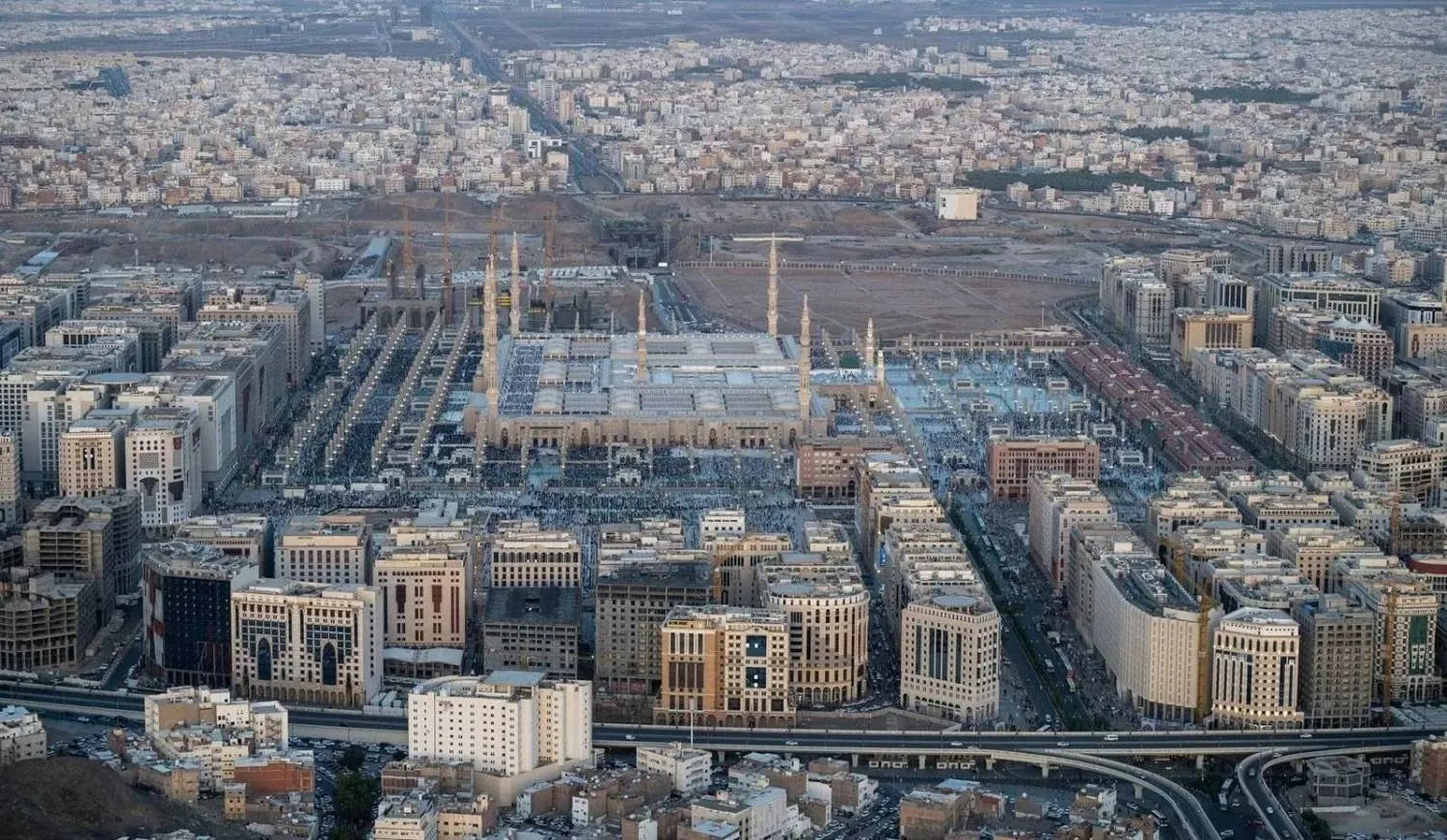
A cluster of buildings and hotels surrounding the Prophet’s Mosque (SPA). 
TT

Madinah Sees Tourism Surge Ahead of Ramadan, Spending Tops $13.9 Billion

A cluster of buildings and hotels surrounding the Prophet’s Mosque (SPA). 

Saudi Arabia’s Minister of Tourism, Ahmed Al-Khateeb, has toured hospitality facilities and visitor services in Madinah as part of the “Spirit of Ramadan” inspection tour, which also included Jeddah and Makkah.

New data show visitor numbers exceeded 21 million over the past year, a 12 percent increase from 2024, while total tourism spending reached SAR 52 billion (about $13.9 billion), up 22 percent.

The visit focused on assessing the sector’s readiness for the Ramadan season, evaluating service quality, and supporting ongoing and upcoming tourism projects.

Madinah posted strong tourism performance in 2025, driven by higher visitor inflows and expanded hospitality capacity, reinforcing its position as a leading religious destination within Saudi Arabia’s tourism landscape.

Demand growth has been matched by a sharp rise in supply. Licensed hospitality facilities increased to 610, up 35 percent, while the number of licensed rooms surpassed 76,000, a 24 percent gain, strengthening the city’s ability to accommodate during peak seasons such as Ramadan and Hajj.

Travel and tourism offices also grew to more than 240, reflecting a 29 percent expansion in supporting services.

Al-Khateeb said the entry of international hospitality brands and new projects over the past five years underscores both sectoral growth and rising investor confidence in the Kingdom’s tourism ecosystem.

“The landscape today is different. The sector is growing steadily, supported by a system that empowers investors and facilitates their journey, with a promising future ahead,” he said.

To expand hotel capacity, the minister inaugurated the Radisson Hotel Madinah, a project worth more than SAR 39 million (around $10 million) and financed by the Tourism Development Fund.

The 2025 performance signals a shift from traditional seasonal growth toward more sustainable expansion built on diversified offerings, improved service quality, and a stronger contribution to the local economy.


Airbus Planning Record Commercial Aircraft Deliveries in 2026

An Airbus A350-1000 at the Singapore Airshow on February 4. The company said Thursday it aims to deliver a record number of aircraft this year. Roslan RAHMAN / AFP/File
TT

Airbus Planning Record Commercial Aircraft Deliveries in 2026

An Airbus A350-1000 at the Singapore Airshow on February 4. The company said Thursday it aims to deliver a record number of aircraft this year. Roslan RAHMAN / AFP/File

Plane maker Airbus aims to deliver a record number of commercial aircraft this year, the company said Thursday, capitalizing on "strong demand" and a jump in profit in 2025.

"2025 was a landmark year, characterized by very strong demand for our products and services across all businesses," CEO Guillaume Faury said in a press release announcing annual results.

The European manufacturer said it received 1,000 orders for commercial planes in 2025, with net orders of 889 after taking cancellations into account, and 793 delivered.

Last year, its overall profit jumped 23 percent to 5.2 billion euros ($6.1 billion).

The company said it is targeting "around 870 commercial aircraft deliveries" this year.

"As the basis for its 2026 guidance, the Company assumes no additional disruptions to global trade or the world economy, air traffic, the supply chain, its internal operations, and its ability to deliver products and services," it said in its outlook.

Both Airbus and its rival Boeing have struggled to return to pre-pandemic production levels after their entire network of suppliers was disrupted, even as airlines are eager to modernize their fleets with more fuel-efficient aircraft and expand to meet an expected increase in passenger numbers over the coming decades.