


World Shares Retreat After Trump’s Order Imposing New Tariffs on 68 Countries and the EU 

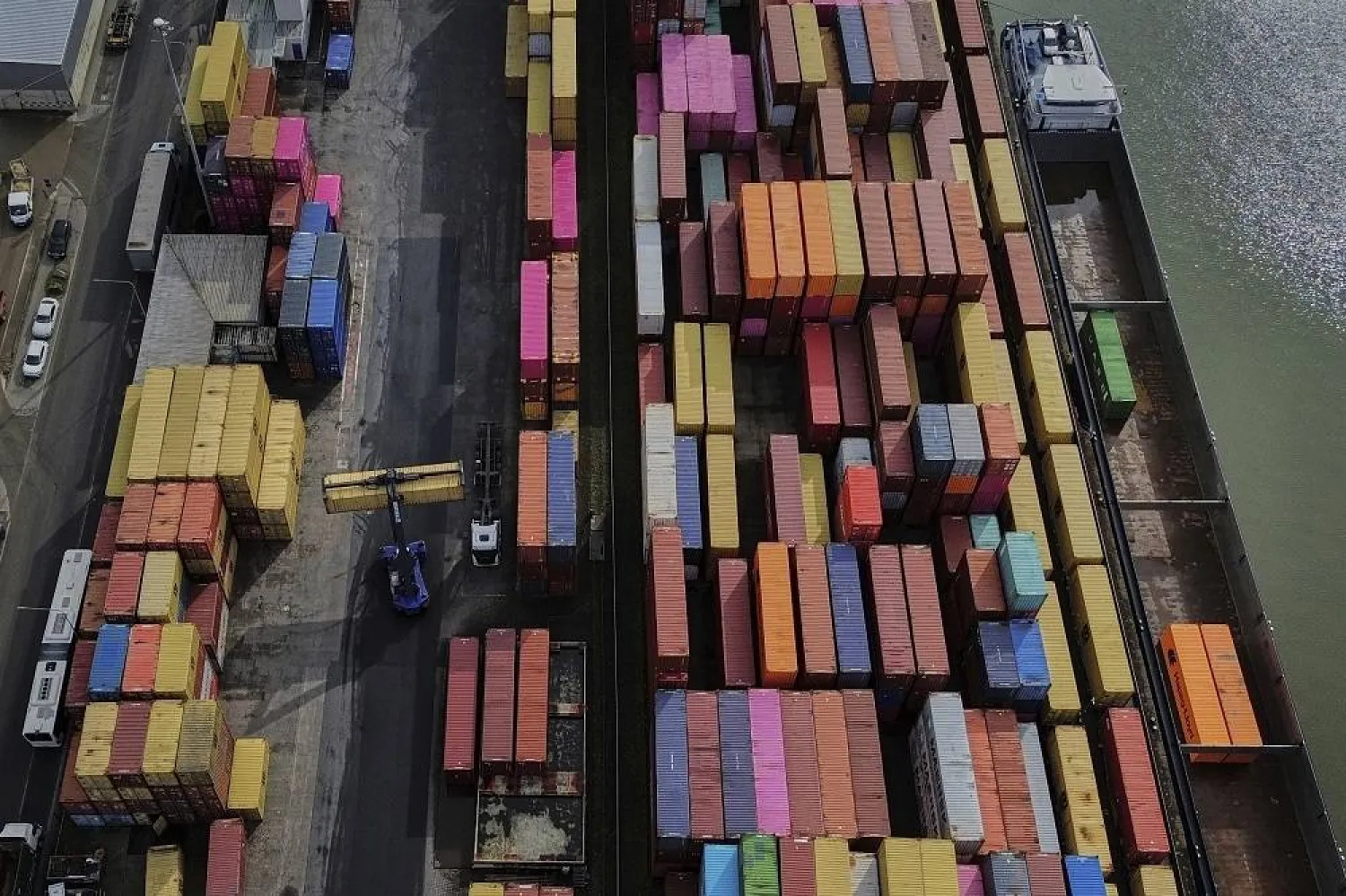
Containers are piled up in a cargo terminal in Frankfurt, Germany, Friday, Aug. 1, 2025. (AP)
TT

World Shares Retreat After Trump’s Order Imposing New Tariffs on 68 Countries and the EU 

Containers are piled up in a cargo terminal in Frankfurt, Germany, Friday, Aug. 1, 2025. (AP)

World shares retreated Friday following choppy trading on Wall Street that saw more losses and as investors assess President Donald Trump's order imposing new tariffs on 68 countries and the European Union starting in seven days.

Trump’s order, which pushed back the tariff deadline earlier set on Aug. 1, has injected a new dose of uncertainty in an already uncertain process.

In early European trading, Germany's Dax fell 1.5% to 23,697.31. Britain's FTSE 100 dropped 0.7% to 9,068.97. In Paris, the CAC 40 shed 1.6% to 7,647.56.

The future for S&P 500 was down 0.8% and that for the Dow Jones Industrial Average was also 0.8% lower.

Japan’s Nikkei 225 slid 0.7 % to 40,799.60 while South Korea’s Kospi tumbled 3.9% to 3,119.41.

Hong Kong’s Hang Seng index shed 1.1% to 24,507.81, while the Shanghai Composite slipped 0.4% to 3,559.95.

Australia’s S&P ASX 200 shed 0.9% to 8,662, India’s BSE Sensex lost 0.4% to 80,837.19 and Taiwan’s TAIEX slid 0.5% to 23,434.38.

“Trump’s new tariff directive, signed behind closed doors just ahead of the Aug. 1 deadline, slaps a new floor under global trade costs: a 10% minimum rate for nearly all partners, with surcharges of 15% or higher for surplus nations,” with Canada drawing particular ire, Stephen Innes of SPI Asset Management said in a commentary.

“This wasn’t just an update — it was a structural rewrite. The average US tariff jumps from 13.3% to 15.2%, a seismic shift from the 2.3% average before Trump retook office. This reshapes the cost calculus for everything from semiconductors to copper pipes,” he added.

Benjamin Picton, senior market strategist at Rabo Bank, said in a commentary about the US tariffs: “The USA is cherry-picking high value-add industry for its own economy while forcing trading partners to grant preferential market access for its exports and supply it with cheap imports. Make no mistake, this is imperial trade.”

On Wall Street on Thursday, stocks capped the trading day with more losses after an early big tech rally faded and a health care sector pullback led the market lower.

The S&P 500 fell 0.4%, its third straight decline. The benchmark index, which is just below the record high it set Monday, notched a 2.2% gain for the month of July and is up 7.8% so far this year.

The Dow Jones Industrial Average lost 0.7% and the Nasdaq composite closed less than 0.1% lower.

Roughly 70% of stocks in the S&P 500 lost ground, with health care companies accounting for the biggest drag on the market.

Health care stocks sank after the White House released letters asking big pharmaceutical companies to cut prices and make other changes in the next 60 days. Eli Lilly & Co. fell 2.6%, UnitedHealth Group slid 6.2% and Bristol-Myers Squibb dropped 5.8%.

Gains by some big technology stocks with hefty values helped temper the impact of the broader market’s decline.

Meta Platforms surged 11.3% after the parent company of Facebook and Instagram crushed Wall Street’s sales and profit targets even as the company continues to pour billions of dollars into artificial intelligence.

Microsoft climbed 3.9% after posting better results than analysts expected. The software pioneer also gave investors an encouraging update on its Azure cloud computing platform, which is a centerpiece of the company’s artificial intelligence efforts.

Big Tech companies have regularly been the driving force behind much of the market’s gains over enthusiasm for the future of artificial intelligence.

In other dealings Friday, US benchmark crude oil added 15 cents to $69.41 per barrel, while Brent crude, the international standard, also rose 15 cents to $71.85 per barrel.

The US dollar fell to 150.55 Japanese yen from 150.67 yen. The euro rose to $1.1419 from $1.1421.



US-Saudi Business Council President: Critical Minerals Cooperation Enhances Supply Chain Resilience

The Saudi flag. Asharq Al-Awsat
TT

US-Saudi Business Council President: Critical Minerals Cooperation Enhances Supply Chain Resilience

The Saudi flag. Asharq Al-Awsat

President and CEO of the US-Saudi Business Council Charles Hallab affirmed that cooperation between the Kingdom and the US in critical minerals is gaining significant momentum.

This growth is fueled by strategic investment opportunities and long-term industrial partnerships aimed at localizing value chains and strengthening global supply chain resilience.

In a statement to the Saudi Press Agency, he noted that the interest shown by US companies reflects a practical desire to expand partnerships and explore investment opportunities, including supply arrangements and long-term offtake agreements that support the economic interests of both countries.

Hallab’s remarks came following a high-level roundtable organized by the US-Saudi Business Council in Riyadh to discuss critical minerals and industrial supply chains, as part of the Future Minerals Forum 2026.

He pointed out that the roundtable was attended by more than 120 senior officials, decision-makers, and business leaders from both sides. The participants were led by a high-level US government delegation, as well as officials from Saudi and US entities, companies, and industrial leaders.


Gold Flashes Past $4,700/oz as Trump Threats Dampen Global Sentiment

(FILES) Gold wafers are displayed at Galeri 24, a state-owned gold retailer, in Surabaya, East Java, on October 16, 2025, as Indonesia's gold price stays near record highs and demand for safe-haven assets remains strong. (Photo by Juni KRISWANTO / AFP)
TT

Gold Flashes Past $4,700/oz as Trump Threats Dampen Global Sentiment

(FILES) Gold wafers are displayed at Galeri 24, a state-owned gold retailer, in Surabaya, East Java, on October 16, 2025, as Indonesia's gold price stays near record highs and demand for safe-haven assets remains strong. (Photo by Juni KRISWANTO / AFP)

Gold jumped past $4,700 per ounce for the first time on Tuesday, while silver traded near a record high, as US President Donald Trump's threats to slap extra tariffs on European allies soured global sentiment and sparked a rush into safe-haven assets.

Spot gold gained 0.7% to $4,699.93 per ounce by 0514 GMT, having hit an all-time high ‌of $4,701.23 earlier. ‌US gold futures for February delivery climbed ‌2.4% ⁠to $4,706.50 per ​ounce, Reuters said.

Spot ‌silver fell 0.4% to $94.27 an ounce, after hitting a record high of $94.72 earlier in the session.

Trump has intensified his push to wrest sovereignty over Greenland from fellow NATO member Denmark, prompting the European Union to weigh hitting back with its own measures.

"Trump's 'disruptive' policy approach to international affairs and desire to see lower interest ⁠rates suit precious metals very well, as reflected by gold and silver's rampant run," ‌said Tim Waterer, KCM Trade's chief ‍market analyst.

"Trump's second term ‍thus far has been a boon for precious metals, with ‍his unconventional approach to politics playing into the hands of gold and silver."

Gold prices have rallied more than 70% since Trump began his second term a year ago.

On Tuesday, gold also found support ​as concerns lingered around the Federal Reserve's independence with the US Supreme Court this week expected to hear ⁠a case around Trump's attempt to fire Fed Governor Lisa Cook.

The Fed is broadly expected to maintain interest rates at its January 27-28 meeting despite Trump's calls for cuts. Gold, which does not yield interest, typically performs well during periods of low interest rates.

Kelvin Wong, a senior market analyst at OANDA, expects the Fed to continue its rate-cut cycle into 2026, citing a sluggish labor market and lackluster consumer sentiment, with the next reduction now being priced further down the calendar in either June or ‌July.

Among other precious metals, spot platinum slid 0.8% to $2,355.60 an ounce, while palladium dropped 0.7% to $1,828.58.


IMF Raises Saudi Arabia’s Growth Forecast to 4.5% in 2026

The Saudi capital, Riyadh (SPA)
TT

IMF Raises Saudi Arabia’s Growth Forecast to 4.5% in 2026

The Saudi capital, Riyadh (SPA)

For the third time in six months, the International Monetary Fund (IMF) has raised its forecast for Saudi Arabia's economic growth for 2025 and 2026, in a sign of a growing robust economy.

The fund is now forecasting the Kingdom's economy, the largest in the Arab world, to grow by 4.3% in 2025 and 4.5% in 2026. This is 0.3 percentage points and 0.5 percentage points respectively higher than the October forecast, according to the IMF’s latest World Economic Outlook Update.

These projections are close to the Saudi government's estimates of 4.4% growth in 2025 and 4.6% this year, stated in the Kingdom’s Pre-Budget Statement for Fiscal Year 2026.

The IMF forecast came after Fitch Ratings affirmed Saudi Arabia’s sovereign credit rating at A+ with a stable outlook, reflecting the Kingdom’s strong fiscal and the momentum of social and economic reforms, according to a report issued by the agency last Friday.

It said the Saudi economy will benefit from higher oil production, as well as the “healthy” prospects for non-oil activities, underpinned by reform, high levels of government and GRE spending, new projects coming on stream and buoyant consumer spending.

Earlier this month, the IMF said next year will be pivotal for the Kingdom thanks to deeper reforms implemented throughout the past years.

It said the resilience shown in 2025 underscores the progress already achieved in reducing the economy’s exposure to oil fluctuations and the sustainability of the Kingdom's financial stability.

Saudi Arabia also built a more diversified and solid economic base, and maintained the growth momentum in its non-oil sector even as oil production falls.

This reflects the ability of the Saudi economy to face market fluctuations, and regional and global challenges.