


Trump Tariffs Don't Spare His Fans in EU

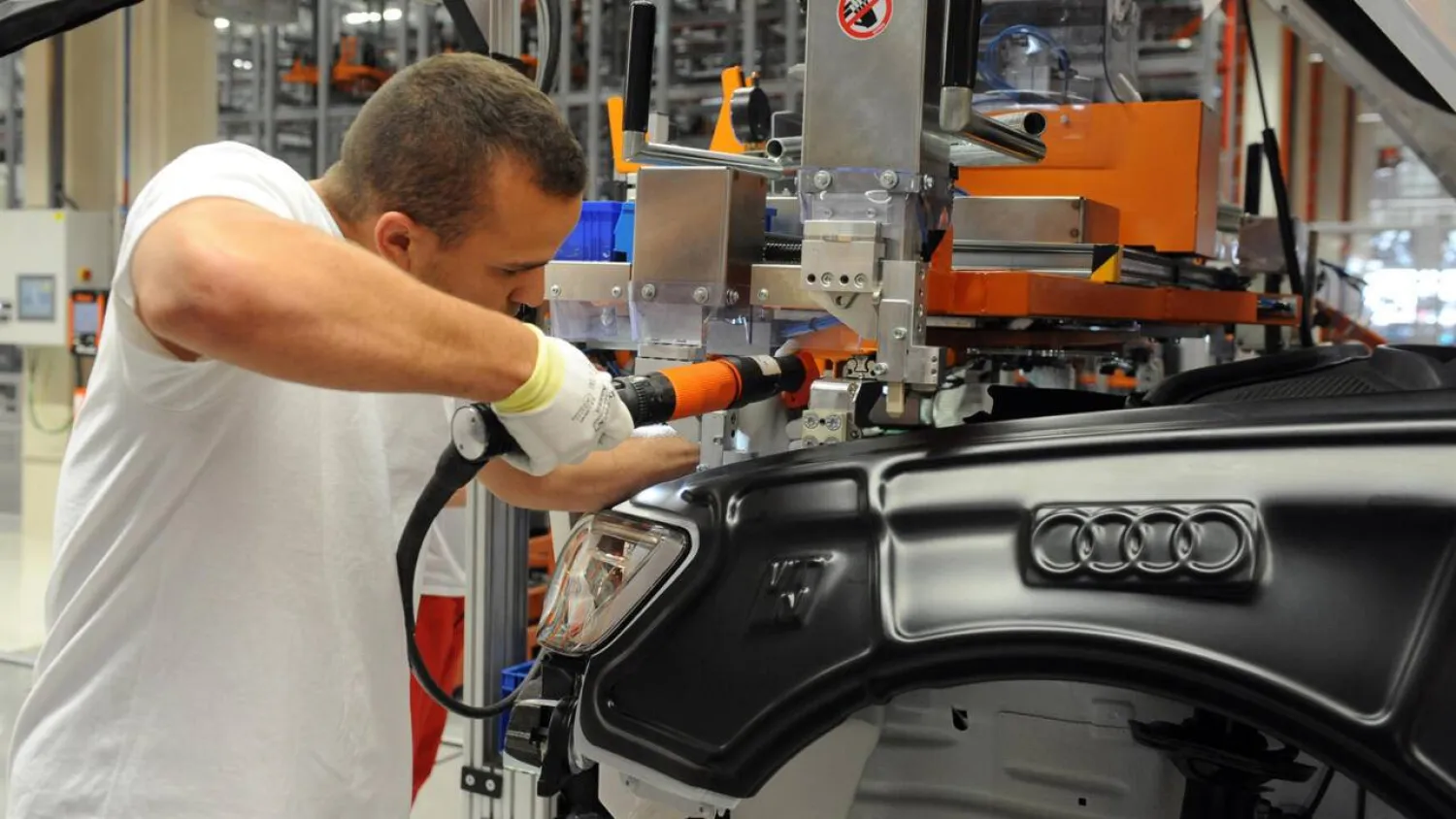
The Hungarian city of Gyor is a prominent auto industry hub, home to more than a dozen suppliers of parts and components. STR / AFP/File
TT

Trump Tariffs Don't Spare His Fans in EU

The Hungarian city of Gyor is a prominent auto industry hub, home to more than a dozen suppliers of parts and components. STR / AFP/File

Hungarian Prime Minister Viktor Orban promised that the return of his "dear friend" Donald Trump as US president would usher in a new "golden age".

But trade unionist Zoltan Laszlo says Hungary's auto industry has seen the opposite as the United States announced new tariffs, with order cancellations and workflow disruptions marking employees' day-to-day experience, AFP said.

With tariff rates rising from 2.5 percent before Trump's return to around 25 percent and finally to 15 percent, the "American tariff slalom" has caused nothing but chaos in the car industry, said Laszlo, who represents workers at Mexican automotive parts manufacturer Nemak's Hungarian plant.

In recent years, Hungary and neighboring Slovakia have become European manufacturing hubs for global car brands seeking lower labor costs, including British Jaguar Land Rover, German Mercedes and Japanese Suzuki.

But due to the export-oriented nature of their automotive sectors, catering in part to the US market, they are among those EU nations hardest-hit by the latest tariffs slated to kick in on August 7.

Despite hailing Trump's comeback and visiting him twice at his Mar-a-Lago luxury estate last year, Orban -- his closest EU ally -- was not spared the pain.

Distress calls

Neither were more favorable conditions extended to Slovakian Prime Minister Robert Fico, whose country is the world's largest automobile manufacturer per capita.

According to analyst Matej Hornak, the incoming tariffs won't bode well. He warns of a drop in exports amounting to "several hundred million euros" and the loss of "10,000-12,000" jobs in the sector.

After the announcement of the EU-US trade deal, Orban was quick to apportion blame to EU Commission president Ursula von der Leyen, saying Trump "ate" her "for breakfast".

But in April, the mayor of the Hungarian city of Gyor, whose strong economic growth is closely linked to its car manufacturing plants, had already warned of possible cutbacks and layoffs.

For the city, which is home to various global brands and more than a dozen different parts and component suppliers including Nemak, the fresh tariffs are a disaster.

As one of the biggest employers in Hungary, German carmaker Volkswagen alone provides jobs for more than 12,000 people. Its main engine factory in Gyor produces some Audi-branded vehicles directly for the US market.

The Hungarian government has said that it is still assessing the impact of the tariff rates, vowing that upcoming business deals with Washington could mitigate the negative effects of Trump's "America first" policy.

Difficult compromise

But more headwinds are ahead for Hungary and Slovakia, said Brussels-based geopolitical analyst Botond Feledy.

"When it comes to European dealmaking, Trump now prioritizes more geopolitically influential figures -- the main option for smaller nations such as Slovakia and Hungary is to join forces with others," he told AFP.

But the "aggressive posturing" in the same vein of Trump's protectionist policies both countries adopted in recent months have isolated them among fellow EU countries, making compromises difficult, the expert added.

Moreover, the stakes are high for Orban, whose 15-year rule has recently been challenged by former government insider-turned-rival Peter Magyar ahead of elections scheduled for next spring.

"Dissatisfaction with the standard of living has made voters more critical, which is also reflected in the popularity ratings of the governing parties," said economist Zoltan Pogatsa, adding that "Hungary has been in a state of near stagnation for many years now".

This year's economic "flying start" touted by Orban did not materialize, with the government further lowering the country's growth goal from the initial 3.4 to one percent.

"So far, Trump's second presidency has only impacted the Hungarian economy through his tariff policy, which has been negative," Pogatsa added.

At the Nemak plant, a recent warning strike has led to management promising to sort out the unpredictable work schedules caused by the tariff changes, which were "unhealthy and physically unbearable" and made "family and private life become incompatible with work", said Laszlo.



IMF's Growth Forecasts to Show Resilience to Global Trade Shocks, Georgieva Says

International Monetary Fund (IMF) Managing Director Kristalina Georgieva speaks during an interview with Reuters, amid Russia's attack on Ukraine, in Kyiv, Ukraine January 15, 2026. REUTERS/Valentyn Ogirenko
TT

IMF's Growth Forecasts to Show Resilience to Global Trade Shocks, Georgieva Says

International Monetary Fund (IMF) Managing Director Kristalina Georgieva speaks during an interview with Reuters, amid Russia's attack on Ukraine, in Kyiv, Ukraine January 15, 2026. REUTERS/Valentyn Ogirenko

The International Monetary Fund's latest economic forecasts due next week will show the global economy's continued resilience to trade shocks and "fairly strong" growth, IMF Managing Director Kristalina Georgieva told Reuters on Thursday.

In an interview during a visit to Kyiv to discuss the IMF's loan to Ukraine, Georgieva suggested the IMF could again revise its forecasts slightly upward as the World Bank did this week.

In October, the IMF edged its 2025 global GDP growth forecast higher to 3.2% from 3.0% in July as the drag from US tariffs was less than initially ‌feared. It kept ‌its 2026 global growth outlook unchanged at 3.1%.

Asked what ‌the ⁠January forecasts ‌would show after the upgrade in October, Georgieva said: "More of the same - that the world economy is remarkably resilient, that trade shock has not derailed global growth, that risks are more tilted to the downside, even if performance now is fairly strong."

The IMF is expected to release its World Economic Outlook update on January 19.

Georgieva said risks were focused on geopolitical tensions and rapid technological shifts. Things could turn out well, ⁠she said, but the global economy could also face significant financial distress if the huge resources flowing into ‌artificial intelligence did not result in promised productivity gains.

"We ‍are in a more unpredictable ‍world, and yet, quite a number of businesses and policymakers operate as if ‍the world hasn't changed."

Georgieva said she worried that many countries had failed to build up sufficient reserves to deal with any new shock that could occur. The IMF currently has 50 lending programs, a high number by historic standards, but was bracing for more countries to seek funds, she said.

The IMF chief said US economic performance had been "quite impressive" despite a raft of tariffs imposed by President Donald ⁠Trump last year on nearly every country in the world.

She said overall tariff levels were lower than initially threatened, and the US accounted for only about 13% to 14% of global trade. Most other countries had also refrained - at least so far - from imposing retaliatory measures, which had helped limit the impact of the wave of US tariffs.

She said inflation and macroeconomic conditions could still worsen, though, if the trade picture darkened.

Geopolitical factors were also clouding the outlook and now played a more significant role than in years past, said Georgieva, who took office in October 2019, just months before the COVID-19 pandemic hit in early 2020.

"Regrettably, since I took ‌this job (in 2019), there has been one shock after another after another," she said.


Mauritania to Saudi Investors: We Are Your Atlantic Gateway to Securing Minerals of the Future

Mauritania’s Minister of Mines and Industry, Thiam Tijani (Asharq Al-Awsat) 
TT

Mauritania to Saudi Investors: We Are Your Atlantic Gateway to Securing Minerals of the Future

Mauritania’s Minister of Mines and Industry, Thiam Tijani (Asharq Al-Awsat) 

Mauritania is positioning its mining weight and strategic Atlantic Ocean location as an “African mining gateway” for Saudi investments, extending a clear invitation to move immediately into partnerships that go beyond traditional extraction and open new horizons in downstream and value-added industries.

This message was conveyed by Mauritania’s Minister of Mines and Industry, Thiam Tijani, in an interview with Asharq Al-Awsat on the sidelines of the International Mining Conference held in Riyadh.

He stressed that the message was not merely an economic call, but a reaffirmation that Saudi investment in Mauritania is an “investment in the future” and a “unique development partnership in which the Saudi investor is not viewed as a stranger, but as a genuine partner welcomed through the open doors of Nouakchott to translate historical ties into major projects that benefit both brotherly countries.”

Today, Mauritania’s mining sector represents the backbone of the national economy, contributing more than 24 percent of GDP. The sector is undergoing a profound transformation aimed at moving it from a purely extractive activity into a comprehensive development sector.

While Mauritania has historically relied on iron ore and gold, recent discoveries and the country’s push toward green hydrogen are placing it on the threshold of an unprecedented industrial transformation on the African continent.

The minister said Mauritania is redrawing its mining map to make it broader and richer, setting ambitious targets for the next five years. Nouakchott aims to raise iron ore production to more than 20 million tons annually and increase gold output to over 1.5 million ounces per year.

He emphasized that the next phase will prioritize not only production volumes, but also the sector’s ability to generate local added value that supports sustainable economic growth.

Saudi Arabia... The Strategic Partner and the Awaited Expertise

Addressing bilateral relations, Tijani described Saudi Arabia as a “strategic partner,” noting that these ties are grounded in the forward-looking vision of the two countries’ leaderships. He praised the historic role of the Saudi Fund for Development, as well as investments by Saudi companies such as SABIC.

He expressed Mauritania’s aspiration for broader participation by major industrial players, including Maaden, stressing that the country is aligning its laws and regulations to be attractive to Saudi investors, whom he described as “partners in development, not strangers to the home,” particularly in downstream industries where the Kingdom has long-standing expertise.

Leadership in Hydrogen and the Production of “Green Steel”

On the energy front, Tijani revealed Mauritania’s ambition to become Africa’s “capital of green hydrogen,” capitalizing on its abundant wind and solar resources. The strategic plan, he said, is to use clean energy to process iron ore locally into “green steel,” a project he believes has the potential to “change the rules of the game globally.”

He extended an open invitation to leading Saudi companies in renewable energy and heavy industries to take part in this transformation, ensuring that Mauritanian mining products become among the most in demand in global markets in the future.

Fuel of Technology... Lithium and Rare Minerals

Turning to the minerals of the future, Tijani said recent geological surveys have revealed promising potential for lithium, cobalt, nickel, and chromium. Describing these minerals as the “fuel of the technological revolution” and electric vehicles, he noted that Mauritania has designated new concession areas and prepared technical files to present to Saudi partners.

He stressed that Saudi Arabia has a valuable opportunity to secure its supply chains for these strategic materials through direct investment in Mauritanian mines.

To ensure smooth investment flows, Tijani announced a major leap in facilitating procedures through the digitization of the mining land registry and making it available online, ensuring full transparency and allowing investors in Riyadh to access maps and data remotely. He added that a dedicated one-stop shop has been established to reduce bureaucracy and accelerate the processing of applications.

He concluded with a message of reassurance to leaders in Saudi Arabia’s mining sector, emphasizing that “Mauritania is the safest and most viable destination, thanks to its political and security stability and a legal framework that protects rights,” inviting them to invest in “the future” through Mauritania’s Atlantic gateway.


China Says 'Resolutely Opposes' US-Taiwan Trade Deal

File photo: Chinese and US flags flutter near The Bund, before US trade delegation meet their Chinese counterparts for talks in Shanghai, China, July 30, 2019. (Reuters)
TT

China Says 'Resolutely Opposes' US-Taiwan Trade Deal

File photo: Chinese and US flags flutter near The Bund, before US trade delegation meet their Chinese counterparts for talks in Shanghai, China, July 30, 2019. (Reuters)

China said Friday it "resolutely opposes" a deal signed by Washington and Taipei to reduce tariffs on Taiwanese products and increase the self-ruled island's investment in the United States.

"China consistently and resolutely opposes any agreement... signed between countries with which it has diplomatic relations and the Taiwan region of China," ministry spokesman Guo Jiakun said, urging Washington to abide by the one-China principle.

China claims Taiwan as part of its territory, and has not ruled out using force to bring it under its control.