

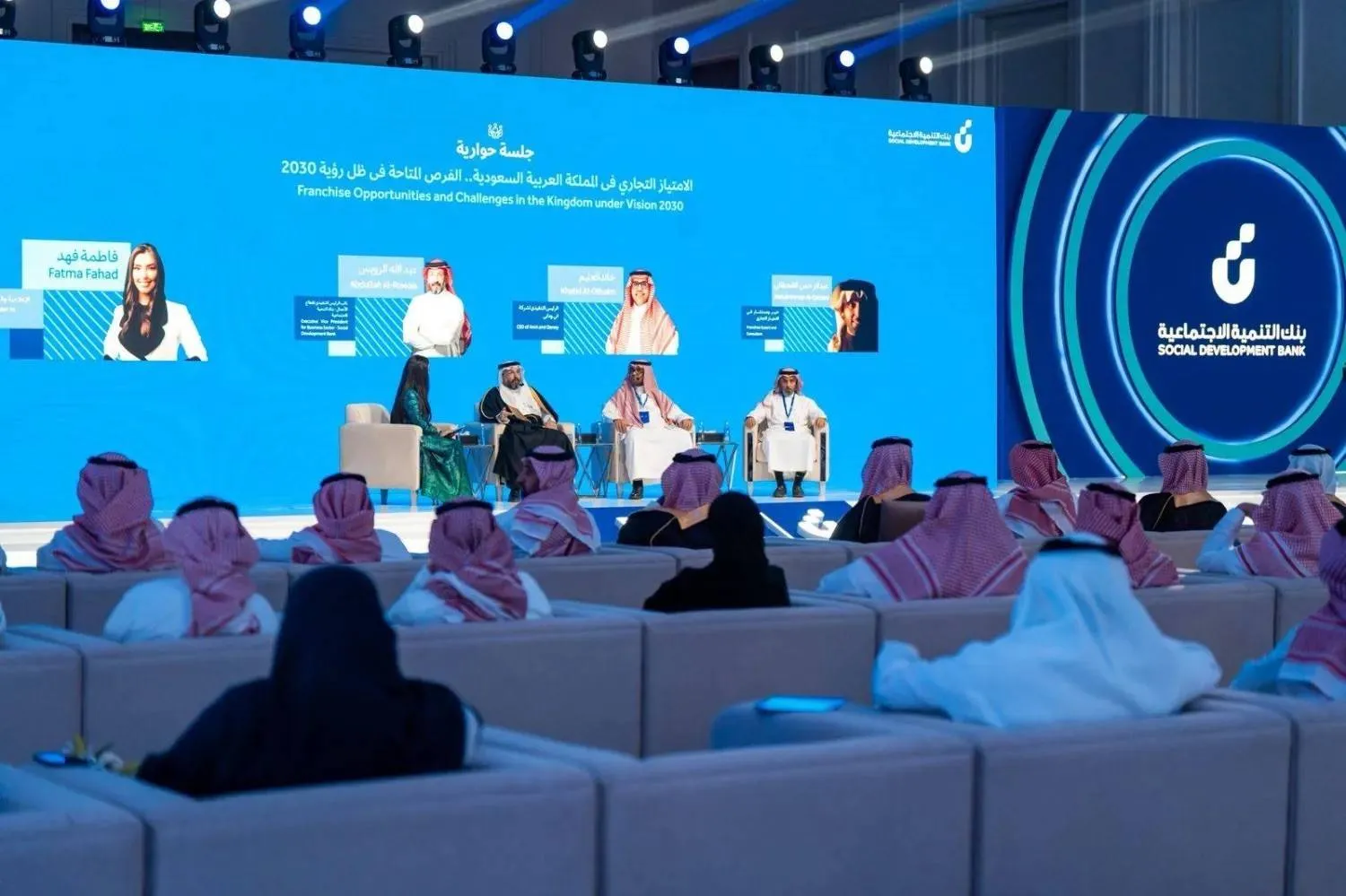

Financing Services Target Promising Sectors in Saudi Arabia’s Franchise Market

Abdullah Al-Ruwais speaking to the audience during a panel session at the Franchise Forum (Asharq Al-Awsat) 
TT

Financing Services Target Promising Sectors in Saudi Arabia’s Franchise Market

Abdullah Al-Ruwais speaking to the audience during a panel session at the Franchise Forum (Asharq Al-Awsat) 

Franchising has emerged as one of the most dynamic engines of modern economies, playing a key role in diversifying income sources, creating jobs, and localizing expertise. With the rapid expansion of global and local brands, the franchise model offers a unique blend of brand strength from franchisors and entrepreneurial drive from franchisees.

In Saudi Arabia, franchising holds particular importance under Vision 2030. The sector’s market value has already exceeded SAR 53 billion ($14.1 billion), with franchise brands growing at an annual rate of 27 percent. This makes franchising a vital driver of economic development.

To sustain this momentum, the Social Development Bank (SDB) is stepping in with flexible financial solutions tailored to the country’s economic priorities.

Abdullah Al-Ruwais, Vice President, Business Sector at Social Development Bank, told Asharq Al-Awsat during the Riyadh Franchise Forum that the bank is focusing its financing services on promising sectors within franchising, ensuring flexibility and alignment with national goals. He noted that the sector is expanding rapidly, growing more than 27 percent annually, and is projected to reach 35 percent by 2030.

Al-Ruwais emphasized that this growth requires continuous development of financing tools. Promising sectors include healthcare services, fintech, logistics, e-commerce, entertainment, and tourism. The bank also plays a broader role by offering advisory, mentorship, and training services to both franchisors and franchisees.

He highlighted the new franchising law as a “transformational milestone” for the Saudi market, creating a fair environment for both sides of the franchise relationship. By providing a structured framework supported by regulators and financial institutions, the system fosters a thriving market that strengthens GDP contributions, generates jobs, and deepens local knowledge and industry.

The Riyadh Franchise Forum featured a full program of panel discussions on key topics, including “The Future of Franchising” and “Opportunities and Challenges in the Sector,” along with inspiring success stories.

An accompanying exhibition gave participants direct access to franchisors and successful franchise models. It also offered professional workshops and one-on-one advisory sessions, delivered by experts from the bank and the “Delni Business Center,” to help entrepreneurs design operational and marketing plans. These initiatives aim to empower startups with practical guidance and financial support, ensuring sustainable growth across the Kingdom’s regions.


Saudi Infrastructure Fund Announces $1.2 Bln ‘HUMAIN’ Financing in Davos

Saudi Infrastructure Fund Announces $1.2 Bln ‘HUMAIN’ Financing in Davos
TT

Saudi Infrastructure Fund Announces $1.2 Bln ‘HUMAIN’ Financing in Davos

Saudi Infrastructure Fund Announces $1.2 Bln ‘HUMAIN’ Financing in Davos

Saudi Arabia sharpened its push into artificial intelligence infrastructure on the sidelines of the World Economic Forum in Davos, as the National Infrastructure Fund, known as Infra, unveiled a framework agreement for up to $1.2 billion in strategic financing with HUMAIN, a Public Investment Fund-owned company, to back the expansion of AI and digital infrastructure across the kingdom.

Infra’s chief executive officer, Esmail bin Mohammad Alsallom, said in an interview with Asharq Al-Awsat that the announcement was “an extension of the fund’s role in supporting new categories of infrastructure assets that are seeing accelerating demand,” adding that developing advanced infrastructure, including digital infrastructure, is “a fundamental requirement for achieving the goals of Vision 2030.”

Crown Prince Mohammed bin Salman, prime minister and chairman of the Public Investment Fund, launched HUMAIN on May 12 to develop and manage artificial intelligence solutions and technologies, and to invest across the sector’s ecosystem.

Under the non-binding agreement, the parties set out financing terms to develop up to 250 megawatts of hyperscale AI data centers for HUMAIN, relying on advanced graphics processing units to train and run artificial intelligence models.

The facilities are intended to meet the company’s customers’ needs locally, regionally, and globally, according to an official statement from HUMAIN.

The statement said Infra and HUMAIN had also agreed to explore the creation of an AI data center investment platform anchored by both parties and structured to allow participation by local and global institutional investors, supporting the expansion of HUMAIN’s strategy in the sector.

HUMAIN chief executive officer Tareq Amin was quoted in the statement as saying that demand for advanced computing capacity is accelerating, and that the agreement positions the company to respond quickly and at scale.

He added that the goal is to deliver world-class AI data center infrastructure that companies can rely on as their computing needs become more complex.

Bridging financing gaps

Alsallom said the National Infrastructure Fund’s role is to bridge financing and structural gaps that some strategically essential infrastructure projects may face.

This role is vital at stages when commercial financing alone cannot meet funding needs, whether because of the size of the investment, its long time horizon, or the nature of the associated risks.

He said the fund’s focus is not simply on financing projects, but on enabling them to become investable and attractive to private capital, especially institutional investors, in ways that enhance sustainability and reduce reliance on direct government funding.

Expanding infrastructure asset classes

Alsallom described the framework agreement with HUMAIN as an extension of the fund’s support for new infrastructure asset classes experiencing rapid demand growth, foremost among them digital infrastructure and AI data centers.

He said such assets typically require significant, long-term capital investments and often need funding at early stages before they meet the conditions of traditional financing.

From this perspective, the fund’s intervention at this stage aims to raise market maturity, define appropriate financing structures, and enable broader, more sustainable participation by institutional investors.

A comprehensive approach

Asked whether the move signals a new focus on artificial intelligence, Alsallom said the fund does not target sectors as such, but instead focuses on the impact of infrastructure projects in supporting and enabling economic growth.

“Artificial intelligence today depends on an interconnected ecosystem of infrastructure assets, including energy, water, telecommunications, and data centers,” he said.

“When these projects become an important element in achieving sustainable economic development goals and attracting investment, the fund’s involvement is a natural extension of its role, regardless of the end sector these assets serve.”

Flexible financing solutions

Comparing the fund’s role with traditional commercial financing, Alsallom said its added value lies in aligning financing structures with the nature of the underlying asset.

“In new infrastructure projects, or those undergoing a transition in their operating or financing models, risks may be unbalanced or returns long-term in a way that does not suit traditional commercial financing,” he said.

“In this context, the fund provides flexible financing solutions that help encourage private sector participation, mitigate risk and support the financial sustainability of projects, without disrupting market balance or crowding out commercial finance.”

An AI data center investment platform

Alsallom said studying the creation of an AI data center investment platform reflects the fund’s approach of viewing such assets within an integrated framework rather than as standalone projects.

The aim, he said, is to build a scalable, repeatable model that enables asset aggregation, standardization, and the attraction of long-term capital from local and international institutional investors, thereby enhancing financing efficiency and investment sustainability.

Financial sustainability and private sector participation

In a broader context, Alsallom linked this approach to the objectives of Vision 2030, which aim to build a diversified, productive, and investment-attractive economy.

He said that developing advanced infrastructure, including digital infrastructure, is a prerequisite for that goal, and that the fund’s role is to accelerate this development in a financially sustainable way while strengthening private-sector participation.


France Not Considering Soccer World Cup Boycott over Greenland for Now

President Donald Trump is presented with the inaugural FIFA Peace Prize by FIFA President Gianni Infantino during the 2026 FIFA World Cup draw at the Kennedy Center, Dec. 5, 2025, in Washington. (AP Photo/Evan Vucci, file)
TT

France Not Considering Soccer World Cup Boycott over Greenland for Now

President Donald Trump is presented with the inaugural FIFA Peace Prize by FIFA President Gianni Infantino during the 2026 FIFA World Cup draw at the Kennedy Center, Dec. 5, 2025, in Washington. (AP Photo/Evan Vucci, file)

France's sports minister says her country is not currently thinking about boycotting the soccer World Cup in the United States amid growing tensions related to Donald Trump's quest to control Greenland.

“At the moment we are speaking, there is no desire from the ministry to boycott this major, much-anticipated competition," sports minister Marina Ferrari told reporters on Tuesday evening. "That said, I am not prejudging what might happen.”

Ferrari added that she wants to keep sports separate from politics, The AP news reported.

“The 2026 World Cup is an extremely important moment for all sports lovers,” she said.

With the tournament kicking off in June in the United States, Canada and Mexico, the US president's ambitions to wrest control of Greenland from NATO ally Denmark has the potential to tear relations with European allies.

In France, leftist lawmaker Eric Coquerel said the opportunity of a boycott by France, a two-time winner of the men's World Cup, should be considered.

“Seriously, can we really imagine going to play the footie World Cup in a country that attacks its ‘neighbors,’ threatens to invade Greenland, undermines international law, wants to torpedo the UN," he asked in a message posted on social media.

“The question seriously arises, especially since it is still possible to refocus the event on Mexico and Canada,” he wrote.

France lost to Argentina in the final of the World Cup in 2022.

No boycott by Scotland after 28-year wait In the UK, the Scottish National Party’s Westminster leader, Stephen Flynn, said boycotting the World Cup was not the right option for Scotland, which will feature at the World Cup for the first time since 1998.

“Without being flippant, we have boycotted the World Cup proactively since 1998 and I’m not entirely sure that’s a route that we want to go down again,” Flynn said.

“Instead I think we need serious and committed international dialogue with our allies on the European continent."

On Tuesday a number of MPs called for the home nations to boycott the World Cup. England and Scotland have qualified for the showcase event, while Wales and Northern Ireland are in the playoffs.


Saudi-Jordanian Business Forum Approves Roadmap for Cooperation in Promising Sectors

The forum's activities included meetings of the joint Saudi-Jordanian Business Council - SPA
TT

Saudi-Jordanian Business Forum Approves Roadmap for Cooperation in Promising Sectors

The forum's activities included meetings of the joint Saudi-Jordanian Business Council - SPA

The Federation of Saudi Chambers and the Jordan Chamber of Commerce organized the Saudi-Jordanian Business Forum at the federation's headquarters in Riyadh.

The forum's activities included meetings of the joint Saudi-Jordanian Business Council, the signing of five Saudi-Jordanian agreements in various sectors, and bilateral meetings between representatives of Saudi and Jordanian companies to build commercial and investment partnerships, SPA reported.

Specialized meetings were also held for the sectoral committees emanating from the Joint Business Council, to draw up a roadmap for cooperation in promising sectors including: agriculture and food security; industry, mining and energy; financial services and trade finance; health, pharmaceuticals and medical supplies; logistics, ports and transportation; reconstruction and infrastructure; tourism and hospitality; investment, trade and franchising; contracts; education and human resources; and information technology and digital trade.
