

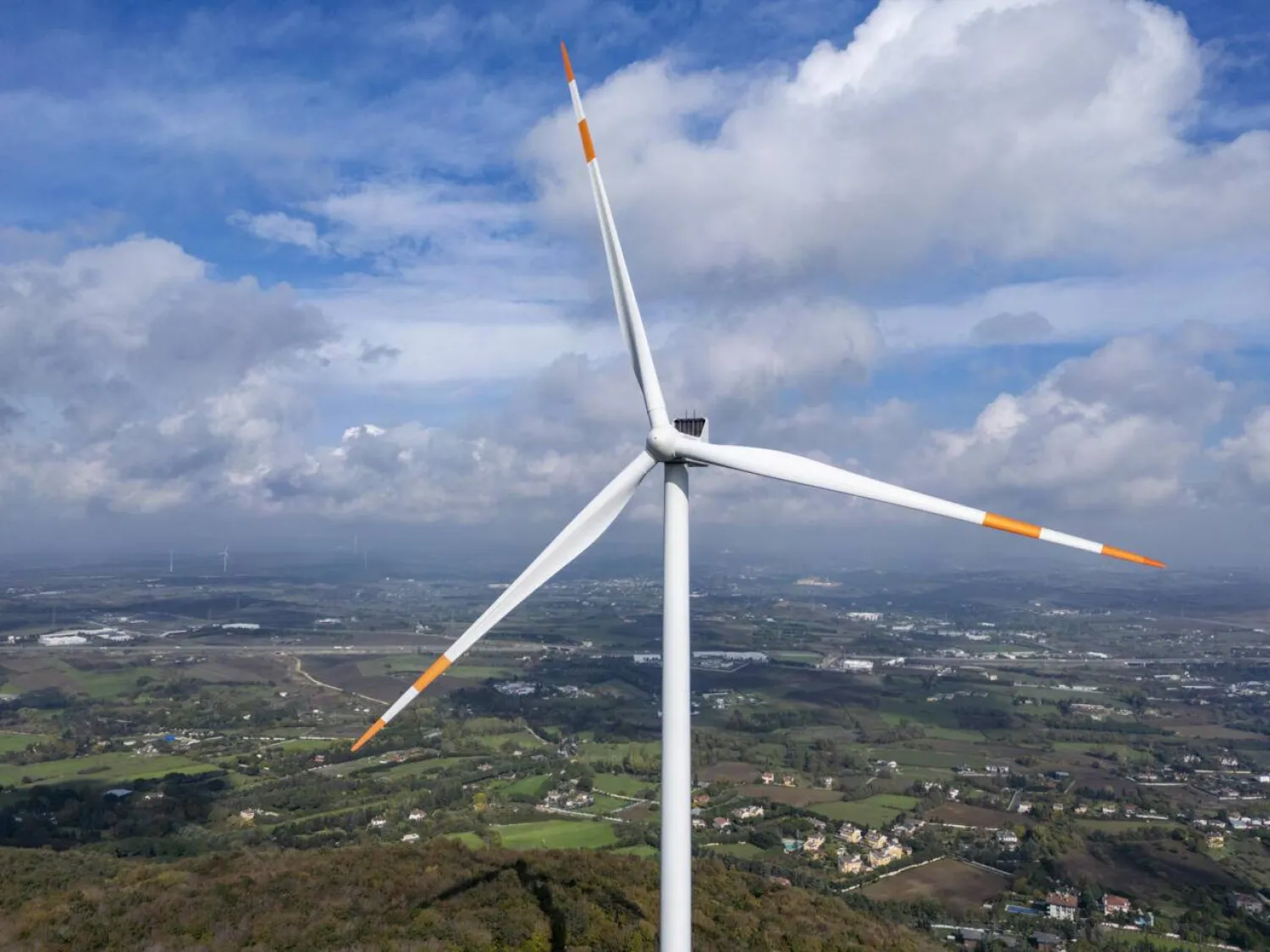

Türkiye Showcases Renewables Surge, but Leaves Coal Intact

Türkiye is rapidly expanding its renewable energy capacity. But as host of COP31, the country faces growing pressure to match its clean energy ambitions with a clear commitment to phase out fossil fuels. Yasin AKGUL / AFP
TT

Türkiye Showcases Renewables Surge, but Leaves Coal Intact

Türkiye is rapidly expanding its renewable energy capacity. But as host of COP31, the country faces growing pressure to match its clean energy ambitions with a clear commitment to phase out fossil fuels. Yasin AKGUL / AFP

On a windy hillside about an hour's drive northwest of Istanbul, the Catalca power plant was one of Türkiye's first large-scale wind farms and has been feeding electricity into the grid for 18 years.

With an installed capacity of 93 megawatts, it generates 287 million kilowatt-hours of electricity a year, enough for around 115,000 households, said AFP.

"By replacing electricity that would otherwise come from fossil fuel-fired power plants, this output avoids 185,936 tons of carbon emissions each year," operator Sanko Enerji says.

Nearly two decades on, Catalca is one of nearly 300 wind farms, its giant turbines a symbol of the rapidly expanding capacity for renewable energy in Türkiye which is hosting the COP31 UN climate summit that opens in Antalya on Monday.

Last year, 43 percent of Türkiye's electricity came from clean energy sources, of which wind and solar accounted for 22 percent, according to energy think tank Ember.

With electrification emerging as one of the central themes of COP31, Türkiye has been pushing hard for it to be an implementation-focused summit that turns existing climate pledges into action.

Energy Minister Alparslan Bayraktar has outlined plans to triple Türkiye's installed solar and wind capacity from around 40 gigawatts to 120 gigawatts by 2035.

But with coal still the leading source of power generation, Türkiye is under pressure to pair its impressive renewables growth with a definitive shift away from fossil fuels.

Not only is it still building coal-fired power plants, it has yet to set a date to phase out fossil fuels.

- Coal still dominant -

"Türkiye's continued reliance on coal, alongside plans for further expansion, highlights the contradiction at the heart of its current trajectory," Duygu Kutluay of Beyond Fossil Fuels told AFP.

Embracing an electrification agenda alone did not amount to a genuine energy transition because "coal remains the country's largest source of electricity generation", she said.

Coal-fired power plants accounted for 33.5 percent of Türkiye's electricity production in 2025, energy ministry figures show, with Ember saying almost two-thirds of its coal was imported.

Plans to expand coal capacity "risk locking in further fossil-fuel dependence", she warned.

"As Türkiye increases renewable capacity, it must ensure clean electricity replaces fossil-fuel generation rather than simply meeting additional demand," Kutluay said.

The challenge is not only expanding renewables but establishing "a clear pathway to phase out coal".

Asked about Türkiye's continuing reliance on coal, Bayraktar told AFP in February that Ankara prioritized securing affordable energy supplies and reducing dependence on imports.

"Coal can initially be replaced with gas, but in the medium and long term it can be substituted with nuclear," he said.

Ibrahim Erden, president of the Turkish Wind Energy Association, said every country's transition was different with "no single path that suits everyone".

- Need for investment -

Emin Emrah Danis, chief executive of MOBEN consultancy, said Türkiye's energy policy was shaped by rising electricity demand and the need for "baseload" generation to deliver constant power around the clock.

"This is why Türkiye has invested heavily in gas- and coal-fired power plants over the past 30 years," he told AFP.

"For coal's share of power generation to fall to meaningful levels, Türkiye needs substantial investment in electricity storage and nuclear power," he said, referring to battery storage for renewable power.

Türkiye is currently putting the finishing touches on the first reactor of its Akkuyu nuclear power plant, which should be online by the start of 2027, Bayraktar told an energy summit last week.

But Türkiye's nuclear expansion, with two more plants in the pipeline, was unlikely to add enough baseload capacity to replace coal-fired electricity generation before around 2040, Danis said.

And coal would likely remain part of the energy mix for decades, with the need for baseload power and dependence on imports making a full phase-out infeasible before "the mid-2050s".

Türkiye relies heavily on imports of oil, natural gas and coal from countries like Russia, Iran and Azerbaijan.

Erden said infrastructure updates were essential to give greater place to renewables.

"We cannot simply shut down coal-fired power plants today and rely solely on wind and solar energy ... The technological and physical infrastructure is not yet capable of supporting that."

Beyond the climate argument, geopolitical tensions have also strengthened the case for domestic renewables.

"Renewables ... are not only one of the most effective tools for tackling climate change, but also an important means of strengthening energy security and reducing dependence on foreign supplies," he said.



Saudi Arabia Leads OPEC+ Production Recovery Toward Pre-War Levels

Aramco storage tanks and pipelines (Aramco) 
TT

Saudi Arabia Leads OPEC+ Production Recovery Toward Pre-War Levels

Aramco storage tanks and pipelines (Aramco) 

OPEC+ crude oil output rebounded in October to nearly its pre-Iran war level, driven by a sharp increase in Saudi production despite continued disruptions to oil shipments through the Strait of Hormuz.

Saudi Arabia reported its highest output since the war began, helping lift the alliance’s combined production to 41.23 million barrels per day (bpd), according to OPEC’s monthly report released Wednesday.

That represented an increase of approximately 2.04 million bpd from September and brought production to about 97% of the 42.72 million bpd recorded in February, according to Reuters calculations based on OPEC data.

The rebound highlights the ability of Saudi Arabia and other Gulf producers to restore supplies despite the war’s continuing impact and restrictions on tanker movements through the strategic waterway.

Some producers have worked around the disruptions through alternative shipping arrangements, including ship-to-ship oil transfers, and pipelines that allow crude exports to bypass the strait.

Saudi Arabia Drives Production Increase

Saudi Arabia informed OPEC that its crude output rose to 10.563 million bpd in October, up from approximately 8.372 million bpd in September, an increase of nearly 26%.

That marked its highest level since February, when production reached 10.882 million bpd.

The Kingdom had raised output in February, ahead of US and Israeli strikes on Iran, reflecting its readiness to bolster supplies amid expectations of escalating market disruptions.

The latest figures show that Riyadh substantially increased production in October despite persistent risks to regional oil exports.

Iraq also reported higher output, reaching approximately 4.9 million bpd, its highest level since the conflict began.

However, secondary sources cited by OPEC estimated Iraqi production at 4.491 million bpd, placing it close to its assigned production target.

Russian, Kazakh and Nigerian Output Rises

Russian oil production increased by approximately 41,000 bpd in October from September to 8.668 million bpd, according to secondary-source data in OPEC’s report.

The increase followed months of declining output amid Ukrainian attacks on Russian energy infrastructure, including oil refineries.

US President Donald Trump announced an energy-sector ceasefire between Russia and Ukraine last month, but the agreement failed to hold in any meaningful way.

Nevertheless, a temporary reduction in attacks on Russian refining facilities may have helped support production.

Kazakhstan’s output also increased, rising by approximately 34,000 bpd month on month to 1.887 million bpd.

In Nigeria, crude oil production averaged 1.69 million bpd in October, according to the country’s petroleum regulator, marking the sixth consecutive month in which Nigeria met its OPEC production quota.

Excluding condensates, output stood at approximately 1.51 million bpd, slightly above its quota of 1.5 million bpd.

The regulator attributed the improvement to greater operational efficiency, more consistent production and better transportation of crude from oilfields to export terminals.

OPEC Maintains Demand Forecasts

OPEC left its forecasts for global oil demand growth in 2026 and 2027 unchanged, after lowering its demand-growth estimates for six consecutive months.

The organization expects global demand to increase by approximately 180,000 bpd in 2026 and by 2.55 million bpd in 2027, bringing average worldwide consumption to 108.3 million bpd.

The projections come as October’s production figures point to a recovery in Gulf supplies after months of disruptions that forced several producers to reduce output or suspend some exports.

The rebound is particularly significant as OPEC+ prepares to complete a review of its members’ maximum production capacities in the coming days.

The findings will help determine production targets for 2027.

The alliance is scheduled to meet online on November 29 to discuss next year’s output targets, with members facing markedly different circumstances.

While some countries have restored much of their production capacity, others continue to contend with operational constraints and export-related challenges.


How Will Saudi Arabia’s Consumer Protection Law Reshape Relations Between Buyers and Sellers?

 Centria Mall in Riyadh (Saudi Tourism)
Centria Mall in Riyadh (Saudi Tourism)
TT

How Will Saudi Arabia’s Consumer Protection Law Reshape Relations Between Buyers and Sellers?

 Centria Mall in Riyadh (Saudi Tourism)
Centria Mall in Riyadh (Saudi Tourism)

Saudi Arabia’s new consumer protection law could reshape everyday transactions in the kingdom, promising greater transparency, safeguards against harmful business practices and easier access to redress.

But its real test will be whether effective enforcement and swift complaint resolution turn legal guarantees into tangible protection.

Lawyer and legal consultant Dr. Tael bin Fahm told Asharq Al-Awsat that the law could strengthen relations between consumers and businesses by making transactions more transparent and clarifying mutual rights and obligations, creating a more reliable and consistent shopping and service experience.

For consumers, the biggest change would be a shift from seeking redress after suffering harm to preventing it in the first place, he said. That would require clear information on products, services, prices, warranties, contract terms and complaint procedures.

Making Consumer Rights Easier to Enforce

Consumers have long faced hurdles in asserting their rights, from difficulties proving violations and navigating multiple authorities to lengthy disputes, particularly over warranties and defective products, Bin Fahm said.

For some, the cost of pursuing a complaint outweighs the damage itself, discouraging them from seeking compensation.

The solution, he said, lies in simpler complaint procedures, faster decisions, clearer escalation channels and digital tools to track cases.

Recognizing consumer rights is not enough; consumers must be able to exercise them.

Stronger legal protections could also push businesses to improve service quality, ensure credible advertising, strengthen after-sales support and resolve customer complaints more quickly, Bin Fahm said.

Beyond tackling violations, he said, the law could bolster consumer confidence and foster a more competitive market where respect for consumer rights becomes a core measure of business performance.

Enforcement Holds the Key

The law offers an opportunity to strengthen consumer protection as Saudi Arabia’s e-commerce sector expands and the range of goods and services grows. But Bin Fahm cautioned that its impact would depend on enforcement, not merely enactment.

Legislation lays the groundwork, he said, but effective oversight, enforcement procedures and public awareness are what turn legal protections into reality.

He identified clear implementing regulations, effective market oversight, swift complaint resolution, meaningful penalties and accessible compensation for valid claims as critical to success. Greater awareness of rights and responsibilities among consumers and businesses would also be essential.

To gauge whether the law is delivering, Bin Fahm called for measurable benchmarks, including average complaint resolution times, dispute settlement rates, consumer satisfaction and reductions in repeat violations.

Ultimately, he said, success would be measured not by the number of legal provisions or penalties, but by whether consumers feel safe and confident in everyday transactions and can secure their rights without complicated procedures or costs disproportionate to the harm suffered.

The goal is a market where consumer rights are respected as a matter of course and fair business practices are the rule, not the exception.


Hapag-Lloyd Raises Outlook for Third Time on Strong Freight Rates

Hapag-Lloyd containers at a loading terminal at the harbor in Hamburg, Germany, July 13, 2025. (Reuters)
TT

Hapag-Lloyd Raises Outlook for Third Time on Strong Freight Rates

Hapag-Lloyd containers at a loading terminal at the harbor in Hamburg, Germany, July 13, 2025. (Reuters)

German container shipping company Hapag-Lloyd on Wednesday raised its full-year earnings outlook for the third time this year, citing strength in freight rates and a stronger-than-expected performance ‌in the ‌fourth quarter.

The stock was ‌up ⁠2.4% at 0925 ⁠GMT.

The upgrade adds to a series of positive outlook revisions across the European logistics sector, where resilient global trade, elevated shipping ⁠rates and persistent ‌supply-chain disruptions have ‌supported earnings and boosted profitability.

Hapag-Lloyd ‌now expects full-year earnings ‌before interest and tax of $2.0 billion to $2.4 billion, up from previous expectations of $1.25 billion to $1.75 ‌billion.

The company also lifted its 2026 earnings before ⁠interest, tax, ⁠depreciation and amortization guidance to $4.6 billion to $5.0 billion, from $3.9 billion to $4.4 billion previously.

The latest increase follows earlier upgrades in July and September, reflecting sustained strength in container shipping markets and management's improved expectations for year-end trading.