ECB's Lagarde Warns of Risk to World Economy Via Trump Interference on Fed

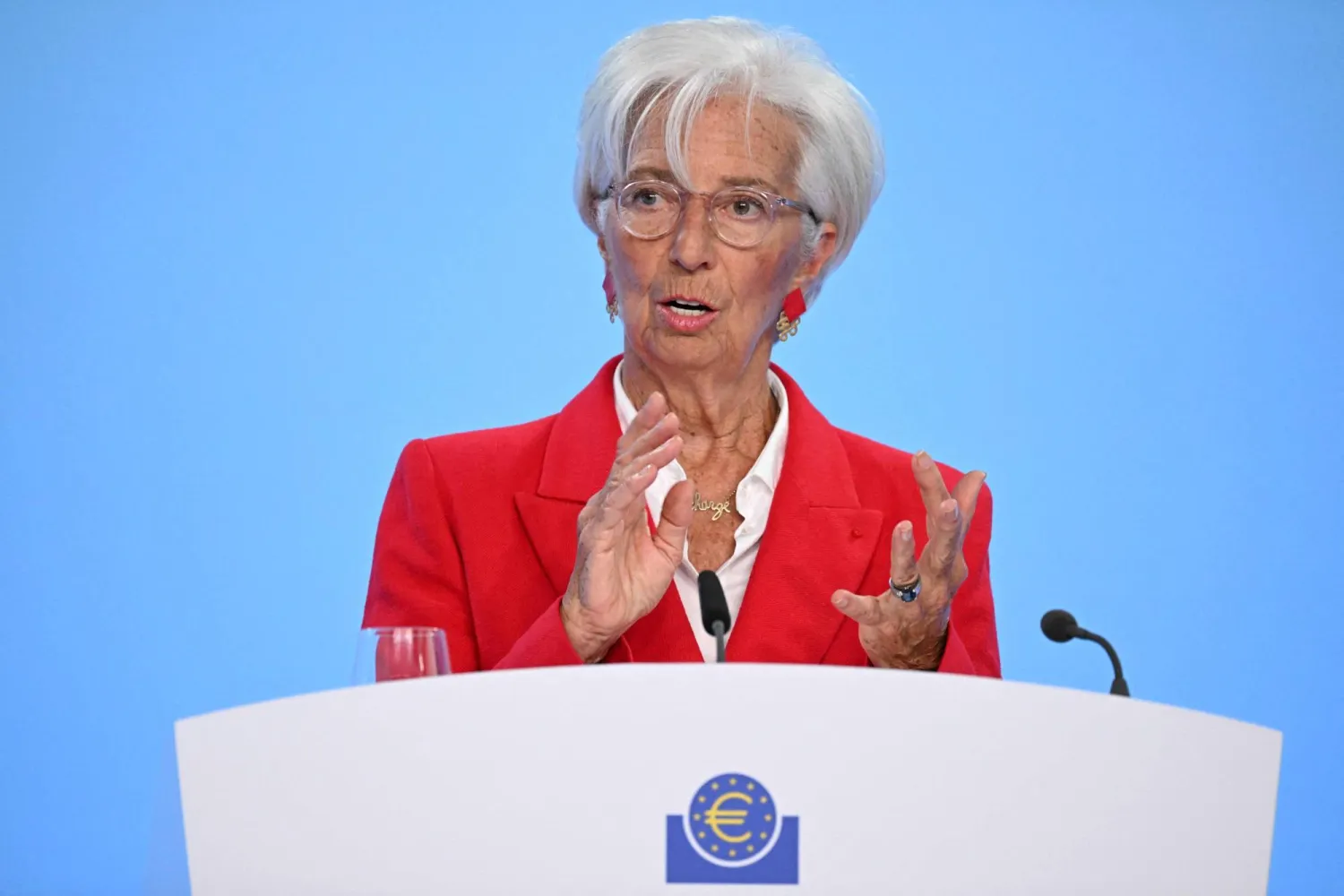
(FILES) European Central Bank (ECB) President Christine Lagarde gestures as she addresses a press conference on the Eurozone's monetary policy, at the central bank's headquarters in Frankfurt am Main, western Germany, on June 5, 2025. (Photo by Kirill KUDRYAVTSEV / AFP)
TT

ECB's Lagarde Warns of Risk to World Economy Via Trump Interference on Fed

(FILES) European Central Bank (ECB) President Christine Lagarde gestures as she addresses a press conference on the Eurozone's monetary policy, at the central bank's headquarters in Frankfurt am Main, western Germany, on June 5, 2025. (Photo by Kirill KUDRYAVTSEV / AFP)

If US President Donald Trump removed Federal Reserve Chairman Jerome Powell or Fed governor Lisa Cook, then this would represent a "very serious danger for the US economy and the world economy,” the European Central Bank President Christine Lagarde said on Monday.

Speaking to French broadcaster Radio Classique in an interview, Lagarde said: "If US monetary policy were no longer independent and instead dependent on the dictates of this or that person, then I believe that the effect on the balance of the American economy could, as a result of the effects this would have around the world, be very worrying, because it is the largest economy in the world."

Trump has repeatedly attacked the Fed’s chair, Jerome Powell, for not cutting the short-term interest rate and threatened to fire him. Trump is also attempting to fire Federal Reserve Governor Lisa Cook.

A court hearing on Trump's attempt to fire Cook ended on Friday with no immediate ruling on the unprecedented legal fight, meaning the US central bank policymaker will remain in place for now.

After hearing oral arguments for two hours in a court in Washington, D.C., US District Judge Jia Cobb asked Cook's lawyers to file a brief on Tuesday laying out in more detail their arguments for why the ouster was unlawful.

The case, which will likely end up before the US Supreme Court, has ramifications for the Fed's ability to set interest rate policy without regard to politicians' wishes, widely seen as critical to any central bank's ability to keep inflation under control.

The Fed has said it would abide by any court decision. It has given no indication that Cook's status as a member of its Board of Governors has changed, and she remains listed on its website as an active member of several internal committees.


Germany Growth Forecasts Slashed as Mideast War Hits Economy

Germany's economy is struggling with fierce Chinese competition in sectors from cars to chemicals © Ronny HARTMANN / AFP/File
TT

Germany Growth Forecasts Slashed as Mideast War Hits Economy

Germany's economy is struggling with fierce Chinese competition in sectors from cars to chemicals © Ronny HARTMANN / AFP/File

Leading economic institutes more than halved their growth forecast for Germany on Wednesday, warning that the energy shock caused by the Middle East war would hit Europe's top economy hard.

A group of leading institutes slashed their joint GDP growth forecast for 2026 to 0.6 percent, down from a September prediction of 1.3 percent.

Inflation is now forecast to rise to 2.8 percent, up from 2.0 percent, "weighing on household purchasing power".

"The energy price shock triggered by the Iran war is hitting the recovery hard," said economist Timo Wollmershaeuser of the Ifo institute, adding that increased government spending was nevertheless "preventing a stronger slide", AFP reported.

Oil and natural gas prices have surged since the end of February, when the United States and Israel attacked Iran, killed its supreme leader and plunged the Middle East into war.

Iran has since closed the Strait of Hormuz to ships of countries it considers allied with the US and Israel, effectively blocking a sea lane that normally transports about a fifth of the world's oil and liquefied natural gas.

Higher inflation in Germany would hit consumer spending, the institutes said, weighing on an already weak economy that has barely grown since a burst of pent-up demand after the Covid pandemic in 2022.

The government on Wednesday introduced rules allowing petrol stations to only raise prices once a day, at noon.

But motorist Sebastian, a 49-year-old estate agent who did not want to give his surname, told AFP at a Frankfurt petrol station that this was not enough to protect his spending power.

"Whether the price of petrol changes once a day or 10 times a day doesn't really matter," he said, adding it was "certainly not enough" to lower his costs.

Germany's economy, struggling with fierce Chinese competition in sectors from cars to chemicals, was in the doldrums even before US President Donald Trump last year imposed sweeping new tariffs before starting the Mideast war in late February.

Chancellor Friedrich Merz, who took office last May, vowed to borrow and spend hundreds of billions through a special infrastructure fund over coming years in what was dubbed a spending "bazooka" aimed at getting the economy back on its feet.

But the economists said that much of the money was simply paying for day-to-day spending.

"Government expenditure on consumption is rising much more sharply than investment," economist Oliver Holtemoeller of the Halle Institute for Economic Research said. "That was not the idea behind changing the financing rules."

The outlook for the longer term was also dire.

Citing low productivity, industrial decline and an ageing population, the institutes warned that Germany's economy would soon be unable to grow sustainably.

"We have also reassessed the structural changes in the German economy and, in particular, revised our forecast for industrial growth downwards," Wollmershaeuser said.

In an era when "demographic change is hitting with full force", he said, "potential growth will come to a standstill by the end of the decade, and we will have to get used to average GDP growth rates of zero percent".

Speaking to broadcaster Welt TV, Economy Minister Katherina Reiche said the government was working on reducing labour taxes and energy costs but that Germans would have to get used to working more over the course of their lives.

"We need to make this country vigorous again," she said. "Germany needs to get its will to win back."


Dollar Falls for Second Day as Middle East Ceasefire Expectations Rise

US dollar bills (Reuters)
TT

Dollar Falls for Second Day as Middle East Ceasefire Expectations Rise

US dollar bills (Reuters)

The dollar dropped for a second day on Wednesday as expectations of a ceasefire in the Middle East conflict grew after the US signalled that an end to the war could be near, even though markets remained on edge on fears of escalation.

The White House said US President Donald Trump would address the nation "to provide an important update on Iran" at 9 p.m. EDT on Wednesday (0100 GMT on Thursday).

Trump said on Tuesday the US could end its military campaign against Iran within two to three weeks, while Secretary of State Marco Rubio told Fox News Washington could see the "finish line" in the Iran war, according to Reuters.

Expectations that a ceasefire could be near have reversed some of the most popular trades since the war began in late February.

The yen recovered from this year's low of 160.46 per dollar, moving back through the psychologically important 160 level that had fanned concerns about intervention by Japanese authorities. The euro hit its highest level in a week.

The dollar index, which measures the currency against a basket of currencies including the yen and the euro, was last down 0.3% at 99.456, slipping to a one-week low after a 0.65% fall on Tuesday.

"Markets are increasingly buying into the notion of de-escalation in the Middle East overall," said Kirstine Kundby-Nielsen, FX analyst at Danske Bank.

"Markets are optimistic. We're seeing some relief with rates going lower, equities going higher and the price action in euro-dollar reflects that quite well."

The euro edged up 0.5% versus the dollar to $1.1603, after rising 0.8% on Tuesday.

The Japanese yen was up 0.1% at 158.46 per dollar. Sterling strengthened 0.7% to $1.3313.

At the same time, there were still signs of escalation in the conflict.
US Defense Secretary Pete Hegseth said the next few days in the war against Iran would be decisive and warned Tehran that the conflict would intensify if it did not make a deal.

The dollar should remain supported by the Fed's cautious stance on rate cuts, while the yen is being underpinned by rising expectations of a Bank of Japan hike in April, said Sho Suzuki, market analyst at Matsui Securities.

"We may see a tug-of-war between dollar strength and yen strength, with USD/JPY trading sideways in the upper 150s," he said.

The Australian dollar strengthened 0.7% to $0.6946. New Zealand's kiwi strengthened 0.4% to $0.5770.


Oil Slides as Middle East Uncertainty Keeps Markets on Edge

Concerns are growing in Europe about an economic recession as oil prices rise (Reuters)
TT

Oil Slides as Middle East Uncertainty Keeps Markets on Edge

Concerns are growing in Europe about an economic recession as oil prices rise (Reuters)

Oil reversed earlier gains on Wednesday as uncertainty over the situation in the Middle East unnerved markets and US President Donald Trump again suggested the US-Israeli war with Iran could be nearing an end.

The front-month Brent contract for June fell $1.06, or 1%, to $102.91 per barrel at 1106 GMT, having dropped to a session low of $98.35. US West Texas Intermediate crude futures for May slipped $1.44, or 1.4%, to $99.94 per barrel, after falling to $96.50 earlier.

Prices rose earlier on Wednesday but then uncertainty over the Middle East conflict prompted investors to lock in gains.

"Oil prices fell after US President Trump signalled a potential end to the war with Iran," ING said in a report.

Oil supply disruptions from the Middle East will increase in April and will hit Europe as the closure of the Strait of Hormuz hits exports further, International Energy Agency head Fatih Birol said on Wednesday.

Brent futures for June delivery settled down more than $3 on Tuesday following unconfirmed media reports that Iran's president was ready to end the war.

Trump told reporters on Tuesday that the US could end the military campaign within two to three weeks and that Iran does not have to make a deal to end the conflict, his clearest declaration yet that he wants to wind down the month-long war.

Still, analysts expect that energy flows through the Strait of Hormuz would be slow to return to levels before the conflict even if a ceasefire were announced.

"Even if the Strait reopens, clearing the vessel backlog would take time, with production, exports and LNG flows normalising only gradually rather than immediately," ING said.

According to a Wall Street Journal report, Trump has indicated he could end the war before reopening the Strait of Hormuz, the route through which 20% of global oil and liquefied natural gas trade flows.

"Even with diplomatic channels reportedly still active and intermittent comments from the US administration predicting a short end to the conflict, the combination of limited tangible diplomatic progress, continued maritime attacks and explicit threats against energy assets keeps supply risks skewed to the upside," LSEG analysts said in a note.

Illustrating the impact of the closure of the Strait of Hormuz, crude oil output from the Organization of the Petroleum Exporting Countries dropped by 7.5 million barrels per day in March compared with the previous month, as producers were forced to cut output because storage is full.

US crude oil output also fell, dropping by the most in two years in January after a severe winter storm knocked production offline, data from the Energy Information Administration showed on Tuesday.