

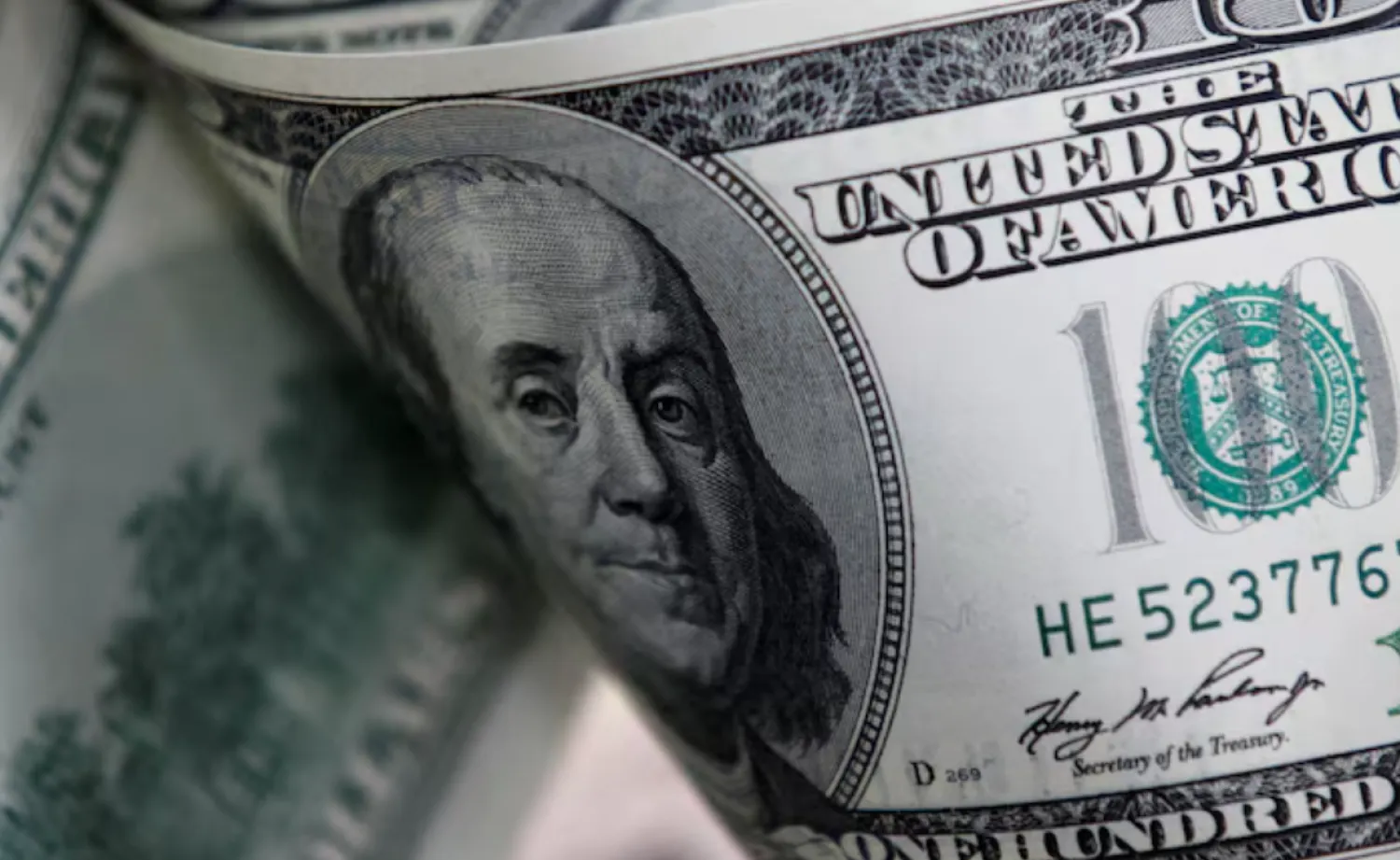

Dollar Hits Lowest since end-July

Dollar Hits Lowest since end-July
TT

Dollar Hits Lowest since end-July

Dollar Hits Lowest since end-July

The dollar hit a five-week low on Monday as investors looked ahead to a raft of US labor market data this week that could affect expectations for the Federal Reserve's easing path.

Traders were also assessing Friday's US inflation figures and a court ruling that most of Donald Trump's tariffs are illegal, as well as the US president's continuing tussle with the Fed over his attempt to fire Governor Lisa Cook.

Money markets have recently priced an around 90% chance of a 25 basis-point Fed rate cut in September and around 100 bps of easing by autumn 2026, according to the CME FedWatch tool.

Against a basket of currencies, the dollar eased 0.15% to 97.71, after hitting 97.534, its lowest level since July 28. It clocked a monthly decline of 2.2% on Friday.

Investors will be focussed on Friday's US nonfarm payrolls report, which will be preceded by data on job openings and private payrolls.

Analysts said the US economy is no longer outperforming as it did for much of the past decade, justifying a weaker dollar, and further signs of a softening labour market are expected to bolster that narrative.

"Severe weakness (in economic data) would point to an even more forceful Fed response than market pricing predicts," Societe Generale economist Klaus Baader said.

"But if May/June weakness is revealed as a statistical mirage, rate cuts would seem unwarranted given the almost certain prospect of rising inflation over the next year or so."

Some analysts still see the chance of a 50 basis-point move by the Fed later this month.

The euro was up 0.22% at $1.1707, while sterling rose 0.25% to $1.3537. US markets were closed for the Labor Day holiday on Monday.

Political risks are in focus as the French government faces likely defeat in a confidence vote next week over its plans for sweeping budget cuts.

Analysts noted that such risks tend to weigh on the currency only when there are clear signs of contagion within the euro area, something that is not evident at the moment.

US TRADE POLICY

Investors are keeping a close eye on trade policy while the US continues negotiations with key trading partners.

"We do not see much market impact from the court ruling," Jefferies economist Mohit Kumar said.

"The matter would pass on to the Supreme Court, which is likely to rule in favour of Trump."

The greenback has also been weighed down by worries over Fed independence, as Trump seeks more influence over monetary policy.

"Fiscal dominance risks should be more clearly apparent in both higher long-end US inflation break-evens and a higher risk discount on the dollar, none of which is materializing yet," George Saravelos, global head of forex research at Deutsche Bank, said.

"Fiscal dominance" refers to a scenario where central banks are pressured to ease monetary policy to help finance large budget deficits.

The dollar was up 0.14% at 147.26 against the yen after a monthly decline of 2.5% in August.

The onshore yuan rose 0.1% to 7.1374, snapping a six-day falling streak. It dropped to 7.1260 on Friday, its lowest level since Trump's presidential election win in early November 2024.

"By setting the daily fixes lower, the PBoC has signalled that policymakers in China are more comfortable to allow the renminbi to strengthen in the near term against the US dollar," said Lee Hardman, senior currency analyst at MUFG.

Such a move "could be a reflection that Chinese policymakers are less concerned over downside risks to growth in the near term", he added.



Saudi Crown Prince’s Directives Cut Riyadh Property Prices by 3%

A general view of Riyadh, Saudi Arabia. (SPA)
TT

Saudi Crown Prince’s Directives Cut Riyadh Property Prices by 3%

A general view of Riyadh, Saudi Arabia. (SPA)

Real estate prices in Saudi Arabia’s capital fell 3% in the final quarter of last year, reversing a 1% rise in the previous quarter, in a shift that highlights the on-the-ground impact of policy moves ordered by Prince Mohammed bin Salman bin Abdulaziz, Crown Prince and Prime Minister, to rein in soaring property costs across the Kingdom, particularly in Riyadh.

According to an index issued by the General Authority for Statistics on Tuesday, the real estate price index in Saudi Arabia fell 0.7% in the fourth quarter of last year compared with the same period of 2024.

The decline was driven mainly by weaker performance in the residential sector, which carries the most significant weight in the index, as its annual rate of change fell 2.2%.

The commercial sector continued to see a slight slowdown in growth momentum, while maintaining positive annual growth of 3.6%.

A real balance

Real estate specialists told Asharq Al-Awsat that the Crown Prince’s directives have become evident on the ground after property prices in Riyadh surged to unprecedented levels, prompting government intervention to curb the increases and enable citizens to own their first homes without excessive financial burdens.

Real estate analyst Khaled Al-Mobid said the 0.7 % decline in the real estate price index in the fourth quarter of 2025 reflects the market’s entry into a phase of real balance after years of rapid price increases, describing it as a healthy indicator that supports, rather than weakens, market sustainability.

“What we are witnessing today is not a loss in value, but a logical price correction, particularly in the residential sector, due to increased supply, improved regulation, and greater awareness among market participants, whether buyers or investors,” Al-Mobid told Asharq Al-Awsat.

He added that this balance creates better opportunities for end users, redirects investment toward appropriate products at fair prices, and curbs short-term speculation, serving the real estate economy over the medium and long term.

Housing stability

Real estate specialist Ahmed Omar Basudan told Asharq Al-Awsat that the sector has seen declines in many regions of the Kingdom, as buyers await the effects of government decisions issued under the Crown Prince’s direction.

He cited recent measures, including the announcement of the names of beneficiaries of subsidized land grants in northern Riyadh, located in some of the area’s best neighborhoods.

Basudan said the decision to fix residential rental prices in Riyadh for five years also contributed to the decline in the capital’s real estate market, as tenants are experiencing a period of housing stability, reducing demand for purchases at this stage.

He added that recent amendments to fees on undeveloped land and vacant properties, which have been implemented and are now being collected, also played a role, prompting landowners to move quickly to sell some plots at competitive prices to avoid bearing those fees.

Data from the General Authority for Statistics showed that residential real estate prices fell in the fourth quarter of last year compared with the same quarter of 2024, with the sector declining 2.2%. The drop was driven by a 2.4% fall in residential land prices, a 2.5% decline in apartment prices, a 1.3% decrease in villa prices, and a 0.2% drop in residential floor prices.

Quarterly comparison

The real estate price index fell 0.4% in the fourth quarter of last year, at a slower pace than in the third quarter.

The index was affected by a 0.4% decline in the residential sector, driven by a 0.7% drop in residential land prices, a 0.4% fall in apartment prices, and a 0.2% decrease in residential floor prices, while villa prices rose 0.8%.

At the regional level, the annual real estate price index fell 0.7% nationwide in the fourth quarter of last year, with Riyadh recording a 3% decline, compared with a 1% increase in the third quarter.

The Eastern Province posted the highest real estate price increase at 4%, followed by Makkah at 2.5%, Tabuk and Jazan at 1.1% each, and Al-Jawf at 0.4%.

By contrast, Hail, the Northern Borders region, and Madinah recorded the steepest declines, at 8.9%, 6.8%, and 6.1%, respectively.


Saudi Industry Minister Meets with Global Leaders at World Economic Forum to Advance Partnerships

Saudi Minister of Industry and Mineral Resources Bandar Alkhorayef held a series of high-level meetings with government officials and global business leaders at the World Economic Forum. (SPA)
TT

Saudi Industry Minister Meets with Global Leaders at World Economic Forum to Advance Partnerships

Saudi Minister of Industry and Mineral Resources Bandar Alkhorayef held a series of high-level meetings with government officials and global business leaders at the World Economic Forum. (SPA)

Saudi Minister of Industry and Mineral Resources Bandar Alkhorayef held on Tuesday a series of high-level meetings with government officials and global business leaders on the sidelines of the Kingdom's participation in the 2026 World Economic Forum in Davos.

As part of the Saudi delegation, Alkhorayef participated in a meeting with Swiss President Guy Parmelin. The meeting reviewed the robust strategic partnership between their nations and explored avenues to deepen cooperation in the industrial and mining sectors, aiming to expand bilateral ties to serve mutual interests.

Alkhorayef met with CEO of BlackRock Larry Fink, and President and CEO of the World Economic Forum Børge Brende. Talks focused on boosting the partnership between the Kingdom and the forum, exploring new cooperation in advanced manufacturing and critical minerals, and strengthening joint efforts to fortify industrial and mining supply chains.

In a series of bilateral meetings, Alkhorayef met with leaders of major global firms, including CEO of Capgemini Aiman Ezzat, Senior Partner at Bain & Company Dr. Jörg Gnamm, and CEO of Copa-Data Stefan Reuther. The meetings focused on unlocking opportunities for collaboration in advanced manufacturing, digital solutions, industrial automation, and smart systems. The officials emphasized leveraging global consulting expertise to boost factory efficiency, accelerate the Kingdom's industrial transformation, and bolster the competitiveness of its industrial and mining sectors.


Saudi-US Trade and Investment Council Meetings Kick Off in Riyadh

Chaired by the GAFT, the Saudi-US Trade and Investment Council aims to strengthen economic cooperation between the two countries by reviewing trade and investment policies, addressing barriers, and supporting technical dialogue among relevant entities. (SPA)
TT

Saudi-US Trade and Investment Council Meetings Kick Off in Riyadh

Chaired by the GAFT, the Saudi-US Trade and Investment Council aims to strengthen economic cooperation between the two countries by reviewing trade and investment policies, addressing barriers, and supporting technical dialogue among relevant entities. (SPA)

Technical team meetings of the Saudi-US Trade and Investment Council (TIFA) kicked off in Riyadh on Tuesday.

Held under the theme “A Platform for Dialogue, Partnership, and Economic Growth,” the meetings were attended by Deputy Governor of the General Authority of Foreign Trade (GAFT) for International Relations Abdulaziz Alsakran, Assistant United States Trade Representative for Europe and the Middle East Bryant Trick, with the participation of 20 entities from both sides.

Chaired by the GAFT, the Saudi-US Trade and Investment Council aims to strengthen economic cooperation between the two countries by reviewing trade and investment policies, addressing barriers, and supporting technical dialogue among relevant entities.

The council focuses on five main objectives: developing trade and investment policies; facilitating trade and addressing technical and regulatory barriers; supporting cooperation on sanitary and phytosanitary measures and agricultural products; enhancing intellectual property protection; and advancing digital trade, innovation, and emerging technologies.

Saudi government entities participating in the council work to develop initiatives and activities that help elevate cooperation between the two countries and achieve its objectives, serving mutual interests.

Over the past ten years, trade exchange between Saudi Arabia and the United States has reached $500 billion, making the United States the Kingdom’s second-largest import partner. Trade exchange since 2020 has recorded a growth rate exceeding 50%, reflecting the depth and strength of economic relations between the two countries.