

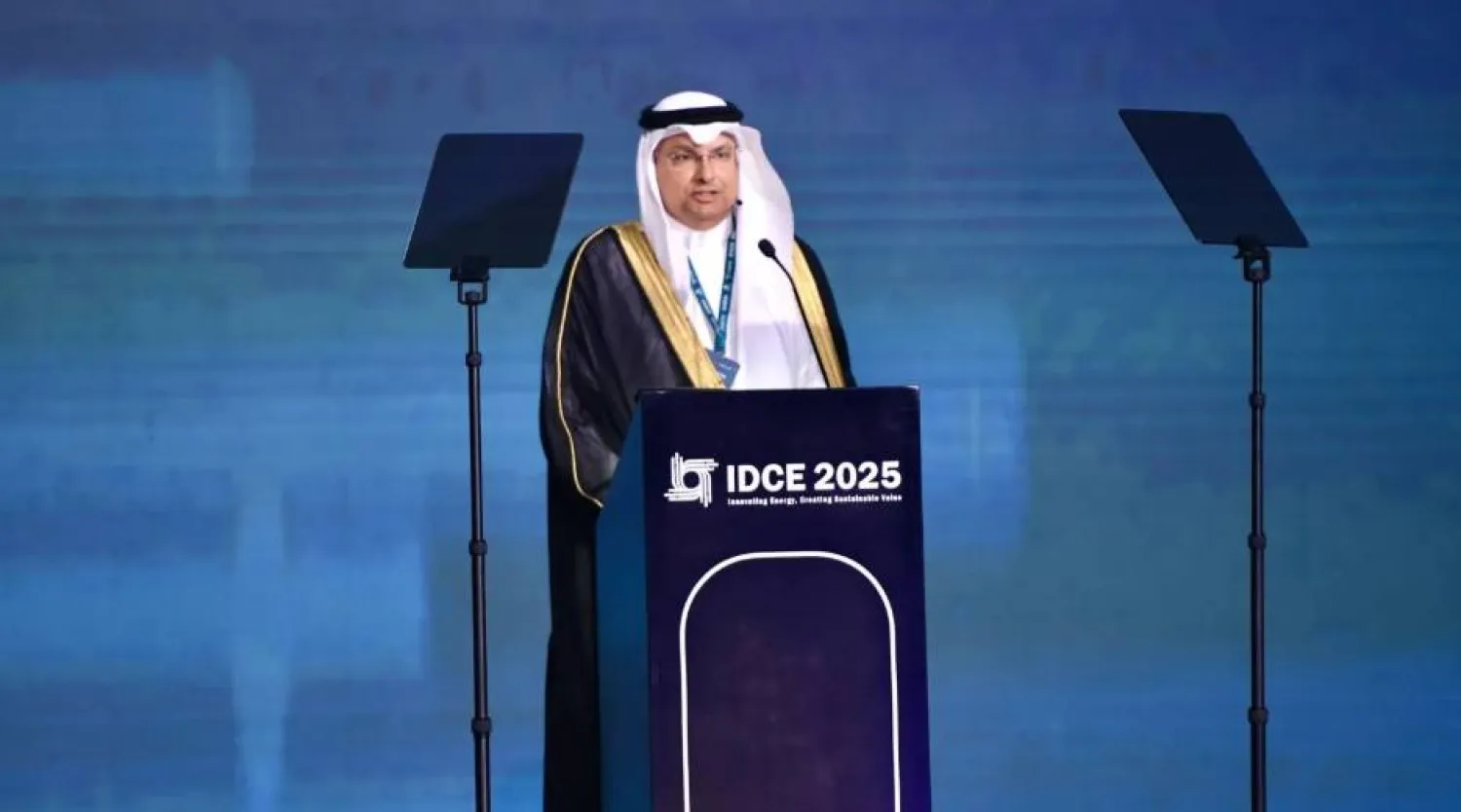

Aramco’s Al Qahtani Highlights Downstream’s Strategic Expansion

Saudi Aramco Downstream President Mohammed Al Qahtani. Photo: Aramco
TT

Aramco’s Al Qahtani Highlights Downstream’s Strategic Expansion

Saudi Aramco Downstream President Mohammed Al Qahtani. Photo: Aramco

Saudi Aramco Downstream President Mohammed Al Qahtani has highlighted the company’s strategic Downstream expansion, which is contributing to help meet the world’s growing energy needs.

In remarks at the Gulf Downstream Association International Downstream Conference & Exhibition (GDA IDCE) held in Bahrain, Al Qahtani stressed on Tuesday the importance of technological innovation and workforce upskilling to achieve Downstream transformation, contribute to energy security, and help reduce emissions.

“I see a clear shift in the narrative of Downstream: from reactive to transformative...and from adaptive to innovative...We view strategic Downstream expansion as essential to diversify our portfolio, capture greater value, and ensure long-term resilience,” Al Qahtani said on Aramco’s Downstream expansion.

“The world still needs more energy...Our global downstream presence, supported by strategic overseas investments, is reinforcing our position as a trusted partner in refining and petrochemicals. As we expand across the portfolio in developing arenas such as retail, fuels, and trading, we remain confident in our ability to thrive in an increasingly carbon-conscious world.”

On technology’s importance to Downstream, Al Qahtani said that tools like AI, cloud computing, IoT, digital twins, and blockchain are supporting the company to operate more efficiently and safely.

“According to research by S&P, with the help of AI, individual assets have achieved cost reductions of 10% to 25%, productivity gains of 3% to 8%, and energy efficiency improvements of 5% to 8%,” he said.

“Our greatest asset remains our HI, Human Intelligence – our people,” he said about Aramco’s workforce evolution and global collaboration.

“As the industry evolves, so does our global workforce. That is why at Aramco, we are investing heavily in developing future leaders – equipping them with new skills and the mindset to lead in a more complex energy world...I believe that together, we can help contribute to a future for this industry that is reliable, resilient, and sustainable,” Al Qahtani told the conference.

The GDA IDCE is a premier event in the Middle East for global energy industry professionals and organizations to explore partnerships and investments, exchange knowledge, address current challenges, and collaborate.

This year’s event brings together more than 5,000 international participants, over 150 speakers, and more than 80 exhibitors to foster innovation, sustainable growth, and downstream excellence.



New Aramco Digital Network to Enable Secure Industrial Connectivity across Saudi Arabia

New Aramco Digital Network to Enable Secure Industrial Connectivity across Saudi Arabia
TT

New Aramco Digital Network to Enable Secure Industrial Connectivity across Saudi Arabia

New Aramco Digital Network to Enable Secure Industrial Connectivity across Saudi Arabia

Aramco Digital, the technology subsidiary of Saudi Aramco, is set to launch the Kingdom’s national industrial communications network operating in the 450 MHz band. Designed to deliver secure, highly reliable industrial connectivity across Saudi Arabia, the network will support sectors that require continuous operations and dependable communications for critical assets and facilities.

As part of the launch, Aramco Digital will introduce a comprehensive portfolio of 450 MHz-based industrial digital solutions, including tailored connectivity packages for various sectors and a new generation of smart radios developed specifically for demanding industrial environments, SPA reported.

These smart radios combine rugged, industrial-grade design with advanced capabilities such as AI, enhanced sensing technologies, extended battery life through improved energy efficiency, and real-time data processing at the device level. Together, these features will support operational accuracy, reliability, and continuity in complex operating conditions.

The network will enable a broad range of Industrial Internet of Things (IIoT) applications, including asset condition and performance monitoring, fleet and equipment tracking, air quality and environmental sensing, smart video surveillance, smart metering, lighting and infrastructure control, and industrial mobility and fleet management solutions. These capabilities will enhance operational transparency, support automation, and improve efficiency across both industrial and service sectors.

The network is intended to underpin the Kingdom’s next phase of industrial development and support the objectives of Saudi Vision 2030. By providing a highly reliable national communications infrastructure, the network will enable advanced automation, intelligent systems, and digital services in vital sectors.


Oil Rises as Market Focuses on Venezuela and US Sanctions Plans

A view shows disused oil pump jacks at the Airankol oil field operated by Caspiy Neft in the Atyrau Region, Kazakhstan April 2, 2025. REUTERS/Pavel Mikheyev
TT

Oil Rises as Market Focuses on Venezuela and US Sanctions Plans

A view shows disused oil pump jacks at the Airankol oil field operated by Caspiy Neft in the Atyrau Region, Kazakhstan April 2, 2025. REUTERS/Pavel Mikheyev

Oil prices rose on Thursday after two days of declines as investors assessed Venezuela developments and reports on progress of proposed US sanctions legislation against countries doing business with Russia.

Brent crude futures were up 59 cents, or 0.98%, at $60.55 a barrel by 1038 GMT. US ‌West Texas Intermediate ‌crude gained 58 cents, or 1%, ‌to $56.57.

Higher ⁠prices ​are ‌led by the US President allowing the Russia sanctions bill to advance, as it raises fears of further disruption to Russian oil exports, said PVM analyst Tamas Varga. Republican Senator Lindsey Graham said on Wednesday that Trump had given the green light on the legislation, adding that the bill could be put ⁠to a vote as early as next week.

Both benchmarks fell more than ‌1% for a second day on Wednesday, ‍with market participants expecting ‍abundant global supply this year. Analysts at Morgan Stanley forecast ‍a surplus of as much as 3 million barrels per day in the first half of 2026. US gasoline and distillate stocks increased by more than analyst expectations in the week ended January ​2, while crude stocks fell, the Energy Information Administration said on Wednesday. On Tuesday, Washington announced a deal with ⁠Caracas to gain access to up to $2 billion of Venezuelan crude. The deal initially could require the rerouting of cargoes that were bound for China, sources told Reuters. Chinese independent refiners that consume much of the country's Venezuelan imports could switch to Iranian oil to make up the shortfall. The US seized two Venezuela-linked oil tankers in the Atlantic Ocean on Wednesday, one sailing under Russia's flag, as part of President Donald Trump's aggressive push to dictate oil flows in the Americas and force ‌Venezuela's socialist government to become an ally.


Gold Falls as Commodity Index Rebalancing Sparks Selling Pressure

UK gold bars and gold Sovereign coins are displayed at Baird & Co in Hatton Garden in London, Britain, October 8, 2025. REUTERS/Hiba Kola//File Photo
TT

Gold Falls as Commodity Index Rebalancing Sparks Selling Pressure

UK gold bars and gold Sovereign coins are displayed at Baird & Co in Hatton Garden in London, Britain, October 8, 2025. REUTERS/Hiba Kola//File Photo

Gold prices fell on Thursday as investors braced for futures selling tied to a commodity index reshuffle, with a stronger US dollar adding pressure by making the metal costlier for overseas buyers.

Spot gold fell 0.6% to $4,428.06 per ounce, as of 1115 GMT. US gold futures for February delivery fell 0.6% to $4,436.30.

"Gold and silver remain under pressure as the annual commodity-index ‌rebalancing gets ‌underway. Over the next five days, COMEX ‌futures ⁠could ​see ‌selling in the region of $6 to $7 billion in each metal," said Ole Hansen, head of commodity strategy at Saxo Bank.

The annual Bloomberg Commodity Index rebalancing, designed to keep the index aligned with the current state of the global commodity market, begins this week, Reuters reported.

"(The US-Venezuela conflict) added a small georisk premium at the beginning of ⁠the week which is now deflating as the attention turns to the rebalancing," ‌Hansen added.

Meanwhile, the US dollar hovered ‍near a one-month high ‍as investors assessed mixed economic data ahead of Friday’s nonfarm payrolls ‍report.

Data on Wednesday showed US job openings dropped to a 14-month low in November while hiring resumed its sluggish tone, pointing to ebbing labor demand.

Investors are now awaiting the US non-farm payrolls data for ​more clues on monetary policy, with markets pricing in two interest rate cuts by the Federal Reserve ⁠this year.

On the geopolitical front, the US seized two Venezuela-linked oil tankers in the Atlantic Ocean on Wednesday.

Spot silver lost 3.2% to $75.64 per ounce, after hitting an all-time high of $83.62 on December 29.

HSBC sees gold hitting $5,000 per ounce in the first half of 2026 on geopolitical risks and rising fiscal debts, and expects silver to trade between $58 and $88 in 2026, driven by supply deficits, robust investment demand, and high gold prices, but warned of a market correction later in the year.

Spot platinum was ‌down 4.2% at $2,211.94 per ounce, while palladium shed 2.4% to $1,721.61 per ounce.