


Sources: China, Malaysia in Talks for Rare Earths Refinery Project

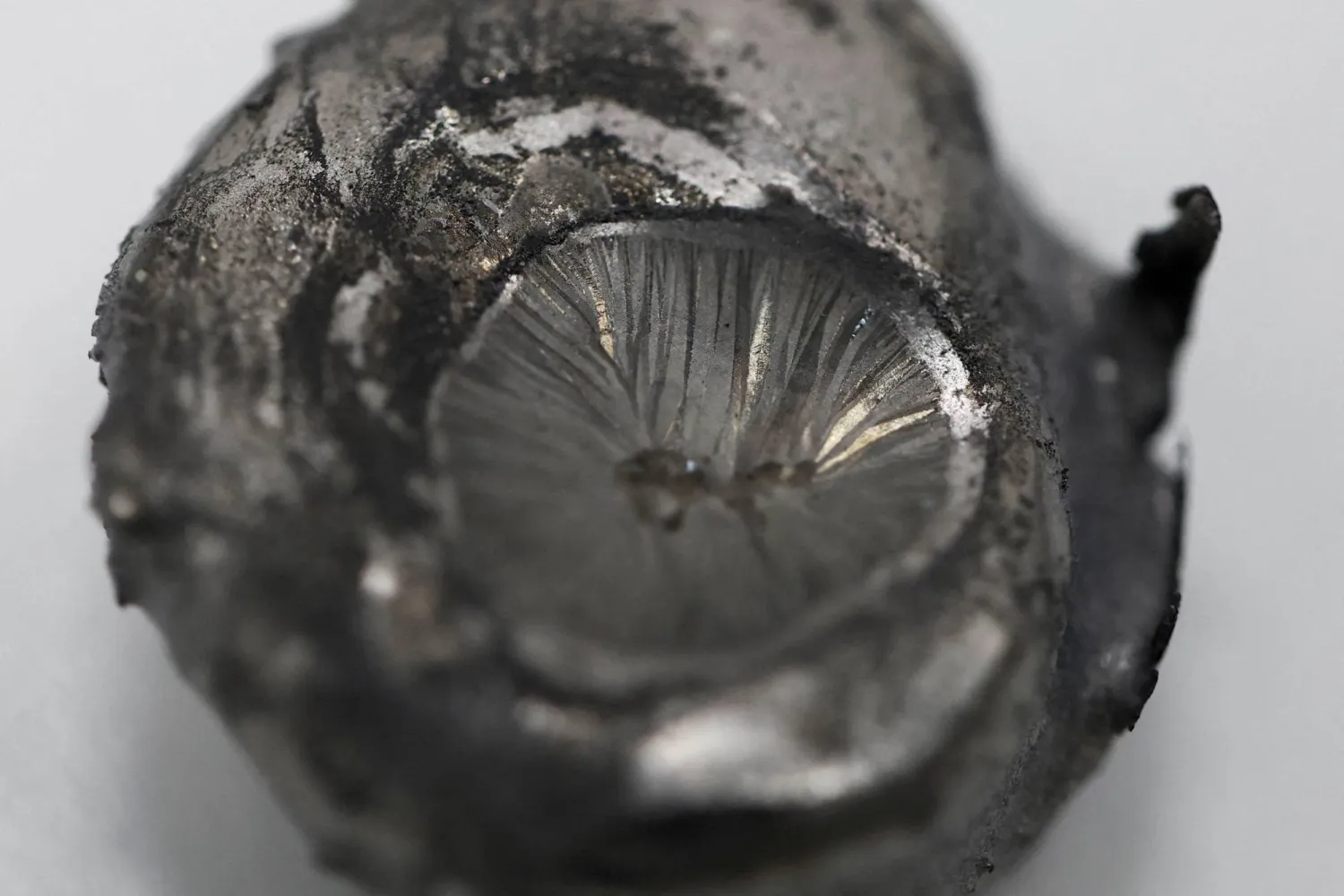
FILE PHOTO: A sample of terbium (Tb) is displayed at the Laboratory of Physics and Material studies (LPEM) in Paris, France, June 23, 2025. REUTERS/Benoit Tessier/File Photo
TT

Sources: China, Malaysia in Talks for Rare Earths Refinery Project

FILE PHOTO: A sample of terbium (Tb) is displayed at the Laboratory of Physics and Material studies (LPEM) in Paris, France, June 23, 2025. REUTERS/Benoit Tessier/File Photo

China and Malaysia are in early talks for a project to process rare earths, with sovereign wealth fund Khazanah Nasional likely to partner with a Chinese state-owned firm to build a refinery in the Southeast Asian nation, people familiar with the matter said.

If the joint venture takes shape, it would represent a significant policy departure for China, the world's top supplier and refiner of rare earths, which has banned export of its processing technology to protect its dominance of the industry.

Beijing is ready to swap its technology for access to Malaysia's untapped rare earths reserves, seeking to limit competition from Australian rival Lynas Rare Earths, which has a processing plant in the central state of Pahang, said two sources in Malaysia with knowledge of the talks.

All four sources who spoke to Reuters for this report sought anonymity because the matter is a sensitive one.

Malaysia's natural resources and trade ministries did not immediately respond to requests for comment on the talks.

Khazanah's chief investment officer, Hisham Hamdan, declined to confirm the talks or plans for the proposed refinery, saying it was "way too early,” but acknowledged that rare earths were among the industries being explored by the fund.

"We do many studies on industries... it's something we're happy to explore and help the government, but it's at government level, right? So I think that's as much as we can say," he told Reuters in an interview in Singapore on Thursday.

China’s State Council Information Office, which handles media queries on behalf of the government, did not immediately respond to a Reuters request for comment due to the National Day holiday.

A Malaysian source said the plan faced several roadblocks, however, such as China's concern whether Malaysia would be able to supply enough raw material for the plant.

Two of the sources said Malaysia was also concerned by the potential environmental impact and regulatory hurdles, since mining activities typically require approvals and licensing from both state and federal government authorities.

Malaysia has said it did not support rare earths mining in sensitive locations such as permanent forest reserves and water catchment areas.

Global manufacturers are scrambling to secure alternative supplies of rare earths, after Beijing's export curbs this year led to output delays for major automakers and magnet producers.

Malaysia has some 16.1 million metric tons of rare earth deposits, the government estimates, but lacks the technology to mine and process them.

It has banned companies from exporting raw rare earths to prevent loss of resources.

The only exception was granted in 2022 to a pilot mining project aimed at helping to set national operating and licensing guidelines for extraction of the rare earths.

Australia's Lynas, the world's largest rare earths producer outside China, signed a deal in May with Malaysia's eastern state of Kelantan for a future supply of mixed rare earths carbonate, seen as an effort to develop the local industry.

The proposed refinery is expected to process both light and heavy rare earths, two Malaysian sources said. These elements are critical to the manufacture of products from cars and mobile phones to military equipment.

Heavy rare earth metals, used widely in the development of clean technology, are less common, however, and some elements face shortages amid high demand.

In August, Johari Abdul Ghani, Malaysia's minister for natural resources said China was prepared to provide technical and technological assistance in processing rare earths.

However, President Xi Jinping had asked to restrict cooperation efforts to state-linked companies so as to protect trade secrets, Johari said, adding that discussions were still preliminary and no deal had been reached.

A successful deal would make Malaysia one of the few countries with both Chinese and non-Chinese rare earths processing technology, Johari added.



Four Saudi Companies Sign Agreements to Develop Syrian Oil and Gas Fields 

Saudi and Syrian officials are seen at Tuesday's signing ceremony. (SANA)
TT

Four Saudi Companies Sign Agreements to Develop Syrian Oil and Gas Fields 

Saudi and Syrian officials are seen at Tuesday's signing ceremony. (SANA)

Under the supervision and follow-up of the Saudi Ministry of Energy, four Saudi companies, TAQA, ADES Holding, Arabian Drilling, and the Arabian Geophysical and Surveying Company (ARGAS), signed on Tuesday agreements with the Syrian Petroleum Company covering services, technical support, and the development of oil and gas fields in Syria.

The agreements build on the ongoing cooperation between Saudi Arabia and Syria in the energy sector. They come within the framework of implementing the memoranda of understanding signed on August 28 and the subsequent technical workshops and field visits to gas fields and associated facilities, reported the Saudi Press Agency.

Tuesday’s deals include an agreement between ADES Holding and the Syrian Petroleum Company that sets out the basic principles for the development, operation, and production of gas fields. It defines the core terms that will form the basis of a final technical services contract to develop and operate gas fields and associated facilities within the designated contract area.

The agreement aims to increase production across five gas fields, Abu Rabah, Qamqam, North Al-Faydh, Al-Tiyas, and Zumlat al-Mahar, as well as any additional areas agreed upon at a later stage.

The second deal is a master service agreement between TAQA and the Syrian Petroleum Company to provide advanced, integrated solutions and services for the construction and maintenance of oil and gas fields and wells in Syria.

The agreement aims to boost operational efficiency and boost production using the latest technologies and state-of-the-art equipment.

Another master service agreement, between ARGAS and the Syrian Petroleum Company, will provide 2D and 3D seismic surveying and related technical services to support exploration and drilling activities.

It establishes a long-term cooperation framework designed to advance petroleum exploration and development in Syria’s energy sector, ensuring rapid response, operational flexibility, and the efficient initiation of technical projects.

The fourth agreement, between Arabian Drilling Company and the Syrian Petroleum Company, calls for the provision of drilling and workover services for oil and gas wells in Syria, including the leasing and operation of onshore drilling and workover rigs.

Arabian Drilling will supply the drilling and workover rigs, deliver workover operations and operational support, and provide workforce training and development.


Egypt’s Inflation Eases to 12.3% in November 

Boats sail on the Nile River in Cairo, Egypt, December 9, 2025. (Reuters)
TT

Egypt’s Inflation Eases to 12.3% in November 

Boats sail on the Nile River in Cairo, Egypt, December 9, 2025. (Reuters)

Egypt's annual urban consumer inflation slowed slightly to 12.3% in November after a month-on-month drop in food prices, statistics agency CAPMAS said on Wednesday, with inflation coming in lower than analyst expectations.

The median forecast in a poll of 14 analysts had been for inflation to climb to 13.1%. The urban consumer inflation rate in October was 12.5%.

Month-on-month, urban consumer prices rose by 0.3% in November, CAPMAS said. Food and beverage prices rose by an annual 0.7% but fell by a monthly 2.6%, it said.

The annual inflation rate has plunged from a record 38% in September 2023, helped by an $8 billion financial support package from the International Monetary Fund in March 2024.

Inflation has been in part fueled by an expanding money supply. M2 money supply grew by an annual 21.68% in October, central bank data showed.

The central bank's monetary policy committee left its overnight lending rate unchanged at its last meeting on November 20, but cut rates by 100 basis points in October and 200 points in August as inflation slowed.

The policy committee is next scheduled to review overnight interest rates at a meeting on December 25.


Egypt, Israel in Advanced Talks to Approve Israeli $35 Billion Gas Agreement

Israeli Energy Minister Eli Cohen and US Ambassador Mike Huckabee visiting the Leviathan platform in October. (Israeli Energy Ministry)
TT

Egypt, Israel in Advanced Talks to Approve Israeli $35 Billion Gas Agreement

Israeli Energy Minister Eli Cohen and US Ambassador Mike Huckabee visiting the Leviathan platform in October. (Israeli Energy Ministry)

Israel’s Ministry of Energy announced on Tuesday that negotiations over a natural gas supply agreement with Egypt have reached an “advanced stage,” though some issues remain unresolved.

Israel signed its largest-ever export deal in August to supply Egypt with up to $35 billion worth of natural gas from the Leviathan field.

After marathon discussions this week between the Leviathan partners and Israel’s Ministry of Energy and Infrastructure, a final agreement was reached that will allow the export of 130 BCM (billion cubic meters) to Egypt for $35 billion, the largest export agreement in the country's history.

Israel's Energy Minister Eli Cohen has said he was holding up approval for the gas deal to secure better commercial terms for the Israeli market, according to Reuters. On Tuesday, he confirmed that talks were still ongoing.

As part of the agreement, the Leviathan Partners, NewMed Energy, Chevron and Ratio Petroleum Energy, will commit to a guaranteed price for the domestic economy, to give priority to the Israeli economy, so that if there are any malfunctions in the Tanin, Karish or Tamar fields, it will transfer gas directly to the local economy.

One of the issues that senior Washington officials have been dealing with is ensuring that US energy major Chevron, which owns 39.66% of Leviathan, remains committed to the deal.

The partners are expected to make an investment decision to expand the Leviathan field infrastructure withing two weeks, once the Israeli government announces its final approval.