

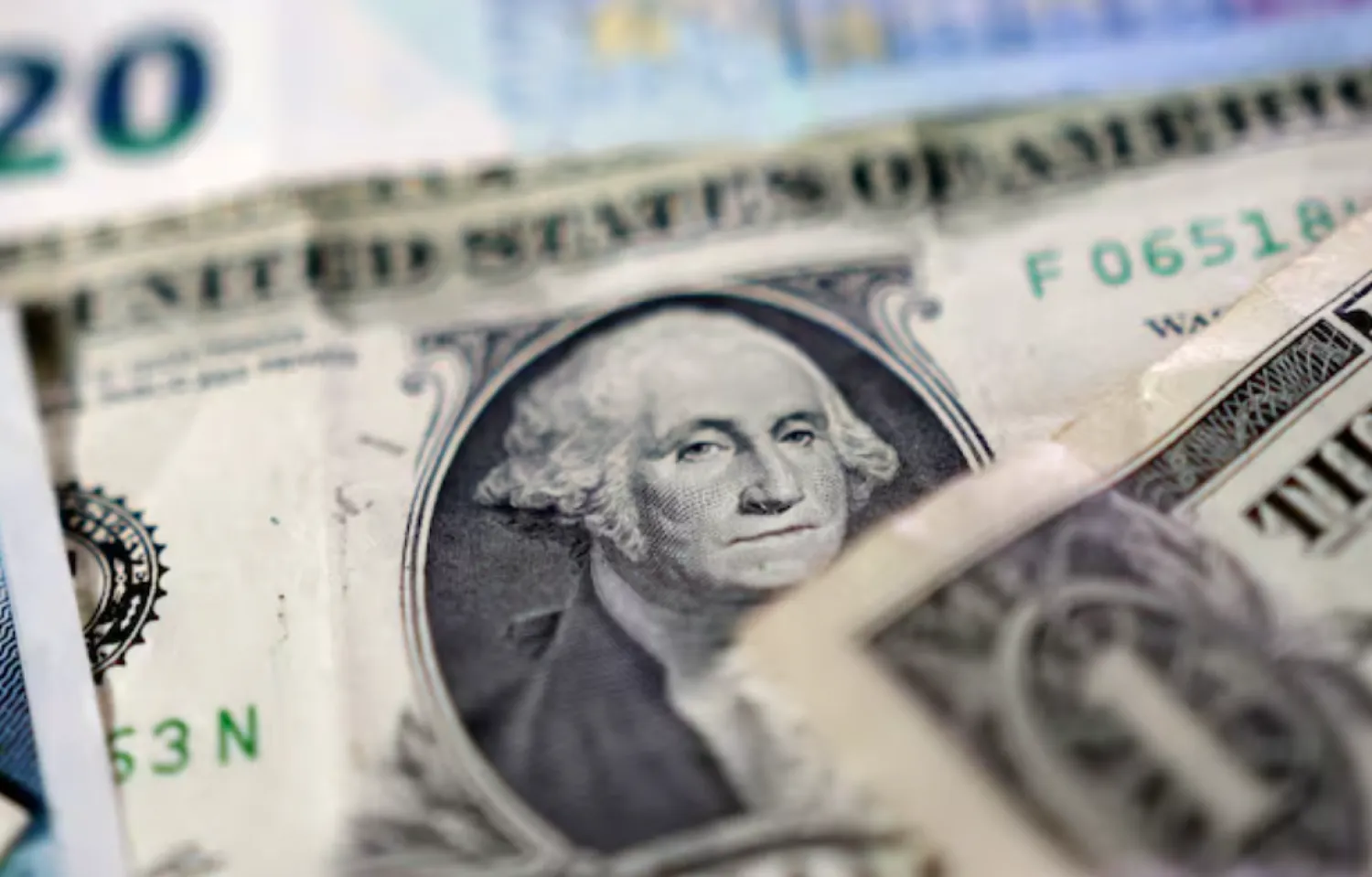

Dollar Reaches Two-month Highs as Euro, Yen Hit by Political Turmoil

US dollar banknotes are seen in this illustration taken May 4, 2025. REUTERS/Dado Ruvic/Illustration
TT

Dollar Reaches Two-month Highs as Euro, Yen Hit by Political Turmoil

US dollar banknotes are seen in this illustration taken May 4, 2025. REUTERS/Dado Ruvic/Illustration

The dollar rose on Thursday, adding to a strong run this week, helped by a weakening euro beset by a political crisis in Paris and a struggling yen amid a change of guard in Japan's ruling party. Markets this week have also grappled with a lengthening US government shutdown. The euro has been struggling following the resignation of France's Prime Minister Sebastien Lecornu and his government earlier this week. But President Emmanuel Macron still surprised markets with plans to appoint a new prime minister this week, according to Reuters.

The single currency last traded 0.1% lower at $1.1616, after touching its lowest level since the end of August on Wednesday. It is down almost 1% this week so far. Similarly, the yen has been under pressure this week after hardline conservative Sanae Takaichi was picked as head of Japan's Liberal Democratic Party, putting her on course to become the country's first female prime minister and fuelling bets of a revival in big spending and loose monetary policy.

The Japanese currency was little changed at 152.72, around its weakest since February. It has fallen nearly 4% for the week thus far.

"In the absence of US data, FX markets have largely focused on French and Japanese politics," said Chris Turner, head of markets at ING.

"President Macron could announce a new PM by Friday evening. This has come as a surprise to a market that had felt that the next chapter in the French political saga could only be new and divisive elections," he said, adding that the news has helped the euro find some support.

The moves in the yen and the euro have in turn provided support for the dollar, which rose to a two-month high, last up 0.1% to 98.92. Federal Reserve officials agreed at their recent policy meeting that risks to the US job market had increased enough to warrant a rate cut. But they remained wary of high inflation amid a debate about how much borrowing costs were weighing on the economy, minutes of their September meeting showed on Wednesday. A prolonged US government shutdown could leave the Fed flying blind at its October meeting as economic data is delayed.

Still, investors continue to price in a 25 basis point cut for its next meeting.


Hyundai Motor Announces $86 Bln Investment in South Korea after US Trade Deal

FILED - 10 January 2017, US, Detroit: A Hyundai logo is seen at the North American International Auto Show (NAIAS) in Detroit, Michigan. Photo: Uli Deck/dpa
TT

Hyundai Motor Announces $86 Bln Investment in South Korea after US Trade Deal

FILED - 10 January 2017, US, Detroit: A Hyundai logo is seen at the North American International Auto Show (NAIAS) in Detroit, Michigan. Photo: Uli Deck/dpa

Hyundai Motor Group will invest 125.2 trillion won ($86.47 billion) in South Korea from 2026 to 2030, the automaker said on Sunday after Seoul finalized a trade deal reducing US tariffs on South Korean autos to 15% from 25%.

That compares with investments by Hyundai Motor and its group affiliate Kia Corp of 89.1 trillion won from 2021 to 2025, according to the group.

South Korean President Lee Jae Myung met with Hyundai Motor Group Chairman Euisun Chung and other business leaders on Sunday, two days after details were released on the trade deal, which includes South Korea's promise to invest $350 billion in US strategic sectors.

"We are well aware of concerns about exports declining and domestic production shrinking due to US tariffs of 15%," Chung said after the meeting, Reuters reported.

"We will diversify export markets, increase exports from domestic factories and more than double auto exports through new electric-vehicle factories by 2030," Chung said, adding that the group will also provide support to auto parts makers hit by President Donald Trump's tariffs.

Of Hyundai's domestic investments, 50.5 trillion won ($35 billion) will be in AI and other future business opportunities, 48.4 trillion won in research and development, and 36.2 trillion won on optimizing production facilities and building a skyscraper, the group said.


Egypt Targets 5 Million Tons of Local Wheat Next Year, Seeking Self-sufficiency

FILE PHOTO: A farmer tends wheat at a field in Giza, Egypt, April 18, 2025. REUTERS/Mohamed Abd El Ghany/File Photo
TT

Egypt Targets 5 Million Tons of Local Wheat Next Year, Seeking Self-sufficiency

FILE PHOTO: A farmer tends wheat at a field in Giza, Egypt, April 18, 2025. REUTERS/Mohamed Abd El Ghany/File Photo

Egypt has targeted procurement of five million metric tons of local wheat next season as it moves away from being one of the world's top wheat importers to self-sufficiency, the supply ministry said on Sunday.

Egypt typically imports about 10 million tons a year, with the state buyer obtaining roughly half of that for the country's bread subsidy program on which 70 million people rely.

In the first half of this year, however, imports were a quarter less than the same period last year, according to shipping and trading data reviewed by Reuters.

The government's share of those imports dropped by more than half to about 1.6 million tons, reflecting slower procurement since the state buyer changed from the General Authority for Supply Commodities (GASC) to the military-linked Future of Egypt for Sustainable Development (Mostakbal Misr).

While the supply ministry said that it procured more than 4 million tons of wheat during the domestic harvest, data seen by Reuters shows that the government bought about 3.9 million tons, slightly below its announced target of between 4 million and 5 million tons in the season from mid-April to mid-August.

Reserves of strategic commodities are within safe buffers and as high as last year or higher in some commodities, the supply ministry added without providing more data.

In November 2024, Egypt's wheat stocks covered five months of consumption, below the six-month threshold Egypt hopes to maintain.


Return to Bad Days of Hyperinflation Looms in Venezuela

 A man pushes a hand truck loaded with plantains through La Candelaria neighborhood in Caracas on November 13, 2025. (AFP)
A man pushes a hand truck loaded with plantains through La Candelaria neighborhood in Caracas on November 13, 2025. (AFP)
TT

Return to Bad Days of Hyperinflation Looms in Venezuela

 A man pushes a hand truck loaded with plantains through La Candelaria neighborhood in Caracas on November 13, 2025. (AFP)
A man pushes a hand truck loaded with plantains through La Candelaria neighborhood in Caracas on November 13, 2025. (AFP)

Venezuelans are grappling with political and economic chaos, a mass population exodus and fears of a US military attack. Now, their wallets are ever thinner as a return to hyperinflation looms.

Increasingly, people live hand to mouth, buying a tomato here, a few onions there as they manage to scrape together enough bolivars for just the basics.

"If we earn 20 bolivars, we need 50," informal merchant Jacinto Moreno, 64, told AFP in downtown Caracas.

To buy a kilogram of tomatoes, a Venezuelan needs the equivalent of one US dollar. But the average salary per month is only a few hundred dollars.

Reliable economic figures are hard to come by and a large portion of incomes are earned under the table in the informal sector.

"Prices go up every day," lamented Moreno. "Every day."

Venezuela has already had the highest inflation rate in the world, more than once.

Memories are still fresh of a record 130,000 year-on-year rise in prices recorded in 2018, according to official figures -- the peak of a four-year hyperinflationary period that ended in 2021 and pushed millions to emigrate.

Venezuela's central bank has not published inflation figures since October 2024, after President Nicolas Maduro claimed victory in what is widely considered his second stolen election in a row.

According to the leader himself, inflation reached 48 percent in 2024.

The International Monetary Fund projects a 548 percent figure for Venezuela for 2025 and 629 percent for 2026.

Norma Guzman, a 66-year-old who works as an office cleaner, told AFP she can no longer afford to buy groceries monthly or weekly.

Leaving a store with nothing but three tomatoes in a bag, she said "I shop daily" as and when she, her husband and their son manage to put aside money for food.

Maduro blames Venezuela's economic woes squarely on US sanctions.

He also accuses Washington, which has deployed a fleet of warships in the Caribbean in a stated anti-drug operation, of seeking to depose him and seize the formerly rich petrostate's vast oil deposits.

Maduro has said Venezuela will register GDP growth of over nine percent in 2025. The IMF estimates 0.5 percent.

Colombian-based Venezuelan economist Oscar Torrealba is among those who expect inflation to soar above 800 percent -- higher than IMF projections.

"This undoubtedly brings us much closer to a hyperinflationary scenario," he told AFP.

For Torrealba, hyperinflation is official once prices rise by more than 50 percent for three consecutive months.

But definitions vary, and for other experts an annual rate of 500 percent, such as predicted by the IMF, already amounts to hyperinflation.

Few economists still living in Venezuela dare to publicly challenge the official line, especially after several of their peers, including a former finance minister, were detained this year.

The arrests were never officially announced but coincided with a series of police operations against the publication of parallel exchange rates on web pages that were subsequently removed.

For now, the steep price rises have not resulted in product shortages as they did a few years ago, when people queued for hours to just to buy a small bag of coffee or sugar.

Maduro at the time responded by decriminalizing use of the US dollar, which became Venezuela's de facto currency, as well as halting money printing and relaxing exchange controls.

Measured in dollar prices, economist Torrealba said Venezuela's inflation hit 80 percent year-on-year in October.

The country is running low on the greenbacks used for a big portion of purchases, and which many Venezuelans try to save as insurance against bolivar devaluation.

A major source of foreign currency used to be US oil giant Chevron, which continues to operate under a special license despite sanctions but no longer pays royalties in cash. It pays in crude, instead, which the state sells on at a discount.

With fewer dollars in the market, the gap between the official exchange rate and the informal one is now over 60 percent, according to analysts.
