
IMF–World Bank Meetings Convene Under the Shadow of the 'Dot-Com' Specter

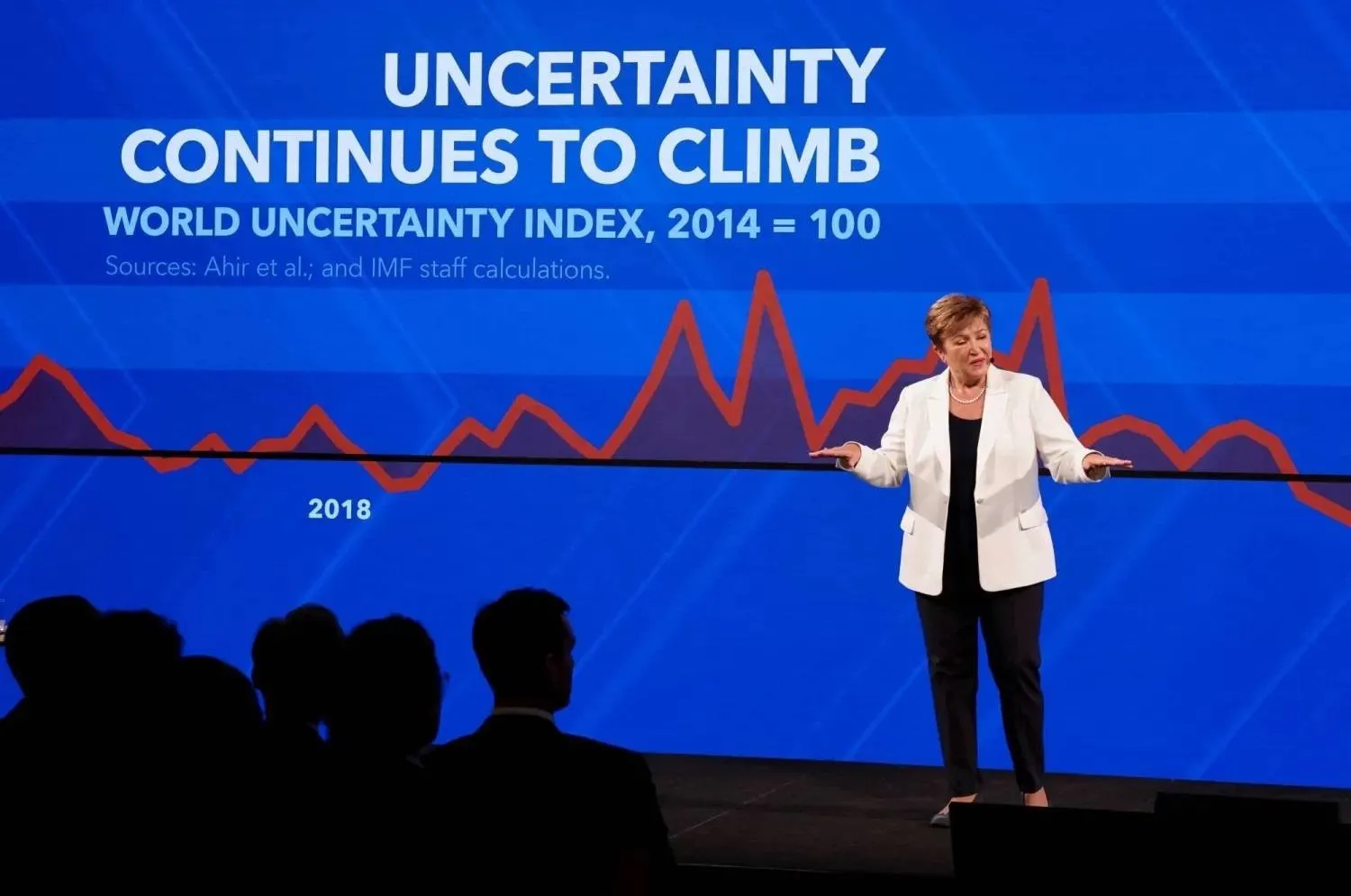
Georgieva makes statements ahead of the annual IMF and World Bank Fall Meetings at the Milken Institute in Washington (Reuters). 
TT

IMF–World Bank Meetings Convene Under the Shadow of the 'Dot-Com' Specter

Georgieva makes statements ahead of the annual IMF and World Bank Fall Meetings at the Milken Institute in Washington (Reuters). 

In a dramatic reversal from the tense atmosphere that gripped their gatherings two years ago, the International Monetary Fund (IMF) and the World Bank are holding their annual meetings in Washington this week under a mood of cautious optimism. The meetings coincide with the announcement of a peace agreement in Gaza, a development that eases geopolitical tensions that have long weighed on the global economy.

This moment marks a stark contrast to the 2023 meetings in Marrakesh, overshadowed by the Gaza war, which had heightened the strain on global policymakers. Yet despite the more encouraging political backdrop, financial experts remain wary.

IMF Managing Director Kristalina Georgieva struck a notably somber tone in remarks delivered days before the meetings, warning investors: “Brace yourselves - uncertainty is the new normal, and it is here to stay.” She cautioned that global stock markets could face sharp corrections if the current investor frenzy around artificial intelligence (AI) stocks fades, evoking fears of a “tech bubble” reminiscent of the dot-com crash a quarter century ago.

The comparison is sobering. In 2000, the dot-com bubble — fueled by speculation in internet-based companies — burst after years of frenzied investment and unrealistic optimism about the potential of the digital economy. The crash erased trillions of dollars in market value and sent major economies into recession. Then, as now, investors were convinced they were witnessing the dawn of a “new economy” that would upend traditional business models and deliver boundless profits.

Georgieva warned that today’s easy financial conditions “mask rather than fix underlying weaknesses” and could reverse suddenly, triggering another market collapse. Such a shock, she said, would compound the growing list of global risks -from persistent trade tensions to unsustainable debt- that finance ministers and central bankers are expected to tackle this week in Washington.

Her warning came shortly after the Bank of England cautioned that the risk of a “sharp market correction” had risen, noting that valuations of AI-focused technology companies now rival those seen at the height of the 2000 bubble. With technology shares accounting for an ever-larger share of benchmark indices, the Bank said markets are “particularly vulnerable to volatility if expectations about AI’s impact turn less optimistic.”

The IMF and the Bank of England are not alone in their concerns. Prominent figures including OpenAI’s Sam Altman, JPMorgan Chase CEO Jamie Dimon, and US Federal Reserve Chair Jerome Powell have all sounded alarms about the pace and scale of AI-driven market speculation.

Georgieva’s concerns extend beyond the tech sector. She noted the unprecedented surge in global demand for gold, whose price has exceeded $4,000 an ounce for the first time in history, which she said was a clear reflection of investor unease in the face of mounting uncertainty. Meanwhile, geopolitical tensions between the United States and China continue to rattle markets. Her comments came as US President Donald Trump renewed his threats to impose 100 percent tariffs on Chinese imports, in retaliation for Beijing’s ban on rare earth metal exports, a move that triggered sharp market sell-offs.

As the meetings unfold, global finance ministers, central bankers, and senior officials face a daunting agenda. Key discussion points include market instability, asset price bubbles, and the possibility of a stock market downturn. Broader debates will address global growth prospects, the sustainability of public debt, the independence of monetary policy, and the structural challenges shaping the world economy.

In its most recent forecast, published in July, the IMF projected global GDP growth of 3 percent for 2025, a slight slowdown from 3.3 percent in 2024. Updated projections are expected during this week’s meetings.

The IMF warns that, despite signs of resilience, the world economy remains fragile. Rising trade barriers, persistent geopolitical tensions, and growing uncertainty continue to cloud the outlook. Financial markets, buoyed by inflated valuations, face the risk of sudden corrections that could tighten financial conditions and drag down growth. The resurgence of protectionism - particularly through US tariff measures - threatens global trade and productivity, while China’s efforts to redirect exports toward other markets present new challenges for developing economies.

Another pressing concern is the rise of nonbank financial intermediation, or “shadow banking.” Its rapid growth and interconnectedness have introduced new risks that require stronger regulatory oversight, a topic emphasized during an IMF conference in June 2025.

Debt remains at the core of the global financial debate. The IMF reports that global debt has surpassed 235 percent of world GDP, with public borrowing rising sharply amid persistent fiscal deficits. The Fund has urged emerging and developing economies to rebuild fiscal credibility, restructure unsustainable debt when necessary, and restore fiscal buffers to sustain essential spending.

There is also growing momentum for reform of the Bretton Woods institutions themselves. The BRICS bloc has called for an end to Western dominance over IMF and World Bank leadership, while the United States advocates a streamlining of their mandates to meet modern challenges more effectively.

Syria, meanwhile, will take a rare place at the center of discussions. The IMF is hosting a special session titled “Rebuilding Syria: A Journey Toward Stability and Prosperity,” featuring Syrian Finance Minister Mohammad Barniyeh. The session, moderated by Jihad Azour, Director of the IMF’s Middle East and Central Asia Department, will focus on postwar economic reforms, international donor coordination, and the IMF’s role in providing technical assistance and capacity-building support.


Lebanese Cabinet Approves Draft Law on Financial Crisis Losses

A photograph released by the Lebanese Government Press Office on December 26, 2025, show Prime Minister Nawaf Salam speaking during a press conference after a cabinet session in Beirut on December 26, 2025. (Photo by Handout / Lebanese Government Press Office / AFP)
TT

Lebanese Cabinet Approves Draft Law on Financial Crisis Losses

A photograph released by the Lebanese Government Press Office on December 26, 2025, show Prime Minister Nawaf Salam speaking during a press conference after a cabinet session in Beirut on December 26, 2025. (Photo by Handout / Lebanese Government Press Office / AFP)

Lebanon's government on Friday approved a draft law to distribute financial losses from the 2019 economic crisis that deprived many Lebanese of their deposits despite strong opposition to the legislation from political parties, depositors and banking officials.

The draft law will be submitted to the country's divided parliament for approval before it can become effective.

The legislation, known as the "financial gap" law, is part of a series of reform measures required by the International Monetary Fund (IMF) in order to access funding from the lender.

The cabinet passed the draft bill with 13 ministers in favor and nine against. It stipulates that each of the state, the central bank, commercial banks and depositors will share the losses accrued as a result of the financial crisis.

Prime Minister Nawaf Salam defended the bill, saying it "is not ideal... and may not meet everyone's aspirations" but is "a realistic and fair step on the path to restoring rights, stopping the collapse... and healing the banking sector.”

According to government estimates, the losses resulting from the financial crisis amounted to about $70 billion, a figure that is expected to have increased over the six years that the crisis was left unaddressed.

Depositors who have less than $100,000 in the banks, and who constitute 85 percent of total accounts, will be able to recover them in full over a period of four years, Salam said.

Larger depositors will be able to obtain $100,000 while the remaining part of their funds will be compensated through tradable bonds, which will be backed by the assets of the central bank.

The central bank's portfolio includes approximately $50 billion, according to Salam.

The premier told journalists that the bill includes "accountability and oversight for the first time.”

"Everyone who transferred their money before the financial collapse in 2019 by exploiting their position or influence... and everyone who benefited from excessive profits or bonuses will be held accountable and required to pay compensation of up to 30 percent of these amounts," he said.

Responding to objections from banking officials, who claim components of the bill place a major burden on the banks, Salam said the law "also aims to revive the banking sector by assessing bank assets and recapitalizing them.”

The IMF, which closely monitored the drafting of the bill, previously insisted on the need to "restore the viability of the banking sector consistent with international standards" and protect small depositors.

Parliament passed a banking secrecy reform law in April, followed by a banking sector restructuring law in June, one of several key pieces of legislation aimed at reforming the financial system.

However, observers believe it is unlikely that parliament will pass the current bill before the next legislative elections in May.

Financial reforms in Lebanon have been repeatedly derailed by political and private interests over the last six years, but Salam and Lebanese President Joseph Aoun have pledged to prioritize them.


Türkiye Says Russia Gave It $9 Billion in New Financing for Akkuyu Nuclear Plant

Türkiye’s Energy Minister Alparslan Bayraktar talks during a meeting in Ankara, Türkiye, September 14, 2023. (Reuters)
TT

Türkiye Says Russia Gave It $9 Billion in New Financing for Akkuyu Nuclear Plant

Türkiye’s Energy Minister Alparslan Bayraktar talks during a meeting in Ankara, Türkiye, September 14, 2023. (Reuters)

Türkiye's energy minister said Russia had provided new financing worth $9 billion for the Akkuyu nuclear power plant being built by ​Moscow's state nuclear energy company Rosatom, adding Ankara expected the power plant to be operational in 2026.

Rosatom is building Türkiye's first nuclear power station at Akkuyu in the Mediterranean province of Mersin per a 2010 accord worth $20 billion. The plant was expected ‌to be operational ‌this year, but has been ‌delayed.

"This (financing) ⁠will ​most ‌likely be used in 2026-2027. There will be at least $4-5 billion from there for 2026 in terms of foreign financing," Alparslan Bayraktar told some local reporters at a briefing in Istanbul, according to a readout from his ministry.

He said ⁠Türkiye was in talks with South Korea, China, Russia, and ‌the United States on ‍nuclear projects in ‍the Sinop province and Thrace region, and added ‍Ankara wanted to receive "the most competitive offer".

Bayraktar said Türkiye wanted to generate nuclear power at home and aimed to provide clear figures on targets.


China Bets on Advanced Technologies to Revive Tepid Industrial Sector

A humanoid robot Tiangong by Beijing Innovation Center of Humanoid Robotics Co, moves an orange as a demonstration at its company, during an organized media tour to Beijing Robotics Industrial Park, in Beijing Economic-Technological Development Area, also known as Beijing E-Town, China May 16, 2025. (Reuters)
TT

China Bets on Advanced Technologies to Revive Tepid Industrial Sector

A humanoid robot Tiangong by Beijing Innovation Center of Humanoid Robotics Co, moves an orange as a demonstration at its company, during an organized media tour to Beijing Robotics Industrial Park, in Beijing Economic-Technological Development Area, also known as Beijing E-Town, China May 16, 2025. (Reuters)

China pledged on Friday to double down on upgrading its manufacturing base and ​promised capital to fund efforts targeting technological breakthroughs, after its industrial sector delivered an underwhelming performance this year.

China's industry ministry expects output of large industrial companies to have increased 5.9% in 2025 compared with 2024, state broadcaster CCTV said on Friday, almost unchanged from the 5.8% pace in 2024.

It would also be less than the ‌6% pace ‌of the first 11 months of ‌2025, ⁠based ​on ‌data released by the National Bureau of Statistics, as a weak Chinese economy suppressed domestic demand.

Industrial output, which covers industrial firms with annual revenue of at least 20 million yuan ($2.85 million), recorded growth of 4.8% in November, the weakest monthly year-on-year rise since August 2024.

Chinese policymakers have been looking ⁠to create new growth drivers in the economy by focusing on advancing ‌its industrial sector.

China has also vowed stronger ‍efforts to achieve technological self-reliance ‍amid intensifying rivalry with the United States over dominance ‍in advanced technology.

At the annual two-day national industrial work conference in Beijing that ended on Friday, officials pledged to deliver major breakthroughs in building a "modern industrial system" anchored by advanced manufacturing.

The ​focus will be on sectors such as integrated circuits, low-altitude economy, aerospace and biomedicine, an industry ministry ⁠statement showed.

The statement comes after China launched on Friday a national venture capital fund aimed at guiding billions of dollars of capital into "key hard technologies" such as quantum technology and brain-computer interfaces.

On artificial intelligence, the industry ministry said it will expand efforts to help small and medium-sized enterprises adopt the technology, while fostering new intelligent agents and AI-native companies in key industries.

Officials also vowed to "firmly curb" deflationary price wars, dubbed "involution", referring to excessive and low-return competition among ‌firms that erodes profits.