
Future Investment Initiative: From ‘Davos in the Desert’ to a Platform for Untangling Global Crises

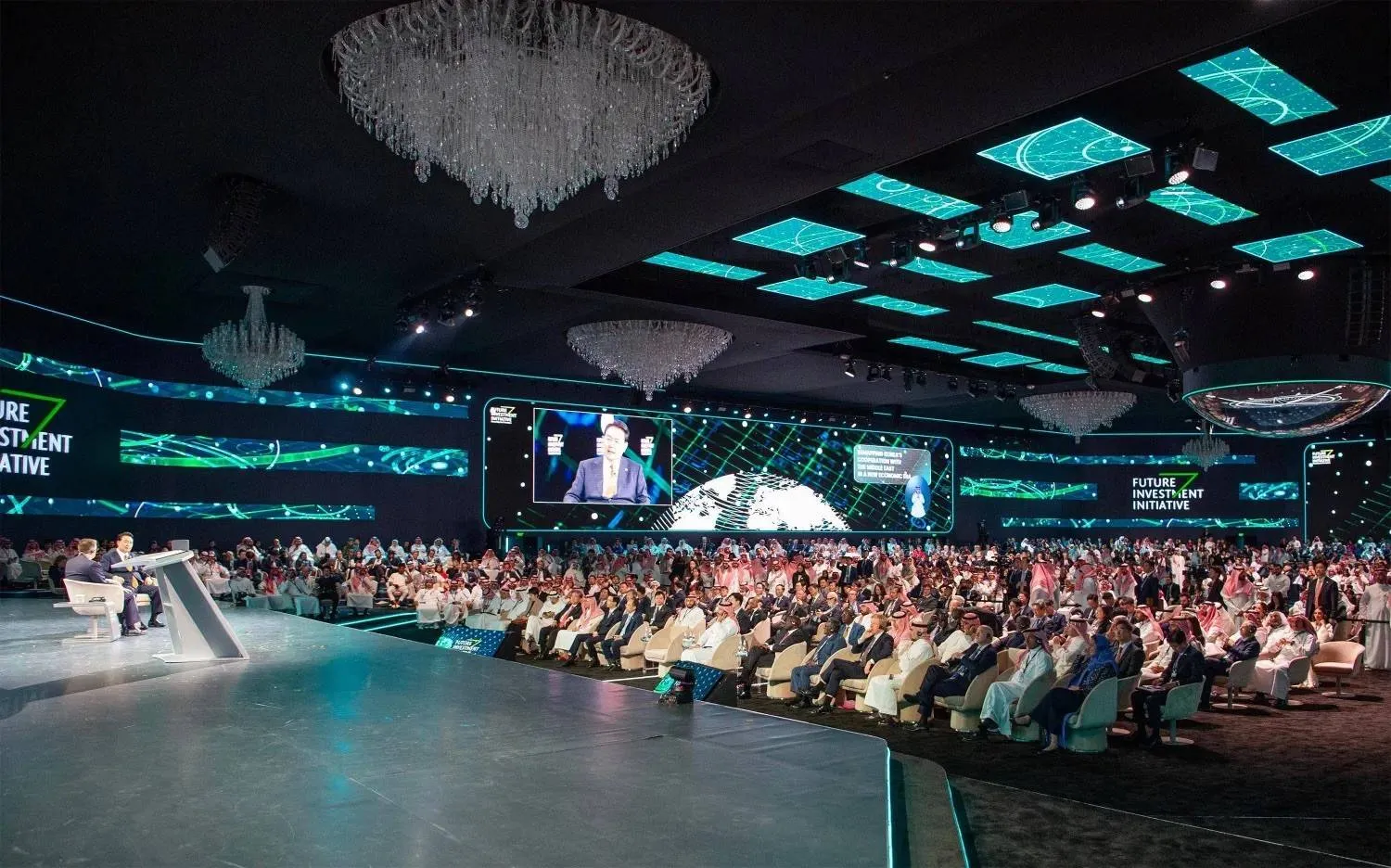
A view of the audience during one of the sessions at the eighth edition of the Future Investment Initiative conference (Asharq Al-Awsat). 
TT

Future Investment Initiative: From ‘Davos in the Desert’ to a Platform for Untangling Global Crises

A view of the audience during one of the sessions at the eighth edition of the Future Investment Initiative conference (Asharq Al-Awsat). 

The annual Future Investment Initiative (FII) is evolving from an investment forum into a powerful geoeconomic and diplomatic platform. In the midst of unprecedented geopolitical and economic transformations, Riyadh is consolidating its status as an indispensable global hub, a place where future-shaping decisions are made and urgent diplomatic solutions take form.

As the Saudi capital hosts the ninth edition of the FII - bringing together some of the world’s most influential figures in finance and technology to chart a roadmap for sustainable growth and artificial intelligence - it is simultaneously witnessing an intense wave of diplomatic activity, including high-level coordination meetings on the two-state solution.

Riyadh is positioning itself as a bridge between global capital, development imperatives, and the requirements of regional stability and peace.

The ninth edition of the forum opened with closed sessions on Monday, with the official launch scheduled for Tuesday under the theme “The New Compass: Unlocking New Frontiers for Growth.” More than 8,000 participants and 650 prominent speakers are taking part in 250 discussions.

What began years ago as an investment gathering with a local lens - dubbed “Davos in the Desert” - has now matured into a global geoeconomic platform designed to navigate and address complex crises.

This transformation comes at a critical time for the world economy. Trade tensions, including US tariffs, and geopolitical instability in Europe and the Middle East have created high levels of uncertainty. Global growth faces mounting risks.

By contrast, Saudi Arabia has charted a different course, demonstrating strong resilience against external shocks and an ability to adapt quickly to changing conditions. This strength is supported by the steady expansion of its non-oil sectors, a cornerstone of its economic diversification strategy, making the Kingdom a reliable anchor for global capital in an increasingly fragmented world.

The initiative also functions as a bridge for global capital and a key platform for investors interested in the Middle East. Globally, discussions on artificial intelligence, sustainable energy, and innovation are already shaping capital flows and influencing the valuations of major companies.

For Saudi Exchange (Tadawul), the event acts as a significant catalyst. Direct engagement between the Public Investment Fund (PIF) and global investment banks enhances awareness of the Saudi market’s depth and liquidity, aligning with the Kingdom’s goal of increasing its weight in global indices and paving the way for large upcoming IPOs.

This year, the forum carries unprecedented geopolitical weight. It takes place at a moment when regional focus is shifting from conflict to reconstruction and development. High-level diplomatic attendance, coordination meetings on the two-state solution, and discussions addressing global conflicts all underscore Riyadh’s emerging role as a mediator capable of linking political stability with economic investment.

One of the forum’s headline sessions explores three key themes: progress, innovation, and fragmentation. It addresses questions of market efficiency, the environmental cost of economic expansion, the responsible use of AI, technological entrepreneurship, climate resilience, and how to secure global supply chains in a world defined by economic competition and digital transformation.

Yasir Al-Rumayyan, Governor of the PIF and Chairman of the Future Investment Initiative Institute, will officially open the forum, presenting the fourth edition of the “Priority Compass.” This extensive survey draws on the views of tens of thousands of participants from 32 countries, representing 66 percent of the world’s population. Its aim is to guide decision-makers toward citizen-centered solutions.

The final day of the event, known as Investment Day, will be devoted to signing deals, presenting high-growth projects and emerging technologies, and fostering connections between founders and global investors. Asset managers overseeing more than $100 trillion in assets are expected to participate.

Among the prominent speakers are Laurence D. Fink of BlackRock, Jamie Dimon of JPMorgan Chase, David Solomon of Goldman Sachs, Bruce Flatt of Brookfield Asset Management, Bill Winters of Standard Chartered, Jane Fraser of Citigroup, Jenny Johnson of Franklin Templeton Investments, Ray Dalio of Bridgewater Associates, Stephen A. Schwarzman of Blackstone, Cathie Wood of ARK Invest, and Alex Clavel of SoftBank Vision Fund. Also attending are CEOs from Barclays, Nasdaq, Temasek Holdings, and China Investment Corporation.

Behind closed doors, Monday’s sessions delved into cutting-edge technological and economic shifts, from quantum computing breakthroughs to digital currencies and carbon accounting. One session, “Can We Win the Quantum Computing Race and Turn It into Profit?”, examined rapid developments in quantum hardware and software and noted that governments worldwide have committed more than $40 billion to research and development in this field.

Another session, supported by Saudi Aramco, reviewed new methods to measure product-level carbon emissions, aiming to bring greater transparency to corporate climate performance. A third session explored how digital currency infrastructure could redefine global finance, with discussions on stablecoins, central bank digital currencies, and the role of major institutions such as Bank of America, PayPal, and Stripe in driving cross-border payment solutions.


Saudi Industry Ministry Signs MoUs to Advance Manufacturing Empowerment

The agreements were signed during the "Industrial Transformation Saudi Arabia 2025” Exhibition. SPA
TT

Saudi Industry Ministry Signs MoUs to Advance Manufacturing Empowerment

The agreements were signed during the "Industrial Transformation Saudi Arabia 2025” Exhibition. SPA

The Ministry of Industry and Mineral Resources has signed a number of memoranda of understanding (MoUs) with leading local and international companies to advance advanced manufacturing, support local content, and strengthen national supply chains, enhancing the regional and global competitiveness of Saudi industry.

The agreements were signed during the "Industrial Transformation Saudi Arabia 2025” Exhibition, organized by the ministry in partnership with Deutsche Messe and Riyadh Exhibitions Company Ltd.

The ministry signed two memoranda to provide innovative financing solutions for industrial establishments, strengthen national supply chains, and support local content.

Additionally, the ministry's National Center for Advanced Manufacturing and Production signed several memoranda of understanding with local and international industrial and advisory companies to support the path of advanced manufacturing, develop supply chains, enhance technological innovation, and boost the competitiveness of national factories, in line with the National Industrial Strategy and Saudi Vision 2030.

These strategic partnerships are part of the ministry's ongoing efforts to develop the Kingdom's industrial ecosystem, enable manufacturers to access the latest industrial solutions, support supply chain development, and stimulate innovation, contributing to the building of a sustainable industrial sector that competes regionally and globally.


China Says Working on Streamlining Rare Earth Export Licenses

FILE PHOTO: Workers transport soil containing rare earth elements for export at a port in Lianyungang, Jiangsu province, China October 31, 2010. REUTERS/Stringer/File Photo
TT

China Says Working on Streamlining Rare Earth Export Licenses

FILE PHOTO: Workers transport soil containing rare earth elements for export at a port in Lianyungang, Jiangsu province, China October 31, 2010. REUTERS/Stringer/File Photo

China said on Thursday it is working on streamlining rare earth export licenses - a key promised outcome after a meeting between US President Donald Trump and his counterpart Xi Jinping.

"The government is actively adapting," Commerce Ministry spokesman He Yadong told reporters at a weekly briefing, adding that authorities "were aligning themselves with general license mechanisms".

Reuters reported on Tuesday that at least three Chinese rare earth magnet makers had secured licenses enabling them to accelerate exports to some customers.

He did not say if new licenses had been issued.

China began designing the new rare earth licensing regime following a late October meeting between Trump and Xi that eased trade tensions between the two countries.


Saudi Aramco's Jafurah Gas Plant Begins Output with 450 Million Cubic Feet Per Day

The resources at Jafurah are now estimated at 229 trillion standard cu ft of gas and 75 billion barrels of condensates. (Saudi Aramco)
TT

Saudi Aramco's Jafurah Gas Plant Begins Output with 450 Million Cubic Feet Per Day

The resources at Jafurah are now estimated at 229 trillion standard cu ft of gas and 75 billion barrels of condensates. (Saudi Aramco)

The first phase of oil giant Aramco's Jafurah gas plant is complete and production has begun with a capacity of 450 million cubic feet per day, the Saudi finance ministry said on Tuesday.

The finance ministry, in its 2026 budget statement, listed the milestone as an achievement reached in 2025.

Jafurah's gas output will be used for domestic power generation, freeing up crude for export that is currently used for power in the kingdom.

Aramco has said its unconventional gas program at peak production is expected to generate electricity equivalent to displacing 500,000 barrels per day of oil.

The $100 billion Jafurah project, estimated to contain 229 trillion standard cubic feet of raw gas, is central to Aramco's ambitions to become a major global player in natural gas and boost its gas production capacity.

Aramco's gas production was 12.6 billion cubic feet per day at the end of September, up from 12 bcfd a year earlier.

Aramco last month said it was boosting its gas growth target to 80% above 2021 levels from a previous targeted growth of 60%.

In its 2021 annual report, Aramco said it reached a single-day record gas output at the time of 10.8 bcfd.

Aramco CEO Amin Nasser, who has called Jafurah a crown jewel in the company's portfolio, said during an earnings call last month the first phase was on track for completion by the end of this year.