

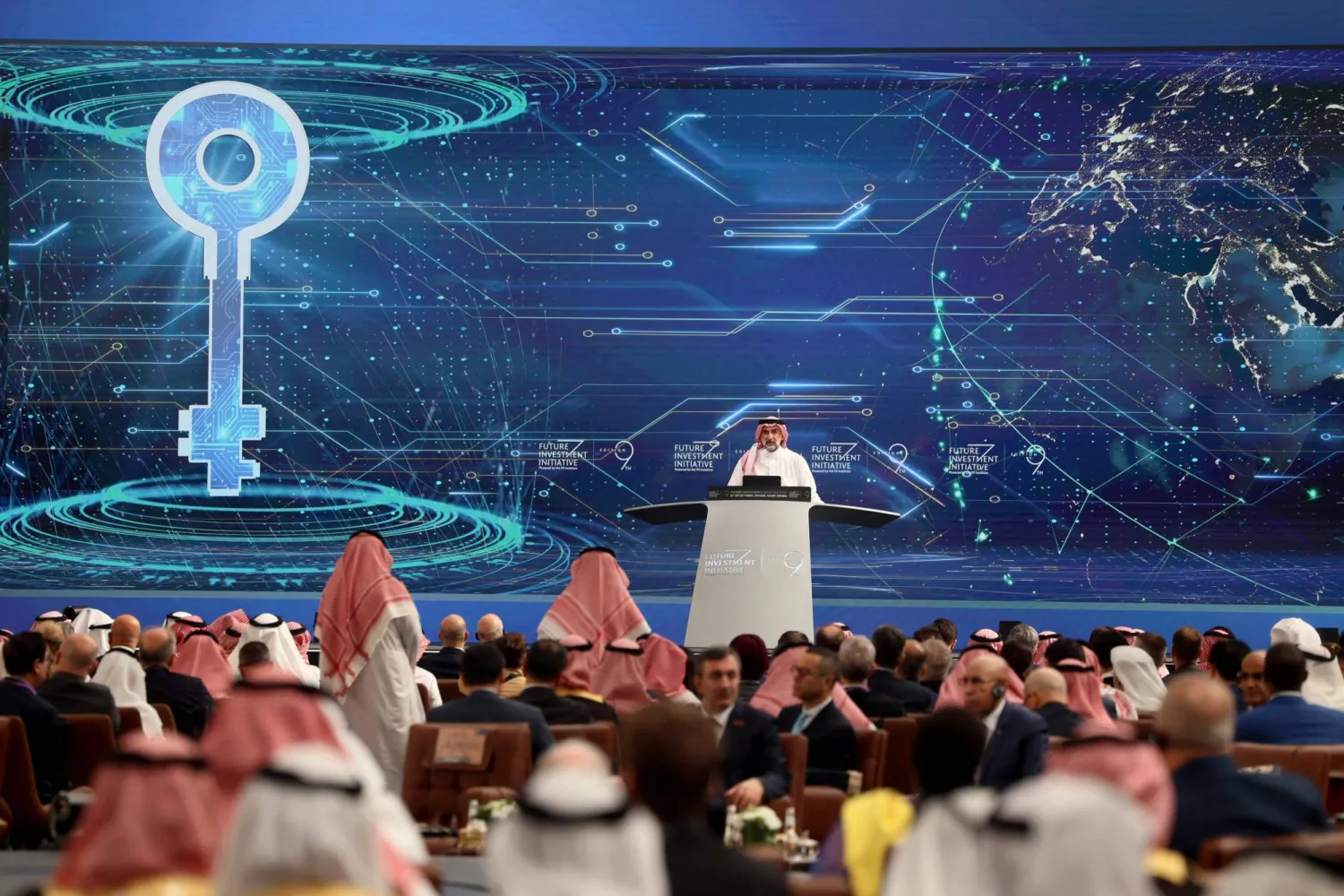

Rumayyan: $250 Billion Worth of Deals Sealed by the FII over Nine Years

Yasir Al-Rumayyan, head of the Public Investment Fund, Saudi Arabia's influential sovereign wealth fund, addresses the opening ceremony of the Future Investment Initiative, in Riyadh on October 28, 2025. (Photo by Fayez Nureldine / AFP)
TT

Rumayyan: $250 Billion Worth of Deals Sealed by the FII over Nine Years

Yasir Al-Rumayyan, head of the Public Investment Fund, Saudi Arabia's influential sovereign wealth fund, addresses the opening ceremony of the Future Investment Initiative, in Riyadh on October 28, 2025. (Photo by Fayez Nureldine / AFP)

The sessions of the ninth edition of the Future Investment Initiative (FII9) conference officially commenced on Tuesday at the King Abdulaziz International Convention Center in Riyadh.

Held under the theme "The Key to Prosperity," the event drew an elite audience, including heads of state, ministers, officials from sovereign wealth funds, senior executives, and pioneers from various fields, the Saudi Press Agency reported Tuesday.

Governor of the Public Investment Fund, Chairman of Saudi Aramco Board, and Chairman of the Board of Trustees of the FII Institute Yasir Al-Rumayyan delivered the opening remarks.

He welcomed attendees, hailing the conference as the world's preeminent gathering for those with the vision to translate ideas and investments into tangible global impact. "Deals worth more than $250 billion have been concluded through this platform since the conference's inception less than a decade ago," he stated. "Together, we have come a long way, but this year we must take our impact to even greater heights."

He stressed the gravity of the moment, noting that the collective power of capital represented by the decision-makers present "imposes a great responsibility on us, and at the same time, gives us a greater opportunity to shape the future of the global economy. We must assume this responsibility and seize this opportunity without delay."

Acknowledging the rapid changes since the last meeting, he pointed out that investors and companies now face a new economic reality and swift technological transformations. The old models that propelled us to this stage, he argued, can no longer keep pace.

"Governments cannot correct the course alone, and the private sector cannot bear the burden alone," he said. "The solution lies in the combined efforts of governments and the private sector as true partners. We need a new model and global cooperation that keeps pace with a new era of shared prosperity."

Al-Rumayyan emphasized that FII is the ideal platform to unite world leaders, investors, and decision-makers from diverse sectors. He cited that the global GDP has surpassed $111 trillion and is expected to grow by $2.8% this year. However, he highlighted a critical disconnect revealed in this year’s FII annual priorities report.

While 66% of people feel positive about their lives, only 37% are optimistic about the world's future, and 69% worry about job loss due to foreign competition. "This gap between individual hope and collective doubt represents a warning," he cautioned.

He proposed that technology could help bridge this divide, provided it is accessible to all. Yet, he noted, three out of four people fear that artificial intelligence will widen the educational gap between societies with educational opportunities and those without.

"We cannot allow this to happen. We must confront the inequalities that have hindered progress," he asserted, noting that in 2025, nearly 10% of the world's population—approximately 808 million people—will live in extreme poverty. "With every challenge comes an opportunity to find solutions that serve all of humanity," he concluded.

The governor underscored the essential partnership between governments and the private sector to harness global capital for security, stability, opportunity creation, and fostering optimism. He called for governments to intensify their efforts, advocating for open, unrestricted markets and smart, rather than excessive, regulation.

Al-Rumayyan praised the Kingdom's economic overhaul: “Under the leadership of His Royal Highness Prince Mohammed bin Salman bin Abdulaziz Al Saud, Crown Prince and Prime Minister, the Kingdom has set a new global standard for economic transformation through Vision 2030, which has opened up broad horizons for future generations."

"Nine years have passed since the launch of the Vision, and the results are evident everywhere: new cities, new industries, integrated ecosystems, and innovative supply chains," he said, revealing that foreign investment grew by 24% last year alone, reaching $31.7 billion. "We have introduced the Kingdom to the world, and now the world is coming to the Kingdom," he stated, pointing to FII, Expo 2030, and the 2034 FIFA World Cup.

He affirmed that wealth in the Kingdom "is not measured by numbers, but by human prosperity." This week in Riyadh provides opportunities to forge cross-border partnerships that make a real impact and embody the true power of global cooperation. The FII, he concluded, will continue its pioneering role, with this edition set to close with a declaration that unites world leaders in a common pursuit of progress for everyone.

Future Investment Initiative (FII) Institute Acting CEO and Executive Committee Chairman Richard Attias also delivered a welcome speech, expressing pride in the institute's success in building a passionate community aspiring to change the world.

He recalled the initiative's founding vision: to bring together global decision-makers not to compete but to collaborate, and not just to talk about the future but to shape it.

This year's edition has reached a historic 9,000 delegates, including 2,000 members and media groups from around the world.

Attias emphasized that today’s event represents a "historic milestone and a launch for the main theme, 'The Key to Prosperity,' which is shaping the world." He highlighted the initiative's greater inclusiveness this year, with ideas that advance bold movement in health, artificial intelligence, and human development.

The FII, he stated, "belongs to everyone. It is a force that comes from collective action and succeeds if all of us, members of this movement and its ideas, participate in creating transformation." He pointed to the unveiling of new financing paths in the coming days, noting, "Creativity and courage, this is what the initiative represents."


Oil Prices Extend Gains on Concerns of Potential US-Iran Conflict

FILE PHOTO: The Phillips 66 Lake Charles Refinery is pictured in West Lake, Louisiana, US, June 12, 2018. REUTERS/Jonathan Bachman/File Photo
TT

Oil Prices Extend Gains on Concerns of Potential US-Iran Conflict

FILE PHOTO: The Phillips 66 Lake Charles Refinery is pictured in West Lake, Louisiana, US, June 12, 2018. REUTERS/Jonathan Bachman/File Photo

Oil prices rose on Thursday as the US and Iran attempted to ease a standoff in talks over Tehran's nuclear program while both sides heightened military activity in the key oil-producing region.

Brent futures climbed 23 cents, or 0.3% to $70.58 a barrel by 0735 GMT, while US West Texas Intermediate (WTI) crude gained 25 cents, or 0.4%, to trade at $65.44 a barrel.

Both benchmarks settled more than 4% higher on Wednesday, posting their highest settlements since January 30, as traders priced in the risk of supply disruptions in the event of ‌a conflict.

"Oil prices are ‌rallying as the market becomes increasingly concerned over the potential ‌for ⁠imminent US action ⁠against Iran," said ING analysts in a Thursday note.

Iranian state media reported the country had shut down the Strait of Hormuz for a few hours on Tuesday, without making clear whether the waterway had fully reopened. About 20% ⁠of the world's oil supply passes through the waterway.

"Tensions between Washington ‌and Tehran remain high, but the prevailing view ‌is that full-scale armed conflict is unlikely, prompting a wait-and-see approach," said Hiroyuki Kikukawa, chief strategist of ‌Nissan Securities Investment, a unit of Nissan Securities.

"US President Donald Trump does not ‌want a sharp rise in crude prices, and even if military action occurs, it would likely be limited to short-term air strikes," Kikukawa added.

A degree of progress was made during Iran talks in Geneva this week but distance remained on some issues, the White House said on Wednesday, ‌adding that it expected Tehran to come back with more details in a couple of weeks.

Iran issued a notice to ⁠airmen (NOTAM) that ⁠it plans rocket launches in areas across its south on Thursday from 0330 GMT to 1330 GMT, according to the US Federal Aviation Administration website.

At the same time, the US has deployed warships near Iran, with US Vice President JD Vance saying Washington was weighing whether to continue diplomatic engagement with Tehran or pursue "another option".

Meanwhile, two days of peace talks in Geneva between Ukraine and Russia ended on Wednesday without a breakthrough, with Ukrainian President Volodymyr Zelenskiy accusing Moscow of stalling US-mediated efforts to end the four-year-old war.

US crude and gasoline and distillate inventories fell last week, market sources said, citing American Petroleum Institute figures on Wednesday, contrary to expectations in a Reuters poll that crude stocks would rise by 2.1 million barrels in the week to February 13.

Official US oil inventory reports from the Energy Information Administration are due on Thursday.


Madinah Sees Tourism Surge Ahead of Ramadan, Spending Tops $13.9 Billion

A cluster of buildings and hotels surrounding the Prophet’s Mosque (SPA). 
TT

Madinah Sees Tourism Surge Ahead of Ramadan, Spending Tops $13.9 Billion

A cluster of buildings and hotels surrounding the Prophet’s Mosque (SPA). 

Saudi Arabia’s Minister of Tourism, Ahmed Al-Khateeb, has toured hospitality facilities and visitor services in Madinah as part of the “Spirit of Ramadan” inspection tour, which also included Jeddah and Makkah.

New data show visitor numbers exceeded 21 million over the past year, a 12 percent increase from 2024, while total tourism spending reached SAR 52 billion (about $13.9 billion), up 22 percent.

The visit focused on assessing the sector’s readiness for the Ramadan season, evaluating service quality, and supporting ongoing and upcoming tourism projects.

Madinah posted strong tourism performance in 2025, driven by higher visitor inflows and expanded hospitality capacity, reinforcing its position as a leading religious destination within Saudi Arabia’s tourism landscape.

Demand growth has been matched by a sharp rise in supply. Licensed hospitality facilities increased to 610, up 35 percent, while the number of licensed rooms surpassed 76,000, a 24 percent gain, strengthening the city’s ability to accommodate during peak seasons such as Ramadan and Hajj.

Travel and tourism offices also grew to more than 240, reflecting a 29 percent expansion in supporting services.

Al-Khateeb said the entry of international hospitality brands and new projects over the past five years underscores both sectoral growth and rising investor confidence in the Kingdom’s tourism ecosystem.

“The landscape today is different. The sector is growing steadily, supported by a system that empowers investors and facilitates their journey, with a promising future ahead,” he said.

To expand hotel capacity, the minister inaugurated the Radisson Hotel Madinah, a project worth more than SAR 39 million (around $10 million) and financed by the Tourism Development Fund.

The 2025 performance signals a shift from traditional seasonal growth toward more sustainable expansion built on diversified offerings, improved service quality, and a stronger contribution to the local economy.


Airbus Planning Record Commercial Aircraft Deliveries in 2026

An Airbus A350-1000 at the Singapore Airshow on February 4. The company said Thursday it aims to deliver a record number of aircraft this year. Roslan RAHMAN / AFP/File
TT

Airbus Planning Record Commercial Aircraft Deliveries in 2026

An Airbus A350-1000 at the Singapore Airshow on February 4. The company said Thursday it aims to deliver a record number of aircraft this year. Roslan RAHMAN / AFP/File

Plane maker Airbus aims to deliver a record number of commercial aircraft this year, the company said Thursday, capitalizing on "strong demand" and a jump in profit in 2025.

"2025 was a landmark year, characterized by very strong demand for our products and services across all businesses," CEO Guillaume Faury said in a press release announcing annual results.

The European manufacturer said it received 1,000 orders for commercial planes in 2025, with net orders of 889 after taking cancellations into account, and 793 delivered.

Last year, its overall profit jumped 23 percent to 5.2 billion euros ($6.1 billion).

The company said it is targeting "around 870 commercial aircraft deliveries" this year.

"As the basis for its 2026 guidance, the Company assumes no additional disruptions to global trade or the world economy, air traffic, the supply chain, its internal operations, and its ability to deliver products and services," it said in its outlook.

Both Airbus and its rival Boeing have struggled to return to pre-pandemic production levels after their entire network of suppliers was disrupted, even as airlines are eager to modernize their fleets with more fuel-efficient aircraft and expand to meet an expected increase in passenger numbers over the coming decades.
