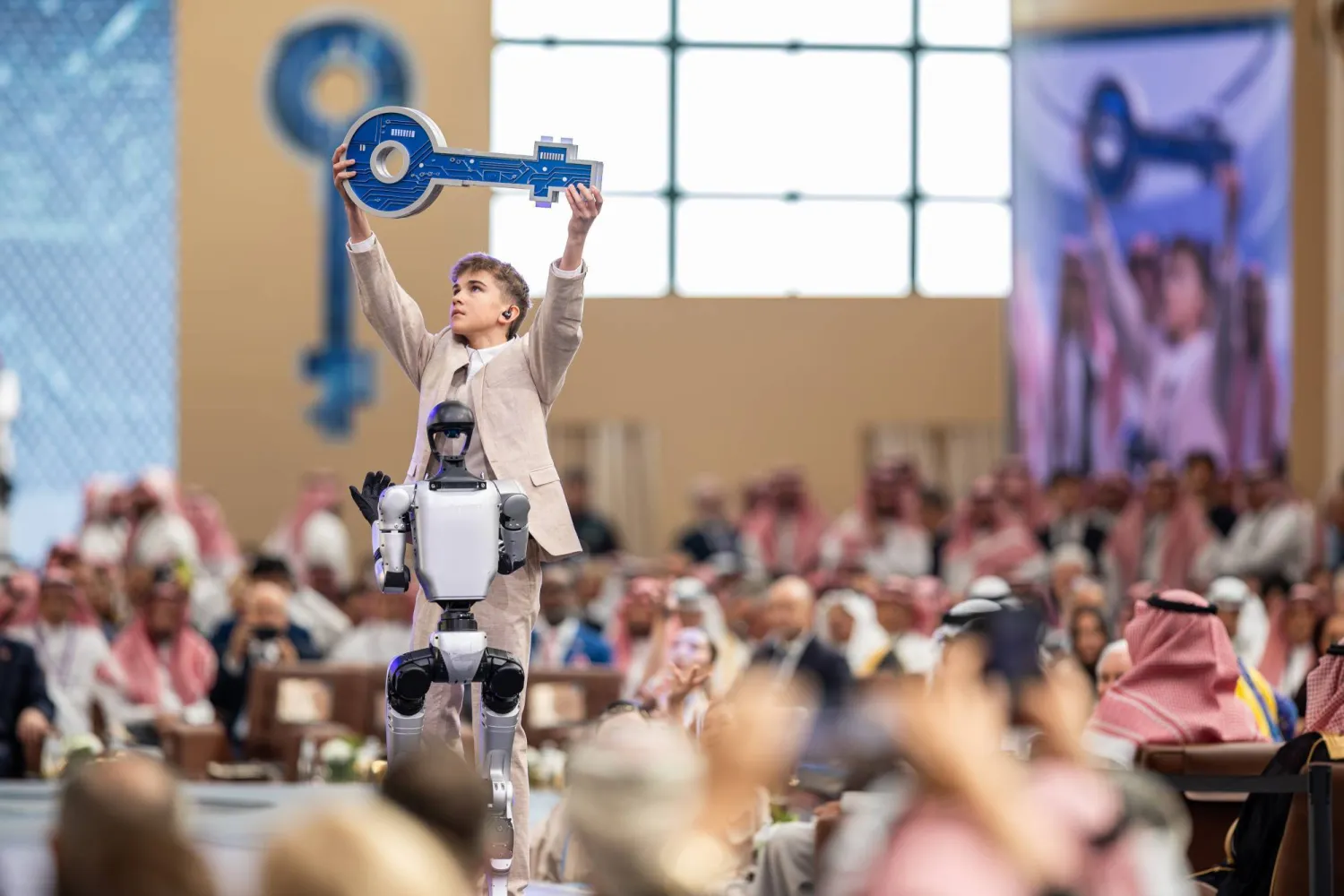

A humanoid robot carrying “The Key to Prosperity,” matching this year’s Future Investment Initiative (FII) theme, stole the spotlight as the ninth edition of the global investment forum opened in Riyadh, symbolizing the unlocking of global economic potential through innovation and bold ideas.
Held under the patronage of Custodian of the Two Holy Mosques, King Salman bin Abdulaziz, the three-day event began on Tuesday at the King Abdulaziz International Conference Center, drawing heads of state, ministers, sovereign wealth fund chiefs, senior executives, and global industry leaders.
The opening ceremony featured a symbolic moment as the robot handed the “Key to Prosperity” to the event’s artist, marking the start of panel discussions that brought together some of the world’s most influential decision-makers.
This year’s agenda aims to drive global collaboration and shape the future of the world economy with a focus on health, artificial intelligence, and human development.
Panels covered a broad range of pressing issues, including the impact of AI and robotics on productivity, wealth creation amid rising inequality, the geoeconomic consequences of resource scarcity, demographic shifts reshaping future workforces, and strategies to balance economic growth with environmental sustainability.
Yasir Al-Rumayyan urges elevating global impact
In his opening remarks, Yasir Al-Rumayyan, Governor of the Public Investment Fund (PIF), Chairman of Saudi Aramco, and Chairman of the FII Institute, described the forum as the world’s most influential gathering for those who can turn ideas and investments into tangible global impact.
“It's incredible to see all of these visionary leaders who have truly changed the world in the same room. For those with the vision to turn ideas and investments into global impact, this is the greatest gathering in the world,” said Al-Rumayyan.
“$250 billion worth of deals have been made on this platform since it was born less than a decade ago,” he revealed.
“We have come a long way together, but at this year's FII, we must take our impact to the next level,” urged Al-Rumayyan.
He stressed that the financial power represented by today’s leaders comes with great responsibility and an even greater opportunity to shape the world’s economic future.
“We must act on this responsibility and seize this opportunity without any delay,” he added.
“The old models that brought us to this point are no longer fit for purpose,” he noted, saying that “We need a new model. We need a global collaboration for a new era of global prosperity.”
Highlighting global economic growth, Al-Rumayyan noted that the world’s GDP has surpassed $111 trillion and is expected to expand by 2.8% this year. Yet, he warned of growing social disparities: “66% of people feel positive about their lives. Yet only 37% are optimistic about the world and 69% are concerned their country will lose jobs to foreign competition. This gap between personal hope and global doubt is a warning.”
Technology, he said, could bridge that divide — if it remains accessible.
“Three and four people worry that AI will widen the education gap between societies who have access and those that don't. We can't allow that to happen. We must address inequalities that have held us back for too long,” said Al-Rumayyan.
Vision 2030 and expanding opportunities
Al-Rumayyan said governments and the private sector must work together to harness global capital for security, stability, and opportunity.
“Under the leadership Prince Mohammed bin Salma, Crown Prince and Prime Minister, Saudi Arabia's economic transformation has set a new global benchmark for a national vision,” he said.
“Nine years since the launch of vision 2030, you can see the results everywhere. New cities, new industries, new ecosystems and supply chains. And last year, foreign investment grew 24% reaching 31.7 billion dollars.”
“We have taken Saudi Arabia to the world and now the world is coming to Saudi Arabia, to FII every year, to Expo in 2030, and to the FIFA World Cup in 2034.”
He emphasized that Saudi wealth is measured not in numbers, but in human prosperity.
“In Riyadh, this week we have the opportunity to forge deals across borders that deliver impact and capture the true power of partnerships,” he remarked.
Richard Attias, CEO of the FII Institute and Chairman of its Executive Committee, welcomed global leaders and delegates, expressing pride in how FII has evolved into a passionate community determined to change the world.
Foreign investment and economic transformation
Saudi Investment Minister Khalid Al-Falih said in a panel session that 90% of foreign direct investment (FDI) flowing into the Kingdom now targets non-oil sectors, while only 10% goes to oil-related industries.
According to Al-Falih, the Saudi economy is in a phase of dynamic expansion, driven by emerging sectors such as advanced manufacturing, technology, tourism, entrepreneurship, and deep tech — where investments have grown tenfold.
Al-Falih added that Saudi Arabia’s GDP has doubled over the past decade, mostly fueled by non-oil growth.
As per the minister, the Kingdom is entering a new phase of economic diversification, with $1 billion deployed into startups and 60% of Middle East venture funding now originating in Saudi Arabia.
He added that 40% of the Kingdom’s budget and expenditures are now financed by non-oil revenues, underscoring the strong macroeconomic and fiscal balance achieved.