

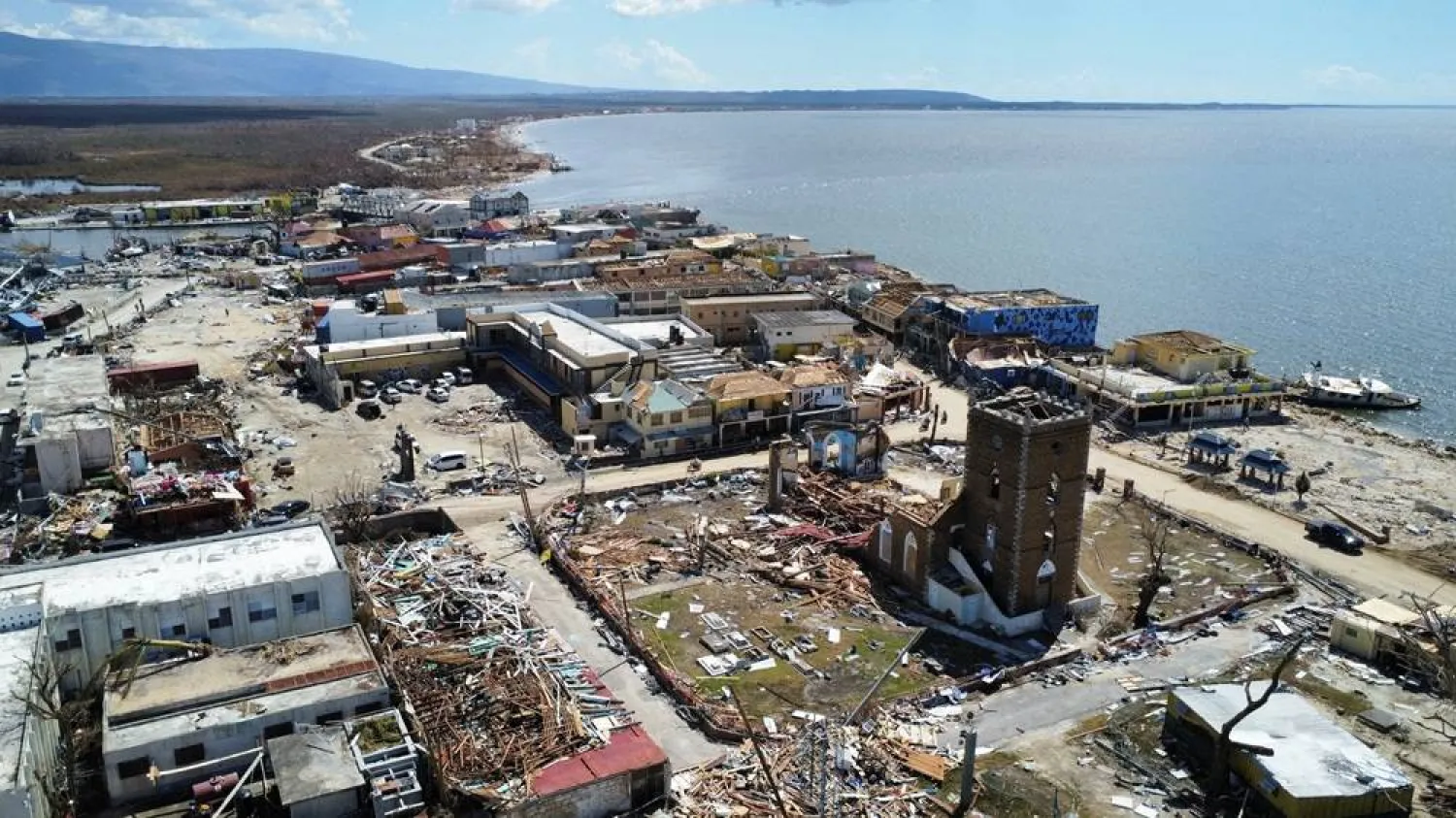

Jamaica Rushes to Prepare for Peak Tourism Season as It Digs Out from Hurricane Melissa

Drone view of a destroyed church and damaged buildings, in the aftermath of Hurricane Melissa, in Black River, Jamaica, November 2, 2025. (Reuters)
TT

Jamaica Rushes to Prepare for Peak Tourism Season as It Digs Out from Hurricane Melissa

Drone view of a destroyed church and damaged buildings, in the aftermath of Hurricane Melissa, in Black River, Jamaica, November 2, 2025. (Reuters)

Jamaica’s peak tourism season is one month away, and officials in the hurricane-ravaged nation are rushing to rebuild from the catastrophic Category 5 storm that shredded the island’s western region.

Before Hurricane Melissa hit on Oct. 28, the government expected Jamaica’s tourism industry to grow by 7% this winter season and was preparing to welcome an estimated 4.3 million visitors.

Now, officials are scrambling to repair hotels and clear debris in the western half of the island in hopes of securing tourist dollars at a moment when they’re needed the most.

“We are still doing our assessments, but most of the damage was in the northwest and southwest,” said Christopher Jarrett, who leads the Jamaica Hotel and Tourist Association.

He noted that the popular Negril area in Westmoreland was spared major damage.

All international airports in Jamaica have reopened and are receiving commercial flights. But almost a week after one of the most powerful Atlantic hurricanes on record struck the western end of Jamaica, tourism officials were still trying to get a true picture of the damage to the sector — a mainstay of the island’s economy.

Jarrett said the lobby group that represents private hotels and attractions on the island is still unable to reach many of its members, especially in the western parish of Hanover, as communication and electricity services were down.

“Every individual member who was affected is doing everything to get back up and running,” he said.

In recent days, Tourism Minister Edmund Bartlett said he expected Jamaica’s tourism sector to be back to normal by Dec. 15, the start of the island’s peak tourism season.

“It’s doable for some and not for others,” Jarrett said of the timeline, pointing out that the larger hotel chains would be able to recover faster.

Jarrett, who operates the family-owned Altamont Court Hotel that has properties in Kingston and Montego Bay, said only one property in Montego Bay sustained roof damage and that repairs were underway.

Despite the disruption to the important tourism sector, Jarrett said he doesn’t expect the economic fallout to be significant. He said many hotels in the capital of Kingston and in the northern coastal town of Ocho Rios were gaining business from the influx of aid workers and volunteers in the hurricane’s aftermath.

“Right now, we’re giving discounts, between 25% and 50%, and some (hotels) are giving complimentary stays as well,” Jarrett said.

Tourism is Jamaica’s main source of foreign exchange earnings, contributing a combined 30% to GDP directly and indirectly. It employs an estimated 175,000 people and is a major economic driver for other sectors in the Jamaican economy, such as construction, banking and finance, utilities and agriculture.

The disruption to the tourism sector also is affecting many providers of goods and services.

“With some of the hotels closed and most of the tourists gone, many of us are left without work. This storm didn’t just destroy buildings; it shattered jobs and incomes for many of us and our families,” said Patricia Mighten, who works in the western parish of Hanover as a hotel housekeeper.

Desrine Smith, a craft vendor who plies her trade in the resort town of Falmouth in the northwestern parish of Trelawny, echoed those sentiments.

“Going days without tourists coming to buy anything means no sales and no money. We survive on daily earnings, and now everything is uncertain,” she said. “The hurricane has impacted our pockets hard.”




Survey: Swiss Companies Plan Investment Abroad to Offset US Tariffs

FILE PHOTO: Reinsurer Swiss Re's headquarters are seen on the banks of Lake Zurich in Zurich, Switzerland February 21, 2019.  REUTERS/Arnd WIegmann/File Photo
FILE PHOTO: Reinsurer Swiss Re's headquarters are seen on the banks of Lake Zurich in Zurich, Switzerland February 21, 2019. REUTERS/Arnd WIegmann/File Photo
TT

Survey: Swiss Companies Plan Investment Abroad to Offset US Tariffs

FILE PHOTO: Reinsurer Swiss Re's headquarters are seen on the banks of Lake Zurich in Zurich, Switzerland February 21, 2019.  REUTERS/Arnd WIegmann/File Photo
FILE PHOTO: Reinsurer Swiss Re's headquarters are seen on the banks of Lake Zurich in Zurich, Switzerland February 21, 2019. REUTERS/Arnd WIegmann/File Photo

Swiss companies plan to relocate some of their operations and production abroad to deal with the impact of US tariffs, according to a study by business association economiesuisse.

It surveyed more than 400 companies before and after Switzerland last month agreed a deal to reduce US tariffs from 39% to 15%, with a quarter of the firms already having identified concrete steps they were taking, Reuters reported.

Nearly a third of those firms have decided to increase investments outside Switzerland and shift production and operations abroad, the survey said.

Some 16% of companies said they were going to relocate operations to countries outside the European Union or the United States, in addition to 10% going to the US, and another 5% looking at the European Union.

Other options included looking more at other markets, raising prices and even halting exports to the US.

Rudolf Minsch, economiesuisse's chief economist, said the relocation and investment was not damaging for Switzerland, which remained an attractive business location, though he cautioned high-skilled jobs and R&D should be kept.

As part of its agreement, Bern has also pledged $200 billion in investments from its companies in the US, raising concerns about the potential long-term economic impact.

UBS has said if the pharmaceuticals industry - Switzerland's biggest export sector - relocates all US-bound production to that country - cumulative Swiss economic growth over five years would be reduced from a forecast 10% to 7.7%.

Minsch said Switzerland was too small to absorb the $200 billion, and had a long tradition of investing abroad.

Those investments also helped secure jobs at home, he said.


UN's FAO: World Food Prices Fall for 3rd Month in November

FILE PHOTO: Prices of food are displayed at the Borough Market in London, Britain May 22, 2024. REUTERS/Maja Smiejkowska/File Photo
TT

UN's FAO: World Food Prices Fall for 3rd Month in November

FILE PHOTO: Prices of food are displayed at the Borough Market in London, Britain May 22, 2024. REUTERS/Maja Smiejkowska/File Photo

World food commodity prices fell for a third consecutive month in November, with all major staple foods except cereals showing a decline, the United Nations' Food and Agriculture Organization said on Friday.

The FAO Food Price Index, which tracks a basket of globally traded food commodities, averaged 125.1 points in November, down from a revised 126.6 in October and the lowest since January, Reuters reported.

The November average was also 2.1% below the year-earlier level and 21.9% down from a peak in March 2022 following Russia's full-scale invasion of Ukraine, the FAO said.

The agency's sugar price reference fell 5.9% from October to its lowest since December 2020, pressured by ample global supply expectations, while the dairy price index dropped 3.1% in a fifth consecutive monthly decline, reflecting increased milk production and export supplies.

Vegetable oil prices fell 2.6% to a five-month low, as declines for most products including palm oil outweighed strength in soy oil.

Meat prices declined 0.8%, with pork and poultry leading the decrease, while beef quotations stabilized as the removal of US tariffs on beef imports tempered recent strength, the FAO said.

In contrast, the FAO's cereal price benchmark rose 1.8% month-on-month. Wheat prices increased due to potential demand from China and geopolitical tensions in the Black Sea region, while maize prices were supported by demand for Brazilian exports and reports of weather disruption to field work in South America.

In a separate cereal supply and demand report, the FAO raised its global cereal production forecast for 2025 to a record 3.003 billion metric tons, compared with 2.990 billion tons projected last month, mainly due to increased wheat output estimates.

Forecast world cereal stocks at the end of the 2025/26 season were also revised up to a record 925.5 million tons, reflecting expectations of expanded wheat stocks in China and India as well as higher coarse grain stocks in exporting countries, the FAO said.


World Bank Forecasts 4.3% Growth for Saudi Economy, Supported by Non-Oil Activities

The Saudi flag. Asharq Al-Awsat
TT

World Bank Forecasts 4.3% Growth for Saudi Economy, Supported by Non-Oil Activities

The Saudi flag. Asharq Al-Awsat

The World Bank affirmed on Thursday that Saudi Arabia's economy has gained significant momentum for 2026-2027, driven by robust non-oil sector expansion under Vision 2030.

In a report titled “The Gulf’s Digital Transformation: A Powerful Engine for Economic Diversification,” the World Bank said growth is expected to persist in the Kingdom with non-oil activities expanding by 4% on average.

The report lifted its forecast for Saudi Arabia’s real GDP growth to 3.8% in 2025 compared to a 3.2% last October.

The forecast represents a major upward revision affirming the resilience of the Saudi economy and its ability to absorb external volatility. It also indicates growing confidence in the effectiveness of ongoing structural reforms within Vision 2030.

On Tuesday, Saudi Arabia approved its state budget for 2026, projecting real GDP growth of 4.6% in 2026.

The report showed that in the Kingdom, economic momentum is strengthening across oil and non-oil sectors with non-oil activities expanding by 4% on average and oil activities expanding by 5.4%, bringing overall real growth to an average of 4.3%.

It said oil activities grew by 1.7% y/y in the first half of 2025, benefiting from the phase-out of OPEC+ voluntary production cuts starting in April 2025.

At the financial level, the fiscal deficit between 2025 and 2027 is projected to remain at an average of 3.8% of GDP.

Meanwhile, the current account balance slightly recovered, settling at 0.5% of GDP in the first quarter of 2025 against -2.6% in the second half of 2024.

The report said real GDP growth remained stable at 3.6% y/y in the first half of 2025, thanks to the stabilization of the oil sector and sustained non-oil growth.

Non-oil activities expanded by 4.8% over the period, in line with the performance of 2024 while non-oil growth was driven by the wholesale, retail trade, restaurants, and hotels sector (+7.5% y/y in the first half of 2025), consolidating the role of hospitality and tourism as engines of economic diversification.

The report also indicated that oil activities grew by 1.7% y/y in the first half of 2025, benefiting from the phase-out of OPEC+ voluntary production cuts starting in April 2025.

These trends are expected to persist in 2026-2027, with non-oil activities expanding by 4% on average and oil activities expanding by 5.4%, bringing overall real growth to an average of 4.3%.

Job Market and Inflation
The report said the labor market mirrors the stabilization of the real economy and is rapidly becoming more inclusive to women.

Overall unemployment decreased by 0.7 point between the first quarter of 2024 and the first quarter of 2025, with the female unemployment rate dropping from 11.8% to 8.1% over the same period.

Also, inflation remained low and stable in Saudi Arabia, settling at an average of 2.2% in the first half of 2025.

However, price increases have been concentrated in the housing and utilities sector as rental prices have become a key issue, largely because rental supply has failed to match demographic growth, especially in Riyadh.

While this reflects the government’s efforts to dynamize the Kingdom’s urban centers, the price increases prompted the government to freeze rental prices in Riyadh for the next five years, as anticipated increases in housing supply should help control rental prices.

Finally, the report said Saudi Arabia’s external position stabilized in the second half of 2024 and the first quarter of 2025.

Although net foreign direct investment has remained relatively stable, the World Bank has emphasized that recent changes in foreign ownership regulations in Saudi Arabia, coupled with continued structural reforms, are positive steps to attract greater flows of foreign direct investment (FDI).