

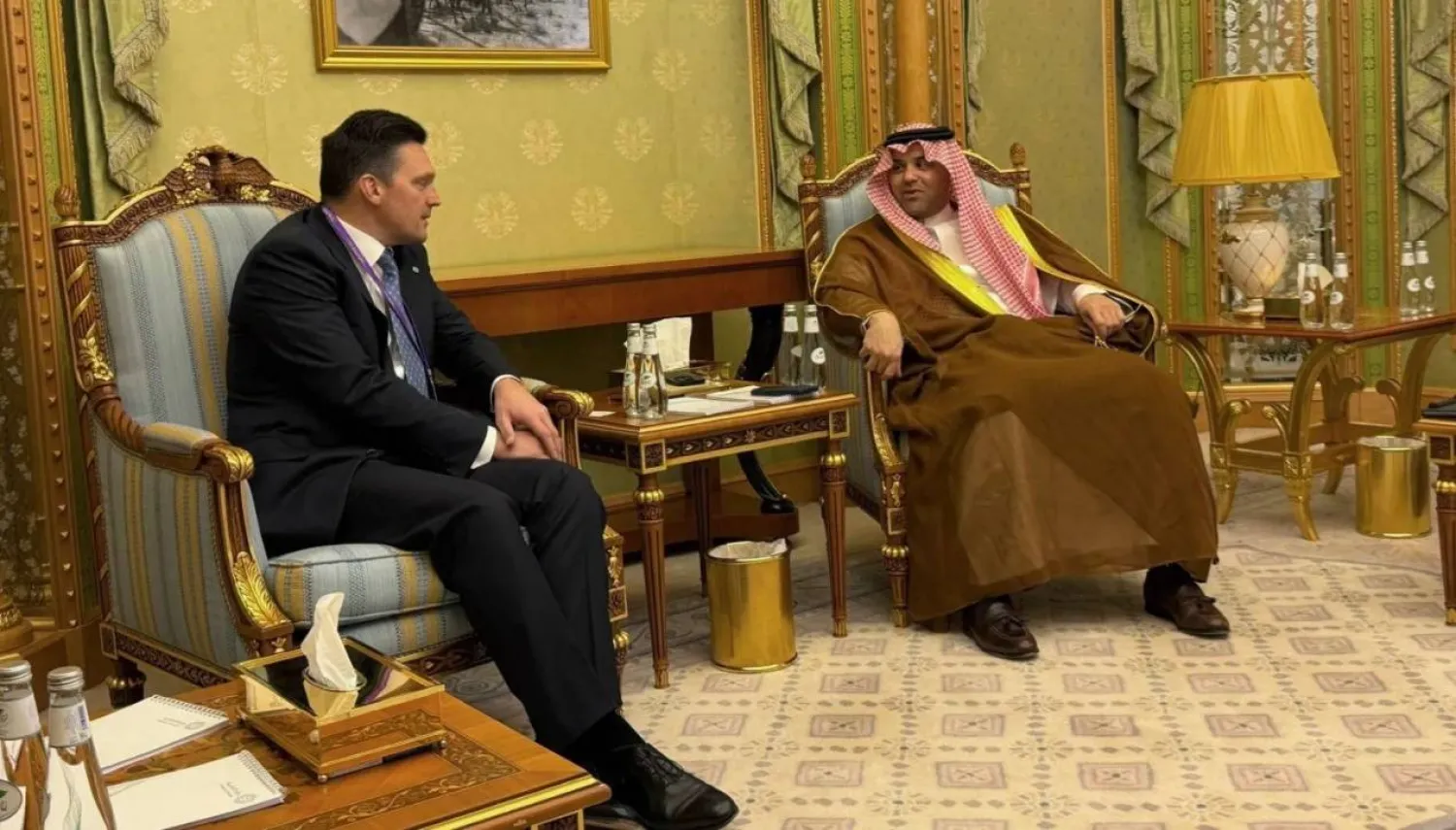

EDB Tells Asharq Al-Awsat it Aims to ‘Promote the Gulf-Eurasia Investment Corridor’

Nikolai Podguzov met with Saudi Deputy Minister of Finance for International Relations Khalid Bawazier on the sidelines of FII held in Riyadh. Photo: Podguzov’s LinkedIn account
TT

EDB Tells Asharq Al-Awsat it Aims to ‘Promote the Gulf-Eurasia Investment Corridor’

Nikolai Podguzov met with Saudi Deputy Minister of Finance for International Relations Khalid Bawazier on the sidelines of FII held in Riyadh. Photo: Podguzov’s LinkedIn account

Chairman of the Management Board of the Eurasian Development Bank (EDB) Nikolai Podguzov has said that the bank aims to build partnerships, deploy its structuring expertise, and promote the Gulf–Eurasia investment corridor.

In remarks to Asharq Al-Awsat, Podguzov said EDB is participating in the Future Investment Initiative (FII) in Riyadh as part of its strategic effort to deepen engagement with the Gulf region and explore cooperative investment and project financing opportunities beyond its traditional member states.

“At FII, the Bank aims to build partnerships, deploy its structuring expertise, and promote the Gulf–Eurasia investment corridor,” he said.

The Bank offers Gulf partners access to investment opportunities in green energy, transport infrastructure, logistics, and industry - sectors crucial for sustainable growth across Central Asia.

“We can offer our potential Gulf partners access to investment opportunities in Central Asia’s green energy, transport infrastructure, and logistics sectors. We are fully committed to championing Islamic finance across Central Asia and beyond. This aligns with our strategic goals for long-term regional development,” he said.

Cooperation opportunities with Saudi Arabia
Asked about the opportunities for financial and banking cooperation between the Eurasian Development Bank and Saudi banks, Podguzov said: “The Bank's extensive experience as an issuer of debt instruments (including ESG bonds) in local and international capital markets in various currencies creates the foundation for joint collaboration and partnership with Saudi Arabian financial institutions, including through the local financial market infrastructure, where the Saudi exchange Tadawul is a key participant. We also see potential for developing mutually beneficial cooperation with the Public Investment Fund (PIF), the Saudi Fund for Development, and national development banks, including Saudi Exim.”

“In addition, we identify significant potential for cooperation in the area of trade finance and export support programs. This includes the development of joint instruments such as letters of credit and guarantees to facilitate trade between the member countries of the Eurasian Development Bank and the Kingdom.”

Challenges
On the challenges facing banking and financial growth globally, Podguzov said: “There are quite a few of them. Elevated risks – lessons from the Global Financial Crisis are partially forgotten. Rising sovereign debt. Challenges related to the efficient implementation of digital solutions. Emergence of new alternative forms and sources of credit, which have yet to prove their resilience. Limited availability of longer-term and cheaper financing for developing countries and sustainable development.”

“Since I am a development banker, let me say a few things about the availability of financing for development. If we talk about private capital, what private capital wants is a good risk-return ratio. Development projects usually carry low margins. If margins will be higher, and risks lower, then private capital will be available. So the tasks are to better structure projects so that margins are sustained and risks are contained.”

Talking about development financial institutions, they are mission-driven banks, Podguzov told Asharq Al-Awsat.

“They are a right source of capital to fund the SDGs. But they face issues with their capital and efficiency of operations. For example, annual volumes of financing by multilateral development banks (MDBs) stay at $180 billion.”

“Over the past 25 years, the value of MDB assets relative to global GDP has actually fallen from 1.9% to 1.7%. That means that the MDB role in the global economy has in fact shrunk in real terms,” he added.

MDBs should invest more through better project expertise, more local knowledge and presence, and finally more capital, he stated.

Non-sovereign financing

The EDB is a leading institution in non-sovereign financing across Eurasia and Central Asia. It focuses on mobilizing external funds for large-scale private sector and public–private partnership (PPP) projects that drive sustainable economic growth and regional integration, Podguzov said.

“Our team has extensive experience in investing in transport infrastructure, industrial modernization projects aimed at improving environmental performance and efficiency, the construction of renewable energy facilities, and the development of energy initiatives. All projects are selected in line with international ESG principles, ensuring both financial returns and a positive social and environmental impact.”

Islamic financing
“We are also working to develop Islamic finance across Central Asia and aim to serve as a key regional platform for its growth. In late 2024, the EDB joined the Islamic Financial Services Board (IFSB) as an Associate Member and, in early 2025, became a member of the Accounting and Auditing Organization for Islamic Financial Institutions (AAOIFI). These memberships reinforce our commitment to high supervisory standards and global best practices,” he said.

As part of this initiative, the EDB is exploring the potential issuance of sukuk to finance strategic projects and expand sustainable financing tools.

“Our team is also undertaking economic studies that are relevant to Central Asia. Together with the Islamic Development Bank and the London Stock Exchange Group (LSEG), we recently published a study on Islamic finance in Central Asia. The region currently hosts 18 Islamic banks and 14 non-bank financial institutions, as well as takaful, ijara, and Islamic fintech operators.”

However, the Islamic capital market, particularly sukuk, is developing at a slower pace. According to the report, Islamic banking assets in the region are projected to grow to $2.5 billion by 2028 and $6.3 billion by 2033, while the sukuk market is expected to reach $2.05 billion by 2028 and $5.6 billion by 2033, led by Kazakhstan and Uzbekistan.

Direct investments
In October, the EDB releases its first macroeconomic study of the Gulf countries, analyzing the period 2020–2024. Over the past five years, mutual trade between Central Asia and the Gulf states has increased 4.2 times, reaching $3.3 billion, while accumulated direct investments have risen 1.8 times to $16.2 billion, Podguzov said.

The potential for additional trade between the regions is estimated at $4.9 billion, equivalent to 150% of the current level.

In a recent milestone, the EDB became the first development institution to issue dirham-denominated bonds in Kazakhstan, diversifying its investor base, creating a pricing benchmark for future issuers, and further strengthening financial ties between the Gulf Cooperation Council and Eurasia, he added.



Saudia to Launch Riyadh-Kozhikode Flights in February

Saudi Arabian Airlines plane, is seen at the airport of the Red Sea resort of Sharm el-Sheikh, Egypt, August 9, 2021. Picture taken through a window. REUTERS/Mohamed Abd El Ghany/File Photo
TT

Saudia to Launch Riyadh-Kozhikode Flights in February

Saudi Arabian Airlines plane, is seen at the airport of the Red Sea resort of Sharm el-Sheikh, Egypt, August 9, 2021. Picture taken through a window. REUTERS/Mohamed Abd El Ghany/File Photo

Saudia Airlines has added Kozhikode, India, to its network of scheduled international destinations, marking its seventh destination in the country alongside Bangalore, Mumbai, Kochi, Delhi, Hyderabad, and Lucknow, as part of the airline’s strategy to reach new international markets, connect the Kingdom to the world through its modern fleet, and strengthen its global competitive position, SPA reported.

Flights to Kozhikode will begin on February 1, 2026, with four weekly departures from King Khalid International Airport in Riyadh.

Reservations are available through the airline’s website and mobile applications.

The addition of Kozhikode further expands Saudia's growing operational network, which now covers over 100 destinations across four continents and operates more than 550 domestic and international flights daily.


Egypt Signs Renewable Energy Deals Worth $1.8 Billion

The Wolf Moon, the first supermoon of 2026, lights up the night sky in Cairo, Egypt, January 3, 2026. REUTERS/Mohamed Abd El Ghany
TT

Egypt Signs Renewable Energy Deals Worth $1.8 Billion

The Wolf Moon, the first supermoon of 2026, lights up the night sky in Cairo, Egypt, January 3, 2026. REUTERS/Mohamed Abd El Ghany

Egypt has signed renewable energy deals worth a combined $1.8 billion, state TV reported on Sunday.

Among the deals were contracts with Norwegian renewable energy developer Scatec and China's Sungrow.

Egypt hopes to have renewable energy reach 42% of its electricity generation mix by 2030, but officials say the goal will be ⁠at risk without more international support.

The first project will be the construction by Scatec of a solar energy plant to generate electricity and energy storage stations in Upper Egypt's Minya, ⁠an Egyptian cabinet statement said.

It would have a generation capacity of 1.7 gigawatts supported by battery storage systems with total capacity of 4 gigawatt hours.

A second project will be a Sungrow factory to manufacture energy storage batteries at the Suez Canal Economic Zone. A share of the factory's output ⁠would be supplied to the first project, the cabinet said.

The deals also include power purchase agreements, with Scatec signing a deal for total capacity of 1.95 gigawatts and 3.9 gigawatt hours of battery storage systems, the Norwegian company said in a statement.


Iraq Says Gas Flaring to Reach Zero by End-2028

Iraq’s Prime Minister Mohammed Shia al-Sudani inspects the electricity ministry pavilion at the Iraq Energy Exhibition and Conference
TT

Iraq Says Gas Flaring to Reach Zero by End-2028

Iraq’s Prime Minister Mohammed Shia al-Sudani inspects the electricity ministry pavilion at the Iraq Energy Exhibition and Conference

Iraq’s Prime Minister Mohammed Shia al-Sudani stated on Saturday that the government is moving forward with the development of clean and renewable energy sectors.

Speaking at the opening of the Iraq Energy Exhibition and Conference, al-Sudani said Iraq has made significant progress in capturing associated gas, with the rate of flaring reduced by more than 72%.

He said flaring will be fully eliminated by the end of 2028.

“We have infrastructure projects at the level of the Ministry of Oil that ensure export capacity and the diversification of export outlets,” al-Sudani said, according to the Iraqi News Agency.

He added that Iraq is holding talks with international companies to invest in associated gas and free gas in oil fields and exploration blocks, expressing hope that the conference would help reinforce this direction. He said the government has also moved toward establishing a permanent platform to secure Iraq’s gas needs through imports or future exports.

Al-Sudani stated that the Ministry of Electricity is working to increase power generation under an ambitious plan that exceeds 57,000 megawatts through the Siemens and GE project.

He added that the ministry is also advancing renewable energy projects, both large and small, with a plan at the district and subdistrict levels in Baghdad and other provinces to transition to renewable energy, which is expected to be implemented by next summer.

He said the government is placing strong emphasis on both conventional and renewable energy in a way that ensures sustainable development.

Al-Sudani stated that the exhibition showcases Iraq’s position as a promising market with significant opportunities in the energy sector, through various projects, partnerships, and investment opportunities.

He said the government has made significant progress in boosting energy production through major oil projects in partnership with global companies, including TotalEnergies and BP, adding that talks are ongoing with ExxonMobil, Chevron, and other international firms.

Talks with Chevron

Iraq’s Oil Minister Hayan Abdul Ghani said talks are underway with Chevron regarding the West Qurna 2 oil field, which is operated by Lukoil and represents the company’s largest foreign asset.

Chevron and Exxon Mobil are among the potential bidders for Lukoil’s overseas assets following the imposition of US sanctions on the Russian oil producer.

Speaking to reporters after the opening of the energy exhibition and conference, Abdul Ghani stated that negotiations with Chevron over the West Qurna 2 field in Basra province are ongoing.

He added that Basra Oil Company, the second partner in the field, has not yet taken over operations following Lukoil’s withdrawal.

Al-Sudani opened the 11th edition of the Iraq Energy Exhibition and Conference in Baghdad on Saturday, with the participation of more than 450 local, Arab, and international companies specializing in energy and investment.

The event runs for three days.

The Iraqi Company for Exhibitions and Commercial Services said the conference, held at the Baghdad International Fairgrounds from Jan. 10 to 12, will feature panel discussions, specialized workshops, and meetings aimed at supporting the energy sector and expanding partnership and investment opportunities, with participation from more than 450 companies.

Iranian gas

Iraq’s Ministry of Electricity said there are no indications that Iranian gas supplies will resume soon.

A ministry spokesperson stated that media outlets were notified via a message from Iran on Telegram, which indicated that gas supplies had been halted due to low temperatures and Tehran’s domestic gas needs.

Iraq announced in December that Iranian gas supplies had ceased, resulting in the shutdown of some power generation units and load reductions at others. The Ministry of Electricity said the grid lost between 4,000 and 4,500 megawatts as a result.

Iran supplies between 30% and 40% of Iraq’s gas and electricity needs.

Electricity ministry officials previously stated that peak winter demand in Iraq reaches approximately 48,000 megawatts, while domestic production stands at around 27,000 megawatts, forcing the country to rely on imports to bridge the gap.