

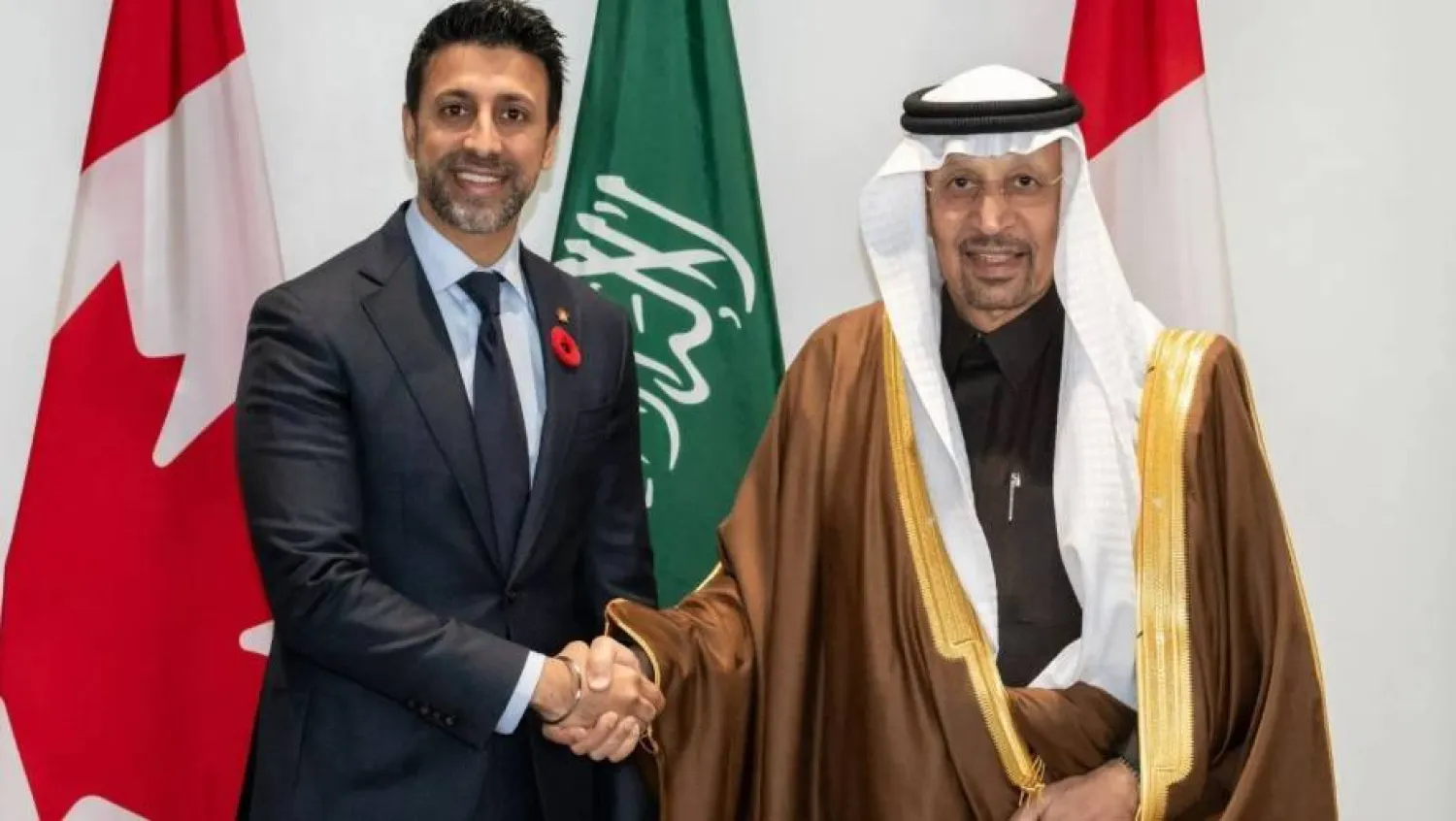

Riyadh, Ottawa Launch Foreign Investment Agreement and Reactivate Joint Commission

The Saudi Minister of Investment meets with the Canadian Minister of Trade. Asharq A-Awsat
TT

Riyadh, Ottawa Launch Foreign Investment Agreement and Reactivate Joint Commission

The Saudi Minister of Investment meets with the Canadian Minister of Trade. Asharq A-Awsat

Saudi Arabia and Canada have launched negotiations on a Foreign Investment and Protection Agreement in the Canadian capital, Ottawa, a move reflecting the shared commitment to strengthening bilateral economic relations.

The talks coincided with a visit by a high-level Saudi delegation led by the Minister of Investment, Eng. Khalid Al-Falih, during which both sides announced the reactivation of the Joint Economic Commission.

These developments are gaining significant momentum, supported by Canada’s endorsement of Saudi Vision 2030 and the two countries’ willingness to expand their economic partnership across vital and non-oil sectors.

The Canadian Ambassador to Saudi Arabia, Jean-Philippe Linteau, told Asharq Al-Awsat that Canada was thrilled to welcome Al-Falih.

“His meetings with Prime Minister Mark Carney, Minister of Trade Maninder Sidhu and Foreign Minister Anita Anand, as well as with senior Canadian business leaders, were a clear illustration of Canada’s desire to grow the economic partnership between Saudi Arabia and Canada,” said Linteau.

The diplomat added that “there is growing momentum because of Canada’s support for the Kingdom’s Vision 2030 goals and the visit helped advance key engagement on trade and investment as well as partnerships in sectors such as education, mining, AI and infrastructure.”

In 2024, Saudi Arabia was Canada’s largest merchandise trading partner in the Middle East. Two-way merchandise trade between the two countries in 2024 was valued at approximately $4.1 billion.

Over 150 Canadian companies are active in Saudi Arabia, offering competitive solutions in artificial intelligence and frontier technology, healthcare, infrastructure, mining, defense products, and creative industries.

During their meeting in Ottawa, Sidhu and Al-Falih announced the launch of negotiations for a Foreign Investment and Protection Agreement between Canada and Saudi Arabia. They also announced the reactivation of the Joint Economic Commission, a treaty-based mechanism to promote trade and economic initiatives of mutual benefit.

Sidhu and Al-Falih welcomed the October 23 signing of a memorandum of understanding between Export Development Canada and the Saudi EXIM Bank.

The increased partnership between Canada and Saudi Arabia will boost business opportunities, increase bilateral trade and unlock export opportunities and investments in Canadian and Saudi Arabian companies alike.

The two ministers also discussed future strategic sector partnerships between Canadian and Saudi Arabian companies, including in the areas of artificial intelligence and frontier technologies, healthcare, infrastructure, mining, defense, and creative industries.

They also met with business leaders and industry stakeholders, participated in a business round table with Invest in Canada and focused on deepening Canada-Saudi relations by highlighting commercial success stories between Canadian and Saudi companies.

“Saudi Arabia is an important market for Canada as our largest bilateral merchandise trading partner in the Middle East. We’re committed to advancing economic cooperation and mutually beneficial investment opportunities to foster greater commercial prosperity for Canadians and Saudis,” Sidhu said in a statement.

“I look forward to strengthening the relationship between our two countries and promoting continued cooperation for our businesses, industries and workers,” he added.



Yanbu Commercial Port Boosts Operational Efficiency by Serving 11 Vessels Simultaneously

The accomplishment builds on the vital role of Yanbu Commercial Port in strengthening Saudi Arabia's maritime transport system. (SPA)
TT

Yanbu Commercial Port Boosts Operational Efficiency by Serving 11 Vessels Simultaneously

The accomplishment builds on the vital role of Yanbu Commercial Port in strengthening Saudi Arabia's maritime transport system. (SPA)

Saudi Arabia’s Yanbu Commercial Port achieved a new operational milestone by successfully serving 11 vessels simultaneously of various sizes and cargo capacities, reflecting the port's high level of operational readiness, reported the Saudi Press Agency on Monday.

The achievement underscores the efficiency of the port's operations and its ability to manage maritime and commercial traffic with a high degree of effectiveness.

It contributes to smoother import and export activities and supports the continuity of supply chains in accordance with the highest operational and logistical standards.

The accomplishment builds on the vital role of Yanbu Commercial Port in strengthening Saudi Arabia's maritime transport system and reinforcing its position as a key logistics hub on the Red Sea coast.

It also supports economic growth and enhances the competitiveness of the maritime and commercial sectors.


IMF Ready to Help Africa Weather Middle East Shock, Says Zeidane

 Workers sort avocados for export to Chinese markets, at the Sunripe fresh fruits exporters factory in Limuru district of Kiambu County near Nairobi, Kenya June 4, 2026. (Reuters)
Workers sort avocados for export to Chinese markets, at the Sunripe fresh fruits exporters factory in Limuru district of Kiambu County near Nairobi, Kenya June 4, 2026. (Reuters)
TT

IMF Ready to Help Africa Weather Middle East Shock, Says Zeidane

 Workers sort avocados for export to Chinese markets, at the Sunripe fresh fruits exporters factory in Limuru district of Kiambu County near Nairobi, Kenya June 4, 2026. (Reuters)
Workers sort avocados for export to Chinese markets, at the Sunripe fresh fruits exporters factory in Limuru district of Kiambu County near Nairobi, Kenya June 4, 2026. (Reuters)

The International Monetary Fund's new Africa chief, Zeine Zeidane, said that conflict in the Middle East has created difficulties for sub-Saharan Africa but reaffirmed the fund's commitment to aiding nations under economic strain.

Zeidane, who assumed his role as Director of the IMF's African Department on May 1, oversees operations and engagement with 45 countries across the region.

"My immediate priority is really to help countries in ‌the region to weather ‌this shock," Zeidane said at ‌a ⁠media briefing.

The IMF ⁠has already reached staff-level agreements to provide augmented financing in response to the conflict's effects for Burkina Faso, The Gambia and São Tomé and Príncipe.

For Ethiopia, which has a large IMF program in place, Zeidane said the fund accelerated about $200 million ⁠in financing.

Zeidane warned that disruptions linked to ‌the Middle East conflict could ‌take months to resolve, noting that a ceasefire was already ‌in place but that Gulf nations had ‌indicated it typically takes six to seven months for production and exports to resume fully.

He added that the Middle East's role as a significant exporter of fertilizers would have ‌far-reaching implications for Africa's food security and production costs.

Despite immediate challenges, Zeidane expressed ⁠optimism over ⁠sub-Saharan Africa's long-term prospects, noting that prior to the current crisis, the region was among the fastest-growing globally and had made strides in fiscal consolidation.

"The future, the next growth engine for the world, will be Africa," he said. "We need to support Africa to unlock its potential."

Zeidane, who began his IMF career in 2012, previously served as Mauritania's prime minister, central bank governor and economic adviser to the president. He succeeded Abebe Aemro Selassie, who retired from the IMF in May.


The High Cost of Hormuz: $37 Billion Shock Exposes Iraq’s Economic Vulnerability

A drone view shows oil trucks arriving from Iraq on their way to the Baniyas oil terminal, Syria, May 14, 2026.  (Reuters)
A drone view shows oil trucks arriving from Iraq on their way to the Baniyas oil terminal, Syria, May 14, 2026. (Reuters)
TT

The High Cost of Hormuz: $37 Billion Shock Exposes Iraq’s Economic Vulnerability

A drone view shows oil trucks arriving from Iraq on their way to the Baniyas oil terminal, Syria, May 14, 2026.  (Reuters)
A drone view shows oil trucks arriving from Iraq on their way to the Baniyas oil terminal, Syria, May 14, 2026. (Reuters)

The recent regional war and the closure of the Strait of Hormuz have pushed Iraq’s economy into one of its most serious crises in decades. The massive financial losses are more than just another consequence of regional conflict; they have exposed Iraq’s near-total dependence on a single maritime export route.

As Baghdad struggles to finance public-sector salaries through domestic borrowing and the use of foreign-exchange reserves, the crisis has renewed scrutiny of years of poor planning, corruption, and political obstruction of strategic projects, such as the Basra-Aqaba oil pipeline, initiatives that could have provided alternative export routes and a safety net for the country’s most important source of income.

Financial and energy analysts estimate Iraq’s losses at more than $37 billion, a severe blow to an economy that relies overwhelmingly on oil revenues.

The disruption has forced authorities to draw on domestic debt and accumulated reserves to cover monthly salary and pension obligations estimated at roughly $6.5 billion.

Slow recovery

Although the conflict appears to be winding down and the Oil Ministry has expressed optimism about resuming production, energy experts caution that Iraqi oil fields may require months to return to their prewar output levels.

Before the crisis, Iraq produced more than 4.2 million barrels per day, including approximately 3.5 million barrels exported to international markets.

Observers said the consequences extend beyond the immediate financial shock caused by the freezing of oil revenues. The conflict revealed a “dangerous strategic vulnerability”: Iraq’s overwhelming reliance on southern Gulf export terminals and the Strait of Hormuz as the sole outlet for its most valuable resource.

The crisis has also revived debate over decades of mismanagement and inadequate planning in one of the country’s most vital economic sectors.

Oil trucks arrive from Iraq, on their way to the Baniyas oil terminal, in Qamishli, Syria, May 11, 2026. (Reuters)

A single export gateway

Over previous decades, Iraq possessed several overland export routes, including the Kirkuk–Ceyhan pipeline to Türkiye, the Iraq-Saudi pipeline, and the historic Kirkuk-Haifa and Kirkuk-Baniyas lines. Most have been out of service for years because of wars, political instability, and security challenges.

Successive governments sought to revive export diversification. Among the most significant proposals was the Basra-Aqaba pipeline, championed during the administration of former Prime Minister Mustafa Al-Kadhimi. The project would transport crude oil from southern Iraq to Jordan’s Red Sea port of Aqaba.

Energy specialists regard it as a strategic asset that could have reduced Iraq’s dependence on Gulf shipping routes. Political disputes and regional pressures, however, prevented its implementation.

Limited alternatives

As the crisis intensified and oil revenues dwindled, Iraq attempted to expand exports through Türkiye, Syria, and Jordan. Energy experts said those efforts achieved only marginal results.

Contrary to reports that Iraq was exporting oil through 700 tanker trucks through Syria, former Oil Ministry spokesman Asim Jihad said exports through Syrian territory amount to no more than 200 tankers per day.

He told Asharq Al-Awsat that Iraq is exporting fuel oil rather than crude oil through Syria to avoid bottlenecks at producing fields.

Such shipments, he added, are operationally complex and generate only limited revenue compared with normal export volumes.

On the northern route, Jihad noted that Iraq exports between 150,000 and 200,000 barrels per day through the Kurdistan Region’s pipeline to the port of Ceyhan in Türkiye.

Meanwhile, the older federal pipeline linking Kirkuk to Ceyhan remains out of service because of extensive damage that has yet to be repaired.

A drone view shows the Rumaila oil field in Basra, Iraq, June 8, 2026. (Reuters)

Jihad expressed little optimism that Iraq can establish major alternative export corridors outside the Gulf in the near future, citing time constraints, high costs, and political complications.

He also voiced uncertainty about negotiations with Ankara over future export agreements through Ceyhan, particularly as existing arrangements are set to expire at the end of July.

“The only option left for Iraq is to hope that no new conflict erupts in the Gulf that would once again close the Strait of Hormuz and deprive the country of its primary source of income,” he added.

Cost of the blockade

The Eco Iraq Observatory estimated that Iraq has lost roughly 350 million barrels of oil exports since the Strait of Hormuz was closed on February 28, representing missed sales worth approximately $37.7 billion at average market prices during the period.

According to the organization, Iraq had been exporting between 103 million and 107 million barrels of crude oil per month before the closure. Export losses reached 84.4 million barrels in March, 93.1 million in April, 92.8 million in May, and 79.6 million in June.

Eco Iraq argued that the “New Levant” initiative — a regional economic integration project involving Iraq, Jordan, and Egypt — has become a strategic necessity.

The plan envisions deeper economic cooperation, infrastructure links, and alternative export routes, including the shipment of Iraqi oil through Jordan to Egyptian ports, reducing dependence on geopolitically vulnerable maritime corridors.