


Saudi Budget Forum Reveals Govt. Spending Now Independent of ‘Oil Cycle’

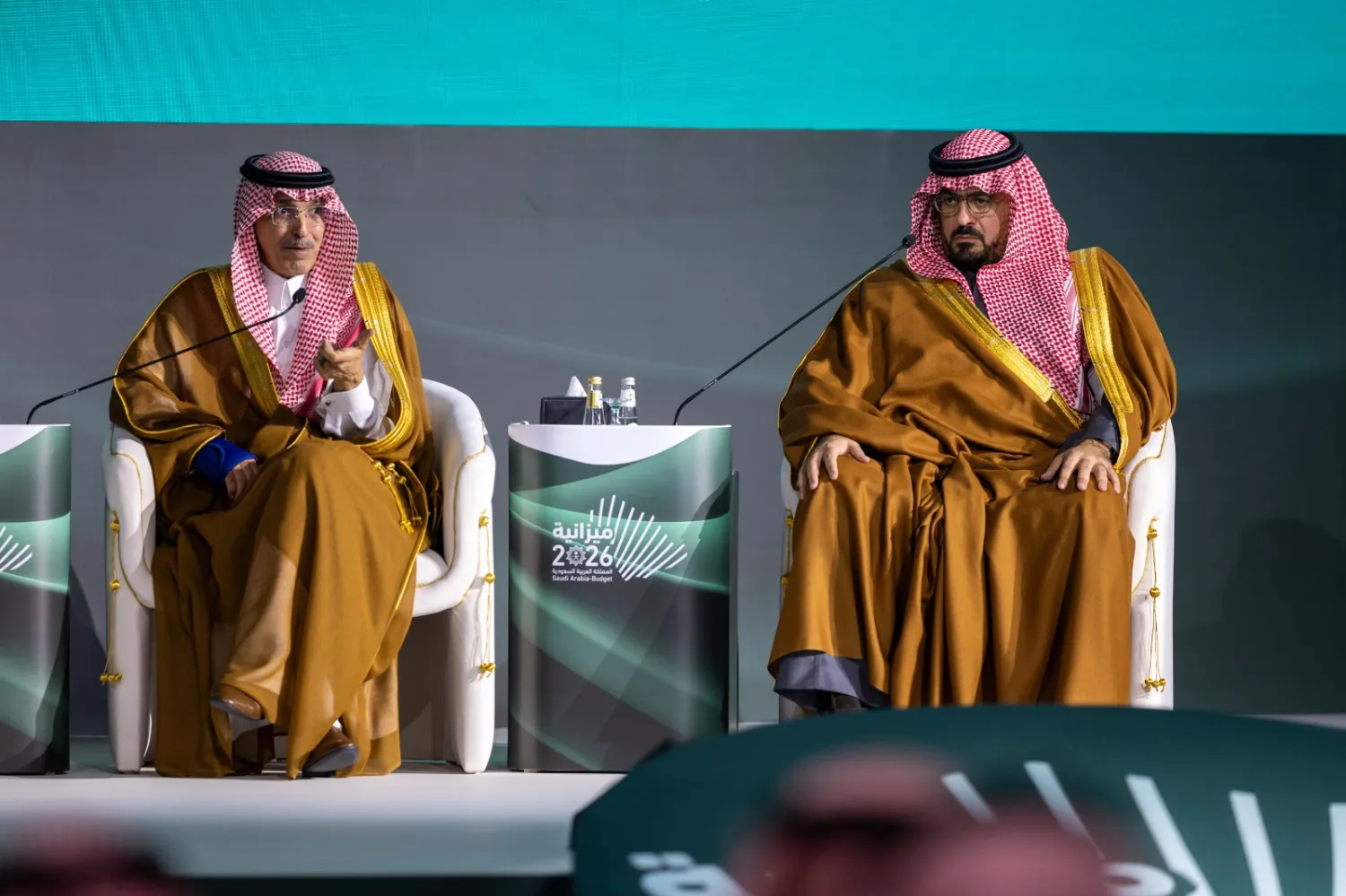
Saudi Finance Minister Mohammed al-Jadaan and Economy Minister Faisal Alibrahim attend the Saudi Budget Forum (Saudi 2026 Budget Forum)
TT

Saudi Budget Forum Reveals Govt. Spending Now Independent of ‘Oil Cycle’

Saudi Finance Minister Mohammed al-Jadaan and Economy Minister Faisal Alibrahim attend the Saudi Budget Forum (Saudi 2026 Budget Forum)

Saudi Arabia’s 2026 budget forum, held a day after the Cabinet approved the new fiscal plan under the chairmanship of Crown Prince and Prime Minister Mohammed bin Salman, served as a high-level platform to explain the budget’s objectives and strategic direction.

Officials said the budget aims to balance fiscal prudence with the acceleration of Vision 2030’s third phase, intensifying efforts to implement its programs and projects to deliver sustainable economic and social impact.

The Crown Prince has repeatedly stressed that citizens’ welfare remains the government’s top priority.

The Cabinet approved the 2026 budget on Tuesday with total spending of 1.31 trillion riyals ($349.3 billion) and projected revenues of 1.15 trillion riyals ($306 billion), implying a deficit of 165 billion riyals ($43.9 billion).

Finance Minister Mohammed al-Jadaan said the government had overcome a key structural challenge by ending the link between public spending and oil price cycles. “Expenditure is now increasing in a studied, deliberate manner, away from the volatility of the oil sector,” he said.

Economy and Planning Minister Faisal Alibrahim said the kingdom is entering a new phase in which artificial intelligence will become the main driver of non-oil growth, reshaping the economy.

Technology, he said, will amplify economic returns and allow Saudi companies such as HUMAIN to play a leading role in the future economy, similar to the role Aramco played in the energy sector.

Officials said this approach is part of a broader strategy to strengthen institutional capacity and expand private-sector partnerships to sustain the momentum of non-oil growth, projected to remain between 4.5 and 6 % in coming years.

Fiscal Policy Shift: Spending Decoupled from Oil

At the forum’s opening session, al-Jadaan outlined a new fiscal policy designed to delink spending from oil-revenue fluctuations — a structural reform marking a turning point in Saudi financial management.

“The biggest challenge in previous years was that spending moved in line with the economic cycle,” he said. “Under the current policy, spending now grows in a disciplined and planned way.”

He said the shift ensures steady non-oil growth regardless of oil-market swings. The minister noted that the oil sector had recorded “negative growth for eight years,” underscoring the need for this policy change.

Al-Jadaan added that the government has capped public debt at 40 % of GDP and expects non-oil revenues this year to reach 501 billion riyals ($133.4 billion), accounting for almost 46 % of total revenues — the highest share in five years.

He said debt levels were not a concern “as long as returns exceed costs,” adding: “Debt in itself is not good on a personal level, and the same applies to the state — but there are exceptions.”

He stressed that “the government’s goal is not to raise taxes but to expand the size of the economy.”

Economic Transformation Delivering ‘Large Real Returns’

Alibrahim said Vision 2030’s transformation drive is producing “very large real returns,” reflected in strong growth across sectors. He emphasized that quality growth, not just quantity, will define the next stage.

He said 74 economic activities have grown by more than 5 % annually over the past five years, while 37 have expanded by over 10%. “The non-oil economy is now the foundation of sustainable growth,” he said, noting that cumulative growth since 2015 has exceeded 30% and reliance on oil revenues has fallen from 90 to 68%.

Non-oil growth is expected to average between 4.5 and 6% annually in the coming years.

Private-sector participation, he said, remains essential to sustaining this trajectory. Its contribution to GDP has risen from 30 to 50%, with further room for expansion “provided projects are executed at the right cost.”

Alibrahim said hundreds of international firms have entered the Saudi market, and domestic investment has surged, showing the kingdom’s progress in building a competitive business climate. “Opening long-term opportunities for the private sector is crucial to creating quality jobs and achieving sustainable growth,” he said.

He estimated that infrastructure investment needs would reach 3.5 trillion riyals over the next decade, calling infrastructure “one of the fastest-growing asset classes globally.”

The minister said artificial intelligence will power the next phase of economic diversification, boosting productivity, maximizing returns, and attracting global talent and technology firms. He cited HUMAIN, a Public Investment Fund- and Aramco-backed firm, as poised to take a pioneering role in the future economy “just as Aramco did for decades in energy.”

Foreign Property Ownership and Housing

Housing Minister Majed al-Hogail said the government will begin implementing a new law next month allowing foreigners to own property in Saudi Arabia. The legislation, he said, is intended to bring balance to the real-estate market through the white-land fee policy.

He said development housing programs for low-income families had enabled more than 50,000 households to acquire homes and protect over 16,000 families from default.

Al-Hogail said the Finance Ministry and the central bank had provided 46.6 billion riyals to inject liquidity into housing programs. More than 250,000 citizens benefited from mortgage guarantees for those with financial challenges.

He said over 20,000 rental contracts have been signed under market-balancing initiatives, with plans to add 60,000 housing units next year and 100,000 under off-plan sales. The housing program aims to grant ownership to 20,000 families by 2026.

Logistics Hub Ambitions

Transport and Logistics Minister Saleh al-Jasser said Saudi Arabia is witnessing a major transformation toward becoming a global logistics hub and a model of integrated mobility.

Private-sector investment in transport and logistics has exceeded 280 billion riyals across aviation, maritime, rail, and road services, he said.

The aviation sector, he added, is expanding rapidly with more than 500 aircraft on confirmed order for national carriers. Passenger routes have increased to 172 from 100 before the pandemic, with a target of 250 by 2030.

Projects include expanding King Abdulaziz Airport, building King Salman Airport, opening new airports in Jazan and Jouf, and launching an additional national carrier in the Eastern Province.

Air-freight volumes grew 30% last year, with a goal of surpassing 3.5 million tons by 2030. The rail network now spans 6,000 kilometers, with plans to double its length, move 30 million tons of freight and 10 million passengers, and add 10 new passenger trains.

Building a World-Class Labor Market

Human Resources and Social Development Minister Ahmed al-Rajhi said Saudi Arabia is crafting a new strategy to make its labor market among the best globally.

He said the 2020 Labor Market Strategy introduced 28 reform initiatives, 94% of which have been implemented. His ministry participates in eight of the 11 Vision 2030 programs and has completed most of its 100 related initiatives.

The number of Saudis working in the private sector rose from 1.7 million to 2.5 million in four years, he said. Engineering jobs grew from 52,000 to 218,000 Saudi nationals, and freelance work expanded to 430,000 workers nationwide.

Tourism Growth

Deputy Tourism Minister Princess Haifa Al Saud said the number of visitors to the kingdom reached 116 million, with spending totaling 275 billion riyals.

Tourists from Europe accounted for 14% of arrivals and those from East Asia and the Pacific 15%. Domestic tourism spending climbed to 105 billion riyals by the end of the third quarter of 2025, up 18% year-on-year, reflecting the sector’s growing role in diversifying revenue sources.

Defense Industries and Localization

General Authority for Military Industries Governor Ahmed al-Ohali said the sector has undergone a major transformation over the past six years, driven by regulatory reforms and investment incentives.

He said the number of licensed defense companies jumped from fewer than five in 2018 to more than 340 in 2024, while local military spending rose from 4 to 25% of total outlays and local content reached 40%.


KSIA Commences Construction of Third Runway to Enhance Operational Efficiency

 The airport will incorporate the King Khalid terminals - SPA
The airport will incorporate the King Khalid terminals - SPA
TT

KSIA Commences Construction of Third Runway to Enhance Operational Efficiency

 The airport will incorporate the King Khalid terminals - SPA
The airport will incorporate the King Khalid terminals - SPA

King Salman International Airport (KSIA), a PIF company, has commenced construction works on the third runway, marking a strategic step that reflects continued progress in airfield development and enhances the airport’s operational readiness to support long-term growth in air traffic demand.

The third runway forms a key component of the KSIA Master Plan and represents a major milestone in the airport’s expansion journey.
According to a press release issued by the KSIA, the project is being delivered in collaboration with FCC Construcción SA and Al-Mabani General Contractors Company and has been designed in alignment with Riyadh’s prevailing wind patterns to ensure safe and efficient aircraft operations under all operating conditions, SPA reported.

The current operational capacity stands at 65 aircraft movements per hour. With the implementation of operational enhancements and the introduction of the third runway, capacity is expected to increase to 85 aircraft movements per hour, contributing to improved operational efficiency and supporting long-term growth.

The third runway incorporates multiple access taxiways to ensure smooth aircraft flow and will span 4,200 meters in length.

Acting CEO of KSIA Marco Mejia said: “Launching construction of the third runway marks a pivotal step in delivering the KSIA Master Plan and reflects our commitment to developing world-class infrastructure capable of supporting future growth, enhancing operational efficiency, and expanding long-haul connectivity without constraints.”

King Salman International Airport is a strategic and transformative national project that reflects the Kingdom’s ambition to position Riyadh as a global capital and a leading aviation hub. The project was announced by His Royal Highness Prince Mohammed bin Salman bin Abdulaziz, Crown Prince, Prime Minister, Chairman of the Council of Economic and Development Affairs and Chairman of the Board of Directors of King Salman International Airport, underscoring its national significance and its role in advancing the objectives of Saudi Vision 2030.

Located on the existing site of King Khalid International Airport in Riyadh, the airport will incorporate the King Khalid terminals, in addition to three new terminals, residential and leisure assets, six runways, and logistics facilities. Spanning 57 square kilometers, it is designed to accommodate 100 million passengers annually and handle over two million tons of cargo by 2030.

This phase of construction contributes to strengthening King Salman International Airport’s international flight network across multiple global destinations, reinforcing Riyadh’s position as an internationally connected aviation gateway and supporting national development objectives within the air transport sector.


Mawani, Arabian Chemical Terminals Sign Land Lease for Jubail Port Storage Tanks

Mawani, Arabian Chemical Terminals Sign Land Lease for Jubail Port Storage Tanks
TT

Mawani, Arabian Chemical Terminals Sign Land Lease for Jubail Port Storage Tanks

Mawani, Arabian Chemical Terminals Sign Land Lease for Jubail Port Storage Tanks

The Saudi Ports Authority (Mawani) signed a contract with Arabian Chemical Terminals Ltd. to establish storage tanks for chemical and petrochemical materials at Jubail Commercial Port, with an investment exceeding SAR500 million on an area of 49,000 square meters.

The project will contribute to enhancing operational efficiency and increasing handling capacity in line with the objectives of the National Transport and Logistics Strategy to consolidate the Kingdom’s position as a global logistics hub, SPA reported.

This step is part of Mawani’s efforts to strengthen the role of the private sector in supporting the gross domestic product and to reinforce the position of Jubail Commercial Port as a driver of commercial activity. The project’s storage capacity will reach 70,000 cubic tons, boosting the competitiveness of the Kingdom’s ports at both regional and international levels.

The project aims to develop and expand storage capacity and the export of chemical and petrochemical materials in accordance with the highest international standards while supporting supply chains. It includes the establishment and development of specialized facilities for storing and exporting chemical and petrochemical products, as well as the provision of storage and distribution services for local and international import and export of chemicals in line with global quality and safety standards.

The project will contribute to supporting national supply chains, boosting the Kingdom’s chemical logistics capabilities, and raising operational efficiency and capacity, thereby improving customer competitiveness. It also supports the achievement of Saudi Vision 2030 objectives by promoting the development of infrastructure to advance the energy, industry, and supply chain sectors in the Kingdom.


Oil Prices Stable as Investors Seek Clarity on Russia-Ukraine Talks

A view shows the crude oil terminal Kozmino on the shore of Nakhodka Bay near the port city of Nakhodka, Russia August 12, 2022. REUTERS/Tatiana Meel
TT

Oil Prices Stable as Investors Seek Clarity on Russia-Ukraine Talks

A view shows the crude oil terminal Kozmino on the shore of Nakhodka Bay near the port city of Nakhodka, Russia August 12, 2022. REUTERS/Tatiana Meel

Oil prices were little changed on Tuesday as investors took stock of ​dented hopes of a Russia-Ukraine peace deal and rising geopolitical tensions in the Middle East around Yemen, Reuters reported.

Brent crude futures for February delivery, which expire on Tuesday, were up 15 cents at $62.09 a barrel as of 0918 GMT. The more active March contract was at $61.61, up 12 cents.

US West Texas Intermediate ‌crude gained 14 ‌cents to $58.22.

The Brent and ‌WTI ⁠benchmarks ​settled ‌more than 2% higher in the previous session as Saudi Arabia launched airstrikes against Yemen and after Moscow accused Kyiv of targeting Putin's residence, denting hopes of a peace deal.

Kyiv dismissed Moscow's accusation as baseless and designed to undermine peace negotiations. After a phone call ⁠with Putin, US President Donald Trump said he was angered by details ‌of the alleged attack.

"I think the ‍markets are sensing that ‍a deal is going to be very hard ‍to come by," said Marex analyst Ed Meir.

Traders also watched other Middle East developments after Trump said the United States could support another major strike on Iran were Tehran to resume rebuilding its ballistic missile or nuclear weapons programs.

Despite renewed fears of potential supply disruptions, perceptions of an oversupplied global market remain and could cap prices, analysts say.

Marex's Meir said prices would trend downwards in the first quarter of 2026 due to ‌a "growing oil glut".
