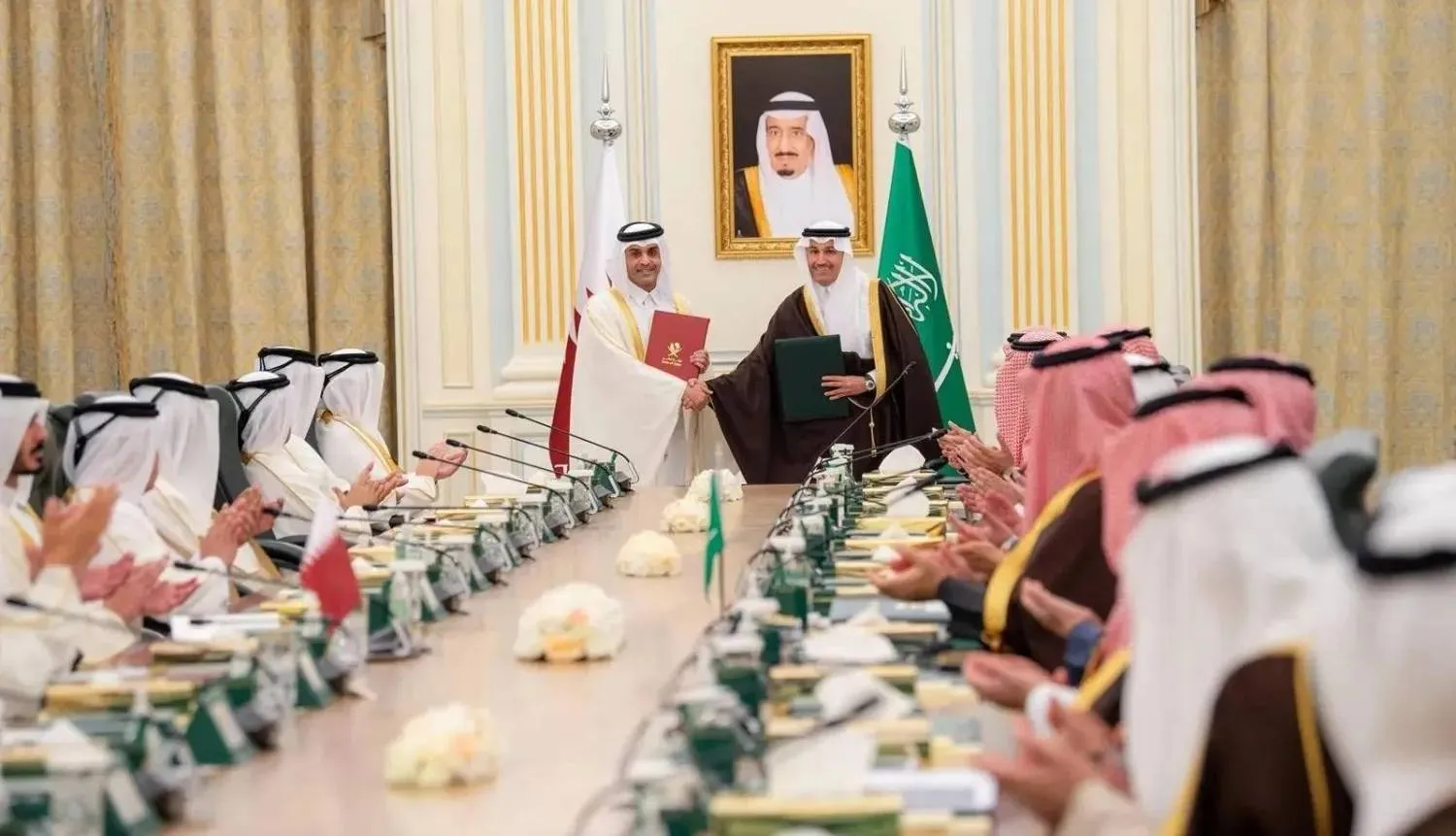
Saudi-Qatar Electric Rail Project to Deepen Economic, Logistics Ties

Signing of Saudi-Qatar high speed rail deal attended by Saudi Crown Prince and Qatar Emir (SPA)
TT

Saudi-Qatar Electric Rail Project to Deepen Economic, Logistics Ties

Signing of Saudi-Qatar high speed rail deal attended by Saudi Crown Prince and Qatar Emir (SPA)

Hussein al-Khawaja, chairman of the land transport committee at the Al-Ahsa Chamber, said the agreement to build a high speed electric passenger railway between Saudi Arabia and Qatar, the largest modern infrastructure venture ever undertaken by two Gulf states, ushers in a new chapter of economic and logistics integration.

He said the line will spur the movement of goods and travelers, energize commercial and tourism flows, strengthen cross border supply chains through more resilient logistics solutions, and lift bilateral trade by shortening delivery times and trimming the edges of operating costs.

He told Asharq Al-Awsat that the deal represents a major strategic leap within both countries’ efforts to deepen economic cooperation and developmental integration, cement social ties, and support sustainable development paths under Saudi Vision 2030 and Qatar National Vision 2030.

Al-Khawaja said the project will redefine travel between the two countries. It will give passengers and investors broader, faster and more flexible routes connecting business hubs and global aviation centers, with a capacity exceeding ten million passengers a year.

He said the venture’s projected economic return of about 115 billion riyals to the combined gross domestic product underscores its position as one of the most significant strategic projects driving regional development.

It is expected to generate around thirty thousand direct and indirect jobs in Saudi Arabia and Qatar during construction and operation.

Addressing the impact on Al-Ahsa, al-Khawaja said the project will help turn the province into a pivotal logistics and commercial corridor that links Gulf economies.

It will strengthen intra Gulf trade and economic integration and open the door to major infrastructure investments, reinforcing Al-Ahsa’s standing as a key geographic and strategic location and a promising commercial and logistics center.

He added that the railway will bolster the local economy’s capacity and growth, create new jobs, lower transport costs for goods and passengers, support the logistics sector and supply chains, spur local manufacturing, attract investment, reduce maintenance costs and expand tourism, while building a more competitive, integrated and sustainable economic landscape.


Oil Prices Rise 1% as Supply Risks Remain in Focus

The Nave Photon, carrying crude oil from Venezuela, is docked at Port Freeport in Freeport, Texas, US, January 15, 2026. REUTERS/Antranik Tavitian
TT

Oil Prices Rise 1% as Supply Risks Remain in Focus

The Nave Photon, carrying crude oil from Venezuela, is docked at Port Freeport in Freeport, Texas, US, January 15, 2026. REUTERS/Antranik Tavitian

Oil prices rose over 1% on Friday as supply risks remained in focus despite the receding likelihood of a US military strike against Iran.

Brent crude was up 84 cents, or 1.3%, to $64.60 a barrel at 1413 GMT, on course for a fourth consecutive weekly gain. US West Texas Intermediate was up 80 cents, or 1.4%, to $59.99.

At those levels, Brent was on course for a 2% weekly gain and WTI for a 1.4% gain. Brent ⁠was up a little more than $1 at its intraday peak as investors continue to weigh the potential for supply outages should tensions in the Middle East escalate, Reuters reported.

"While geopolitical tensions in the Middle East have eased, they have not disappeared, and market participants remain concerned about potential supply disruptions," said UBS analyst Giovanni Staunovo.

Both benchmarks hit multi-month highs this week ⁠after protests flared up in Iran and US President Donald Trump signaled the potential for military strikes, but lost over 4% on Thursday as Trump said that Tehran's crackdown on the protesters was easing, allaying concerns of possible military action that could disrupt oil supplies.

"Above all, there are worries about a possible blockade of the Strait of Hormuz by Iran in the event of an escalation, through which around a quarter of seaborne oil supplies flow," Commerzbank analysts said in a note.

"Should there be signs of a sustained easing on ⁠this front, developments in Venezuela are likely to return to the spotlight, with oil that was recently sanctioned or blocked gradually flowing onto the world market."

Meanwhile, analysts expect higher supply this year, potentially creating a ceiling for the geopolitical risk premium on prices.

"Despite the steady drumbeat of geopolitical risks and macro speculation, the underlying balance still points to ample supply," said Phillip Nova analyst Priyanka Sachdeva.

"Unless we see a genuine revival in Chinese demand or a meaningful bottleneck in physical barrel flows, oil looks range-bound, with Brent broadly hovering between $57 and $67."


Gold Eases as Strong US Data, Easing Geopolitical Tensions Sap Momentum

FILE PHOTO: A saleswoman displays a gold necklace inside a jewellery showroom on the occasion of Akshaya Tritiya, a major gold buying festival, in Kolkata, India, May 7, 2019. REUTERS/Rupak De Chowdhuri/File Photo
TT

Gold Eases as Strong US Data, Easing Geopolitical Tensions Sap Momentum

FILE PHOTO: A saleswoman displays a gold necklace inside a jewellery showroom on the occasion of Akshaya Tritiya, a major gold buying festival, in Kolkata, India, May 7, 2019. REUTERS/Rupak De Chowdhuri/File Photo

Gold prices ticked lower on Friday, extending losses from the previous session, as stronger-than-expected US economic data and easing geopolitical tensions in Iran hampered bullion's bullish momentum.

Spot gold eased 0.3% to $4,603.02 per ounce by 0918 GMT. However, the metal is poised for a weekly gain of about 2% after scaling a record peak of $4,642.72 on Wednesday. US gold futures for February delivery edged 0.4% lower to $4,606.70.

"There was ‌a lot of ‌momentum in the (gold) market, which seems to ‌have ⁠faded slightly ‌at the moment....the economic news flow out of the US has been causing some headwinds rather than tailwinds as of late, which is reflected in a somewhat stronger US dollar," said Julius Baer analyst Carsten Menke.

The US dollar hovered near a six-week high on the back of positive economic data on Thursday showing initial jobless claims dropped 9,000 ⁠to a seasonally adjusted 198,000 last week, below economists' forecast of 215,000.

A firmer ‌dollar makes greenback-priced bullion more expensive for overseas ‍buyers. On the geopolitical front, people ‍inside Iran, reached by Reuters on Wednesday and Thursday, said ‍protests appeared to have abated since Monday.

Safe-haven gold tends to do well during times of geopolitical and economic uncertainty. Meanwhile, gold demand in India stayed muted this week as prices hit record highs again, taking the shine off retail buying, while bullion traded at a premium in China as demand remained steady ahead of the Lunar ⁠New Year.

Spot silver shed 1.1% to $91.33 per ounce, although it was headed for a weekly gain of over 14% after hitting an all-time high of $93.57 in the previous session. "The silver market seemed very determined to reach the $100 per ounce threshold before moving lower again....speculative traders are keeping an eye on that level even though it would not be sustainable in the medium to longer-term," Menke added.

Spot platinum dropped 2.7% to $2,345.78 per ounce, and was set to gain more than 3.1% for the week so far. Palladium lost 2.6% to $1,755.04 per ‌ounce, after hitting a more than one-week low earlier, and was headed for a weekly loss of 3.3%.


IMF's Growth Forecasts to Show Resilience to Global Trade Shocks, Georgieva Says

International Monetary Fund (IMF) Managing Director Kristalina Georgieva speaks during an interview with Reuters, amid Russia's attack on Ukraine, in Kyiv, Ukraine January 15, 2026. REUTERS/Valentyn Ogirenko
TT

IMF's Growth Forecasts to Show Resilience to Global Trade Shocks, Georgieva Says

International Monetary Fund (IMF) Managing Director Kristalina Georgieva speaks during an interview with Reuters, amid Russia's attack on Ukraine, in Kyiv, Ukraine January 15, 2026. REUTERS/Valentyn Ogirenko

The International Monetary Fund's latest economic forecasts due next week will show the global economy's continued resilience to trade shocks and "fairly strong" growth, IMF Managing Director Kristalina Georgieva told Reuters on Thursday.

In an interview during a visit to Kyiv to discuss the IMF's loan to Ukraine, Georgieva suggested the IMF could again revise its forecasts slightly upward as the World Bank did this week.

In October, the IMF edged its 2025 global GDP growth forecast higher to 3.2% from 3.0% in July as the drag from US tariffs was less than initially ‌feared. It kept ‌its 2026 global growth outlook unchanged at 3.1%.

Asked what ‌the ⁠January forecasts ‌would show after the upgrade in October, Georgieva said: "More of the same - that the world economy is remarkably resilient, that trade shock has not derailed global growth, that risks are more tilted to the downside, even if performance now is fairly strong."

The IMF is expected to release its World Economic Outlook update on January 19.

Georgieva said risks were focused on geopolitical tensions and rapid technological shifts. Things could turn out well, ⁠she said, but the global economy could also face significant financial distress if the huge resources flowing into ‌artificial intelligence did not result in promised productivity gains.

"We ‍are in a more unpredictable ‍world, and yet, quite a number of businesses and policymakers operate as if ‍the world hasn't changed."

Georgieva said she worried that many countries had failed to build up sufficient reserves to deal with any new shock that could occur. The IMF currently has 50 lending programs, a high number by historic standards, but was bracing for more countries to seek funds, she said.

The IMF chief said US economic performance had been "quite impressive" despite a raft of tariffs imposed by President Donald ⁠Trump last year on nearly every country in the world.

She said overall tariff levels were lower than initially threatened, and the US accounted for only about 13% to 14% of global trade. Most other countries had also refrained - at least so far - from imposing retaliatory measures, which had helped limit the impact of the wave of US tariffs.

She said inflation and macroeconomic conditions could still worsen, though, if the trade picture darkened.

Geopolitical factors were also clouding the outlook and now played a more significant role than in years past, said Georgieva, who took office in October 2019, just months before the COVID-19 pandemic hit in early 2020.

"Regrettably, since I took ‌this job (in 2019), there has been one shock after another after another," she said.