

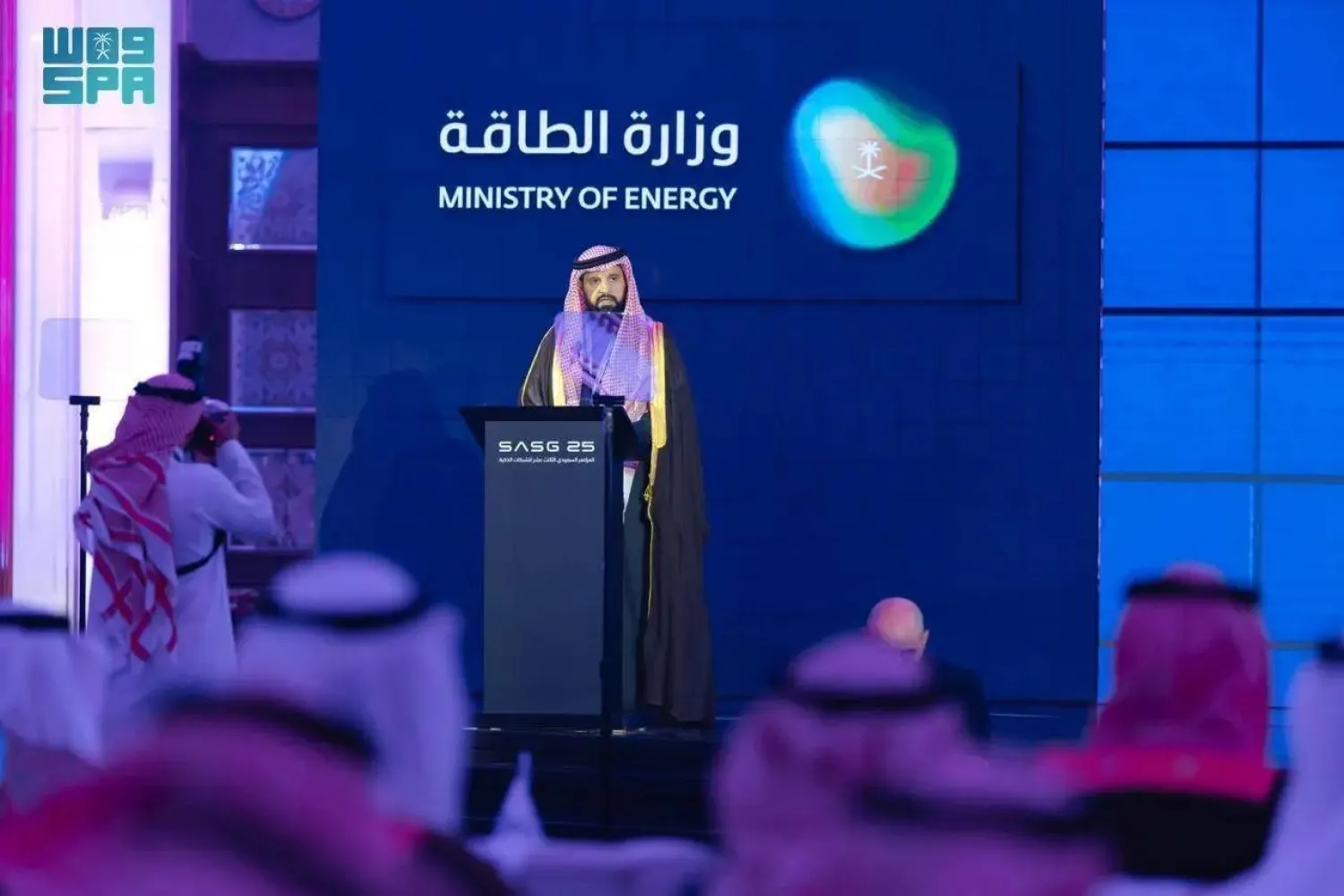

13th Saudi Smart Grid Conference Opens in Riyadh

The three-day conference brings together experts and specialists from 25 countries and features 28 panel discussions and technical sessions. (SPA)
TT

13th Saudi Smart Grid Conference Opens in Riyadh

The three-day conference brings together experts and specialists from 25 countries and features 28 panel discussions and technical sessions. (SPA)

The 13th Saudi Smart Grid Conference (SASG 2025), and its accompanying exhibition, opened in Riyadh on Monday under the patronage of the Saudi Ministry of Energy.

Held the theme “Innovation Today for a Sustainable Tomorrow,” the three-day conference brings together experts and specialists from 25 countries and features 28 panel discussions and technical sessions presenting 225 scientific papers on global advancements in smart grid systems.

In an opening address, Assistant Minister of Energy for Electricity Affairs, Eng. Nasser Al-Qahtani highlighted the continued support extended to the energy sector by the Kingdom’s leadership.

He commended the Minister of Energy’s support for convening and sponsoring the conference, noting its importance in advancing dialogue on smart grid technologies.

“Smart grid technologies are a cornerstone of the global energy transition,” Al-Qahtani said. “They enable improvements across electricity generation, transmission, and distribution, while strengthening grid security and reliability.”

In line with Saudi Vision 2030, the Ministry of Energy is advancing long-term planning to optimize the use of the Kingdom’s diverse energy resources, with the aim of strengthening grid security and resilience and improving generation efficiency, he added.

These efforts reinforce Saudi Arabia’s leadership in this vital sector, position the Kingdom as a global hub for electricity interconnection and renewable power exports, and support the development of a regional electricity trading market, an optimal energy mix, and national emissions-reduction targets, he remarked.

Al-Qahtani stressed that the Kingdom’s electricity sector has undergone significant transformation in recent years, including major upgrades to grid infrastructure to enhance readiness for renewable energy integration and energy-storage systems.

“Smart grids are a fundamental component of electricity sector development,” he said. “They enhance incident response, accelerate system recovery, and improve service reliability by analyzing smart-meter data through the use of artificial intelligence to support proactive, data-driven decision-making.”

He noted that distribution network automation in the Kingdom reached approximately 40% by the end of 2025, an optimal level in line with international best practices in terms of return on investment.

He also highlighted the development of renewable power projects with a combined capacity of nearly 64 gigawatts, of which 12.3 gigawatts have already been connected to the national grid.

Additionally, battery energy-storage systems with a total capacity of 30 gigawatt-hours are under development, with 8 gigawatt-hours already grid-connected. These projects, he said, play a critical role in enabling the grid to balance real-time fluctuations between supply and demand resulting from the variable nature of renewable energy sources.

The opening ceremony included the recognition of the Energy Hackathon winners, the exchange of agreements, and the inauguration of the accompanying exhibition.

The conference provides a global platform for sharing expertise and forging partnerships in smart grids and the digital economy, and convenes international experts, decision-makers, researchers, and specialists.

Discussions will address key challenges and opportunities across the power sector, renewable energy, regulation and the future of smart grids, with emphasis on technology localization, capacity building and technical partnerships to strengthen smart infrastructure and support a sustainable, investment-friendly and innovation-enabling energy ecosystem.

The conference will also explore the integration of renewable energy sources, the latest developments in electricity storage solutions and smart load-management systems, as well as the role of cybersecurity in protecting energy infrastructure and strengthening system reliability.



Morocco Targets $10 Billion AI Contribution to GDP by 2030

 People wave Morocco's flag in the old town of Rabat, on January 9, 2026 prior the Africa Cup of Nations (CAN) quarter-final football match Morocco v Cameroon. (AFP)
People wave Morocco's flag in the old town of Rabat, on January 9, 2026 prior the Africa Cup of Nations (CAN) quarter-final football match Morocco v Cameroon. (AFP)
TT

Morocco Targets $10 Billion AI Contribution to GDP by 2030

 People wave Morocco's flag in the old town of Rabat, on January 9, 2026 prior the Africa Cup of Nations (CAN) quarter-final football match Morocco v Cameroon. (AFP)
People wave Morocco's flag in the old town of Rabat, on January 9, 2026 prior the Africa Cup of Nations (CAN) quarter-final football match Morocco v Cameroon. (AFP)

Morocco is targeting a 100 billion dirhams ($10 billion) boost to its gross domestic product from artificial intelligence by 2030, the minister in charge of digital transition said on Monday, as the country steps up its investment in training programs, sovereign data centers and cloud services.

Morocco, whose current GDP comes to around $170 billion, plans to invest in artificial intelligence centers linked ‌to universities and ‌the private sector, and ‌to ⁠integrate AI solutions ‌into public administration and industry, Minister Amal El Fallah Seghrouchni told a conference in Rabat.

The GDP boost would largely come from expanding domestic data-processing capacity through sovereign data centers, scaling up cloud and fiber-optic infrastructure, and building an AI-skilled workforce ⁠to support the deployment of AI solutions across industry ‌and government, she said.

Under the ‍plan, Morocco expects ‍to create 50,000 AI-related jobs and train ‍200,000 graduates in AI skills by 2030.

As part of that effort, Seghrouchni on Monday signed a partnership agreement with France's Mistral AI to support the development of generative AI tools in Morocco.

"We want to turn Morocco into ⁠a future excellence hub in AI and data science," Seghrouchni said.

The government is also preparing legislation governing artificial intelligence, according to the minister.

Morocco has earmarked 11 billion dirhams ($1.2 billion) for its digital transformation strategy for 2024–2026, covering AI initiatives and the expansion of fiber-optic infrastructure. It is separately planning a 500-megawatt, renewable energy-powered data center in the southern city of Dakhla ‌to boost the security and sovereignty of national data storage.


Saudi Arabia Consolidates Its Position Among the World’s Top 20 Economies in 2026

Riyadh, Saudi Arabia (Reuters) 
TT

Saudi Arabia Consolidates Its Position Among the World’s Top 20 Economies in 2026

Riyadh, Saudi Arabia (Reuters) 

As the global financial landscape is reshaped by accelerating geopolitical shifts, economic data show that Saudi Arabia has firmly consolidated its place among the world’s 20 largest economies in 2026.

This standing reflects the success of Vision 2030 in diversifying income sources and expanding gross domestic product. The Kingdom ranks 19th globally, outperforming several long-established economies, with GDP projected at $1.316 trillion.

According to data based on International Monetary Fund reports released in October 2025, the global economy is expected to reach $123.6 trillion in 2026. Economic power remains highly concentrated, with the world’s five largest economies accounting for more than 55 percent of total global output:

United States: Continues to lead with GDP of $31.8 trillion, supported by a resilient labor market and sustained consumer spending, with real growth projected at 2.1 percent.

China: Ranks second with an estimated GDP of $20.7 trillion, despite demographic challenges and its transition toward advanced manufacturing.

Germany: Retains Europe’s top position in third place with GDP of $5.3 trillion, despite pressure from high energy costs.

India: The “rising star,” securing fourth place globally with GDP of $4.5 trillion and posting the fastest growth among major economies at 6.2 percent.

Japan: Slips to fifth place with GDP of $4.4 trillion, facing demographic headwinds despite strengths in robotics and automotive industries.

Linked to recent IMF assessments, Saudi Arabia stands out as a key pillar in what experts describe as a new “economic geography.” While many emerging markets have struggled with interest-rate volatility and inflation distortions in advanced economies - particularly the United States - the Kingdom has demonstrated a strong ability to absorb external shocks.

The IMF views Saudi Arabia’s large-scale investments in high-potential sectors not merely as a driver of domestic growth, but as part of a broader global shift in capital flows toward destinations offering stability and long-term attractiveness.

The data also underscore the strong performance of other economies on the list. Brazil ranks 11th with GDP exceeding $2.2 trillion, while Türkiye and Indonesia continue to compete closely in 16th and 17th place, respectively.


Saudi Industrial Production Index Records Highest Growth Since Early 2023

A facility operated by the Saudi International Petrochemical Company (Sipchem). (Sipchem)
TT

Saudi Industrial Production Index Records Highest Growth Since Early 2023

A facility operated by the Saudi International Petrochemical Company (Sipchem). (Sipchem)

Saudi Arabia’s Industrial Production Index posted a year-on-year increase of 10.4 percent in November 2025, compared with the same month a year earlier, marking its highest growth rate since the beginning of 2023, according to preliminary data. On a monthly basis, however, the index declined by 0.7 percent.

Data released by the General Authority for Statistics on Sunday showed that the index for oil-related activities rose by 12.9 percent year on year in November, while the index for non-oil activities increased by 4.4 percent compared with the same month of the previous year.

Month on month, the index for oil activities recorded a rise of 0.5 percent, while the non-oil activities index fell by 3.4 percent compared with October 2025.

In November, the sub-index for mining and quarrying activities climbed 12.6 percent year on year, driven by higher oil production during the month. Saudi oil output rose to 10.1 million barrels per day, compared with 8.9 million barrels per day in November last year.

On a monthly basis, the mining and quarrying sub-index also increased by 0.5 percent.

The manufacturing sub-index recorded an annual rise of 8.1 percent, supported by a 14.5 percent increase in the manufacture of coke and refined petroleum products, as well as a 10.9 percent rise in the manufacture of chemicals and chemical products.

In monthly terms, preliminary results showed the manufacturing sub-index edged up by 0.3 percent, buoyed by a 0.3 percent increase in the manufacture of coke and refined petroleum products and a 1.0 percent rise in the manufacture of chemicals and chemical products.

As for other activities, the sub-index for electricity, gas, steam and air-conditioning supply fell by 4.3 percent year on year. In contrast, the sub-index for water supply, sewerage, waste management and remediation activities rose by 10.2 percent compared with November last year.

Compared with October 2025, the electricity, gas, steam and air-conditioning supply sub-index dropped sharply by 28.6 percent, while the water supply, sewerage, waste management and remediation activities sub-index declined by 3.1 percent.