


Iraq’s Oil Hub Slows to a Crawl as Strait of Hormuz Shutdown Strangles Exports

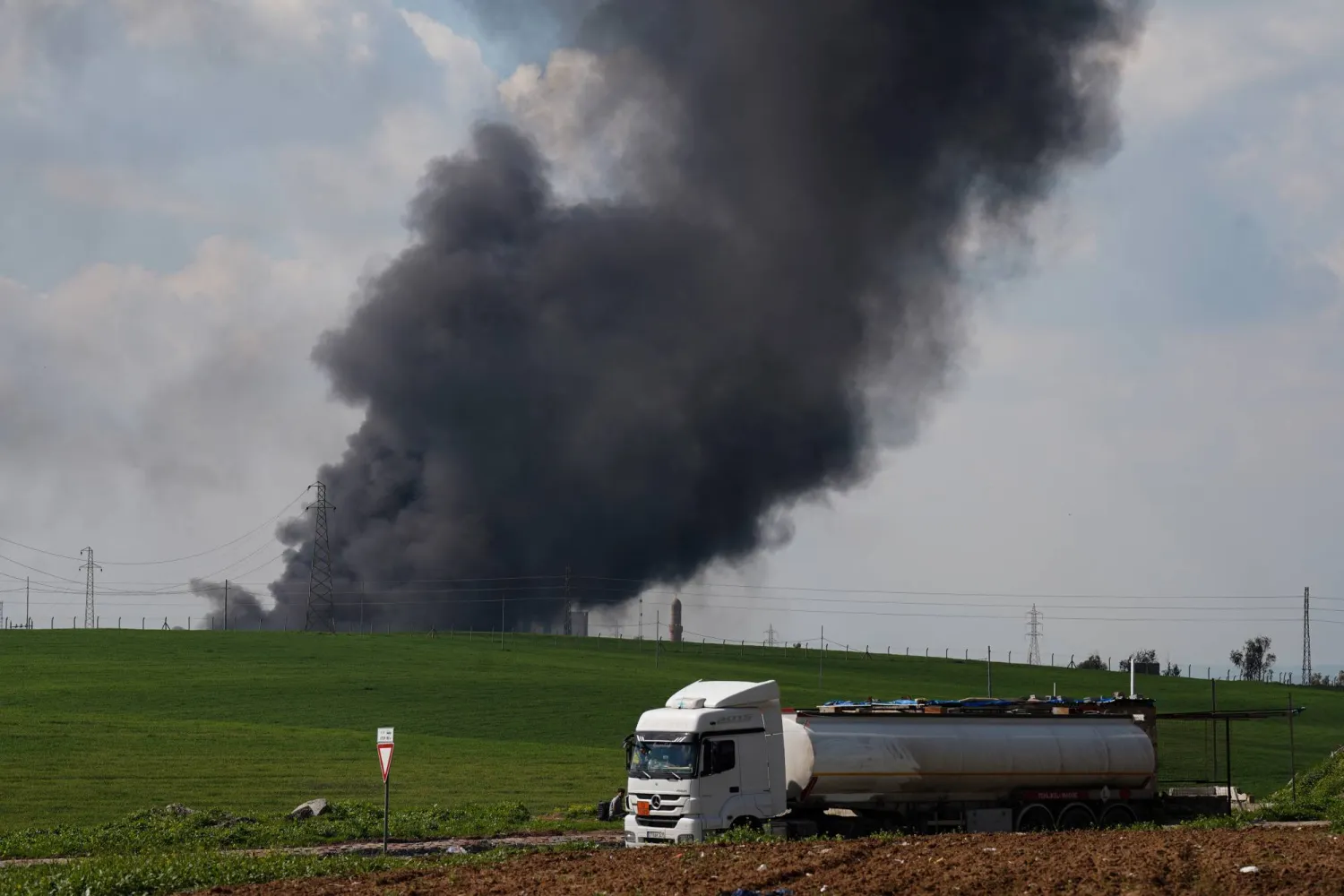
01 April 2026, Iraq, Erbil: Smoke rises from a motor oil depot on the outskirts of Erbil, after it was hit by a drone attack. Photo: Ismael Adnan/dpa
TT

Iraq’s Oil Hub Slows to a Crawl as Strait of Hormuz Shutdown Strangles Exports

01 April 2026, Iraq, Erbil: Smoke rises from a motor oil depot on the outskirts of Erbil, after it was hit by a drone attack. Photo: Ismael Adnan/dpa

Iraqi oil fields once alive with the buzz of workers are nearly deserted. Ports that pulsed with the churn of cargo have fallen still, the din of commerce replaced by the soft rhythm of waves.

A month after the war in Iran started, workers at ports and oil fields in the province of Basra, where almost all of Iraq's crude is produced and exported, have grown accustomed to rockets streaking across the sky, aimed at US air bases and other strategic facilities, The Associated Press said.

The war, which began with US-Israeli strikes, is dealing a heavy blow to Iraq's economy. Iraq relies on oil revenues for roughly 90% of its budget, and most of its oil is exported through the Strait of Hormuz, the narrow mouth of the Arabian Gulf where Iran has effectively stopped cargo traffic during the conflict. The war also has led to a sharp reduction in the volume of imported goods reaching southern Iraq's ports, while attacks have halted traffic at the border it shares with Iran.

Unlike other countries in the Middle East touched by the war, Iraq hosts both entrenched Iran-aligned forces and significant US interests, leaving it exposed to attacks from both sides. Since the war started, oil production in southern Iraq, where Basra is located, has fallen by more than 70% and the volume of imported goods reaching the country's ports has been cut in half. Drone and missile attacks have targeted American companies and military bases. Iran's allied Iraqi militias also have struck oil fields and energy infrastructure. Many foreign workers have left.

The Iraqi government should have enough funds to get through mid-May without new oil sales, according to experts, but then it will have to borrow money.

“After that, the government would resort to issuing bonds,” said Ahmed Tabaqchali, an expert in Iraq’s economy. “But not without consequences.”

Oil production suspended

Across southern Iraq, the closure of the Strait of Hormuz has prompted oil fields to scale back production and focus on domestic needs, while oil prices around the globe have risen. Basra’s Zubair oil field, once producing around 400,000 barrels per day, has seen output drop to roughly 250,000, officials said.

Iran has offered assurances that Iraqi crude can safely transit the strait, said Bassem Abdul Karim, the head of the state-run Basra Oil Company, which oversees production in the province. However, because Iraq lacks its own tanker fleet and depends on chartered vessels, shipments ultimately hinge on whether tanker owners are willing to accept the heightened risks of making the journey. Most are not.

At a degassing station in Zubair, where crude is processed, production has also slowed dramatically. “It’s quiet now because of the reductions,” said chief engineer Ammar Hashim. “Of course we are worried.”

The downturn in Zubair reflects a broader decline in Basra. Output has dropped from 3.1 million barrels per day to roughly 900,000 across the province, according to Abdul Karim.

“Exports are currently completely halted. At the moment, we are considering alternative loading areas, but none are fully operational,” he told The Associated Press.

That morning, a drone crashed in the Majnoon oil field north of Basra without detonating. A security official said it's an increasingly common occurrence, adding that the drone was likely headed toward US bases in Kuwait. Production at the field has been suspended due to the frequency of these events. The official spoke on condition of anonymity because he was not permitted to speak to news media.

Hundreds of employees from American, British, Italian, French and other international oil companies have left Iraq due to the war. The departures accelerated after a March 6 drone strike hit the Burjisiya complex in Basra, a key logistics hub for Iraq’s oil industry used by numerous companies. The attack targeted US oil services company KBR, striking its chemical storage facility.

Another drone struck the British-Petroleum operated Rumaila oil field, prompting some foreign workers there to leave, said Abdul Karim. The field is still operating, he said. On Wednesday, multiple drones attacked a fuel warehouse linked to BP in northern Iraq.

Efforts to reroute Iraq's oil face major constraints: The country doesn't have the capacity to boost exports via its northern pipeline, and trucking through Jordan and Syria is costly and inefficient, said Abdul Karim.

Shipping lanes closed Umm Qasr, Iraq’s primary deep-water port, was once so noisy with imported cargo that it could give you a headache, workers there said.

Now, with the Strait of Hormuz closed, large mother ships bringing shipments to Iraq can no longer get to the port. Instead, they dock in the United Arab Emirates, where the cargo is carried by trucks and then smaller ships to get to Umm Qasr, a costly workaround.

The port’s jetties are running well below their former capacity, with volumes halved by the war, according to port director Mohammed Tahir Fadhil.

When the AP visited, just one cargo ship from the U.A.E. had docked.

The threat to shipping lanes escalated after Iran destroyed two tankers on March 11 in Iraqi waters, the Marshall Islands-flagged Safesea Vishnu and the Malta-flagged Zefyros.

“Today, our only gateway for goods is the United Arab Emirates,” said Farhan Fartousi, director of the Iraqi Ports Company.

Trade disrupted

On Sunday morning, Haidar Abdul-Samad, deputy director of Basra’s Shalamcha border crossing with Iran, was on the phone with an Iranian official, complaining about electricity cuts that had halted trade, urging a quick resolution. The power cuts followed an airstrike that hit the Iranian side of the crossing.

Such disruptions, local officials say, have become routine.

Before the war, the crossing saw constant movement, reflecting strong familial and commercial ties between Iranians and Iraqis in the area. It is also a key transit point for traders and pilgrims heading to Shiite holy sites in central Iraq.

That morning, trucks were backed up for miles.

“Priority is given to food supplies to prevent price increases,” Abdul-Samad said. “Passenger movement is not at the same level as before; activity has declined due to the war in Iran.”

Once electricity was restored, 30-year-old Iranian trader Atefa Al-Fatlawi arrived with her husband and young son. She buys goods at lower prices in Basra to sell back home.

“We are scared because of the bombings,” she said. “Shalamcha was targeted. Today, there were no transport vehicles at the garage because of the attack.”



UK Budget Deficit for 2025/26 Narrows to Six-year Low

Skyscrapers in London's financial district (Reuters)
TT

UK Budget Deficit for 2025/26 Narrows to Six-year Low

Skyscrapers in London's financial district (Reuters)

Britain's budget deficit for the last financial year narrowed to a six-year low as a percentage of economic output although borrowing for March alone exceeded forecasts, official data showed on Thursday.

The Office for National Statistics reported 132.0 billion pounds ($178.1 billion) of public sector net borrowing in the 2025/26 financial year that ⁠ended in March.

That ⁠was 0.7 billion pounds less than the most recent forecast from the Office for Budget Responsibility and down from 151.9 billion pounds in 2024/25.

Equivalent to 4.3% of ⁠economic output - in line with the OBR prediction - the deficit was the smallest since the 2019/20 financial year, which ended just as the response to the COVID-19 pandemic caused debt to soar.

Debt interest spending in 2025/26 was 97.6 billion pounds, up from 85.4 billion pounds a year ⁠previously ⁠and marking the second-highest figure in cash terms since 2022/23, when inflation soared after Russia's invasion of Ukraine.

Last week, the International Monetary Fund cut Britain's economic growth forecasts for 2026 by more than for any other Group of Seven nation due to the country's exposure to higher energy prices with its heavy use of natural gas.

"A more stagflationary backdrop is forecast to take shape, with speculation already building about the impact of weaker growth on the Chancellor's headroom," Nabil Taleb, economist at PwC UK, said, referring to Reeves' ability to meet her borrowing target.

"Recent moves in bond markets, with gilt yields briefly touching 5% for the first time since 2008 before easing, also highlight the UK's vulnerability to uncertainty."

In March alone, the ONS reported public sector net borrowing of 12.6 billion pounds. Economists polled by Reuters had a median forecast of a 10.3 billion-pound deficit for the month.


Saudi Arabia, Philippines to Join JPMorgan Emerging Market Bond Index in 2027

FILE PHOTO: Signage is seen at the JPMorgan Chase & Co. New York Head Quarters in Manhattan, New York City, US, June 30, 2022. REUTERS/Andrew Kelly/File Photo
TT

Saudi Arabia, Philippines to Join JPMorgan Emerging Market Bond Index in 2027

FILE PHOTO: Signage is seen at the JPMorgan Chase & Co. New York Head Quarters in Manhattan, New York City, US, June 30, 2022. REUTERS/Andrew Kelly/File Photo

J.P. Morgan said on Wednesday that Saudi Arabia and the Philippines will be added to its local currency emerging market debt index from January 29 next year.

The inclusion will cover Saudi riyal-denominated sovereign sukuk and Philippine peso-denominated government bonds, both entering the widely tracked GBI-EM ⁠index series.

Their weights ⁠will be introduced gradually, with Saudi Arabia expected to reach 2.52% and the Philippines 1.78% once fully phased in.

The update is part ⁠of a broader index adjustment, which will lower the "Country Cap" - the maximum weight, or share, any single country can hold in the "diversified" index - to 9% from 10%.

As a result, major markets including China, India, Mexico, Malaysia, and Indonesia will see their ⁠weight ⁠reduced to the new limit.

Based on current eligibility criteria, about eight Saudi sovereign sukuk with a combined value of roughly $69 billion could be included, JPMorgan said.

For the Philippines, nine eligible government bonds with a combined value of around $49 billion are under consideration.


Oil to Fabric: Middle East Crises Reshape Global Fashion

A worker arranges spools of thread at a textile factory in Haiyan, Jiangsu province, China (Reuters)
TT

Oil to Fabric: Middle East Crises Reshape Global Fashion

A worker arranges spools of thread at a textile factory in Haiyan, Jiangsu province, China (Reuters)

Rising oil prices are no longer just an energy market story; they are feeding directly into the cost of clothing. From petrochemical plants to fabric mills and retail racks, a complex supply chain is passing on higher costs, pushing up the final price consumers pay.

According to the “Materials Market 2025” report by the Organization for Textile Exchange, polyester makes up about 59% of global fabric output, with roughly 88% produced from non-recycled petroleum sources, leaving the industry exposed to energy price swings.

Oil prices have surged about 32% since the start of the US-Israeli war on Iran on Feb. 28, approaching $100 per barrel.

Fabrics under oil pressure

Amal Saqr, a textile design consultant, said the sector is highly sensitive to shifts in oil prices because of its reliance on synthetic fibers.

More than 60% of fabrics used in global clothing production depend on petroleum-based materials such as polyester, nylon and acrylic, she said, adding that any rise in oil prices feeds directly into fabric costs.

She pointed to 2008, when polyester prices jumped about 30% within three months as oil hit record highs, forcing Asian spinning mills to cut output by 20% to 25%.

Disruptions in the Red Sea between 2023 and 2024 also drove shipping costs up by about 300%, raising raw material costs and straining supply chains.

Yemen’s Iran-aligned Houthis began targeting ships linked to Israel on Nov. 19, 2023, using drones and missiles.

Natural fabrics not immune

Natural fibers such as cotton and linen avoid direct reliance on oil, but are still exposed to energy costs, Saqr said, noting that farming depends on fertilizers, fuel and transport.

The global fertilizer crisis in 2021 pushed prices up about 80%, driving cotton prices higher by roughly 40%. Later disruptions in the Strait of Hormuz added another 40% increase in fertilizer costs due to shipping delays.

Global cotton production reached about 24.5 million tons in 2024, or roughly 19% of total fiber output, making it less dominant than synthetic fibers but relatively more stable in pricing, according to the Textile Exchange report.

Rising production costs

Higher energy prices are hitting every stage of production, from spinning to dyeing and drying, Saqr said.

With already thin margins, textile factories face a stark choice: raise prices or cut output, both of which ultimately hit consumers.

World Bank data shows operating costs for textile factories in several countries have risen by about 18% following recent energy price increases.

Import markets feel it fast

Import-dependent markets are quick to absorb shocks from shipping or energy disruptions, Saqr said.

Shipping costs from Asia have lifted synthetic fabric prices by 10% to 18%, while imported cotton prices have climbed by 15% to 25%.

Rerouting shipments from the Strait of Hormuz to the Cape of Good Hope has added 10 to 14 days to transit times, leading to shortages and swings in the availability of fabrics and garments.

Value chains under rethink

Burak Cakmak, chief executive of the Saudi Fashion Commission, said the impact of oil prices is not immediate, as final pricing reflects a full value chain including production, marketing and distribution.

Instead of passing costs on, many brands are rethinking how to create value, improving efficiency and working more closely with suppliers, he said.

He also pointed to a shift toward localized production, with brands operating closer to their markets and managing inventory more tightly to control costs and improve flexibility.

Sustainability gains urgency

Sustainability is no longer just an environmental concern; it is tied to efficiency and long-term economic viability, Cakmak said.

The sector is moving toward circular models, including recycling and waste reduction, practices that are becoming essential to improving operations.

Designers double down

Anna Zinola, director of Istituto Marangoni in Riyadh, said rising oil prices are reinforcing, not reshaping, designers’ shift toward more conscious material choices.

Sustainability is embedded in the curriculum as a core approach guiding every design decision, she said.

Students are trained to balance cost, sustainability and consumer demand, while exploring material innovations that combine environmental and commercial goals.

Prices set to rise

Reports by McKinsey and Euratex expect global clothing prices to rise by 8% to 12% over the next year, as supply chain pressure persists and shipping costs remain elevated.