


Trump Shook up Global Trade This Year; Some Uncertainty May Persist in 2026 

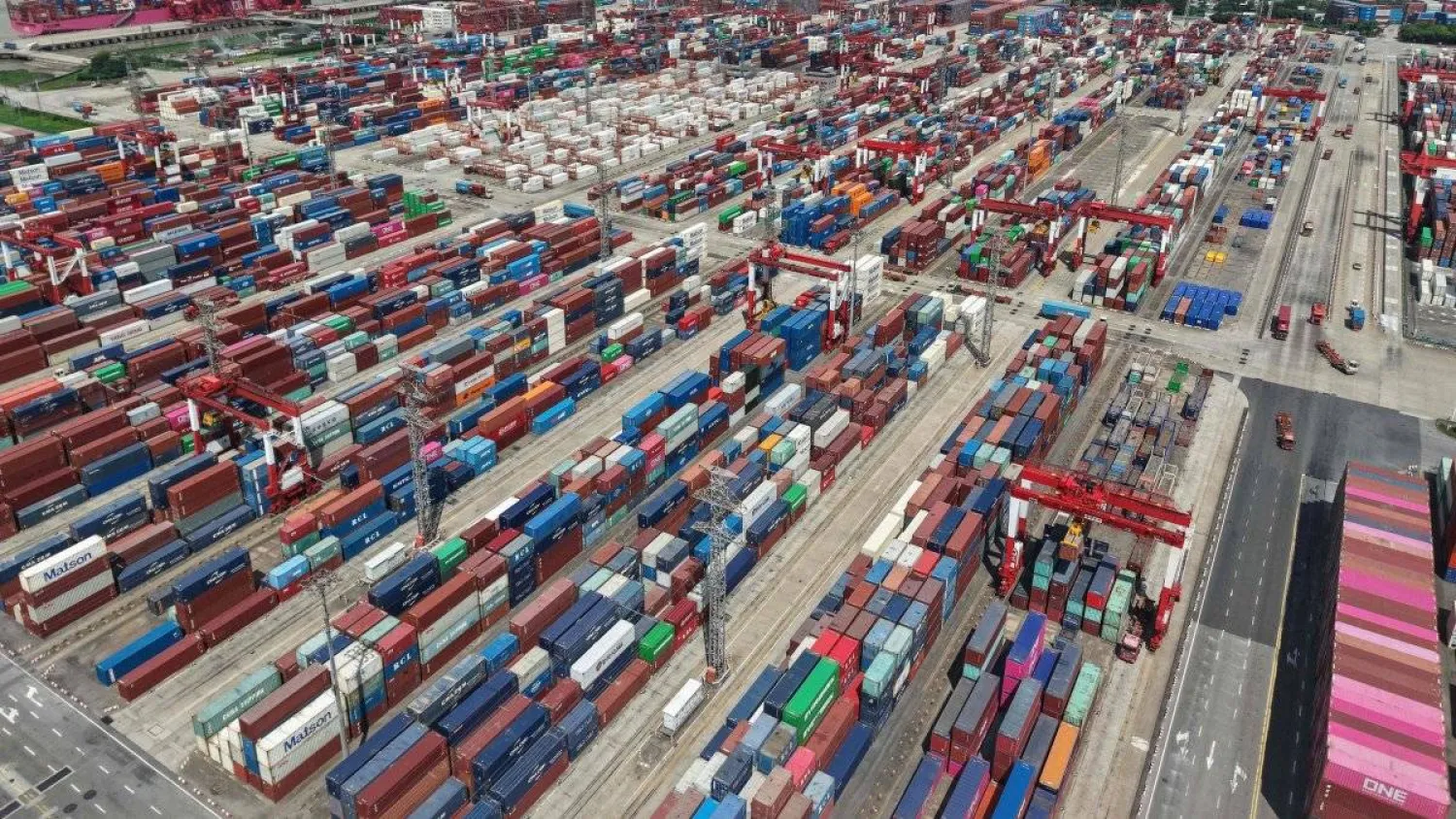
Containers are seen at the port in Shanghai, China, Oct. 13, 2025. (AFP)
TT

Trump Shook up Global Trade This Year; Some Uncertainty May Persist in 2026 

Containers are seen at the port in Shanghai, China, Oct. 13, 2025. (AFP)

President Donald Trump's return to the White House in 2025 kicked off a frenetic year for global trade, with waves of tariffs on US trading partners that lifted import taxes to their highest since the Great Depression, roiled financial markets and sparked rounds of negotiations over trade and investment deals.

His trade policies - and the global reaction to them - will remain front and center in 2026, but face some hefty challenges.

WHAT HAPPENED IN 2025

Trump's moves, aimed broadly at reviving a declining manufacturing base, lifted the average tariff rate to nearly 17% from less than 3% at the end of 2024, according to Yale Budget Lab, and the levies are now generating roughly $30 billion a month of revenue for the US Treasury.

They brought world leaders scrambling to Washington seeking deals for lower rates, often in return for pledges of billions of dollars in US investments. Framework deals were struck with a host of major trading partners, including the European Union, the United Kingdom, Switzerland, Japan, South Korea, Vietnam and others, but notably a final agreement with China remains on the undone list despite multiple rounds of talks and a face-to-face meeting between Trump and Chinese leader Xi Jinping.

The EU was criticized by many for its deal for a 15% tariff on its exports and a vague ‌commitment to big ‌US investments. France's prime minister at the time, Francois Bayrou, called it an act of submission ‌and ⁠a "somber day" for the ‌bloc. Others shrugged that it was the "least bad" deal on offer.

Since then, European exporters and economies have broadly coped with the new tariff rate, thanks to various exemptions and their ability to find markets elsewhere. French bank Societe Generale estimated the total direct impact of the tariffs was equivalent to just 0.37% of the region's GDP.

Meanwhile, China's trade surplus defied Trump's tariffs to surpass $1 trillion as it succeeded in diversifying away from the US, moved its manufacturing sector up the value chain, and used the leverage it has gained in rare earth minerals - crucial inputs into the West's security scaffolding - to push back against pressure from the US or Europe to curb its surplus.

What notably did not happen was the economic calamity and high inflation that legions ⁠of economists predicted would unfold from Trump's tariffs.

The US economy suffered a modest contraction in the first quarter amid a scramble to import goods before tariffs took effect, but quickly rebounded and ‌continues to grow at an above-trend pace thanks to a massive artificial intelligence investment boom ‍and resilient consumer spending. The International Monetary Fund, in fact, twice ‍lifted its global growth outlook in the months following Trump's "Liberation Day" tariffs announcement in April as uncertainty ebbed and deals were struck to reduce ‍the originally announced rates.

And while US inflation remains somewhat elevated in part because of tariffs, economists and policymakers now expect the effects to be more mild and short-lived than feared, with cost sharing of the import taxes occurring across the supply chain among producers, importers, retailers and consumers.

WHAT TO LOOK FOR IN 2026 AND WHY IT MATTERS

A big unknown for 2026 is whether many of Trump's tariffs are allowed to stand. A challenge to the novel legal premise for what he branded as "reciprocal" tariffs on goods from individual countries and for levies imposed on China, Canada and Mexico tied to the flow of fentanyl into the US was argued before the US Supreme Court in late 2025, ⁠and a decision is expected in early 2026.

The Trump administration insists it can shift to other, more-established legal authorities to keep tariffs in place should it lose. But those are more cumbersome and often limited in scope, so a loss at the high court for the administration might prompt renegotiations of the deals struck so far or usher in a new era of uncertainty about where the tariffs will end up.

Arguably just as important for Europe is what is happening with its trading relationship with China, for years a reliable destination for its exporters. The depreciation of the yuan and the gradual move up the value chain for Chinese companies have helped China's exporters. Europe's companies meanwhile have struggled to make further inroads into the slowing domestic Chinese market. One of the key questions for 2026 is whether Europe finally uses tariffs or other measures to address what some of its officials are starting to call the "imbalances" in the China-EU trading ties.

Efforts to finally cement a US-China deal loom large as well. A shaky detente reached in this year's talks will expire in the second half of 2026, and Trump and Xi are tentatively set to meet twice over the course of the ‌year.

And lastly, the free trade deal with the two largest US trading partners - Canada and Mexico - is up for review in 2026 amid uncertainty over whether Trump will let the pact expire or try to retool it more to his liking.



Saudi Crown Prince’s Directives Cut Riyadh Property Prices by 3%

A general view of Riyadh, Saudi Arabia. (SPA)
TT

Saudi Crown Prince’s Directives Cut Riyadh Property Prices by 3%

A general view of Riyadh, Saudi Arabia. (SPA)

Real estate prices in Saudi Arabia’s capital fell 3% in the final quarter of last year, reversing a 1% rise in the previous quarter, in a shift that highlights the on-the-ground impact of policy moves ordered by Prince Mohammed bin Salman bin Abdulaziz, Crown Prince and Prime Minister, to rein in soaring property costs across the Kingdom, particularly in Riyadh.

According to an index issued by the General Authority for Statistics on Tuesday, the real estate price index in Saudi Arabia fell 0.7% in the fourth quarter of last year compared with the same period of 2024.

The decline was driven mainly by weaker performance in the residential sector, which carries the most significant weight in the index, as its annual rate of change fell 2.2%.

The commercial sector continued to see a slight slowdown in growth momentum, while maintaining positive annual growth of 3.6%.

A real balance

Real estate specialists told Asharq Al-Awsat that the Crown Prince’s directives have become evident on the ground after property prices in Riyadh surged to unprecedented levels, prompting government intervention to curb the increases and enable citizens to own their first homes without excessive financial burdens.

Real estate analyst Khaled Al-Mobid said the 0.7 % decline in the real estate price index in the fourth quarter of 2025 reflects the market’s entry into a phase of real balance after years of rapid price increases, describing it as a healthy indicator that supports, rather than weakens, market sustainability.

“What we are witnessing today is not a loss in value, but a logical price correction, particularly in the residential sector, due to increased supply, improved regulation, and greater awareness among market participants, whether buyers or investors,” Al-Mobid told Asharq Al-Awsat.

He added that this balance creates better opportunities for end users, redirects investment toward appropriate products at fair prices, and curbs short-term speculation, serving the real estate economy over the medium and long term.

Housing stability

Real estate specialist Ahmed Omar Basudan told Asharq Al-Awsat that the sector has seen declines in many regions of the Kingdom, as buyers await the effects of government decisions issued under the Crown Prince’s direction.

He cited recent measures, including the announcement of the names of beneficiaries of subsidized land grants in northern Riyadh, located in some of the area’s best neighborhoods.

Basudan said the decision to fix residential rental prices in Riyadh for five years also contributed to the decline in the capital’s real estate market, as tenants are experiencing a period of housing stability, reducing demand for purchases at this stage.

He added that recent amendments to fees on undeveloped land and vacant properties, which have been implemented and are now being collected, also played a role, prompting landowners to move quickly to sell some plots at competitive prices to avoid bearing those fees.

Data from the General Authority for Statistics showed that residential real estate prices fell in the fourth quarter of last year compared with the same quarter of 2024, with the sector declining 2.2%. The drop was driven by a 2.4% fall in residential land prices, a 2.5% decline in apartment prices, a 1.3% decrease in villa prices, and a 0.2% drop in residential floor prices.

Quarterly comparison

The real estate price index fell 0.4% in the fourth quarter of last year, at a slower pace than in the third quarter.

The index was affected by a 0.4% decline in the residential sector, driven by a 0.7% drop in residential land prices, a 0.4% fall in apartment prices, and a 0.2% decrease in residential floor prices, while villa prices rose 0.8%.

At the regional level, the annual real estate price index fell 0.7% nationwide in the fourth quarter of last year, with Riyadh recording a 3% decline, compared with a 1% increase in the third quarter.

The Eastern Province posted the highest real estate price increase at 4%, followed by Makkah at 2.5%, Tabuk and Jazan at 1.1% each, and Al-Jawf at 0.4%.

By contrast, Hail, the Northern Borders region, and Madinah recorded the steepest declines, at 8.9%, 6.8%, and 6.1%, respectively.


Saudi Industry Minister Meets with Global Leaders at World Economic Forum to Advance Partnerships

Saudi Minister of Industry and Mineral Resources Bandar Alkhorayef held a series of high-level meetings with government officials and global business leaders at the World Economic Forum. (SPA)
TT

Saudi Industry Minister Meets with Global Leaders at World Economic Forum to Advance Partnerships

Saudi Minister of Industry and Mineral Resources Bandar Alkhorayef held a series of high-level meetings with government officials and global business leaders at the World Economic Forum. (SPA)

Saudi Minister of Industry and Mineral Resources Bandar Alkhorayef held on Tuesday a series of high-level meetings with government officials and global business leaders on the sidelines of the Kingdom's participation in the 2026 World Economic Forum in Davos.

As part of the Saudi delegation, Alkhorayef participated in a meeting with Swiss President Guy Parmelin. The meeting reviewed the robust strategic partnership between their nations and explored avenues to deepen cooperation in the industrial and mining sectors, aiming to expand bilateral ties to serve mutual interests.

Alkhorayef met with CEO of BlackRock Larry Fink, and President and CEO of the World Economic Forum Børge Brende. Talks focused on boosting the partnership between the Kingdom and the forum, exploring new cooperation in advanced manufacturing and critical minerals, and strengthening joint efforts to fortify industrial and mining supply chains.

In a series of bilateral meetings, Alkhorayef met with leaders of major global firms, including CEO of Capgemini Aiman Ezzat, Senior Partner at Bain & Company Dr. Jörg Gnamm, and CEO of Copa-Data Stefan Reuther. The meetings focused on unlocking opportunities for collaboration in advanced manufacturing, digital solutions, industrial automation, and smart systems. The officials emphasized leveraging global consulting expertise to boost factory efficiency, accelerate the Kingdom's industrial transformation, and bolster the competitiveness of its industrial and mining sectors.


Saudi-US Trade and Investment Council Meetings Kick Off in Riyadh

Chaired by the GAFT, the Saudi-US Trade and Investment Council aims to strengthen economic cooperation between the two countries by reviewing trade and investment policies, addressing barriers, and supporting technical dialogue among relevant entities. (SPA)
TT

Saudi-US Trade and Investment Council Meetings Kick Off in Riyadh

Chaired by the GAFT, the Saudi-US Trade and Investment Council aims to strengthen economic cooperation between the two countries by reviewing trade and investment policies, addressing barriers, and supporting technical dialogue among relevant entities. (SPA)

Technical team meetings of the Saudi-US Trade and Investment Council (TIFA) kicked off in Riyadh on Tuesday.

Held under the theme “A Platform for Dialogue, Partnership, and Economic Growth,” the meetings were attended by Deputy Governor of the General Authority of Foreign Trade (GAFT) for International Relations Abdulaziz Alsakran, Assistant United States Trade Representative for Europe and the Middle East Bryant Trick, with the participation of 20 entities from both sides.

Chaired by the GAFT, the Saudi-US Trade and Investment Council aims to strengthen economic cooperation between the two countries by reviewing trade and investment policies, addressing barriers, and supporting technical dialogue among relevant entities.

The council focuses on five main objectives: developing trade and investment policies; facilitating trade and addressing technical and regulatory barriers; supporting cooperation on sanitary and phytosanitary measures and agricultural products; enhancing intellectual property protection; and advancing digital trade, innovation, and emerging technologies.

Saudi government entities participating in the council work to develop initiatives and activities that help elevate cooperation between the two countries and achieve its objectives, serving mutual interests.

Over the past ten years, trade exchange between Saudi Arabia and the United States has reached $500 billion, making the United States the Kingdom’s second-largest import partner. Trade exchange since 2020 has recorded a growth rate exceeding 50%, reflecting the depth and strength of economic relations between the two countries.