


Japan Proposes Record Budget Spending While Curbing Fresh Debt

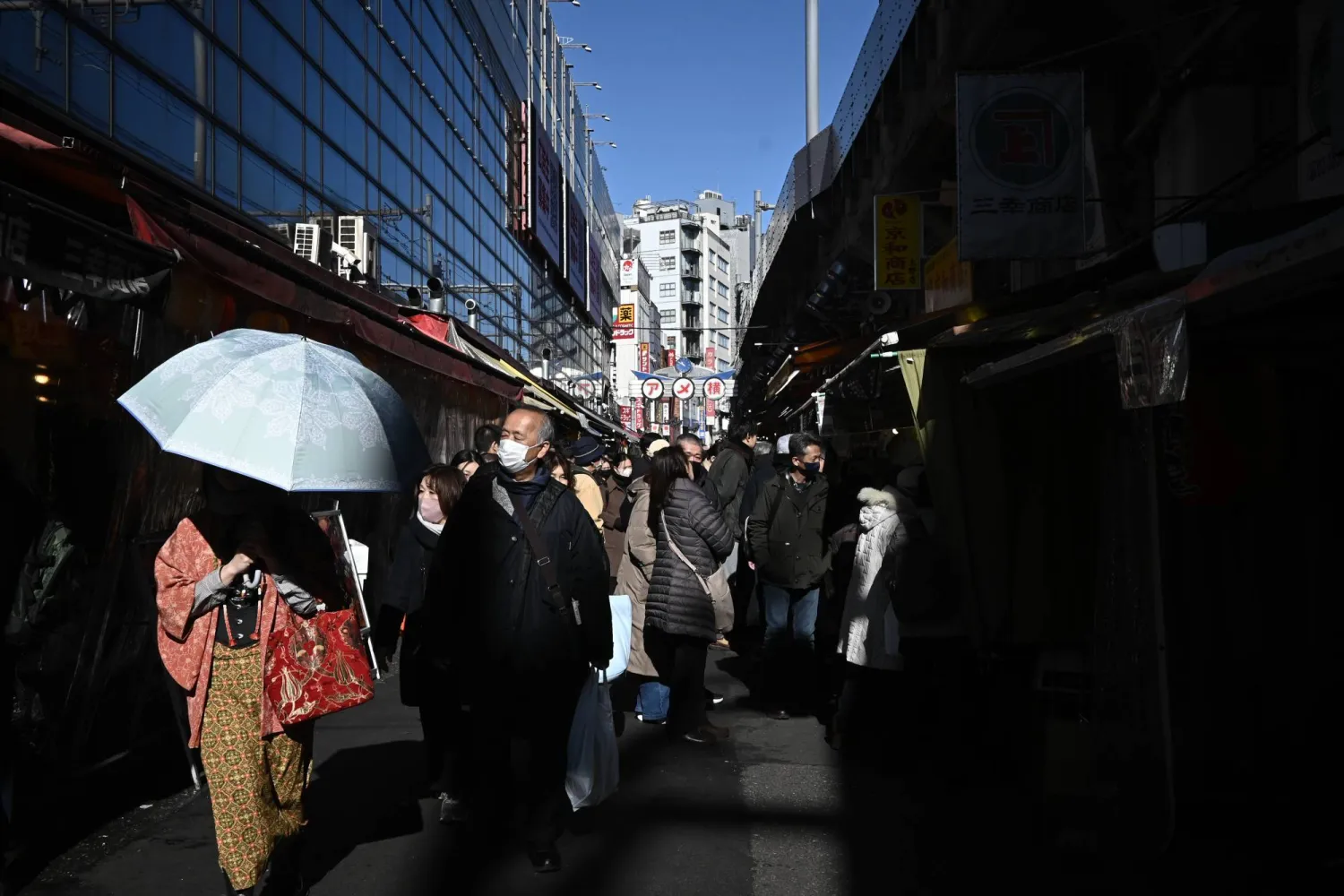
Year-end shoppers walk along at the Ameyoko shopping street ahead of the New Year in Tokyo, Japan, 26 December 2025. (EPA)
TT

Japan Proposes Record Budget Spending While Curbing Fresh Debt

Year-end shoppers walk along at the Ameyoko shopping street ahead of the New Year in Tokyo, Japan, 26 December 2025. (EPA)

Japan's government on Friday proposed record spending for next fiscal year while curbing debt issuance, underscoring Prime Minister Sanae Takaichi's challenge in boosting the ​economy while inflation remains above the central bank's target.

Her cabinet approved a draft budget of $783 billion that addresses market jitters by capping bond issuance and reducing the proportion of the budget financed by fresh debt to the lowest in almost three decades.

Also complicating Takaichi's policy challenge, core inflation in Tokyo stayed above the Bank of Japan's 2% target this month while the yen remains weak, bolstering the central bank's case to keep raising interest rates.

The record 122.3-trillion-yen budget for the year starting in April, a core part of Takaichi's "proactive" fiscal policy, will likely underpin consumption but could also accelerate inflation and further strain Japan's tattered finances.

DELICATE BALANCE OF BUDGET SUPPORT, DEBT RESTRAINT

Investor unease about fiscal expansion in an economy with the heaviest debt burden in the industrialized world has driven super-long government bond yields to record highs and weighed on the ‌yen.

"We believe we have ‌been able to draft a budget that not only increases allocations for key policy ‌measures ⁠but also takes ​fiscal discipline ‌into account, achieving both a strong economy and fiscal sustainability," said Finance Minister Satsuki Katayama.

She told a press conference the draft budget keeps new bond issuance below 30 trillion yen ($190 billion) for a second consecutive year, with the debt dependence ratio falling to 24.2%, the lowest since 1998.

The Takaichi government's efforts to reassure Japanese government bond investors were showing some success.

The 30-year JGB yield fell on Thursday from a record high 3.45% after Reuters reported the government will likely reduce new issuance of super-long JGBs next fiscal year to the lowest in 17 years. Yields slipped further on Friday on the administration's efforts at fiscal restraint.

The budget was not as large as initially feared, said Saisuke Sakai, senior economist at Mizuho Research & Technologies. "But political fragmentation raises ⁠the risk that Takaichi may resort to a large supplementary budget next year to secure opposition support, keeping alive market concerns that fiscal expansion could push the yen down and accelerate inflation," he ‌said.

"It's too optimistic to assume that the current environment will persist."

The proposed spending is ‍inflated by a jump in debt-servicing costs for interest payments and ‍debt redemption.

It also reflects a 3.8% rise in military spending to 9 trillion yen ($60 billion) as part of the assertive defense ‍policy of Takaichi, a conservative nationalist, and in line with a U.S. push for its allies to pay more for their own defense.

TOKYO INFLATION SLOWS BUT STILL POINTS TO RATE HIKES

The Tokyo core consumer price index, which excludes volatile costs of fresh food, rose 2.3% in December from a year earlier, less than market forecasts for a 2.5% gain and slowing from a 2.8% increase in November.

The data backs up the central bank's view that core inflation will ​slide below its 2% target in coming months on easing cost pressure, before resuming a more demand-led increase that justifies additional rate increases.

But some analysts warn of the risk renewed yen declines may prod firms to keep raising ⁠prices, leading to sticky, cost-led inflation that could quicken the pace of BOJ rate hikes.

"Today's data suggests food inflation may be peaking. But the weak yen may give firms an excuse to resume price hikes for food, which may keep inflation elevated," said Yoshiki Shinke, senior executive economist at Dai-ichi Life Research Institute.

An inflation index for the capital that strips away both fresh food and fuel costs - closely watched by the BOJ as a measure of demand-driven prices - rose 2.6% in December after a 2.8% increase in November.

Data on Friday also showed Japan's factory output fell 2.6% in November from the previous month, deeper than market forecasts for a 2.0% drop, due to cuts in automobile and lithium-ion battery production.

The BOJ raised its policy rate last week to a 30-year high of 0.75%, taking another landmark step in ending decades of huge monetary support, in a sign of its conviction Japan is progressing toward durably hitting its 2% inflation target.

With core inflation exceeding the BOJ's target for nearly four years, Governor Kazuo Ueda has signaled the BOJ's readiness to keep raising rates if the economy continues to improve, backed by solid wage gains.

Yen bears, however, have dumped ‌the Japanese currency in the belief that Ueda's rate hikes are too gradual, prompting Katayama last week to threaten yen-buying intervention, saying the government was "alarmed as we are clearly seeing one-sided, sharp moves" in the yen.



Trump: 8 EU Countries will be Charged 10% Tariff for Opposing US Control of Greenland

A military vessel HDMS Knud Rasmussen of the Royal Danish Navy docked in Nuuk, Greenland, on Saturday, Jan. 17, 2026. (AP Photo/Evgeniy Maloletka)
TT

Trump: 8 EU Countries will be Charged 10% Tariff for Opposing US Control of Greenland

A military vessel HDMS Knud Rasmussen of the Royal Danish Navy docked in Nuuk, Greenland, on Saturday, Jan. 17, 2026. (AP Photo/Evgeniy Maloletka)

President Donald Trump said Saturday that he would charge a 10% import tax starting in February on goods from eight European nations because of opposition to US control of Greenland.

He said in a social media post that Denmark, Norway, Sweden, France, Germany, the United Kingdom, the Netherlands, and Finland would face the tariff, which would be raised to 25% on June 1 if a deal is not in place for “the Complete and Total purchase of Greenland” by the United States.

Earlier Saturday, hundreds of people in Greenland's capital braved near-freezing temperatures, rain and icy streets to march in a rally in support of their own self-governance in the face of threats of an American takeover.

The Greenlanders waved their red-and-white national flags and listened to traditional songs as they walked through Nuuk's small downtown. Some carried signs with messages like “We shape our future,” “Greenland is not for sale” and “Greenland is already GREAT.” They were joined by thousands of others in rallies across the Danish kingdom.

Meanwhile, Danish Maj. Gen. Søren Andersen, leader of the Joint Arctic Command, told The Associated Press that Denmark doesn't expect the US military to attack Greenland, or any other NATO ally, and that European troops were recently deployed to Nuuk for Arctic defense training.

“I will not go into the political part, but I will say that I would never expect a NATO country to attack another NATO country,” he told the AP on Saturday aboard a Danish military vessel docked in Nuuk. “For us, for me, it’s not about signaling. It is actually about training military units, working together with allies.”

Trump has insisted for months that the US should control Greenland, a semiautonomous territory of NATO ally Denmark, and said earlier this week that anything less than the Arctic island being in US hands would be “unacceptable.”

During an unrelated event at the White House about rural health care, he recounted Friday how he had threatened European allies with tariffs on pharmaceuticals.

“I may do that for Greenland, too,” Trump said, before his announcement Saturday about his targeted tariffs. “I may put a tariff on countries if they don’t go along with Greenland, because we need Greenland for national security. So I may do that."

He had not previously mentioned using tariffs to try to force the issue.


High-Ranking Saudi Delegation to Attend World Economic Forum Meeting in Davos

FILED - 23 January 2020, Switzerland, Davos: The World Economic Forum logo is displayed on a board during a plenary session. Photo: Ciaran McCrickard/World Economic Forum/dpa
TT

High-Ranking Saudi Delegation to Attend World Economic Forum Meeting in Davos

FILED - 23 January 2020, Switzerland, Davos: The World Economic Forum logo is displayed on a board during a plenary session. Photo: Ciaran McCrickard/World Economic Forum/dpa

A high-ranking Saudi delegation led by Minister of Foreign Affairs Prince Faisal bin Farhan bin Abdullah will participate in the World Economic Forum (WEF) Annual Meeting 2026 in Davos, Switzerland, from January 19 to 23.

Alongside Prince Saisal, the delegation includes Saudi Ambassador to the US Princess Reema bint Bandar bin Sultan bin Abdulaziz, Minister of Commerce Majid Al-Kassabi, Minister of Tourism Ahmed Al-Khateeb, Minister of Investment Khalid Al-Falih, Minister of Finance Mohammed Aljadaan, Minister of Communications and Information Technology Abdullah Alswaha, Minister of Industry and Mineral Resources Bandar Alkhorayef, and Minister of Economy and Planning Faisal Alibrahim.

Prince Faisal affirmed that the Kingdom’s participation in the World Economic Forum 2026, themed "A Spirit of Dialogue," demonstrates its commitment to international cooperation in addressing economic challenges.

He stressed the importance of maintaining regional peace, supporting sustainable development, and enhancing global economic partnerships.

In a statement to the Saudi Press Agency (SPA), Prince Faisal also highlighted the importance of public-private collaboration to achieve prosperity and security.

He noted that the Kingdom is broadening cooperation with international partners to better confront economic and environmental challenges while focusing on building institutional and human capacities to adapt to rapid transformations.

Prince Faisal stated that the Kingdom views the Davos 2026 forum as a vital opportunity to strengthen cooperation in building institutional and human capacities, essential pillars for adapting to rapid global economic shifts.

Saudi Arabia is focused on developing innovative solutions in technology and scientific research, he said.

As for Aljadaan, he affirmed that Saudi Arabia's participation in the 56th World Economic Forum stems from its commitment to strengthening international cooperation and addressing global economic challenges.

In a statement to SPA, Aljadaan pointed to the Kingdom's growing influence in shaping global economic trends, driven by its robust economy and regional and international standing.

He emphasized that the Kingdom will use this platform, which brings together government, business, and academic leaders, to explore ways to promote global stability and growth.

The minister stated that this year's forum focuses on five key global challenges: building trust and cooperation, identifying new drivers for sustainable growth, investing in human capital, ensuring the responsible use of technology and innovation, and integrating environmental sustainability into economic models. Discussions will also cover the impacts of artificial intelligence, digital transformation, and cybersecurity on global industries.

Al-Khateeb affirmed that Saudi Arabia's participation in the 2026 World Economic Forum aligns with its leadership in strengthening international cooperation and building partnerships that translate dialogue into tangible results.

Al-Khateeb told SPA that this participation extends the Kingdom's approach to opening joint investment opportunities in vital sectors, particularly tourism. He noted that Saudi Arabia has become a new global tourism powerhouse and a rapidly developing model for creating competitive destinations, reflecting its growing prominence on the international map.

Participation in Davos will highlight the importance of developing tourism experiences and service quality to ensure sustainable growth that balances high demand with added value, while preserving cultural identity and natural resources, the minister added.

As for Alswaha, he said the Kingdom’s participation is supported and enabled by Custodian of the Two Holy Mosques King Salman bin Abdulaziz Al Saud and Prince Mohammed bin Salman bin Abdulaziz Al Saud, Saudi Crown Prince and Prime Minister, and embodies the Kingdom's leadership in fostering shared solutions and strengthening global dialogue on technological innovation and sustainable growth, in alignment with the objectives of Saudi Vision 2030.

In a statement to SPA, the minister explained that the Kingdom's participation aims to convey its national experience in transitioning to the smart era and showcase its notable achievements in building a competitive, technology- and AI-driven economy. It also seeks to broaden international cooperation and open new pathways for partnerships and investments with leading global technology companies and private-sector leaders.


Fitch Affirms Saudi Arabia’s Credit Rating at ‘A+’ with Stable Outlook

FILE PHOTO: The Fitch Ratings logo is seen at their offices at Canary Wharf financial district in London,Britain, March 3, 2016. REUTERS/Reinhard Krause/File Photo
TT

Fitch Affirms Saudi Arabia’s Credit Rating at ‘A+’ with Stable Outlook

FILE PHOTO: The Fitch Ratings logo is seen at their offices at Canary Wharf financial district in London,Britain, March 3, 2016. REUTERS/Reinhard Krause/File Photo

Fitch Ratings has affirmed Saudi Arabia’s sovereign credit rating at A+ with a stable outlook, according to a report issued by the agency on Friday.

The agency said the Kingdom’s credit profile reflects the strength of its fiscal position, noting that its government debt-to-GDP ratio and net sovereign foreign assets are significantly stronger than the medians for both the “A” and “AA” rating categories.

Fitch also highlighted Saudi Arabia’s substantial financial buffers, including deposits and other public sector assets.

The ratings agency projected real GDP growth of 4.8% in 2026 and expects the fiscal deficit to narrow to 3.6% of GDP by the end of 2027.

Fitch also said non-oil revenues are expected to continue benefiting from strong economic activity and improved revenue efficiency.

The agency praised the momentum of economic reforms, including the updated investment system and the continued opening of the real estate and equity markets to foreign investors.