


US Seeks to Assert Control over Venezuelan Oil with Tanker Seizures and Sales Worldwide

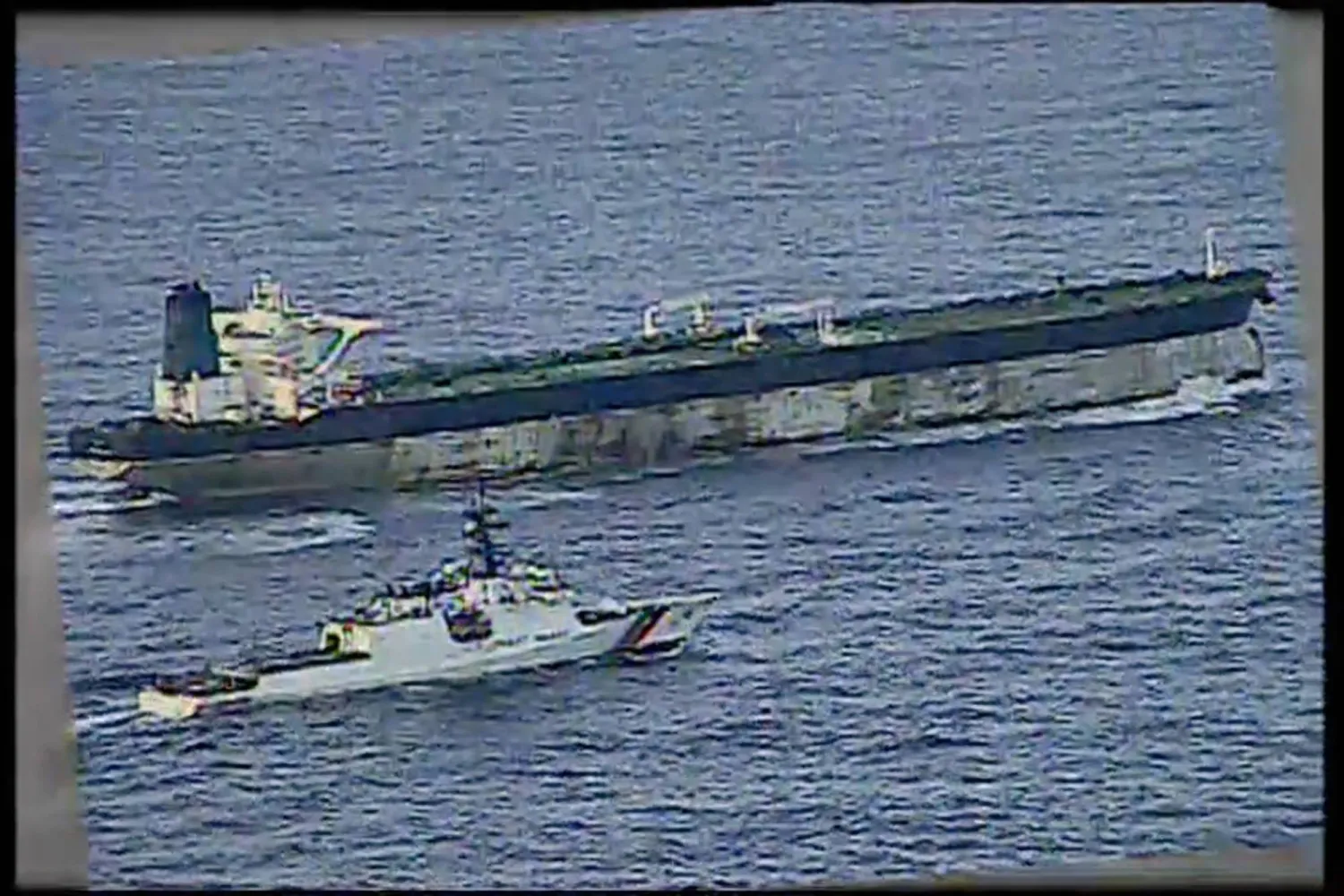
This image from video provided by the US Department of Defense, shows the US Coast Guard cutter Munro shadowing the MV Bella 1 in the North Atlantic Ocean during the maritime interdiction operation Wednesday, Jan. 7, 2026. (Department of Defense via AP)
TT

US Seeks to Assert Control over Venezuelan Oil with Tanker Seizures and Sales Worldwide

This image from video provided by the US Department of Defense, shows the US Coast Guard cutter Munro shadowing the MV Bella 1 in the North Atlantic Ocean during the maritime interdiction operation Wednesday, Jan. 7, 2026. (Department of Defense via AP)

President Donald Trump's administration on Wednesday sought to assert its control over Venezuelan oil, seizing a pair of sanctioned tankers transporting petroleum and announcing plans to relax some sanctions so the US can oversee the sale of Venezuela’s petroleum worldwide.

Trump's administration intends to control the distribution of Venezuela’s oil products globally following its ouster of President Nicolás Maduro in a surprise nighttime raid. Besides the United States enforcing an existing oil embargo, the Energy Department says the “only oil transported in and out of Venezuela” will be through approved channels consistent with US law and national security interests.

That level of control over the world’s largest proven reserves of crude oil could give the Trump administration a broader hold on oil supplies globally in ways that could enable it to influence prices. Both moves reflect the Republican administration’s determination to make good on its effort to control the next steps in Venezuela through its vast oil resources after Trump pledged the US will “run” the country.

Vice President JD Vance said in an interview the US can “control” Venezuela’s “purse strings” by dictating where its oil can be sold.

“We control the energy resources, and we tell the regime, you’re allowed to sell the oil so long as you serve America’s national interest,” Vance said in an interview to air on Fox News Channel’s “Jesse Watters Primetime.”

The vice president added, “And that’s how we exert incredible pressure on that country without wasting a single American life."

Secretary of State Marco Rubio suggested that the oil taken from the sanctioned vessels seized in the North Atlantic and the Caribbean Sea would be sold as part of the deal announced by Trump on Tuesday under which Venezuela would provide up to 50 million barrels of oil to the US.

Venezuela’s interim authorities “want that oil that was seized to be part of this deal,” Rubio told reporters after briefing lawmakers Wednesday about the Maduro operation. “They understand that the only way they can move oil and generate revenue and not have economic collapse is if they cooperate and work with the United States.”

Seizing 2 more vessels US European Command said on social media that the merchant vessel Bella 1 was seized in the North Atlantic for “violations of US sanctions."

The US had been pursuing the tanker since last month after it tried to evade a blockade on sanctioned oil vessels around Venezuela.

Homeland Security Secretary Kristi Noem revealed US forces also took control of the M Sophia in the Caribbean Sea. Noem said on social media that both ships were “either last docked in Venezuela or en route to it."

The two ships join at least two others that were taken by US forces last month — the Skipper and the Centuries.

The Bella 1 had been cruising across the Atlantic nearing the Caribbean on Dec. 15 when it abruptly turned and headed north, toward Europe. The change in direction came days after the first US tanker seizure of a ship on Dec. 10 after it had left Venezuela carrying oil.

When the US Coast Guard tried to board the Bella 1, it fled. US European Command said a Coast Guard vessel had tracked the ship “pursuant to a warrant issued by a US federal court."

As the US pursued it, the Bella 1 was renamed Marinera and flagged to Russia, shipping databases show. A US official, who spoke on the condition of anonymity to discuss sensitive military operations, said the ship’s crew had painted a Russian flag on the side of the hull.

The Russian Foreign Ministry said it had information about Russian nationals among the Marinera's crew and, in a statement carried by Russia’s state news agencies Tass and RIA Novosti, demanded that "the American side ensure humane and dignified treatment of them, strictly respect their rights and interests, and not hinder their speedy return to their homeland.”

Separately, a senior Russian lawmaker, Andrei Klishas, decried the US action as “blatant piracy.”

The Justice Department is investigating crew members of the Bella 1 vessel for failing to obey Coast Guard orders and “criminal charges will be pursued against all culpable actors,” Attorney General Pam Bondi said.

“The Department of Justice is monitoring several other vessels for similar enforcement action — anyone on any vessel who fails to obey instructions of the Coast Guard or other federal officials will be investigated and prosecuted to the fullest extent of the law,” Bondi said on X.

The ship had been sanctioned by the US in 2024 on allegations of smuggling cargo for a company linked to Lebanese militant group Hezbollah, which is backed by Iran.

Easing some sanctions to sell Venezuela's oil The Trump administration, meanwhile, is “selectively” removing sanctions to enable the shipping and sale of Venezuelan oil to markets worldwide, according to an outline of the policies published Wednesday by the Energy Department.

The sales are slated to begin immediately with 30 million to 50 million barrels of oil. The US government said the sales “will continue indefinitely,” with the proceeds settling in US-controlled accounts at “globally recognized banks.” The money would be disbursed to the US and Venezuelan populations at the “discretion” of Trump’s government.

Venezuelan state-owned oil company PDVSA said it is in negotiations with the US government for the sale of crude oil.

“This process is developed under schemes similar to those in force with international companies, such as Chevron, and is based on a strictly commercial transaction, with criteria of legality, transparency and benefit for both parties,” the company said in the statement.

Acting President Delcy Rodríguez on Wednesday night tried to normalize the latest chapter in US-Venezuela economic relations, calling them “neither extraordinary nor irregular.”

“Venezuela must diversify its relations and have relations with all the countries of this hemisphere, just as it should with Asia, Africa, the Middle East and Europe,” she said during a televised meeting with lawmakers and senior government officials.

The US plans to authorize the importation of oil field equipment, parts and services to increase Venezuela’s oil production, which has been roughly 1 million barrels a day.

The Trump administration has indicated it also will invest in the electricity grid to increase production and the quality of life for people in Venezuela, whose economy has been unraveling amid changes to foreign aid and cuts to state subsidies, making necessities, including food, unaffordable to millions.

Meanwhile, Trump abruptly changed his tone about Colombian President Gustavo Petro. Trump said Wednesday that they had exchanged a friendly phone call and he had invited the leader of the South American country to the White House. Trump had said earlier this week that “Colombia is very sick too” and accused Petro of “making cocaine and selling it to the United States.”

Ships said to be part of a shadow fleet Noem said both seized ships were part of a shadow fleet of rusting oil tankers that smuggle oil for countries facing sanctions, such as Venezuela, Russia and Iran.

After the seizure of the now-named Marinera, which open-source maritime tracking sites showed was between Scotland and Iceland earlier Wednesday, the UK defense ministry said Britain’s military provided support, including surveillance aircraft.

“This ship, with a nefarious history, is part of a Russian-Iranian axis of sanctions evasion which is fueling terrorism, conflict, and misery from the Middle East to Ukraine,” UK Defense Secretary John Healey said.

The capture of the M Sophia, on the US sanctions list for moving illicit cargos of oil from Russia, in the Caribbean was much less prolonged.

The ship had been “running dark,” not having transmitted location data since July. Tankers involved in smuggling often turn off their transponders or broadcast inaccurate data to hide their locations.

Samir Madani, co-founder of TankerTrackers.com, said his organization used satellite imagery and surface-level photos to document that at least 16 tankers had left the Venezuelan coast since Saturday, after the US captured Maduro.

The M Sophia was among them, Madani said, citing a recent photo showing it in the waters near Jose Terminal, Venezuela’s main oil export hub.

Windward, a maritime intelligence firm that tracks such vessels, said in a briefing to reporters the M Sophia loaded at the terminal on Dec. 26 and was carrying about 1.8 million barrels of crude oil — a cargo that would be worth about $108 million at current price of about $60 a barrel.



Saudi Arabia Allows Contracting Exceptions for Firms without Regional HQ

The King Abdullah Financial District in Riyadh (Asharq Al-Awsat)
TT

Saudi Arabia Allows Contracting Exceptions for Firms without Regional HQ

The King Abdullah Financial District in Riyadh (Asharq Al-Awsat)

Saudi Arabia has introduced greater flexibility into its investment environment, allowing government entities, under strict controls to safeguard spending efficiency and ensure the delivery of critical projects, to seek exceptions to contract with international companies that do not have regional headquarters in the kingdom.

The Local Content and Government Procurement Authority notified all government bodies of the mechanism to apply for exemptions through the Etimad digital platform.

The step is designed to balance enforcement of the “regional headquarters relocation” decision, in force since early 2024, with the needs of technically specialized projects or those driven by intense price competition.

Under a government decision that took effect at the start of 2024, state entities, including authorities, institutions and government-affiliated funds, are barred from contracting with any foreign commercial company whose regional headquarters in the region is located outside Saudi Arabia.

According to the information, the Local Content and Government Procurement Authority informed all entities of the rules governing contracts with companies that lack a regional headquarters in the kingdom and related parties.

Government entities may request an exemption from the committee for specific projects, multiple projects or a defined time period, provided the application is submitted before launching a tender or initiating direct contracting procedures.

Submission mechanism

In two circulars, the authority detailed how to submit exemption requests and clarified the cases in which contracting is permitted under the controls. It said the exemption service was launched on the Etimad platform in November 2025.

The service is available to entities that float tenders through Etimad. Requests for tenders launched before the service went live, as well as those issued outside the platform, will continue to follow the previously adopted process.

Etimad is the kingdom’s official financial services portal run by the Ministry of Finance, aimed at driving digital transformation of government procedures and boosting transparency and efficiency in managing budgets, contracts, payments, tenders and procurement. The platform streamlines transactions between state entities and the private sector.

Technical criteria

When issuing the contracting controls, the government made clear that companies without a regional headquarters in Saudi Arabia, or related parties, are not barred from bidding for public tenders.

However, their offers can only be accepted in two cases: if there is no more than one technically compliant bid, or if the offer ranks among the best technically and is at least 25% lower in price than the second-best bid after overall evaluation.

Contracts with an estimated value of no more than 1 million riyals ($266,000) are also exempt. The minister may, in the public interest, amend the threshold, cancel the exemption or suspend it temporarily.

More than 700 headquarters

More than 700 multinational companies had relocated their regional headquarters to Riyadh by early 2026, exceeding the initial target of attracting 500 companies by 2030. The program seeks to cement the kingdom’s position as a regional business hub and to localize global expertise.

When announcing the contracting ban, Saudi Arabia said the move was intended to incentivize foreign firms dealing with the government and its affiliated entities to adjust their operations.

It aims to create jobs, curb economic leakage, raise spending efficiency and ensure that key goods and services procured by government entities are delivered inside the kingdom with appropriate local content.

The government said the policy aligns with the objectives of the Riyadh 2030 strategy unveiled during the recent Future Investment Initiative forum, where 24 multinational companies announced plans to move their regional headquarters to the Saudi capital.

It stressed that the decision does not affect any investor’s ability to enter the Saudi economy or continue working with the private sector.


IMF Board to Review Staff-level $8.1 Bln Agreement for Ukraine

The city's downtown on a frosty winter day, amid Russia's attack on Ukraine, in Kyiv, Ukraine February 19, 2026. REUTERS/Alina Smutko
TT

IMF Board to Review Staff-level $8.1 Bln Agreement for Ukraine

The city's downtown on a frosty winter day, amid Russia's attack on Ukraine, in Kyiv, Ukraine February 19, 2026. REUTERS/Alina Smutko

The International Monetary Fund on Thursday said its board ​would review a staff-level agreement for a new $8.1 billion lending program for Ukraine in coming days.

IMF spokeswoman Jule Kozack told reporters that Ukrainian authorities had completed the prior actions needed to move forward with the request ⁠of a new ⁠IMF program, including submission of a draft law on the labor code and adoption of a budget.

She said Ukraine's economic growth in 2025 ⁠was likely under 2%. After four years of war, the country's economy had settled into a slower growth path with larger fiscal and current account balances, she said, noting that the IMF continues to monitor the situation closely.

"Russia's invasion continues to take a ⁠heavy ⁠toll on Ukraine's people and its economy," Kozack said. Intensified aerial attacks by Russia had damaged critical energy and logistics infrastructure, causing disruptions to economic activity, Reuters quoted her as saying.

As of January, she said, 5 million Ukrainian refugees remained in Europe and 3.7 million Ukrainians were displaced inside the country.


US Stocks Fall as Iran Angst Lifts Oil Prices

A screen displays a stock chart at a work station on the floor of the New York Stock Exchange (NYSE) in New York City, US, April 6, 2022. REUTERS/Brendan McDermid
TT

US Stocks Fall as Iran Angst Lifts Oil Prices

A screen displays a stock chart at a work station on the floor of the New York Stock Exchange (NYSE) in New York City, US, April 6, 2022. REUTERS/Brendan McDermid

Wall Street stocks retreated early Thursday as worries over US-Iran tensions lifted oil prices while markets digested mixed results from Walmart.

US oil futures rose to a six-month high as Iran's atomic energy chief Mohammad Eslami said no country can deprive the Islamic republic of its right to nuclear enrichment, after US President Donald Trump again hinted at military action following talks in Geneva.

"We'd call this an undercurrent of concern that is bubbling up in oil prices," Briefing.com analyst Patrick O'Hare said of the "geopolitical angst."

About 10 minutes into trading, the Dow Jones Industrial Average was down 0.6 percent at 49,379.46, AFP reported.

The broad-based S&P 500 fell 0.5 percent to 6,849.35, while the tech-rich Nasdaq Composite Index declined 0.6 percent to 22,621.38.

Among individual companies, Walmart rose 1.7 percent after reporting solid results but offering forecasts that missed analyst expectations.

Shares of the retail giant initially fell, but pushed higher after Walmart executives talked up artificial intelligence investments on a conference call with analysts.

The US trade deficit in goods expanded to a new record in 2025, government data showed, despite sweeping tariffs that Trump imposed during his first year back in the White House.