



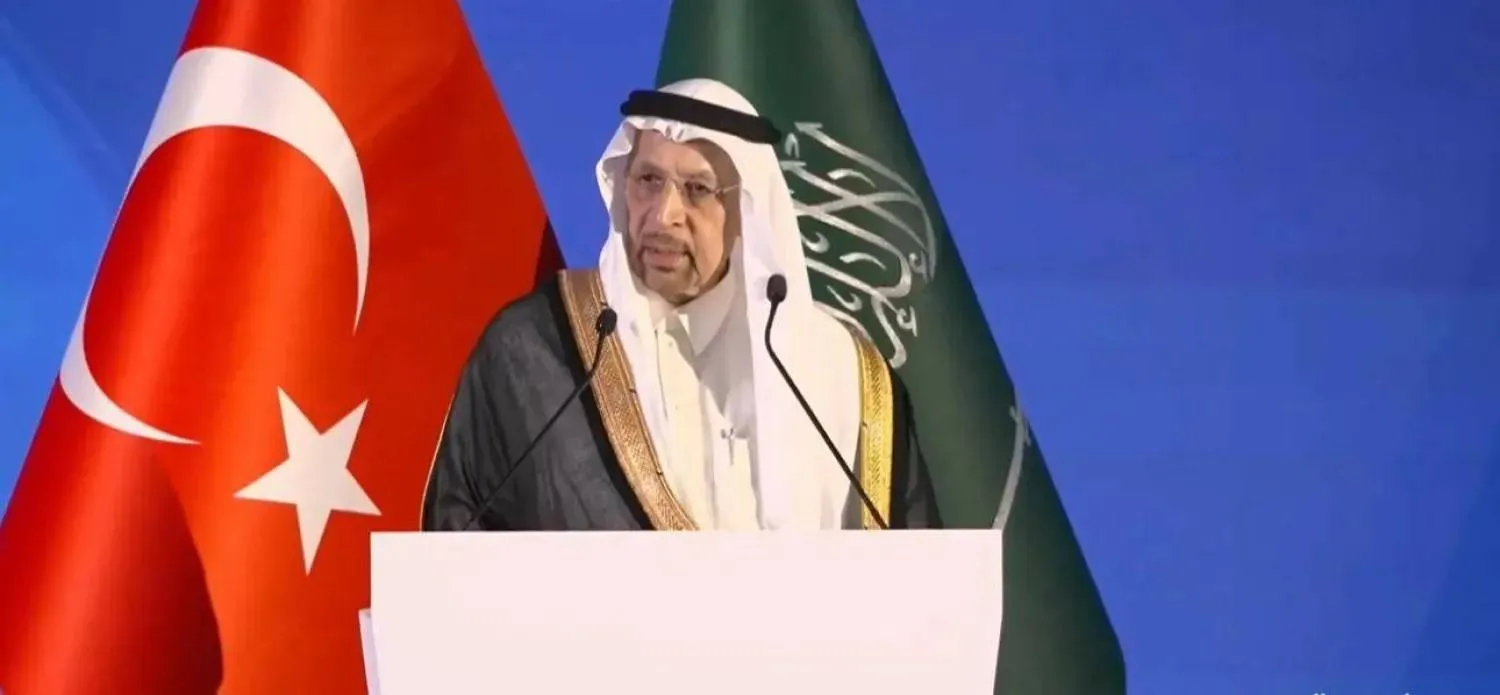

Saudi Arabia’s Minister of Investment Khalid Al-Falih said Turkish direct investment in the Kingdom has exceeded $2 billion. In comparison, bilateral trade has reached about $8 billion, marking 14% growth in a single year.
He said the Saudi-Turkish economic partnership has moved from a phase of dialogue and exploration to one of active execution, underpinned by mutual trust and a central role for the private sector.
Al-Falih was speaking at the Saudi-Turkish Investment Forum, held alongside a meeting in Riyadh on Tuesday between Saudi Crown Prince Mohammed bin Salman and Turkish President Recep Tayyip Erdogan to discuss economic ties and the latest regional developments.
Al-Falih welcomed the presence of a large Turkish business delegation comprising more than 200 companies interested in developing trade, economic, and investment relations with the Kingdom, as well as several regional offices of Turkish firms.
He said Saudi Arabia is looking to attract more Turkish investment.
“This confirms that economic cooperation, particularly the role of the private sector, represents a core pillar of this strategic partnership between the Kingdom and Türkiye,” he said.
“This forum reflects the unprecedented level reached by Saudi-Turkish trade relations, the enthusiasm and confidence on both sides, and our determination to move from dialogue and exploration to an execution phase that has already begun.”
Turkish investments
Regarding economic relations between the two countries, Al-Falih said Turkish direct investment in Saudi Arabia has exceeded $2 billion, concentrated in manufacturing, real estate, construction, agriculture, and trade, among other sectors.
He added that total bilateral trade has reached about $8 billion, up 14% over the past year.
Active companies
Al-Falih said 1,473 investment licenses have been issued to active Turkish companies in the Kingdom up to last year, noting that “all these elements reflect the growth of trade relations between the two countries and the shift from identifying opportunities to implementing declared ambitions.”
Global shifts
He said the current phase of cooperation is critical given its timing, as the world experiences greater caution and selectivity in capital flows and a restructuring of global value and supply chains.
“Investors are now prioritizing high-quality investments of an appropriate scale and flexibility, in countries that enjoy a clear and stable investment environment over the long term,” he said.
Two economic pillars
In this context, Al-Falih said Saudi Arabia and Türkiye stand out as two economic pillars in the Middle East, as the only two countries in the region that are members of the G20, together accounting for around 50% of the region’s total gross domestic product.
He said the two countries account for a large share of global trade between the region and the world, as well as of foreign direct investment inflows.
Saudi Arabia is the largest economy and investment destination in the Arab world, he said, while Türkiye is a leading manufacturing and export hub in the region.
“The advantages sought by investors and enjoyed by our two countries confirm that their economies are more complementary than competitive,” he added.
Competitive advantages
Al-Falih said Saudi Arabia is a global energy hub, based on its entrenched position in oil and gas and its growing role in renewable energy, hydrogen, power generation, and electricity exports.
He said the Kingdom is also a significant investment power steadily moving toward a leading global position in artificial intelligence, digitalization, and data, as well as tourism, transport, and logistics services.
He added that Saudi Arabia has an enabling regulatory environment, supportive cities and economic zones, and one of the most advanced and integrated logistics and digital infrastructures in the region.
Turkish expertise
By contrast, Al-Falih said Türkiye has distinctive expertise and capabilities across several sectors, including manufacturing, tourism, and services, alongside a strong private sector, a highly skilled workforce, and deep integration with European markets through a free trade agreement.


