Oil Extends Climb on Fears of Escalating Iran Tensions

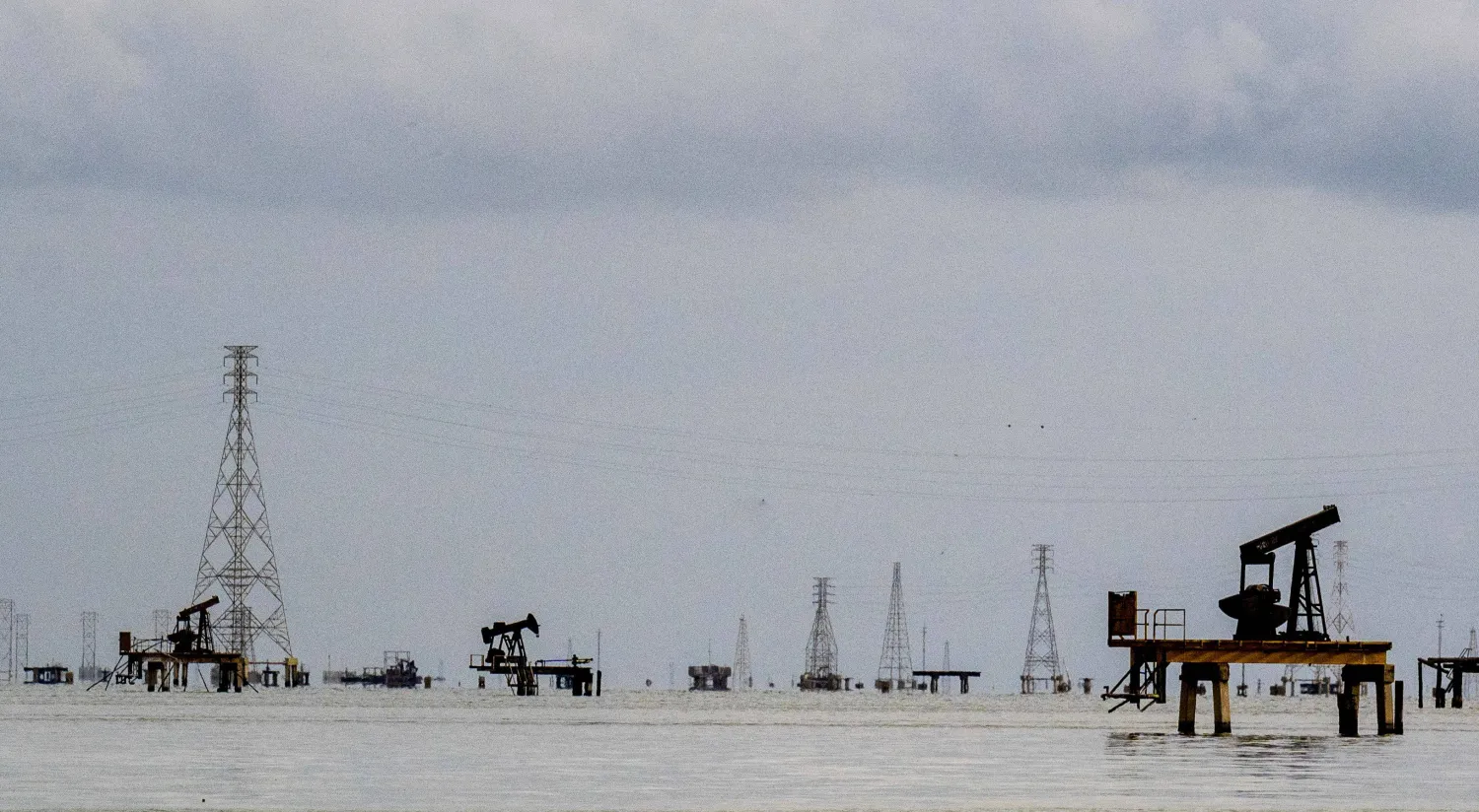
This image shows oil rigs in Cabimas, south of Lake Maracaibo, Zulia State, Venezuela, on January 31, 2026. (AFP)
TT

Oil Extends Climb on Fears of Escalating Iran Tensions

This image shows oil rigs in Cabimas, south of Lake Maracaibo, Zulia State, Venezuela, on January 31, 2026. (AFP)

Oil prices extended gains on Wednesday after the US shot down ​an Iranian drone and armed Iranian boats approached a US-flagged vessel in the Strait of Hormuz, rekindling fears of an escalation in tensions between Washington and Tehran.

Brent crude futures were up 56 cents, or 0.8%, at $67.89 per barrel at 0400 GMT. US West Texas Intermediate crude was up 63 cents, or 1.0%, at $63.84 per barrel.

Both benchmarks rose nearly 2% on Tuesday, as investors monitored developments between the US and Iran.

"Uncertainty about how these talks will play out ‌means the market will ‌likely continue to price in some risk ‌premium," said ⁠ING ​commodity strategists ‌on Wednesday.

The US military on Tuesday shot down an Iranian drone that "aggressively" approached the Abraham Lincoln aircraft carrier in the Arabian Sea, the US military said, in an incident first reported by Reuters.

Separately, in the Strait of Hormuz between the Arabian Gulf and the Gulf of Oman, a group of Iranian gunboats approached a US-flagged tanker north of Oman, maritime sources and a security consultancy said on Tuesday.

Meanwhile, Tehran ⁠is demanding that its talks with the US this week be held in Oman not Türkiye, and ‌that the scope be narrowed to two-way negotiations on ‍nuclear issues only, casting doubt on ‍whether the meeting will proceed as planned.

"Heightened tensions in the Middle East ‍provided support to the oil market," said Satoru Yoshida, a commodity analyst with Rakuten Securities.

OPEC members Saudi Arabia, Iran, the United Arab Emirates, Kuwait and Iraq export most of their crude via the Strait of Hormuz, mainly to Asia. Iran was the third-biggest OPEC ​crude producer in 2025, according to US Energy Information Administration data.

Oil prices also found support from industry data showing a sharp drop in US ⁠crude stockpiles. Inventories in the top producing and consuming nation fell over 11 million barrels last week, sources said, citing American Petroleum Institute figures.

Official data from the US Energy Information Administration is due on Wednesday at 10:30 a.m. EST (1530 GMT). Analysts polled by Reuters were expecting a rise in crude inventories.

On Tuesday, oil prices were also buoyed by a trade agreement between the US and India that raised hopes of stronger global energy demand, while continued Russian attacks on Ukraine added to concerns that Moscow's oil would remain sanctioned for longer.

"India's trade agreement with the US to halt purchases of Russian crude, along with the ongoing Russia-Ukraine war, is also providing support," ‌Yoshida said, projecting that WTI would likely continue to trade around $65 a barrel for now.


Novak Says Oil Demand to Gradually Rise in March, April

FILED - 13 April 2015, Berlin: Then Russian Energy Minister Alexander Novak attends an event in Berlin. Photo: Britta Pedersen/dpa-Zentralbild/dpa
TT

Novak Says Oil Demand to Gradually Rise in March, April

FILED - 13 April 2015, Berlin: Then Russian Energy Minister Alexander Novak attends an event in Berlin. Photo: Britta Pedersen/dpa-Zentralbild/dpa

Russia’s Deputy Prime Minister Alexander Novak said on Tuesday there is currently a balance on the global oil market, while demand will be gradually rising in March and April.

Novak’s comments came when asked about the OPEC+ group’s plans for its production policy.

OPEC expects oil demand to rise by 1.34 million barrels per day in 2027, close to the 1.38 million bpd growth expected this year, it said in a monthly report on its website.

The outlook is OPEC's first 2027 projection in its monthly report.

The report forecast demand for OPEC+ crude will average 43 million bpd in 2026, unchanged from last month and close to what OPEC+ produced in December. The organization projected that demand for OPEC+ crude will average 43.6 million barrels per day (bpd) in 2027.

The main growth drivers are expected to be the US, Brazil, Canada, and Argentina.

Novak did not indicate possible decisions for the months following April.

“As shipping and travel intensify, demand will gradually increase starting in March and April. This will be an additional factor to ensure balance,” he noted.

Eight OPEC+ countries on Sunday agreed to maintain a planned pause in their oil output hikes for March.

The eight countries—Saudi Arabia, Russia, Iraq, the UAE, Kuwait, Kazakhstan, Algeria, and Oman—reaffirmed their commitment to oil market stability, based on a stable global economic outlook and healthy market fundamentals reflected in declining inventory levels.

The OPEC+ countries reiterated that the 1.65 million barrels per day (bpd) reduction may be returned in part or in full subject to evolving market conditions and in a gradual manner. The countries will continue to closely monitor and assess market conditions.

Those countries raised output quotas by about 2.9 million barrels per day (bpd) from April through the end of December 2025, equivalent to nearly 3% of global demand.

India and Russian Oil

Separately, the Kremlin said on Tuesday it had heard no statements from India about halting purchases of Russian oil after US President Donald Trump said New Delhi had agreed to stop such purchases as part of a trade accord with Washington.

Kremlin spokesman Dmitry Peskov said Russia was carefully analyzing Trump's remarks on relations with India.

Asked directly if India had decided to stop buying Russian oil, Peskov said: “So far, we have not heard any statements from Delhi on this issue.”

US President Donald Trump announced a trade deal on Monday with India that slashes US tariffs on Indian goods to 18% from 50% in exchange for India halting Russian oil purchases and lowering trade barriers.

Trump announced the deal on social media following a call with Indian Prime Minister Narendra Modi, noting that India would now buy oil from the US and potentially Venezuela.


Al-Falih: Turkish Investment in Saudi Arabia Tops $2 Bln, Trade up 14%

Saudi Investment Minister Khalid Al-Falih speaks at the Saudi-Turkish Investment Forum in Riyadh (Asharq Al-Awsat)
TT

Al-Falih: Turkish Investment in Saudi Arabia Tops $2 Bln, Trade up 14%

Saudi Investment Minister Khalid Al-Falih speaks at the Saudi-Turkish Investment Forum in Riyadh (Asharq Al-Awsat)

Saudi Arabia’s Minister of Investment Khalid Al-Falih said Turkish direct investment in the Kingdom has exceeded $2 billion. In comparison, bilateral trade has reached about $8 billion, marking 14% growth in a single year.

He said the Saudi-Turkish economic partnership has moved from a phase of dialogue and exploration to one of active execution, underpinned by mutual trust and a central role for the private sector.

Al-Falih was speaking at the Saudi-Turkish Investment Forum, held alongside a meeting in Riyadh on Tuesday between Saudi Crown Prince Mohammed bin Salman and Turkish President Recep Tayyip Erdogan to discuss economic ties and the latest regional developments.

Al-Falih welcomed the presence of a large Turkish business delegation comprising more than 200 companies interested in developing trade, economic, and investment relations with the Kingdom, as well as several regional offices of Turkish firms.

He said Saudi Arabia is looking to attract more Turkish investment.

“This confirms that economic cooperation, particularly the role of the private sector, represents a core pillar of this strategic partnership between the Kingdom and Türkiye,” he said.

“This forum reflects the unprecedented level reached by Saudi-Turkish trade relations, the enthusiasm and confidence on both sides, and our determination to move from dialogue and exploration to an execution phase that has already begun.”

Turkish investments

Regarding economic relations between the two countries, Al-Falih said Turkish direct investment in Saudi Arabia has exceeded $2 billion, concentrated in manufacturing, real estate, construction, agriculture, and trade, among other sectors.

He added that total bilateral trade has reached about $8 billion, up 14% over the past year.

Active companies

Al-Falih said 1,473 investment licenses have been issued to active Turkish companies in the Kingdom up to last year, noting that “all these elements reflect the growth of trade relations between the two countries and the shift from identifying opportunities to implementing declared ambitions.”

Global shifts

He said the current phase of cooperation is critical given its timing, as the world experiences greater caution and selectivity in capital flows and a restructuring of global value and supply chains.

“Investors are now prioritizing high-quality investments of an appropriate scale and flexibility, in countries that enjoy a clear and stable investment environment over the long term,” he said.

Two economic pillars

In this context, Al-Falih said Saudi Arabia and Türkiye stand out as two economic pillars in the Middle East, as the only two countries in the region that are members of the G20, together accounting for around 50% of the region’s total gross domestic product.

He said the two countries account for a large share of global trade between the region and the world, as well as of foreign direct investment inflows.

Saudi Arabia is the largest economy and investment destination in the Arab world, he said, while Türkiye is a leading manufacturing and export hub in the region.

“The advantages sought by investors and enjoyed by our two countries confirm that their economies are more complementary than competitive,” he added.

Competitive advantages

Al-Falih said Saudi Arabia is a global energy hub, based on its entrenched position in oil and gas and its growing role in renewable energy, hydrogen, power generation, and electricity exports.

He said the Kingdom is also a significant investment power steadily moving toward a leading global position in artificial intelligence, digitalization, and data, as well as tourism, transport, and logistics services.

He added that Saudi Arabia has an enabling regulatory environment, supportive cities and economic zones, and one of the most advanced and integrated logistics and digital infrastructures in the region.

Turkish expertise

By contrast, Al-Falih said Türkiye has distinctive expertise and capabilities across several sectors, including manufacturing, tourism, and services, alongside a strong private sector, a highly skilled workforce, and deep integration with European markets through a free trade agreement.


Saudi Arabia Plans Global Village at Expo Site After 2030

Saudi Media Minister Salman Al-Dossary visits the Expo 2030 pavilion at the Saudi Media Forum. (Asharq Al-Awsat)
TT

Saudi Arabia Plans Global Village at Expo Site After 2030

Saudi Media Minister Salman Al-Dossary visits the Expo 2030 pavilion at the Saudi Media Forum. (Asharq Al-Awsat)

Saudi Arabia plans to transform the site of Expo 2030 Riyadh into a permanent, sustainable global village once the six-month world fair ends, officials said on Tuesday, as countries begin locking in their presence at the flagship event, with eight nations, including the US, already securing pavilion space.

The details were disclosed during a media briefing for Expo 2030, held on the sidelines of the Saudi Media Forum in Riyadh.

The briefing was attended by chief executive officer of Expo 2030 Riyadh Company Talal Al-Marri and Director General of the Center for Government Communication Abdullah Al-Maghlouth, along with several officials and specialists.

Al-Marri said the site would be fully prepared by 2029, allowing participating countries to begin early preparations ahead of the opening of the global event. He added that eight countries have already reserved pavilion plots, among them the US.

Infrastructure

Work is progressing steadily to prepare the site. In 2025, the government awarded the main infrastructure development contract and deployed a fleet of heavy equipment.

Excavation and landfill works have been carried out over an area of 1.5 million square meters, and construction of hotels dedicated to the exhibition is expected to begin later this year.

The anticipated event, described by organizers as one of the largest international platforms for bringing countries together, is under the theme “The Era of Change: Together for a Foresighted Tomorrow.” The exhibition will run from October 1, 2030, to March 31, 2031.

The event, overseen by the Bureau International des Expositions (BIE), will be held on a six-million-square-meter site north of Riyadh, near King Salman International Airport.

Organizers expect more than 40 million visitors from inside and outside the Kingdom, along with broad participation from international institutions and governmental and non-governmental organizations.

Sustainable development

Expo 2030 aims to host 197 countries and 29 organizations, with more than 230 pavilions addressing significant global challenges and presenting innovative solutions to build a more sustainable future.

The exhibition is designed as a global platform for sharing ideas and expertise on the future of sustainable development and international cooperation, highlighting innovation, culture, and scientific and technological progress.

Events will include a mix of interactive exhibitions, intellectual forums, advanced technology showcases, and dialogue platforms bringing together governments, companies, non-profit organizations, and universities.

Cultural and entertainment programs reflecting the diversity of global cultures and human history will also be featured.

The site’s design draws inspiration from nature and Riyadh’s historical heritage, is built around an ancient valley, and is inspired by the concepts of the oasis and the garden to reflect harmony between nature and urban progress.

The exhibition has been planned as a fully walkable experience, with public facilities and leisure spaces carefully designed to enhance visitor comfort and engagement across pavilions and open areas.

Solar energy

Among the site’s key design features are 226 spherical pavilions, arranged to reflect the philosophy of international cooperation and cultural harmony among nations.

Shaded walkways and green gardens have also been incorporated into public spaces, providing a comfortable environment for visitors and underscoring Saudi Arabia’s commitment to sustainable environmental practices.

All participating countries will contribute to preparing the pavilions, allowing each nation to showcase its culture, achievements, and future ambitions.

Expo 2030 Riyadh is also built around sustainable environmental strategies, including solar energy, natural resource management, water treatment solutions, and waste recycling, to become one of the world’s most sustainability-focused expos.

The event’s program will address themes such as climate action, prosperity for all, and a better tomorrow, reflecting key issues on the global sustainable development agenda.

Expo 2030 Riyadh reflects the Kingdom’s ambition to position itself as a global hub for knowledge, cultural, and economic exchange. It represents a central milestone in its long-term transformation under Vision 2030, aimed at diversifying the economy and strengthening its role on the global stage.