

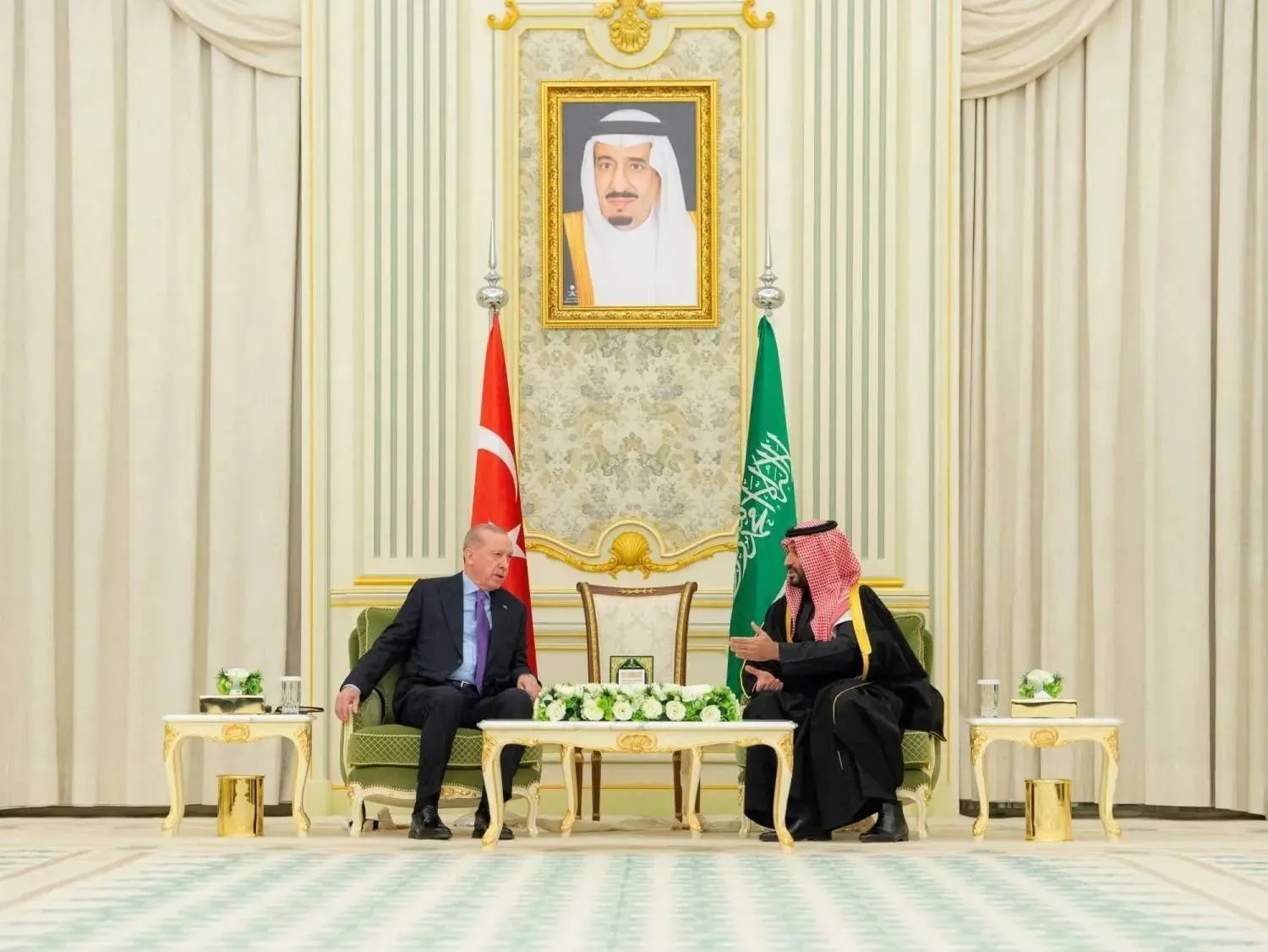

Erdogan’s Saudi Visit to Boost Economic, Investment Ties

Saudi Crown Prince Mohammed bin Salman holding talks with Turkish President Recep Tayyip Erdogan in Riyadh on Feb. 3 (Turkish Presidency)
TT

Erdogan’s Saudi Visit to Boost Economic, Investment Ties

Saudi Crown Prince Mohammed bin Salman holding talks with Turkish President Recep Tayyip Erdogan in Riyadh on Feb. 3 (Turkish Presidency)

Türkiye President Recep Tayyip Erdogan’s visit to Saudi Arabia has given fresh momentum to economic ties between the two countries and opened new avenues for cooperation in trade, energy, and joint investments.

A joint statement issued at the end of Erdogan’s visit to Riyadh on Wednesday said the two sides were determined to move ahead with strengthening their political and economic partnership.

The statement said that Erdogan and Saudi Crown Prince Mohammed bin Salman “held a session of official talks during which they reviewed the historical relations between the two brotherly countries and ways to develop them in all fields.”

The statement showed Saudi-Turkish alignment on deepening economic and investment cooperation and on capitalizing on opportunities offered by Saudi Vision 2030 and the Century of Türkiye Vision.

“In the economic, trade, and investment sectors, both sides commended the strength of the economic ties between the two countries and agreed on further strengthening them, particularly in sectors of mutual priority. They also agreed to capitalize on the investment opportunities offered by the (Saudi Vision 2030) and (Century of Türkiye Vision), for the mutual benefit of both economies,” the statement read.

Emphasizing boosting non-oil trade and activating the Saudi-Turkish Business Council, the statement said the leaders “praised the level of trade exchange and stressed the importance of continued joint efforts to develop the non-oil trade volume, intensify mutual visits between officials in the public and private sectors, and hold trade events in both countries through the (Saudi-Turkish Business Council).”

Energy cooperation

Energy featured prominently in the discussions, with both sides stressing the importance of cooperation in oil, petrochemicals, and renewable energy, and exploring electricity interconnection, clean hydrogen, and energy supply chains to enhance energy security and sustainability.

“Both sides agreed to enhance cooperation in the fields of oil, oil derivatives, and petrochemical supply, and to work together to exploit investment opportunities in the petrochemical and agricultural nutrients sectors, as well as to cooperate on innovative uses of hydrocarbons,” the statement read.

“Both sides affirmed their desire to enhance cooperation in the fields of electricity and renewable energy, leveraging both countries’ extensive experience in renewable energy integration and the Kingdom’s large-scale energy investments.”

“They committed to expediting feasibility studies for electrical interconnection between the two countries, exchanging expertise in electricity and renewable energy technologies and grid automation, electrical grid security and resilience, renewable energy projects, grid interconnection, energy storage technologies, and promoting the participation of companies from both sides in implementing these projects,” it affirmed.

“They also emphasized the importance of strengthening cooperation in energy efficiency and conservation, raising awareness of its importance, and exchanging expertise in the energy services sector and capacity building in this field.”

The two sides also underscored cooperation in mining and the production of critical minerals in support of the global energy transition.

“Both sides agreed to strengthen cooperation in the exploration, extraction, and processing of mineral resources. They also emphasized the importance of international cooperation and joint ventures in critical minerals to ensure the security of supply chains essential for the global energy transition.”

Several agreements and memoranda of understanding were signed during a meeting of the Saudi-Turkish Coordination Council on the sidelines of the visit, covering energy, justice, space, and research and development.

Regarding the Saudi-Turkish Coordination Council, the statement said: “Both sides commended the level of coordination and cooperation within the framework of the (Saudi-Turkish Coordination Council), aimed at achieving shared interests and advancing them to new horizons across all sectors.”

“They emphasized the importance of strengthening cooperation and partnership in the following areas: digital economy, artificial intelligence, emerging technologies, and space technologies; transportation, logistics, and civil aviation; law and justice; culture; tourism; sports and youth; scientific and educational cooperation; media; environment, water, agriculture, and food security; customs, defense industries; Health.”

Reflecting the strong desire to deepen strategic energy cooperation, Saudi Energy Minister Prince Abdulaziz bin Salman and Turkish Energy and Natural Resources Minister Alparslan Bayraktar signed an agreement to collaborate on renewable power generation projects totaling about $2 billion in investment.

The agreement aims to enhance cooperation in renewable energy and green technologies and to support the development and implementation of high-quality projects that help diversify the energy mix, strengthen energy security, and accelerate the shift toward a low-carbon economy in line with both countries’ priorities.

It includes the development and implementation of solar power plants in Türkiye with a total installed capacity of up to 5,000 megawatts in two phases.

The first phase includes two solar projects in the Turkish provinces of Sivas and Karaman, with a combined capacity of 2,000 megawatts. In contrast, the second phase covers additional projects under agreed frameworks, adding an extra 3,000 megawatts.

Projects under the first phase will offer electricity prices that are highly competitive with those of other renewable plants in Türkiye. With investments of about $2 billion, the plants will supply electricity to more than two million Turkish households.

A state-owned Turkish company will purchase the electricity generated by the plants for 30 years, while the projects will maximize the use of locally sourced equipment and services during implementation.

Boost to foreign investment

Turkish Treasury and Finance Minister Mehmet Simsek said the agreement would significantly boost foreign direct investment inflows into Türkiye.

Writing on X on Wednesday, Simsek said "the pace of FDI is picking up, underscoring the growing credibility of our economic program."

"An FDI inflow of USD2bn in Türkiye’s renewable energy projects will accelerate the green transition, enhance energy security, and structurally reduce reliance on energy imports," he added.

Simsek also noted that foreign direct investment in Türkiye reached $12.4 billion in the first 11 months of 2025, up 28% from the same period in 2024.

Economic relations between Saudi Arabia and Türkiye have seen substantial growth over the past two years, reflected in rising trade volumes.

Türkiye’s interest in further strengthening ties was evident in Erdogan’s decision to bring a large business delegation of around 200 company heads and representatives to Riyadh, alongside officials from regional offices of Turkish companies.

The private sector plays a central role in the Saudi-Turkish partnership. Participants at the Saudi-Turkish Economic Forum, held on the sidelines of Erdogan’s visit, stressed the need to enter a new phase focused on implementing joint projects.

Trade growth accelerates

Turkish direct investments in Saudi Arabia have exceeded $2 billion, concentrated in manufacturing, real estate, construction, agriculture, and trade.

Nail Olpak, head of Türkiye’s Foreign Economic Relations Board, said trade with Saudi Arabia was growing at a rapid pace, noting that despite a slowdown in overseas activity by Turkish contractors, they continue to carry out major projects in the kingdom.

According to the latest official Saudi data, total trade between the two countries reached about $8 billion in 2025, up 14% from the previous year. By the end of last year, 1,473 investment licenses had been issued to active Turkish companies.

Saudi Arabia exports crude oil and petrochemical products to Türkiye and imports a range of goods, including carpets, processed stone for construction, tobacco products, food, and furniture.

Data from the Turkish Statistical Institute showed bilateral trade of $5.59 billion in 2015, $5.007 billion in 2016, $4.845 billion in 2017, $4.954 billion in 2018, and $5.107 billion in 2019.

After a decline in 2020 and 2021 due to the COVID-19 pandemic, trade rebounded to $6.493 billion in 2022 and $6.825 billion in 2023, exceeding $7 billion in 2024.

Türkiye’s exports to Saudi Arabia rose to $3.1496 billion in 2025, out of the total bilateral trade of about $8 billion.



TotalEnergies Output Down 15%; Operations at SATORP Refinery in Saudi Arabia Are Normal

FILE PHOTO: The logo of French oil and gas company TotalEnergies is seen on a gas station in Drancy, France March 17, 2025. REUTERS/Abdul Saboor/File Photo
TT

TotalEnergies Output Down 15%; Operations at SATORP Refinery in Saudi Arabia Are Normal

FILE PHOTO: The logo of French oil and gas company TotalEnergies is seen on a gas station in Drancy, France March 17, 2025. REUTERS/Abdul Saboor/File Photo

TotalEnergies has lost 15% of its oil and gas output as the US-Israeli war with Iran shuts fields across the Middle East, including in the UAE, Qatar and Iraq, the French oil major said on its investor website.

That output accounts for ⁠about 10% of ⁠Total's upstream cash flow, it added.

Total said its offshore production in the UAE is shut. The UAE produces around half its oil output from offshore fields.

The French firm said income from an $8 per barrel rise in oil prices that has occurred as a consequence of the ⁠war would ⁠more than offset the loss of output in the Middle East this year as it brings online additional production elsewhere.

Operations at its SATORP refinery in Saudi Arabia are normal, it added.

The impact of shutdowns in Qatar of liquefied natural gas production are limited to two million tons of LNG for Total.


Oil Unlikely to Hit $200 a Barrel, US Energy Chief Says

A foreign tanker carrying Iraqi fuel oil damaged after catching fire in Iraq's territorial waters, following unidentified attacks that targeted two foreign tankers, according to Iraqi port officials, near Basra, Iraq, March 12, 2026.  REUTERS/Mohammed Aty
A foreign tanker carrying Iraqi fuel oil damaged after catching fire in Iraq's territorial waters, following unidentified attacks that targeted two foreign tankers, according to Iraqi port officials, near Basra, Iraq, March 12, 2026. REUTERS/Mohammed Aty
TT

Oil Unlikely to Hit $200 a Barrel, US Energy Chief Says

A foreign tanker carrying Iraqi fuel oil damaged after catching fire in Iraq's territorial waters, following unidentified attacks that targeted two foreign tankers, according to Iraqi port officials, near Basra, Iraq, March 12, 2026.  REUTERS/Mohammed Aty
A foreign tanker carrying Iraqi fuel oil damaged after catching fire in Iraq's territorial waters, following unidentified attacks that targeted two foreign tankers, according to Iraqi port officials, near Basra, Iraq, March 12, 2026. REUTERS/Mohammed Aty

US Energy Secretary Chris Wright said on Thursday that oil prices are unlikely to reach $200 a barrel, with President Donald Trump touting US gains from higher prices as the war with Iran disrupted traffic through the Strait of Hormuz.

"I would say unlikely, but we are focused on the military operation and solving a problem," Wright told CNN when asked if prices would reach $200 a barrel - a level that an Iranian official said prices could hit if the war further escalates, Reuters reported.

Wright's use of the word "unlikely" was a veiled concession that a spike to $200 was possible, though he repeated that the price jump would be weeks not months.

Brent oil hit all-time highs in 2008 of around $147 per barrel, on tension between the West and Iran over its nuclear program, a weak US dollar, and inflation fears.

This time analysts say oil prices could remain high because of the strait's unprecedented shuttering.

"Get ready for the oil barrel to be at $200 because the oil price depends on the regional security which you have destabilized," Ebrahim Zolfaqari, the spokesperson for Tehran's Khatam al-Anbiya military command headquarters, said on Wednesday.

Wright told CNN: "We're in the midst of a significant disruption in the short term to fix the security of energy flow for the long term." The administration was focused on "pragmatic solutions ... to get through these few weeks of tight energy supply," he said.

Trump wrote in a social media post: "The United States is the largest Oil Producer in the World, by far, so when oil prices go up, we make a lot of money." He said he was more focused on stopping Iran from having nuclear weapons.

On Wednesday, Trump urged oil companies to travel through the strait despite the risks. "I think they should use the strait," Trump said. Asked if Iranian mines were in the strait, he added: "We don't think so."

Wright told CNBC on Thursday that the US Navy cannot escort ships through the Strait of Hormuz now but it was "quite likely" that could happen by the end of the month.

On Wednesday, more than 30 countries in the International Energy Agency agreed to the biggest-ever coordinated drawdown of global oil reserves of 400 million barrels, about 40% of which will come from the United States.

The war has forced Middle East Gulf countries to cut total oil production by at least 10 million barrels per day, about 10% of world demand. The IEA said on Thursday that is the biggest oil supply disruption in the history of the global market.

The US will release 172 million barrels of oil from the Strategic Petroleum Reserve, which Wright on Thursday said would be swapped with more than 200 million barrels that will be put back in the reserve within a year.

Wright told CNBC the energy shortages were less likely to affect the United States and other Western Hemisphere countries. "There's no shortage or even really tight oil market in the Western Hemisphere. The issue's in Asia."

US gasoline prices continue to spike 13 days into the war at an average of $3.60 per gallon, according to AAA. Rising oil prices are also likely to boost the costs of other goods, with the closed strait also stalling shipments of fertilizer ingredients and likely raising prices on household items that could hit consumers for months.

Trump had campaigned on lower gasoline and other prices, with Americans set to vote this November in midterm elections that will decide whether his fellow Republicans keep control of Congress.


Saudi Arabia Named Top 10 Global Mining Investment Destination

A view of the skyline of the Saudi capital, Riyadh (SPA)
TT

Saudi Arabia Named Top 10 Global Mining Investment Destination

A view of the skyline of the Saudi capital, Riyadh (SPA)

Saudi Arabia has been named among the world’s top ten mining investment destinations in the Fraser Institute’s Annual Survey of Mining Companies 2025, one of the most respected global benchmarks for assessing mining investment environments and a key reference for international investors.

The report shows that the Kingdom’s mining sector has capped an unprecedented rise on the main ‘Investment Attractiveness Index,’ climbing 13 positions and improving its score by 14.3% within a single year, becoming the only Asian jurisdiction ranked among the world’s top ten mining destinations in 2025, SPA reported.

This milestone reflects a remarkable transformation of the Kingdom’s mining sector, rising from 104th place in 2013 to 23rd in 2024, and now firmly establishing Saudi Arabia as a top ten global destination for mining investment.

This global recognition is based on strong gains in the two fundamental sub-indices. In the ‘Policy Perception Index,’ Saudi Arabia jumped from 20th place last year to 4th globally, scoring 94.99. In the ‘Mineral Potential Index,’ it grew from 24th to 16th, with a score of 73.33. These results reinforce the Kingdom’s message that its investment competitiveness rests on two interlinked criteria: promising geological resources and a modern regulatory framework supported by clear and efficient governance.

Across the detailed policy criteria, Saudi Arabia achieved exceptional results, ranking first globally in three key categories. The Kingdom ranked first globally in ‘Uncertainty Concerning the Administration & Regulations,’ reflecting clarity of mining regulations and executive administration, It recorded a remarkable 558% improvement, driven by the implementation of the new Mining Investment Law and its legal system, the establishment of ESNAD (Saudi Mining Services Company) to strengthen oversight and compliance, and the automation of licensing procedures through the Ta’adeen digital platform.

Saudi Arabia also ranked first globally in ‘Regulatory Duplication and Inconsistencies,’ reflecting success in coordinated efforts across government entities. In addition, the Kingdom ranked first globally in the ‘Taxation Regime,’ strengthening investor confidence and improving the financial competitiveness of mining projects.

In related indicators, Saudi Arabia ranked second globally in ‘Uncertainty Concerning Environmental Regulations’ and third globally in ‘Uncertainty Concerning Disputed Land Claims.’ These results reflect the strength, clarity, and stability of the Kingdom’s environmental regulatory framework, as well as the effectiveness of policies governing land claims and community development. The rankings highlight the impact of coordinated efforts with the Ministry of Environment, Water and Agriculture, alongside structured approaches to managing community engagement requirements around mining operations.

The Kingdom also recorded a significant improvement in the ‘Infrastructure indicator,’ which includes access to roads and energy availability. This progress reflects ongoing efforts to enhance infrastructure, notably through the launch of the Mining Infrastructure Enablement Initiative at the fifth edition of the Future Minerals Forum, held in January.

These top rankings were accompanied by exceptional qualitative leaps, averaging over 100% in other critical criteria. The ‘Legal System’ criterion

improved by 211%, while the ‘Quality of Geological Database’ rose by 203% due to the inclusion of extensive geological survey data, establishing a more transparent and reliable investment environment.

Commenting on the achievement, Vice Minister of Industry and Mineral Resources for Mining Affairs Eng. Khalid bin Saleh Al-Mudaifer said the Kingdom’s entry into the global top ten reflects the depth of reforms implemented under Saudi Vision 2030 in the mining sector.

He noted that the ranking demonstrates the maturity and resilience of Saudi Arabia’s investment environment as the Kingdom positions itself to meet rising global demand for minerals.

Looking ahead, the vice minister added that the ministry will continue to strengthen the sector as a driver of industrial and economic growth by developing legislative and regulatory frameworks that enhance investor confidence and reinforce the Kingdom’s long-term competitiveness.

In addition, he said the Fraser Institute results provide independent international recognition of the rapid transformation underway in Saudi Arabia’s mining sector.

He further noted that ongoing efforts focus on improving the investor experience through greater transparency, faster licensing procedures, and reduced exploration risks, while strengthening supply chain localization and supporting the creation of high-quality employment opportunities.

These regulatory developments are translating into tangible investment outcomes. In 2025, Saudi Arabia issued 61 exploitation licenses for mine development, with investment valued at $11.73 billion (SAR44 billion), compared with 21 licenses in 2024, which represents an increase of 221%.

Active exploration companies increased from six in 2020 to 226 in 2024, representing more than 38‑fold growth. Meanwhile, the number of active exploration mining licenses reached 1,018 by 2025, compared with 500 licenses in 2020, reflecting a growth of approximately 104%.

Saudi Arabia’s Ministry of Industry and Mineral Resources continues to attract investment and facilitate the investor journey through competitive exploration licensing rounds. These rounds have seen unprecedented international interest from leading global mining companies and consortia, including Barrick Gold, Ivanhoe Electric, Shandong Gold, Hancock Prospecting, and Zijin Mining.

As part of these efforts, the ministry recently launched the 11th licensing round, opening competition for exploration licenses across eight mining sites in the regions of Riyadh, Hail, and Aseer, covering a total area of 1,878 km² and targeting deposits of gold, silver, copper, zinc, and iron ore.

To support early‑stage exploration and reduce financial risk, the report also highlighted the ‘Exploration Enablement Program’ as an effective tool for supporting exploration companies. The Kingdom has allocated over $182.67 million (SAR685 million) to the program for the period 2024–2030, targeting exploration licenses in their first five years and requiring participating companies to share geological data to accelerate knowledge exchange and improve the quality of investment decisions.

This advanced ranking and historic progress reflect Saudi Arabia’s continued success in advancing the objectives of Vision 2030: positioning mining as the third pillar of the national industrial base and strengthening the Kingdom’s role as a leading global investment destination and a trusted partner in securing future mineral supply chains.

The survey evaluated 68 mining jurisdictions worldwide, based on 256 responses from senior executives representing global mining companies.