

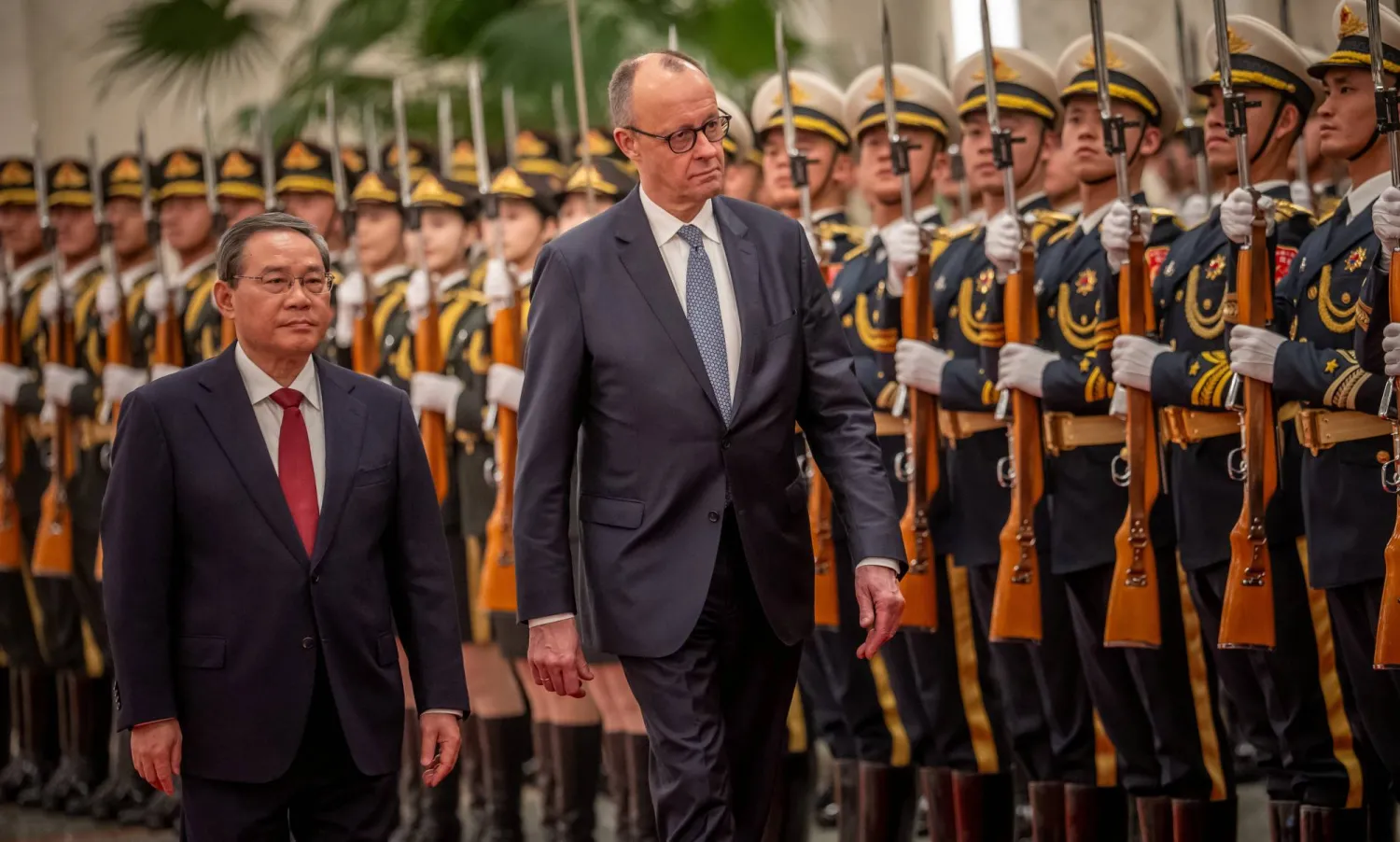

Germany Wants Deeper, Fairer Economic Ties with China, Merz Tells Li 

Chinese Premier Li Qiang welcomes German Chancellor Friedrich Merz with military honors in the Great Hall of the People in in Beijing, China, February 25, 2026. (Reuters)
TT

Germany Wants Deeper, Fairer Economic Ties with China, Merz Tells Li 

Chinese Premier Li Qiang welcomes German Chancellor Friedrich Merz with military honors in the Great Hall of the People in in Beijing, China, February 25, 2026. (Reuters)

China and Germany want to deepen cooperation, German Chancellor Friedrich Merz and Chinese Premier Li Qiang said in Beijing on Wednesday, as Merz began a visit aimed at resetting ties amid a widening trade imbalance.

Merz told Li that Germany attached great importance on maintaining and deepening its extensive economic exchanges with China, its largest trading partner last year, while emphasizing the need for fair cooperation and open communication.

"We have very specific concerns regarding our cooperation, which we want to improve and make fair," said Merz, who faces a tough balancing act of redefining an economic relationship that is increasingly unfavorable to German interests.

Li called on both sides to work together to safeguard multilateralism and free trade, in a comment seen as a reference to US President Donald Trump's trade war, which has upended the global ‌trading system.

"China and ‌Germany, as two of the world's largest economies and major countries with important influence, ‌should ⁠strengthen our confidence in ⁠cooperation, jointly safeguard multilateralism and free trade, and strive to build a more just and fair global governance system," Li said.

NO CONSEQUENTIAL DEALS SIGNED

Despite their calls for deeper engagement, the agreements Merz and Li formalized after their meeting were narrowly targeted and in industries peripheral to both economies.

The five documents signed covered continued efforts in climate change and green transition, cooperation in animal disease prevention and a poultry products protocol, as well as sports collaboration agreements for football and table tennis.

That paled in comparison with Canada and Britain, which respectively signed eight and 12 documents with China last month aimed at boosting trade ⁠and investments.

Still, the business-focused latter half of Merz's visit could see more deals ‌secured.

He is accompanied by a delegation of 30 firms including top carmakers ‌such as Volkswagen and BMW which are acutely feeling the strain of Chinese competition - contributing to the growing trade imbalance that has ‌sparked concern in Berlin and led to calls for protectionist policies.

CHINA-EU TIES IN FOCUS

China is seeking to pitch ‌itself as a reliable economic partner, in contrast to the United States, as Europe struggles to address vulnerabilities in its supply chains and worries about growing dependence on China.

Europe is seeing an acceleration of concerning trends in China, Europe's Trade Commissioner Maroš Šefčovič told the European Parliament on Tuesday, citing China's growing dominance in key manufacturing sectors, a rising imbalance in trade, and falling market share ‌of EU companies in China.

Germany's manufacturing-heavy economy has been particularly hard hit by competition from China's manufacturers, Rhodium Group's China analyst Noah Barkin said in a recent ⁠research note.

Merz, on his first visit ⁠to China, becomes the latest European leader seeking to reset ties with China after Britain's Keir Starmer and Canada's Mark Carney earlier this year, while Beijing touts the benefits of engaging with its massive consumer market and advanced manufacturing base.

Engagement between Europe's largest economy and China could set the stage for EU-China relations this year.

China's market, once coveted by foreign businesses for its wide consumer base and rising spending power, has changed in recent years with a slowing economy capping consumer demand and manufacturing overcapacity increasingly pushing domestic firms to look for opportunities abroad.

CHINA STILL BOASTS MEGA MARKET

In editorials ahead of the visit, Chinese state media emphasized the potential for EU-China cooperation to become a stabilizing force while US tariff policies upend global trade.

Xinhua cited a German chamber of commerce survey finding that innovation gains in China are feeding back into German headquarters.

State-backed newspaper the Global Times said concerns about competition with China would be outweighed by the lure of China's massive market.

"Rhetoric such as 'systemic rival' and 'de-risking' has at times complicated Germany's China policy," it said in an early Wednesday editorial.

"Yet the enthusiasm and actions of the German business community speak louder than political slogans."



Iraq Studies Alternative Options for Oil Exports

Floating oil export loading platforms at the Basra Oil Port, Iraq, March 12, 2026. REUTERS/Mohammed Aty
TT

Iraq Studies Alternative Options for Oil Exports

Floating oil export loading platforms at the Basra Oil Port, Iraq, March 12, 2026. REUTERS/Mohammed Aty

Iraq is studying alternative measures to export crude oil after disruptions to the process amid the US-Israeli war against Iran. At the same time, the country intends to continue producing crude oil at a level of 1.4 million barrels per day.

Iraqi Oil Minister Hayyan Abdul Ghani told the official television channel Al-Iraqiya News that oil exports account for 90 percent of Iraq’s revenues, and that the ministry has decided to continue producing crude oil at 1.4 million barrels per day.

He emphasized that the production and supply of petroleum products to meet domestic demand have not stopped.

He added that refineries are operating at full design capacity to cover local needs, and that sufficient quantities of liquefied gas are available to fully meet domestic needs.

Regarding exports, he explained that the export process has stopped in the south, prompting the government to search for possible alternatives to export crude oil. He revealed that an agreement is close to being signed to export oil through the Turkish Ceyhan pipeline.

Abdul Ghani added that the ministry has prepared a comprehensive plan to manage the current phase, particularly after the new circumstances in the Strait of Hormuz, noting that a plan has been activated to transport 200,000 barrels per day by tanker trucks through Türkiye, Syria, and Jordan.

In a separate context, the oil minister denied that tankers targeted in Iraqi waters belonged to Iraq, explaining that they were not Iraqi vessels and were carrying naphtha.

Iraq recently lost its entire oil export capacity of 3.35 million barrels per day after Iran closed the Strait of Hormuz following escalating conflict in the region.

Iraq relies on crude oil sales for about 95 percent of its revenues to meet the needs of the country’s annual federal budget. This means that the country would face a critical situation if the conflict in the Gulf region and the Strait of Hormuz continues.


Gold Set for Weekly Drop as Oil Price Surge Weighs on Rate-cut Hopes

FILE PHOTO: A goldsmith weighs gold jewelry inside a showroom in Ahmedabad, India, July 31, 2025. REUTERS/Amit Dave/File Photo
TT

Gold Set for Weekly Drop as Oil Price Surge Weighs on Rate-cut Hopes

FILE PHOTO: A goldsmith weighs gold jewelry inside a showroom in Ahmedabad, India, July 31, 2025. REUTERS/Amit Dave/File Photo

Gold prices were on track for a second consecutive weekly drop, despite edging up on Friday, as surging energy prices due to the Middle East war dimmed prospects for near-term US interest rate cuts.

Spot gold was up 0.3% at $5,095.55 per ounce, as of 0633 GMT on Friday. US gold futures for April delivery fell 0.1% to $5,100.20.

The US 10-year Treasury yields eased, increasing the appeal of the non-yielding bullion. Bullion, however, has ‌lost more ‌than 1% so far this week. Since the war ‌started ⁠on February 28, ⁠it has dropped over 3% so far.

Fears of inflation and questions about the Federal Reserve's ability to cut interest rates if high oil prices persist are somewhat counteracting gold's appeal, said Tim Waterer, KCM Trade chief market analyst.

"Given the ongoing uncertainty about the duration and scope of the conflict in the Middle East, I expect gold to remain on the ⁠radar for investors as a safety play." Heightening geopolitical ‌tensions, Iran's Supreme Leader Mojtaba Khamenei said ‌on Thursday that Tehran will keep the strategic Strait of Hormuz closed as ‌leverage against the US and Israel, which has stoked concerns about ‌global energy supply and risk assets.

Oil prices rose above $100 a barrel, as attacks on oil tankers in the Gulf and warnings from Iran shattered prospects of quick de-escalation in the Middle East conflict. As oil prices surged, US President Donald ‌Trump again demanded Fed Chair Jerome Powell cut interest rates.

Traders, however, expect the Fed to keep rates ⁠steady in the current ⁠3.5%-3.75% range at the end of its two-day meeting on March 18, according to CME Group's FedWatch tool. While recent inflation data suggest price growth is under control, the war and the resulting spike in crude prices have yet to filter through the data.

Investors are awaiting the release of the delayed January Personal Consumption Expenditures Index, expected on Friday. Gold discounts in India widened this week to their deepest point in nearly a decade as demand stayed subdued and some traders steered clear of paying import duties, while the escalating Middle East war boosted safe-haven demand in China.

Spot silver was down 1% at $82.91 per ounce. Spot platinum lost 1% to $2,111.45 and palladium fell 1% to $1,603.


Iran War and Rising Fuel Costs Could Boost Panama Canal Traffic, Administrator Says

A cargo ship sails under Las Americas bridge through the Panama Canal, in Panama City, Thursday, March 12, 2026. (AP)
TT

Iran War and Rising Fuel Costs Could Boost Panama Canal Traffic, Administrator Says

A cargo ship sails under Las Americas bridge through the Panama Canal, in Panama City, Thursday, March 12, 2026. (AP)

Panama Canal Administrator Ricaurte Vásquez said Thursday that the conflict in the Middle East and rising fuel costs could ultimately benefit the interoceanic waterway as global shippers adjust routes.

In an interview with The Associated Press, Vásquez said that higher energy, fuel and navigation costs could make the Panama Canal a more attractive option for commercial traffic.

“When costs increase, in general when the price of marine fuel rises, the Panama Canal becomes a more attractive route,” Vásquez said.

Oil prices have risen amid the war in the Middle East, which has led to the temporary closure of the Strait of Hormuz by Iran in response to US and Israeli attacks. About one-fifth of the world’s oil passes through the waterway at the mouth of the Gulf.

If higher energy costs persist, routing cargo through Panama can cut voyages by between three and 15 days, depending on the route, while reducing fuel consumption, he said.

Vásquez said higher fuel costs are expected to affect container ships, bulk carriers and tankers transporting liquefied natural gas. If Middle Eastern supplies are disrupted, shipments may be replaced by other sources, including the United States, which could redirect some LNG cargo from Europe to Asia via Panama.

Gerardo Bósquez, an executive with the Panama Maritime Chamber, said a prolonged conflict could reshape global trade routes, with gas transport among the segments likely to benefit.

Vásquez cautioned that any changes will not be immediate and will depend on how long cargo operators expect the conflict and instability in the Gulf last.