

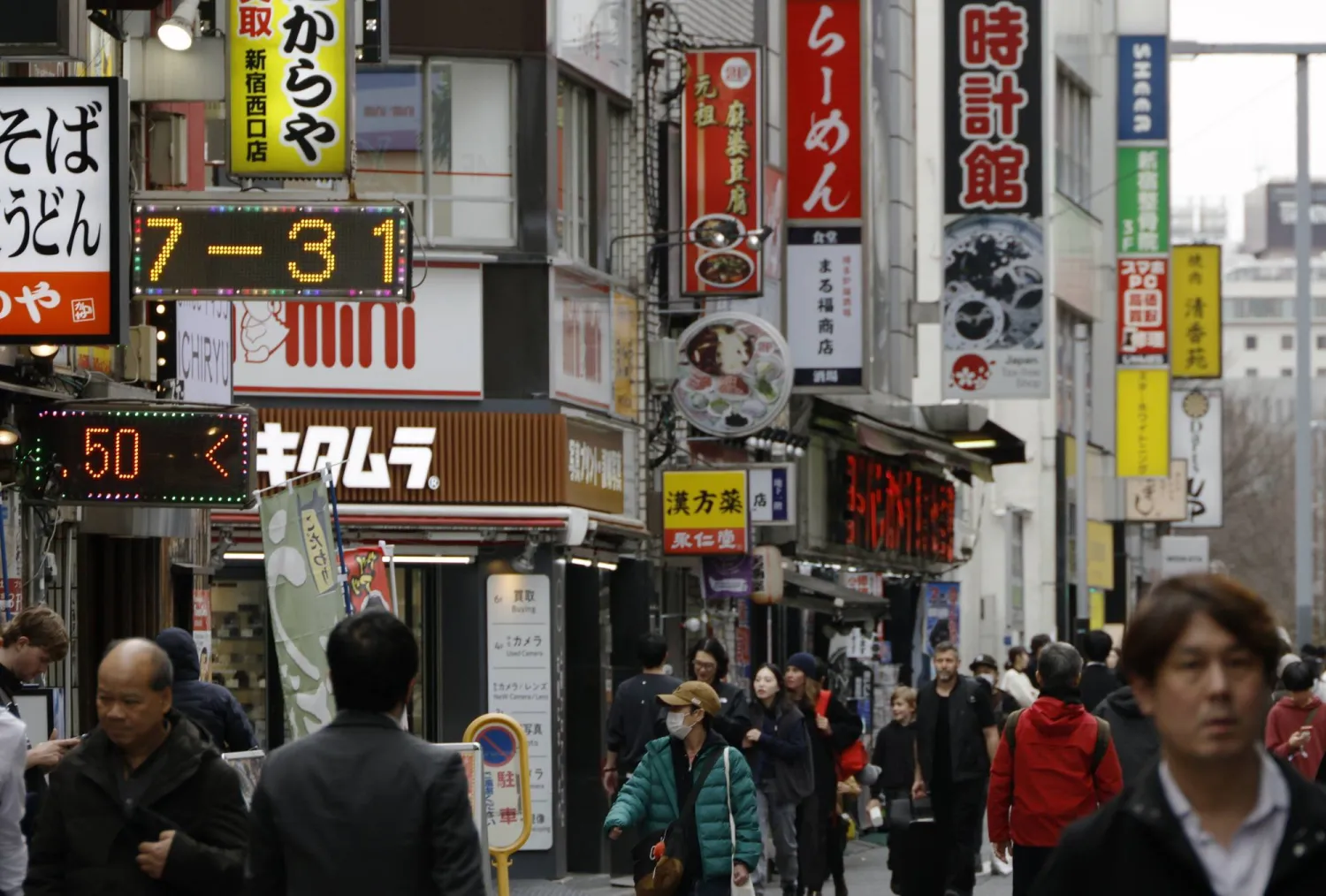

Japan Signals Greater Vigilance Over Yen's Weakness

People walk through Shinjuku shopping district in Tokyo, Japan, 27 February 2026. EPA/FRANCK ROBICHON
TT

Japan Signals Greater Vigilance Over Yen's Weakness

People walk through Shinjuku shopping district in Tokyo, Japan, 27 February 2026. EPA/FRANCK ROBICHON

Japanese Finance Minister Satsuki Katayama on Friday signaled heightened vigilance over currency moves, telling parliament the government is monitoring the yen's recent slide with a strong sense of urgency.

“We are watching recent movements very closely, with a strong sense of urgency,” Katayama told parliament, when asked if the yen's depreciation may be hampering wage growth by pushing up import costs.

“We are also maintaining extremely close communication with the United States, and will continue engaging in dialogue to ensure that the concerns you raise do not materialize,” she said, according to Reuters.

This came while data showed on Friday that annual core inflation in Tokyo slowed in February, running below the Bank of Japan's 2% target for the first time in 16 months, and potentially heightening friction between the central bank and the government on the future path of rate hikes.

The data is in line with the BOJ's projection that consumer inflation will temporarily slow due to the impact of fuel subsidies and the base effect of last year's spike, before reaccelerating on steady wage gains.

The Tokyo core consumer price index, which excludes volatile costs of fresh food, rose 1.8% in the year to February after a 2.0% gain in January, data showed, falling below the 2% target for the first time since October 2024. It compared with a median market forecast for a 1.7% gain.

The slowdown reflected the effect of fuel subsidies and the abolition of gasoline tax surcharges, while a wave of food price hikes has also run its course.

An index stripping away the effect of fresh food and fuel, which is closely watched by the BOJ as a better gauge of trend inflation, rose 2.5% in February from a year earlier, picking up from a 2.4% gain in January.

“I don't think this result alone would affect the Bank of Japan's stance of keeping to its commitment to raise interest rates,” said Kanako Nakamura, an economist at Daiwa Institute of Research, noting the slowdown in core inflation was expected.

But some analysts say the easing core inflationary impulse could give dovish Prime Minister Sanae Takaichi a reason to push the BOJ to go slow on its rate hikes.

In a potential sign of friction over monetary policy, the Mainichi daily reported this week that Takaichi had expressed reservations about additional interest rate hikes during her meeting with BOJ Governor Kazuo Ueda last week.

“If, going forward, the BOJ were to step back from its rate-hike stance, it would be easier to explain that shift not as pressure from the government but as a change in judgment strictly driven by data, namely, weakness in GDP and CPI,” said Masato Koike, a senior economist at Sompo Institute Plus.

Separate government data showed on Friday that Japan's factory output rose 2.2%, the first gain in three months driven by double-digit car output growth.

But the increase undershot even the most bearish economist forecast, with the median forecasting a 5.3% jump. Japanese manufacturers expect their output to fall again in February and March.

The BOJ raised interest rates to a 30-year high of 0.75% in December, taking another landmark step in ending decades of huge monetary support in a sign of its conviction that Japan is progressing toward durably hitting its 2% inflation target.

The central bank has signaled its readiness to continue raising interest rates if its economic and price forecasts materialize.



Oil Prices Set for Swings Next Week as US-Israel Strikes Raise Supply Uncertainty

Markets are anticipating movements in oil prices after the American-Israeli attack on Iran (Reuters)
TT

Oil Prices Set for Swings Next Week as US-Israel Strikes Raise Supply Uncertainty

Markets are anticipating movements in oil prices after the American-Israeli attack on Iran (Reuters)

Oil markets currently closed for the weekend are set to see price swings next week as the impact from the US and Israeli strikes on oil supplies from the Middle East remains unclear.

Scenarios before the latest conflict with Iran foresaw a quick price spike that fades if the attacks didn't affect oil shipping and infrastructure such as Iranian pipelines and its Kharg island terminal. However, there would be a bigger price spike and longer-lasting impact if oil infrastructure or supplies were interrupted, for instance because of disruption of tanker traffic through the Strait of Hormuz.

Oil prices have already risen on war fears. International benchmark Brent crude closed at a seven-month high of $72.87 on Friday, Reuters reported.

Iran exports some 1.6 million barrels of oil a day, most of it going to China, where privately owned refineries are less concerned about the US sanctions that prevent Iran from selling its oil elsewhere. If that supply is disrupted, Chinese customers would look elsewhere for oil on the global market, potentially driving up prices.

Another question is around the Strait of Hormuz, through which 20% of global oil supply pass through each day. Middle East exporters Saudi Arabia, Iraq and the United Arab Emirates send most of their exports through the strait. However analysts say Iran has no incentive to try to close the strait because it would cut off its own exports and hurt its only big customer, China.

Limited strikes on Iran’s nuclear program and the Revolutionary Guard that avoid regime change or all-out war could see prices jump $5-$10 based on fear alone, according to Rystad Energy in a prewar scenario.

A wider war involving Iranian disruption of tanker traffic could see crude push past $90 per barrel and US gas prices “well above” $3 per gallon, according to another prewar scenario from Clayton Seigle at the Center for Strategic & International Studies. US gas prices averaged $2.98 per gallon last week according to US motoring club AAA.


Israel Shuts Down Gas Fields After US-Israel Strikes on Iran

The gas platform for Leviathan, Israel's largest gas field is seen from a helicopter near Haifa bay, northern Israel, August 1, 2023. REUTERS/Ari Rabinovitch
TT

Israel Shuts Down Gas Fields After US-Israel Strikes on Iran

The gas platform for Leviathan, Israel's largest gas field is seen from a helicopter near Haifa bay, northern Israel, August 1, 2023. REUTERS/Ari Rabinovitch

The Israeli Energy Ministry has ordered the temporary shutdown of parts of the country's natural gas reservoirs after Israel and the United States launched strikes on Iran on Saturday.

The Leviathan gas field offshore Israel, operated by Chevron has been shut down, three sources told Reuters. Energean’s production vessel that serves several Israeli fields has also been shut down, the company said in a statement.

Israel’s ministry said the decision was based on “the current situation and in accordance with security assessments”, Reuters reported.

It said country’s energy needs would be met through alternative sources and that the electricity sector was prepared to operate power stations using alternative fuels if necessary.


Emirati Firm Suspends Supplies from Major Iraq Gas Complex

Smoke rises following an Iranian drone attack on Erbil airport in Erbil, Iraq, 28 February 2026.EPA/GAILAN HAJI
TT

Emirati Firm Suspends Supplies from Major Iraq Gas Complex

Smoke rises following an Iranian drone attack on Erbil airport in Erbil, Iraq, 28 February 2026.EPA/GAILAN HAJI

Emirati company Dana Gas has suspended natural gas supplies from a major gas complex in northern Iraq amid the regional escalation, said authorities in Iraq's autonomous Kurdistan region.

Kurdistan's electricity and natural resources ministries said in a statement that "due to the extraordinary circumstances and ongoing events in the region, and to protect employees at the Khor Mor field, Dana Gas has suspended natural gas exports to power plants".

The Khor Mor complex, which supplies most of Kurdistan's power stations, has been hit several times in recent years in attacks blamed on pro-Iran Iraqi groups.