


Iraq to Keep Crude Output at 1.4 million bpd amid Hormuz Tensions, Oil Minister Says

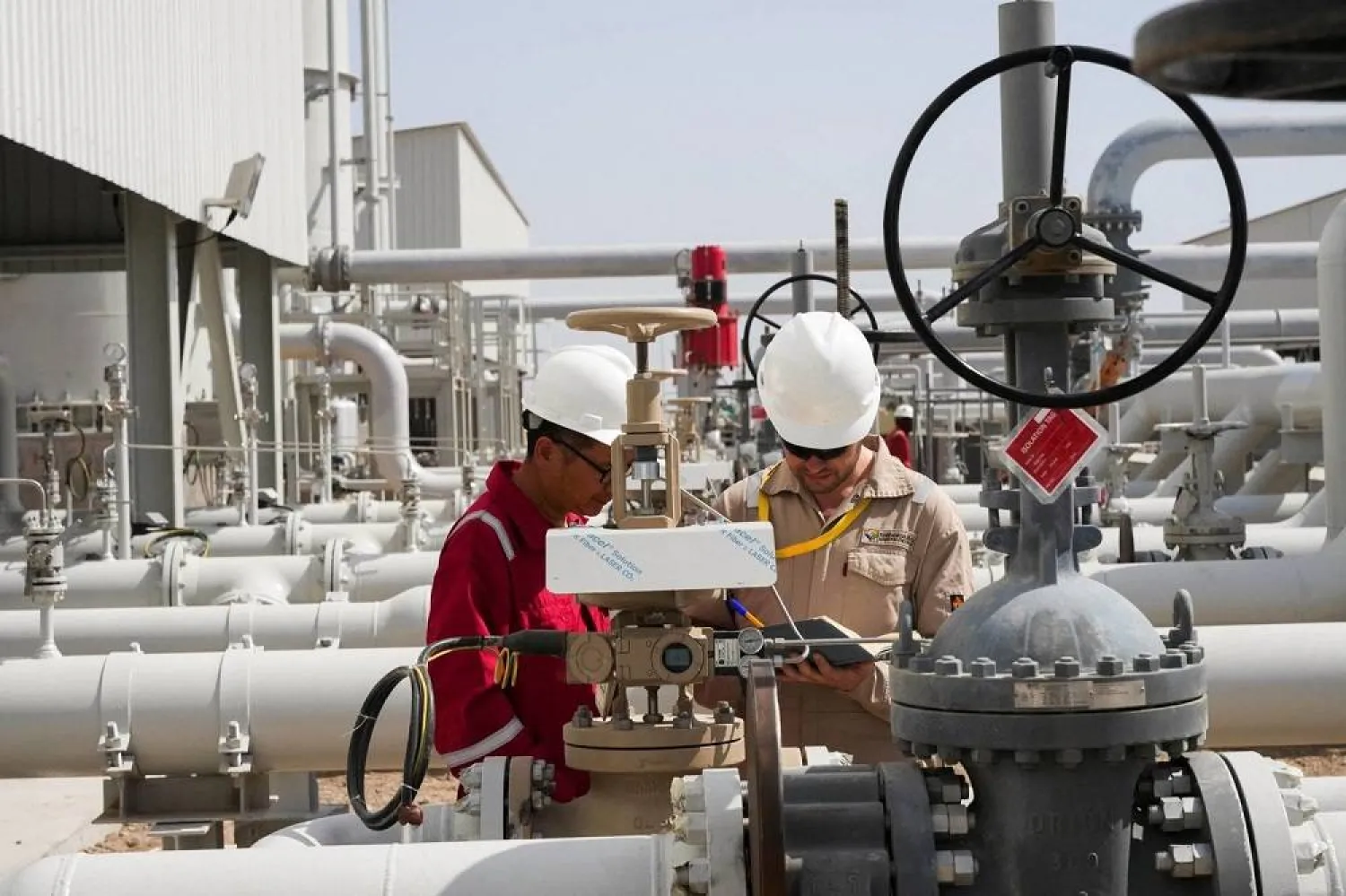
Technicians working at the Majnoon oil field in Basra, Iraq. (Reuters)
TT

Iraq to Keep Crude Output at 1.4 million bpd amid Hormuz Tensions, Oil Minister Says

Technicians working at the Majnoon oil field in Basra, Iraq. (Reuters)

Iraq will keep crude oil production at around 1.4 million barrels per day, Oil Minister Hayan Abdel-Ghani ​was quoted as saying on Thursday, less than a third of the level before the US-Israeli conflict with Iran.

According to the state news agency, the minister said that 200,000 bpd is being transported by truck through Türkiye, Syria, and Jordan ‌and that ‌Iraq has put in ​place ‌a ⁠plan ​to manage ⁠the current disruptions.

Oil production from Iraq's main southern oilfields, where most of its oil is produced and exported, has plunged 70% to just 1.3 million bpd, sources told Reuters on March 8, as the country ⁠is unable to export via the ‌Gulf due to ‌the war.

The drop in ​production and exports ‌is set to strain Iraq's already fragile finances ‌as the state relies on crude sales for nearly all public spending and more than 90% of its income.

Under pressure to mitigate ‌the losses, the oil ministry has asked the Kurdistan Regional Government (KRG) if ⁠it ⁠would pump at least 100,000 bpd from its state-managed Kirkuk oilfields to Türkiye's Ceyhan port, sources told Reuters on Wednesday. The ministry said the KRG has not yet responded to the request.

Abdel-Ghani was quoted as saying on Thursday that Iraq will sign an agreement on exporting oil through the Ceyhan pipeline, but he did not ​give further details. 


Gold Rises as Middle East Optimism Calms Inflation Fears

Samples of gold displayed in a program affiliated with the Brazilian Federal Police specializing in tracking gold in Brasilia (Reuters)
TT

Gold Rises as Middle East Optimism Calms Inflation Fears

Samples of gold displayed in a program affiliated with the Brazilian Federal Police specializing in tracking gold in Brasilia (Reuters)

Gold prices rose on Thursday as growing optimism about a possible end to conflicts in the Middle East calmed inflation worries and improved prospects for lower interest rates.

Spot gold rose 0.5% to $4,815.15 per ounce by 0926 GMT, after rising to a one-month high in the previous session. US gold futures for June delivery gained 0.3% to $4,836.50.

"For the month of March gold was under pressure because of the need for liquidity in the metal following the war, but that is kind of mostly run its course, that need for liquidity," said Nitesh Shah, commodity strategist at WisdomTree.

Shah added that he expects gold prices to remain very well supported as concerns surrounding central bank independence and dollar debasement risk still remain prevalent, Reuters reported.

Optimism grew on Thursday that the war in the Middle East may be near an end, with a key Pakistani mediator in Tehran and the administration of US President Donald Trump talking up hopes for a deal that would open the crucial Strait of Hormuz.

Crude oil prices were up more than 1% on Thursday, but remained well below the $100-a-barrel mark.

"Gold remains supported amid renewed optimism around de-escalation. The pullback in oil prices is easing some of the inflation concerns that weighed on prices earlier in the conflict. The move reflects a broader shift in market focus," ING analysts said.

Global equities vaulted past their previous all-time highs in Asian trading as optimism grew about a deal to end the Iran war.

Gold prices fell to as low as $4,097.99 an ounce on March 23 as high inflation concerns due to soaring energy prices raised expectations of a more hawkish approach to intrest rates by the US Federal Reserve, weighing on the non-yielding metal's demand.

Prices have since recovered as investors now see a more than 34% chance of at least one US interest rate cut by 2026-end, up from 32% a day prior, as per CME's FedWatch Tool.

Among other metals, spot silver rose 1.4% to $80.12 per ounce, platinum gained 1% to $2,130.25, and palladium was up 0.9% at $1,587.25.


UK Economy Surged Ahead of Iran War, but Energy Shock to Test Resilience

Buses pass in front of the Bank of England building in London (Reuters)
TT

UK Economy Surged Ahead of Iran War, but Energy Shock to Test Resilience

Buses pass in front of the Bank of England building in London (Reuters)

Britain's economy put on a burst of growth in February, suggesting it was in slightly better shape before the start of the Iran war than many economists had feared, official figures showed on Thursday.

Gross domestic product expanded 0.5% month-on-month in February, the biggest increase since January 2024, the Office for National Statistics said. Economists polled by Reuters had forecast a much more modest reading of 0.2%.

While the figures are likely to cheer finance minister Rachel Reeves, economists said Britain remained ⁠vulnerable to the fallout from ⁠the Middle East conflict, being highly dependent on imported energy and prone to higher inflation than peers.

"Unfortunately, the latest energy price shock has likely pulled the rug on this momentum, with another year of above-target inflation and a softening labour market likely to come," said Fergus Jiminez-England, associate economist from the National Institute for Economic and Social Research.

Britain suffered the sharpest cut to economic growth forecasts for large rich economies by the International ⁠Monetary Fund due largely to the Iran war, in forecasts published on Tuesday.

"Growth increased further in the three months to February led by broad-based increases across services," ONS chief economist Grant Fitzner said.

"Meanwhile car production recovered from the effects of the autumn cyber incident."

Economic growth for the three months to February was 0.5%, the ONS said, putting Britain's economy on track for a conspicuously strong first quarter, for a third year running.

That pattern has led to suspicions among some economists that the ONS' process of seasonal adjustment has gone awry following unusually large swings in output during the COVID-19 pandemic - something the ONS rejects.

"We're confident in our figures and seasonal adjustment processes," ⁠an ONS spokesperson ⁠said on Thursday, adding that statisticians had looked thoroughly at the issue.

James Smith, economist at ING, said he still doubted whether the ONS had fully accounted for the influence of the last period of high inflation in its seasonal adjustment process, and the timing of price increases.

"We wrote in our reaction to the January data that February or March could see a strong bounce back for exactly this reason," Smith said.

"Suffice to say, all of this is old news anyway, given the crisis we find ourselves in today."

Separate ONS data showed Britain's total trade deficit, excluding the volatile movements of precious metals, rose in inflation-adjusted terms in February to 5.627 billion pounds ($7.62 billion), its highest since November 2024.

The widening was driven by imports rising to their second-highest reading on record, after December 2022.


Oil Little Changed on Skepticism US-Iran Peace Talks Will Ease Hormuz Disruption

FILE PHOTO: A map showing the Strait of Hormuz, also known as Madiq Hurmuz, and 3D printed oil barrels are seen in this illustration taken March 26, 2026. REUTERS/Dado Ruvic/Illustration//File Photo
TT

Oil Little Changed on Skepticism US-Iran Peace Talks Will Ease Hormuz Disruption

FILE PHOTO: A map showing the Strait of Hormuz, also known as Madiq Hurmuz, and 3D printed oil barrels are seen in this illustration taken March 26, 2026. REUTERS/Dado Ruvic/Illustration//File Photo

Oil prices were little changed on Thursday, reversing earlier declines, on skepticism that peace talks between the US and Iran will reach a deal to end the war that has bottled up oil output from the key Middle East producing region.

Brent crude futures were down 26 cents to $94.67 a barrel at 0611 GMT. US West Texas Intermediate crude futures climbed 14 cents to $91.43 a barrel. Both benchmarks settled little changed on Wednesday but traded in a wide range. The US-Israeli war on Iran has ‌resulted in the ‌largest-ever disruption of global oil and gas supplies due ‌to ⁠Iran's interruption of traffic ⁠through the Strait of Hormuz, which typically carries about 20% of the world's oil and liquefied natural gas flows.

"While there are hopes for de-escalation, many investors remain skeptical, given that US-Iran talks have repeatedly broken down even after appearing to make progress," said Toshitaka Tazawa, an analyst at Fujitomi Securities.

"Until a peace deal is reached and free navigation through the strait is restored, WTI prices are expected to continue fluctuating between $80 and $100," ⁠he added.

Analysts from ING estimate that roughly 13 million barrels ‌per day of oil flow has been disrupted ‌by the closure of the strait, after taking into consideration pipeline diversions and the trickle of ‌tankers that have passed through the gateway, they said in a note on ‌Thursday.

With the US blockade on Iranian ports announced after the collapse of peace talks over the weekend, the disruption could increase.

"The physical market is becoming tighter every day that passes without a restart of oil flows through the Strait of Hormuz," the ING analysts said.

A source ‌briefed by Tehran told Reuters that Iran could consider allowing ships to sail freely through the Omani side of the ⁠Strait of Hormuz ⁠if a deal was reached to prevent renewed conflict after a two-week ceasefire started on April 8.

US and Iranian officials were weighing a return to Pakistan for further talks as early as the coming weekend. Pakistan's army chief arrived in Tehran on Wednesday as a mediator to try to prevent a renewal of the conflict.

US Treasury Secretary Scott Bessent said on Wednesday that Washington will not be renewing the waivers that allowed the purchase of some Iranian and Russian oil without facing US sanctions.

Underscoring the tightness of global crude and oil product supply, US inventories of oil, gasoline and distillate fuels fell last week, the Energy Information Administration said on Wednesday, as imports declined and exports jumped to meet the needs of countries searching for barrels to replace the disrupted flows.
