


Oil Prices Ease and Stocks Jump after Trump Says Iran is Talking with the US, Despite Iran's Denials

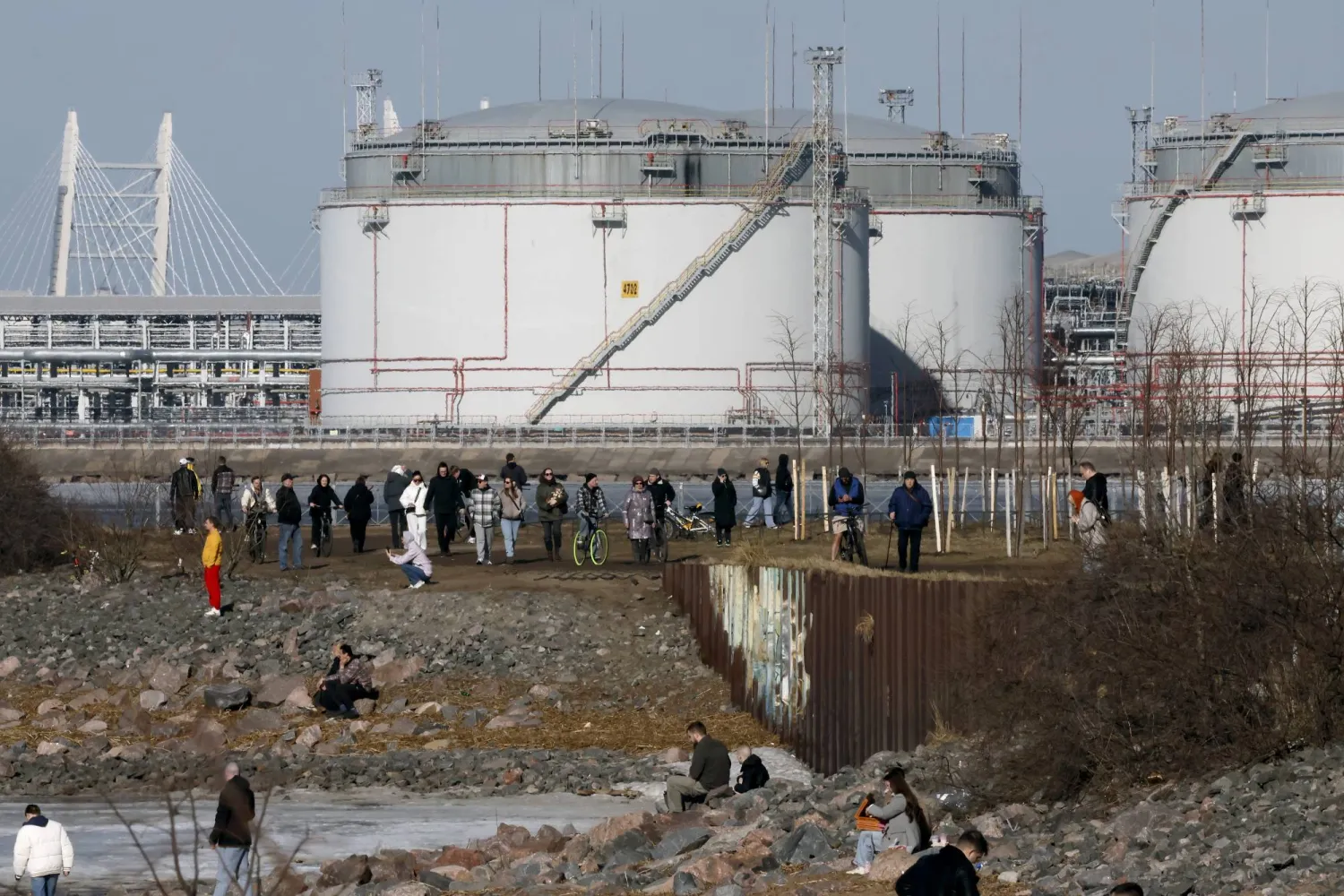
epa12841568 People walk on the shore of the Gulf of Finland with the St. Petersburg Oil Terminal in the background on a sunny day in St. Petersburg, Russia, 22 March 2026. Temperatures in St. Petersburg, Russia's second largest city, reached eleven degrees Celsius.  EPA/ANATOLY MALTSEV
epa12841568 People walk on the shore of the Gulf of Finland with the St. Petersburg Oil Terminal in the background on a sunny day in St. Petersburg, Russia, 22 March 2026. Temperatures in St. Petersburg, Russia's second largest city, reached eleven degrees Celsius. EPA/ANATOLY MALTSEV
TT

Oil Prices Ease and Stocks Jump after Trump Says Iran is Talking with the US, Despite Iran's Denials

epa12841568 People walk on the shore of the Gulf of Finland with the St. Petersburg Oil Terminal in the background on a sunny day in St. Petersburg, Russia, 22 March 2026. Temperatures in St. Petersburg, Russia's second largest city, reached eleven degrees Celsius.  EPA/ANATOLY MALTSEV
epa12841568 People walk on the shore of the Gulf of Finland with the St. Petersburg Oil Terminal in the background on a sunny day in St. Petersburg, Russia, 22 March 2026. Temperatures in St. Petersburg, Russia's second largest city, reached eleven degrees Celsius. EPA/ANATOLY MALTSEV

Relief is ripping through financial markets Monday after President Donald Trump said the United States has talked with Iran about a possible end to their war. Oil prices are easing, and stock prices are jumping on Wall Street following severe losses elsewhere in the world before Trump’s announcement.

The price for a barrel of Brent crude fell 8% to $103.23, down from nearly $120 last week, after Trump said on his social media network that the United States and Iran held productive talks the last two days “regarding a complete and total resolution of our hostilities in the Middle East.”

The S&P 500 leaped 1.3% toward its best day since well before the war began following the step down in tensions, even though Iran denied there were any negotiations, The AP news reported.

Over the weekend, Trump had threatened to obliterate Iran’s power plants if it doesn’t open up the Strait of Hormuz within 48 hours. The strait has become a sore point for Trump because its near-closure by Iran has prevented oil tankers from leaving the Arabian Gulf to supply customers around the world.

Trump said Monday that he is postponing attacks on Iranian power plants for five days to allow talks to continue. Still, caution remains, and the optimism in financial markets was measured. Shortly after Trump’s announcement — hours before his original deadline was set to expire — Iranian state television declared that the American leader had backed down “following Iran’s firm warning.” And a state-owned newspaper said Iran’s Foreign Ministry denied that any negotiations have taken place with the US.

The price of Brent crude fell as low as $96 immediately after Trump’s announcement of the postponement, but it quickly recovered a chunk of that loss. Benchmark US crude had a similar reaction, immediately falling toward $84 per barrel before paring its loss and reaching $90.85.

Financial markets have gone through vicious swings up and down since the war began because of uncertainty about how long it may last. The fear is that the war could keep so much oil and natural gas from the Arabian Gulf off global markets that it sends a debilitating wave of inflation crashing through the global economy.

That in turn could keep the Federal Reserve and other central banks from resuming their cuts to interest rates, which would give the global economy and prices for investments a boost.

Still, the overriding reaction in financial markets on Monday was one of relief. The Dow Jones Industrial Average was up 654 points, or 1.4%, as of 9:35 a.m. Eastern time, and the Nasdaq composite was 1.6% higher.

In Europe, stock indexes immediately flipped from losses to gains following Trump’s announcement and then held onto them. France’s CAC 40 jumped 1.3%, and Germany’s DAX returned 1.8%.

That compares with sharp drops for Asian stock indexes, which finished trading before Trump made his announcement. South Korea’s Kospi careened 6.5% lower, Japan’s Nikkei 225 dropped 3.5% and Hong Kong’s Hang Seng fell 3.5%.

Treasury yields also eased in the bond market following Trump’s announcement. But like oil prices, they nevertheless remain well above where they were before the war began.

The yield on the 10-year Treasury fell to 4.38% from 4.39% late Friday. But it remains solidly above its 3.97% level from just before the war.



EU to Vote on Trump Tariff Deal -- but Eyes Rest of World

The European Parliament will vote on whether to cut EU tariffs on some US imports. CHARLY TRIBALLEAU / AFP/File
TT

EU to Vote on Trump Tariff Deal -- but Eyes Rest of World

The European Parliament will vote on whether to cut EU tariffs on some US imports. CHARLY TRIBALLEAU / AFP/File

European Union lawmakers are on track to give a green light -- with conditions -- Thursday to the bloc's tariff deal with US President Donald Trump, which Europe hopes to salvage while also racing to diversify its trade ties around the globe.

Brussels and Washington clinched the deal last summer that had set tariffs at 15 percent for most EU goods.

But Trump's 2025 tariff blitz, including hefty levies on steel, aluminium and car parts, has jolted the 27-country bloc into cultivating trade ties around the world.

From deals signed with South America to Australia, the EU has its eyes on many prizes.

But that doesn't mean the EU intends to walk away from the 1.6 trillion euro ($1.9 trillion) relationship with its main trade partner, the United States, AFP reported.

The European Parliament is voting Thursday on whether to cut EU tariffs on some US imports -- as a first step towards implementing the 2025 deal -- but with additional safeguards.

The potential green light comes after months of delay as lawmakers resisted approving the accord due to transatlantic tensions over Greenland -- and then put it on hold again following the US Supreme Court's ruling striking down Trump's levies.

The ball started rolling again after the European Commission, in charge of EU trade policy, said it would stick to the pact despite the US ruling and called on lawmakers to do the same, having received reassurances from Washington.

Trump, however, retaliated after the ruling with a new tariff regime -- pushing EU lawmakers to tighten the existing agreement with numerous safeguards.

- Losing access to US energy? -

Lawmakers leading on trade have added several provisions: making an EU tariff reduction automatically lapse in March 2028, and tying tariff cuts on steel and aluminium goods to similar reductions by the US side.

Not all members of the parliament are convinced. French EU lawmakers from the centrist Renew group have said they will vote against the agreement.

"The only political value this agreement had to offer was stability and predictability, even if many say it's an unfair deal. If it no longer even provides predictability, there's no reason to support the deal, even if it has been improved," said MEP Pascal Canfin.

The United States has urged the bloc to implement the agreement.

Washington's ambassador to the EU Andrew Puzder told the Financial Times that if the bloc delayed further, it risked losing "favorable" access to US liquefied natural gas at a time when the Middle East war has led to surging energy costs.

Before the US tariff deal is implemented by the bloc, it still needs to be negotiated with EU member states -- although Brussels hopes talks will go quickly.

- 'Trump factor' -

It is the EU's vulnerability to the consequences of wars and other shocks that has pushed Commission chief Ursula von der Leyen to make diversifying trading partners a priority, to cut overdependence on the United States and China.

The frenzy began with a long-awaited accord signed with the South American Mercosur bloc in January. Weeks later, Brussels struck another pact with India and just this week clinched a stalled deal with Australia.

"The Trump factor sped up their conclusion, for us as well as for our partners," economist Andre Sapir said.

Spurred by Trump, Sapir said, the EU has been pushing to create the world's largest network of free trade areas -- a strategy with a "defensive dimension" allowing it to resist trade "coercion".

"This free trade network carries weight in our discussions with the two giants, the United States and China," he said.

"These agreements are part of our arsenal," Sapir, of the Bruegel think tank, added. "Our strategic weapons in the international order."


China Shipping Giant Cosco Resumes Bookings to Some Gulf Countries

A cargo ship operated by Cosco Shipping is docked at the foreign trade container terminal of Qingdao Port, operated by Shandong Port Group, in China's eastern Shandong province on March 25, 2026. (Photo by CN-STR / AFP)
TT

China Shipping Giant Cosco Resumes Bookings to Some Gulf Countries

A cargo ship operated by Cosco Shipping is docked at the foreign trade container terminal of Qingdao Port, operated by Shandong Port Group, in China's eastern Shandong province on March 25, 2026. (Photo by CN-STR / AFP)

Chinese shipping giant Cosco said on Wednesday that it was resuming new bookings for container shipments to some Gulf countries, after a three-week suspension in response to the Middle East war.

The state-owned, Shanghai-based firm was among several major shipping groups to pause operations in the Strait of Hormuz, a key waterway through which one-fifth of the world's oil and gas passes normally.

Tehran has said several times it was not targeting friendly nations, but transits through the Strait had nevertheless largely ground to a halt.

Iran said in a statement circulated by the International Maritime Organization on Tuesday that "non-hostile vessels" would be granted safe passage through the waterway.

Cosco "resumed new bookings for general cargo containers for shipments" from the "Far East" to the UAE, Saudi Arabia, Bahrain, Qatar, Kuwait, and Iraq "with immediate effect", according to a company statement.

It did not mention shipments travelling in the opposite direction, from the Gulf.

"New booking arrangements and the actual carriage are subject to change due to the volatile situation in the Middle East region," it added.

Cosco, which operates one of the world's largest oil tanker fleets, announced on March 4 that it would suspend new bookings for services for routes through the Strait of Hormuz owing to the "escalating conflicts in the Middle East region and resultant restrictions on maritime traffic".


Qatar Emir Makes Minor Changes to QIA Board

People visit a mall in Doha on March 23, 2026. (Photo by AFP)
TT

Qatar Emir Makes Minor Changes to QIA Board

People visit a mall in Doha on March 23, 2026. (Photo by AFP)

Qatar's Emir Sheikh Tamim bin Hamad Al Thani issued a decree on Wednesday ⁠making minor changes to ⁠the board of the ⁠Qatar Investment Authority, while keeping Sheikh Bandar bin Mohammed bin Saud Al Thani as chairman and Sheikh ⁠Mohammed ⁠bin Hamad bin Khalifa Al Thani as deputy chairman.

The decision stipulated that QIA’s Board of Directors would be restructured as follows: Sheikh Bandar bin Mohammed bin Saud Al Thani as Chairman, Sheikh Mohammed bin Hamad bin Khalifa Al Thani as Deputy Chairman, Ali bin Ahmed Al Kuwari as a member, Saad bin Sherida Al Kaabi as a member, Sheikh Faisal bin Thani bin Faisal Al-Thani as a member, Nasser bin Ghanim Al Khelaifi as a member, and Hassan bin Abdullah Al Thawadi as a member.

The decision is effective starting from its date of issue and is to be published in the official gazette.