


Germany Growth Forecasts Slashed as Mideast War Hits Economy

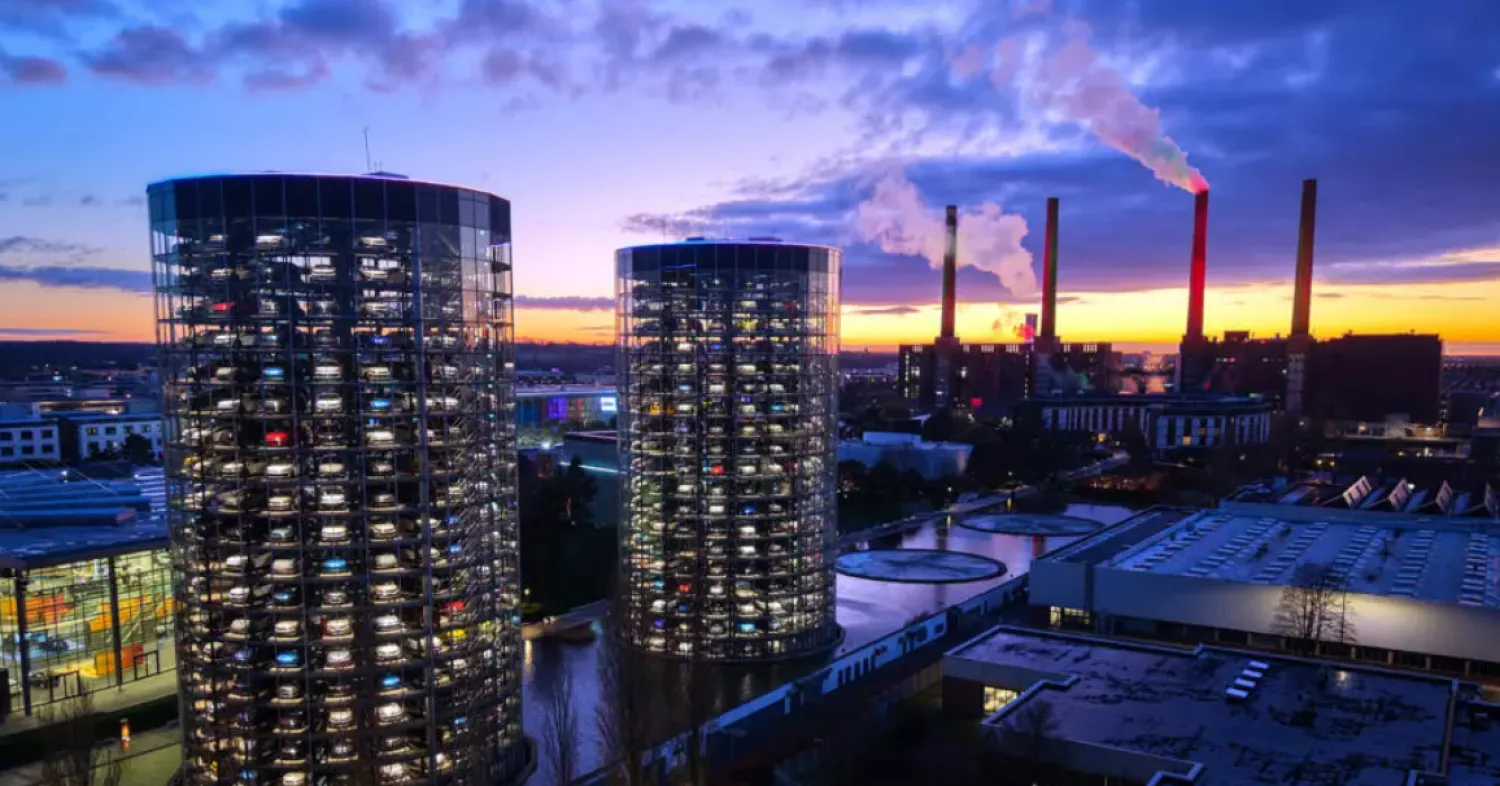
Germany's economy is struggling with fierce Chinese competition in sectors from cars to chemicals © Ronny HARTMANN / AFP/File
TT

Germany Growth Forecasts Slashed as Mideast War Hits Economy

Germany's economy is struggling with fierce Chinese competition in sectors from cars to chemicals © Ronny HARTMANN / AFP/File

Leading economic institutes more than halved their growth forecast for Germany on Wednesday, warning that the energy shock caused by the Middle East war would hit Europe's top economy hard.

A group of leading institutes slashed their joint GDP growth forecast for 2026 to 0.6 percent, down from a September prediction of 1.3 percent.

Inflation is now forecast to rise to 2.8 percent, up from 2.0 percent, "weighing on household purchasing power".

"The energy price shock triggered by the Iran war is hitting the recovery hard," said economist Timo Wollmershaeuser of the Ifo institute, adding that increased government spending was nevertheless "preventing a stronger slide", AFP reported.

Oil and natural gas prices have surged since the end of February, when the United States and Israel attacked Iran, killed its supreme leader and plunged the Middle East into war.

Iran has since closed the Strait of Hormuz to ships of countries it considers allied with the US and Israel, effectively blocking a sea lane that normally transports about a fifth of the world's oil and liquefied natural gas.

Higher inflation in Germany would hit consumer spending, the institutes said, weighing on an already weak economy that has barely grown since a burst of pent-up demand after the Covid pandemic in 2022.

The government on Wednesday introduced rules allowing petrol stations to only raise prices once a day, at noon.

But motorist Sebastian, a 49-year-old estate agent who did not want to give his surname, told AFP at a Frankfurt petrol station that this was not enough to protect his spending power.

"Whether the price of petrol changes once a day or 10 times a day doesn't really matter," he said, adding it was "certainly not enough" to lower his costs.

Germany's economy, struggling with fierce Chinese competition in sectors from cars to chemicals, was in the doldrums even before US President Donald Trump last year imposed sweeping new tariffs before starting the Mideast war in late February.

Chancellor Friedrich Merz, who took office last May, vowed to borrow and spend hundreds of billions through a special infrastructure fund over coming years in what was dubbed a spending "bazooka" aimed at getting the economy back on its feet.

But the economists said that much of the money was simply paying for day-to-day spending.

"Government expenditure on consumption is rising much more sharply than investment," economist Oliver Holtemoeller of the Halle Institute for Economic Research said. "That was not the idea behind changing the financing rules."

The outlook for the longer term was also dire.

Citing low productivity, industrial decline and an ageing population, the institutes warned that Germany's economy would soon be unable to grow sustainably.

"We have also reassessed the structural changes in the German economy and, in particular, revised our forecast for industrial growth downwards," Wollmershaeuser said.

In an era when "demographic change is hitting with full force", he said, "potential growth will come to a standstill by the end of the decade, and we will have to get used to average GDP growth rates of zero percent".

Speaking to broadcaster Welt TV, Economy Minister Katherina Reiche said the government was working on reducing labour taxes and energy costs but that Germans would have to get used to working more over the course of their lives.

"We need to make this country vigorous again," she said. "Germany needs to get its will to win back."


Saudi Arabia, Switzerland Sign Agreement on Reciprocal Protection of Investments

The agreement aims to strengthen and stabilize the investment environment, protect investors’ rights, and support the flow of mutual investments between the two countries. SPA
TT

Saudi Arabia, Switzerland Sign Agreement on Reciprocal Protection of Investments

The agreement aims to strengthen and stabilize the investment environment, protect investors’ rights, and support the flow of mutual investments between the two countries. SPA

Saudi Minister of Foreign Affairs Prince Faisal bin Farhan bin Abdullah and Minister of Investment Fahad Al-Saif have participated in the Saudi-Swiss Investment Roundtable Meeting in Jeddah, which was followed by the signing of an investment agreement between the two countries.

The meeting took place in the presence of Swiss President Guy Parmelin, with the participation of State Secretary for Economic Affairs Helene Budliger Artieda, along with a large number of officials and business leaders from both sides.

During the meeting, the conferees reviewed joint investment opportunities, discussed ways to strengthen economic cooperation between the two countries, and explored the development of partnerships in priority sectors in a manner that supports economic growth and enhances relations.

The meeting was held on the sidelines of the Swiss President’s official visit to the Kingdom, as the two countries mark 70 years of diplomatic relations that have, from the outset, helped lay the foundations of cooperation and build a partnership based on mutual respect and the development of shared interests between the two states.

After the meeting, an agreement was signed between the Saudi government and the Swiss Federal Council on the promotion and reciprocal protection of investments.

It was signed on the Saudi side by Al-Saif, and on the Swiss side by Parmelin.

The agreement aims to strengthen and stabilize the investment environment, protect investors’ rights, and support the flow of mutual investments between the two countries.

The meeting was attended by Saudi Ambassador to Switzerland and the Principality of Liechtenstein Abdulrahman Aldawood.


US Stocks Dip on Mixed Earnings as Markets Monitor Iran

A trader works on the floor of the New York Stock Exchange (NYSE) at the opening bell in New York on March 24, 2026.  (Photo by ANGELA WEISS / AFP)
A trader works on the floor of the New York Stock Exchange (NYSE) at the opening bell in New York on March 24, 2026. (Photo by ANGELA WEISS / AFP)
TT

US Stocks Dip on Mixed Earnings as Markets Monitor Iran

A trader works on the floor of the New York Stock Exchange (NYSE) at the opening bell in New York on March 24, 2026.  (Photo by ANGELA WEISS / AFP)
A trader works on the floor of the New York Stock Exchange (NYSE) at the opening bell in New York on March 24, 2026. (Photo by ANGELA WEISS / AFP)

Wall Street stocks retreated from records early Thursday as markets digested a trove of mixed earnings reports and monitored the latest dynamics between the United States and Iran.

Analysts cited profit-taking after both the S&P 500 and Nasdaq shrugged off a jump in oil prices to finish at records on Wednesday.

About 10 minutes into trading, the Dow Jones Industrial Average was down 0.4 percent at 49,311.39, AFP reported.

The broad-based S&P 500 dipped 0.2 percent to 7,126.19, while the tech-rich Nasdaq Composite Index declined 0.3 percent to 24,588.07.

David Morrison, senior market analyst at FCA, called Thursday's early trading action "a mild bout of profit-taking triggered by some worrying reports of hostile action between the US and Iran," according to a note.

The US Defense Department said its forces boarded a vessel in the Indian Ocean that was transporting oil from Iran, while President Donald Trump announced on social media that he ordered the Navy to "shoot and kill" boats placing mines in the Strait of Hormuz.

Iran vowed it would keep the strait closed to all but a trickle of approved vessels for as long as the United States blockaded its ports.

Among companies reporting results, Tesla fell 1.7 percent and Lockheed Martin dropped 3.7 percent, while American Airlines jumped 4.9 percent.


What Does the Inclusion of Saudi Bonds in the J.P. Morgan Index Mean?

Saudi woman walks at the Saudi stock market in Riyadh - Reuters
TT

What Does the Inclusion of Saudi Bonds in the J.P. Morgan Index Mean?

Saudi woman walks at the Saudi stock market in Riyadh - Reuters

Saudi Arabia’s debt market is set for a strategic shift in early 2027, following J.P. Morgan’s announcement that local-currency bonds will be included in its global emerging markets bond index. The move represents a vote of confidence in the Kingdom’s structural reforms and is expected to open the door to substantial capital inflows that will help finance major economic transformation projects.

In a note, J.P. Morgan said the move follows a series of reforms to improve foreign investor access and enhance local market capabilities.

The bank added that Saudi sukuk, Shariah-compliant debt instruments that function similarly to bonds, with a remaining maturity of up to 15 years, will be eligible for inclusion in the Government Bond Index-Emerging Markets (GBI-EM), the most widely tracked benchmark of its kind, with $233 billion in assets tracking it.

J.P. Morgan said eight sukuk issues would be eligible for inclusion, with a total value of $69 billion.

The Kingdom’s inclusion in the index is expected to boost liquidity and demand for sovereign debt, contributing to lower borrowing costs.

In September, J.P. Morgan had placed Saudi Arabia on “Positive Index Watch,” paving the way for its eventual inclusion in the GBI-EM.

Commenting on the decision, Saudi Finance Minister Mohammed Al-Jadaan told Bloomberg that the move reflects continued confidence in the Kingdom’s economic transformation trajectory. He said the inclusion marks a new milestone in Saudi Arabia’s integration into global financial markets, adding that its immediate impact will be seen in broadening and diversifying the investor base and supporting long-term capital inflows into the domestic debt market, thereby strengthening the resilience and stability of the national economy.

The Significance of the Index

The importance of J.P. Morgan’s index lies in its role as a benchmark guiding major global fund allocations, particularly passive funds that track indices automatically. With an expected weighting of around 2.52 percent, Saudi bonds will become a core component of international investor portfolios, increasing government bond liquidity and reducing borrowing costs over the long term, a critical factor for the Kingdom’s economy.

Passive funds play a key role in ensuring steady inflows. Trillions of dollars globally are managed through such funds. Once Saudi Arabia is included in the index, these funds will purchase Saudi bonds to remain aligned with it. Unlike active investors, they do not rapidly buy or sell based on daily news or market sentiment, but continue to hold bonds as long as they remain in the index, providing significant stability to the Saudi debt market. Their participation also ensures a constant base of large-scale buyers, facilitating bond trading at any time.

Reforms That Paved the Way

This inclusion is the result of a series of regulatory reforms highlighted by the bank in its note. Saudi Arabia has improved international investor access by linking to the global Euroclear system, expanding its network of primary dealers to include international banks, and facilitating cross-border settlement and trading. These measures have enhanced legal certainty and transparency, making the Saudi debt market an attractive and secure destination for foreign capital.

Financial Stability Amid Regional Challenges

Beyond its economic dimensions, the move carries strategic significance amid ongoing geopolitical tensions in the region. Increased inflows into local bonds are expected to strengthen the government’s ability to manage any economic fallout from regional instability. It underscores the resilience and attractiveness of the Saudi economy, demonstrating its capacity to attract quality investment and secure the financing needed for its development plans regardless of external challenges.
