


Behind The Scenes: US-Israeli Military Decisions Shaping Iran's War

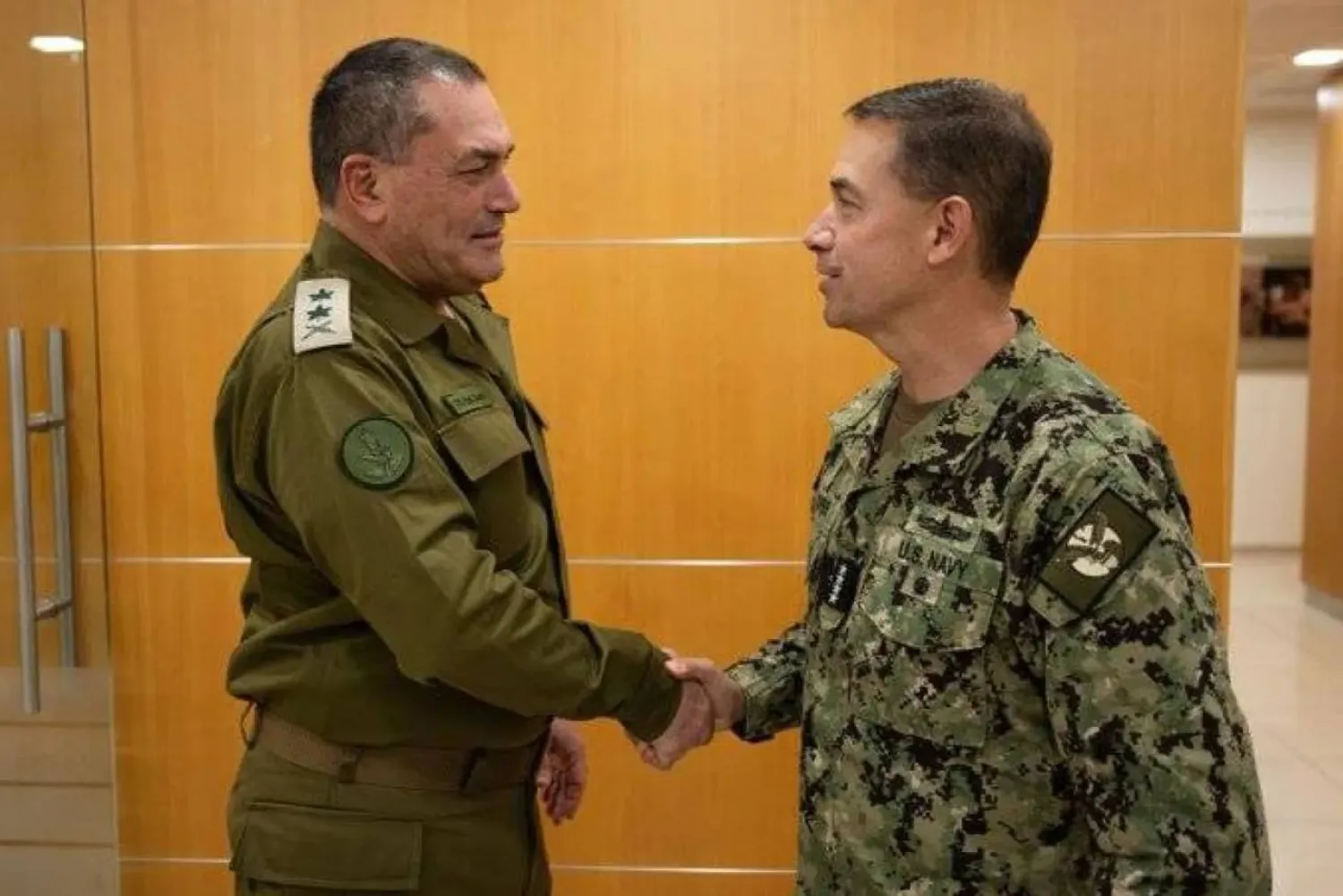
US CENTCOM chief Adm. Brad Cooper meets Israeli Army Chief of Staff Lt-Gen. Eyal Zamir during his visit to Israel (Israeli Army)
TT

Behind The Scenes: US-Israeli Military Decisions Shaping Iran's War

US CENTCOM chief Adm. Brad Cooper meets Israeli Army Chief of Staff Lt-Gen. Eyal Zamir during his visit to Israel (Israeli Army)

Although US President Donald Trump and Israeli Prime Minister Benjamin Netanyahu have made the ultimate war and ceasefire decisions regarding Iran, The Jerusalem Post revealed the details and extent to which Israeli Army Chief of Staff Lt.-Gen. Eyal Zamir, US Joint Chiefs Chairman Gen. Dan Caine, and CENTCOM Chief Admiral Brad Cooper have been the next most dominant figures.

In many ways, Zamir was key to convincing Caine and Cooper that such a war was feasible, such that they would support it, or at least not oppose it.

Caine was then critical in convincing Trump that such a war was viable, while precisely describing risks and second and third order considerations, even as the US chairman himself held doubts about significant aspects of the war, according to the Jerusalem Post.

Caine has also hovered over Trump's decisions to repeatedly announce unilateral ceasefires with Iran out of concern that any upping the ante on the military playing field could cost him in both American lives and politically.

When Netanyahu made an emergency flight to Washington to meet with Trump around 11:00 am on February 12 to try to convince him to go to war with Iran, as the US president had started to move away from that option, he presented a four-step plan.

The four steps were: First, assassinating Supreme Leader Ali Khamenei and his top military and intelligence officials. Second, pounding Iran's ballistic missile and drone capabilities. Third, helping foment an uprising within Iran against the regime, and fourth, transforming the uprising, plus possibly a ground attack by the Kurds who straddle Iran and Iraq, into regime change.

None of the three high commanders really believed in steps three or four, but Zamir was willing to roll the dice to see what might come of it, the Jerusalem Post said. Caine and Cooper were ready to go in for the first two steps and hold their noses regarding efforts at steps three and four.

It was not a coincidence that Israel was assigned to bomb Iran's top leaders and thousands of Revolutionary Guard Corps and Basij command centers and locations, as well as Iranian military threat capabilities, while US forces stayed more focused almost exclusively on Iranian capabilities.

Trump, to some extent under the influence of Caine (with Cooper supporting in the background), kept the US out of direct military involvement in regime change.

Sources have indicated to the Jerusalem Post that Israeli efforts to influence Trump and when and how to go to war have also heavily focused on Caine.

Zamir, Mossad Director David Barnea, and Israeli Army Intelligence Chief Maj. Gen. Shlomi Binder also visited Washington leading up to Netanyahu's February 12 White House sales pitch to make their case directly to a variety of officials, but collectively especially to Caine.
In some ways, Cooper was easier to convince than Caine, the report said.

This is partially true because Cooper did not try as much as his predecessor, Erik Kurilla, to influence the decision of whether to go to war or not, focusing more on being the architect of what the different options of going to war would look like.

Right Timing

Zamir was very successful in bringing on board Caine and Cooper, and then indirectly Trump, in the sense of convincing them that the timing was right.

The Post has learned that Zamir made a sophisticated and nuanced argument to Caine, Cooper, and others, which reached Trump.

The argument acknowledged that in theory Israel and the US could wait some period of months, as Iran had not yet crossed a redline threshold of a volume of ballistic missiles which the Israeli army would have trouble with. After all, Israel's original plan was not to attack Iran's ballistic missile program until sometime between June and November 2026.

However, Zamir said that Iran was racing forward too fast.

Iran was producing an additional 200-300 ballistic missiles per month. It had replaced about half of its lost missiles and half of its lost missile launchers in only eight months, getting back up to 2,500 missiles.

In Zamir's understanding, waiting another six months could mean an Iran with 3,700-4,300 missiles, and waiting another year could mean 4,900 to 6,100 missiles.

The report said it could also mean much more damage, could lead to Israeli difficulties with its volume of missile interceptors at a much earlier point, and collectively force Israel and the US to cut short their attacks on Iran's missile and other capabilities much earlier than what might make sense strategically.

Adding on that if Israel and the US wanted to take a real shot at regime change, that February was a unique moment to build on the January Iranian domestic protests, the Post understands that Zamir argued that February was a unique moment to go to war. This was true despite Israel's original plan for an attack in later 2026.

Two Main Failures

The report held Zamir, Caine and Cooper responsible for two main failures, the first being the inability to stop Iranian missiles.

It said only days into the war, Zamir, Caine, and CENTCOM were telling the public that missile fire was down 70-90%. The expectation was that within a week or two, it would be down to a drizzle. But while missile fire did drop to a medium level, the fading to a drizzle never happened.

None of the top Israeli or American officials anticipated how rapidly Iran would be able to unearth its underground missile launchers, which the allies had caused to be neutralized with cave-ins.

Pre-war estimates were that cave-ins would neutralize such missiles for the rest of the war, whereas in many cases, the Post has learned that Iran has developed bulldozer teams and techniques to uncover caved-in missile teams or silos within less than a day.

Also, Iran spread its surviving missile crews throughout its vast country, making it nearly impossible to track them down efficiently, and adjusted its missiles such that over 70% of them included cluster munitions, which the Israeli army was much less ready to defend against.

The second potential failure of Caine and Cooper relates to Hormuz.

The report found that neither Caine nor Cooper raised their voices loudly and decisively about the Hormuz nightmare scenario, again preferring to provide neutral advice to a US president, who clearly was out of his depth in aspects of this conflict.

The two of them could have seen this scenario coming, and so their choice, despite their heavy potential influence, to not raise the alarm loudly enough leaves them with some contributory fault in not better preparing Trump and the US.

The fact that the US needed to wait several weeks into the war before troops were in place to do something about Hormuz, if necessary, was a massive strategic miss.

In fact, the US could have even deployed forces into the Hormuz area the day the conflict started, as opposed to focusing on sinking large Iranian naval vessels first.

Overall, the report found that the military campaign pitched by Zamir and approved by Caine and Cooper succeeded more than might have been expected upfront, with notable exceptions regarding the continuity of medium-level ballistic missile threats and regarding Hormuz.

It said the military gains into long-standing strategic achievements is now more in the hands of the political and diplomatic leaders than the generals.



US Authorizes Iranian Oil Sales Amid Talks on Final Peace Deal

US Treasury Secretary Scott Bessent attends a bilateral meeting during the G7 Summit in Evian-les-Bains, France, June 17, 2026. (Reuters)
TT

US Authorizes Iranian Oil Sales Amid Talks on Final Peace Deal

US Treasury Secretary Scott Bessent attends a bilateral meeting during the G7 Summit in Evian-les-Bains, France, June 17, 2026. (Reuters)

The United States authorized Iranian oil sales on Monday, easing decades-old sanctions as it pushes toward a final peace deal with Tehran in return for commitments on nuclear inspections and free transit through the Strait of Hormuz.

The general license, announced by the Treasury Department, allows the sale of crude oil and petrochemical and petroleum products of Iranian origin through August 21.

The license says Iranian oil can be imported into the US when necessary to complete ‌its sale, delivery ‌or offloading. The US has not meaningfully imported Iranian ‌oil ⁠since Washington imposed measures ⁠after the 1979 revolution.

"In line with the ongoing productive talks in Switzerland, Iran has committed to free and open transit in the Strait of Hormuz and to permit International Atomic Energy Agency (IAEA) inspectors into their country," Treasury Secretary Scott Bessent wrote on X.

"As part of the framework, Treasury has issued a temporary 60-day general license authorizing the production, delivery and sale of Iranian oil."

Under a memorandum of ⁠understanding signed last week between Washington and Tehran, the US ‌agreed to issue waivers for the export ‌of Iranian crude oil, petroleum products and derivatives, and all associated services, including banking transactions, insurances ‌and transportation.

Payment of funds to Iran may be made in US dollar-denominated ‌funds, according to the license.

Cuba, North Korea and Crimea are among those excluded from the license.

Washington first sanctioned Iran in 1979 when revolutionary students seized the US embassy in Tehran, holding diplomats hostage. Numerous additional sanctions have been imposed since then over the ‌nuclear program and Iran's support for groups the US deems terrorist organizations.

Independent Chinese refiners have been the main buyers ⁠of sanctioned Iranian ⁠oil, taking advantage of deep discounts as others avoided such purchases. India, South Korea, Japan, Italy, Greece, Taiwan and Türkiye were also major buyers of Iranian crude before US sanctions were reimposed in 2018.

Mediators said on Monday that Washington and Tehran made "encouraging progress" at the first round of talks aimed at reaching a final peace deal. The talks began under the terms of the memorandum of understanding reached last week to extend a tenuous ceasefire from April for at least another 60 days.

Oil prices had risen sharply when Tehran started blockading the Strait of Hormuz, prompting a US blockade of Iranian ports, but after the interim deal, fell to their lowest since before the war began on February 28 with US-Israeli attacks on Iran.


Taiwan Begins 5-Day Military Drill with Tanks Patrolling Streets

This picture taken and released by Taiwan's Central News Agency (CNA) on June 22, 2026 shows a row of armored military vehicles driving along the highway in Taoyuan, Taiwan. (AFP photo / CNA Photo)
TT

Taiwan Begins 5-Day Military Drill with Tanks Patrolling Streets

This picture taken and released by Taiwan's Central News Agency (CNA) on June 22, 2026 shows a row of armored military vehicles driving along the highway in Taoyuan, Taiwan. (AFP photo / CNA Photo)

Taiwan kicked off a five-day set of military drills on Monday aimed at boosting the island's combat readiness in case of a Chinese military attack.

In the city of Taoyuan, home to the island's largest international airport, tanks drove down city streets and highways, videos and photos of the exercise showed, as armored vehicles from the Army’s 269th Infantry Brigade conducted combat readiness patrols morning.

The Immediate Combat Readiness Exercises are meant to test how rapidly military units can deploy, especially in the face of a possible sudden escalation of Chinese grey-zone warfare. Grey-zone tactics refer to a range of aggressive tactics that vary from navy ship patrols to drone flights, but fall short of direct combat.

The exercises, announced Sunday afternoon, are meant to be realistic, the Ministry of Defense said in a statement, with an emphasis on “real-time, live-fire and on-site."

These exercises are designed to simulate what would happen before enemy forces launched their ships, according to Taiwan's semi-official Central News Agency. The series of exercises could also include impromptu ones in the future, including real-time responses to Chinese military drills.

China's People's Liberation Army sent 23 aircraft towards Taiwan from Sunday into Monday morning, according to Taiwan's defense ministry. That was accompanied by seven navy ships and five other Chinese government ships. China sends war planes, drones and navy ships towards the island on a daily basis.

Taiwan regularly conducts combat readiness drills as it seeks to bolster its defense capabilities amid ongoing military pressure from China, which claims the self-governed island as its own territory and has not ruled out the use of force to bring it under its control. Earlier in June, Taiwan fired rockets in China's direction for the first time as part of a military exercise.


EU Chief Hails 'Statesman' Starmer after Resignation

European Commission President Ursula von der Leyen gives a press statement on sanctions against Russia at the EU headquarters in Brussels on June 9, 2026. (Photo by Nicolas TUCAT / AFP)
TT

EU Chief Hails 'Statesman' Starmer after Resignation

European Commission President Ursula von der Leyen gives a press statement on sanctions against Russia at the EU headquarters in Brussels on June 9, 2026. (Photo by Nicolas TUCAT / AFP)

EU chief Ursula von der Leyen on Monday praised British Prime Minister Keir Starmer for bolstering "European" security after he announced his resignation.

"It can take many leaders years to grow into the statesman you became in just two years. European and Ukrainian security is stronger because of you. Thank you, dear Keir," the European Commission president posted online.