


Asian Airlines Trim Schedules and Carry Extra Fuel as Supplies Tighten

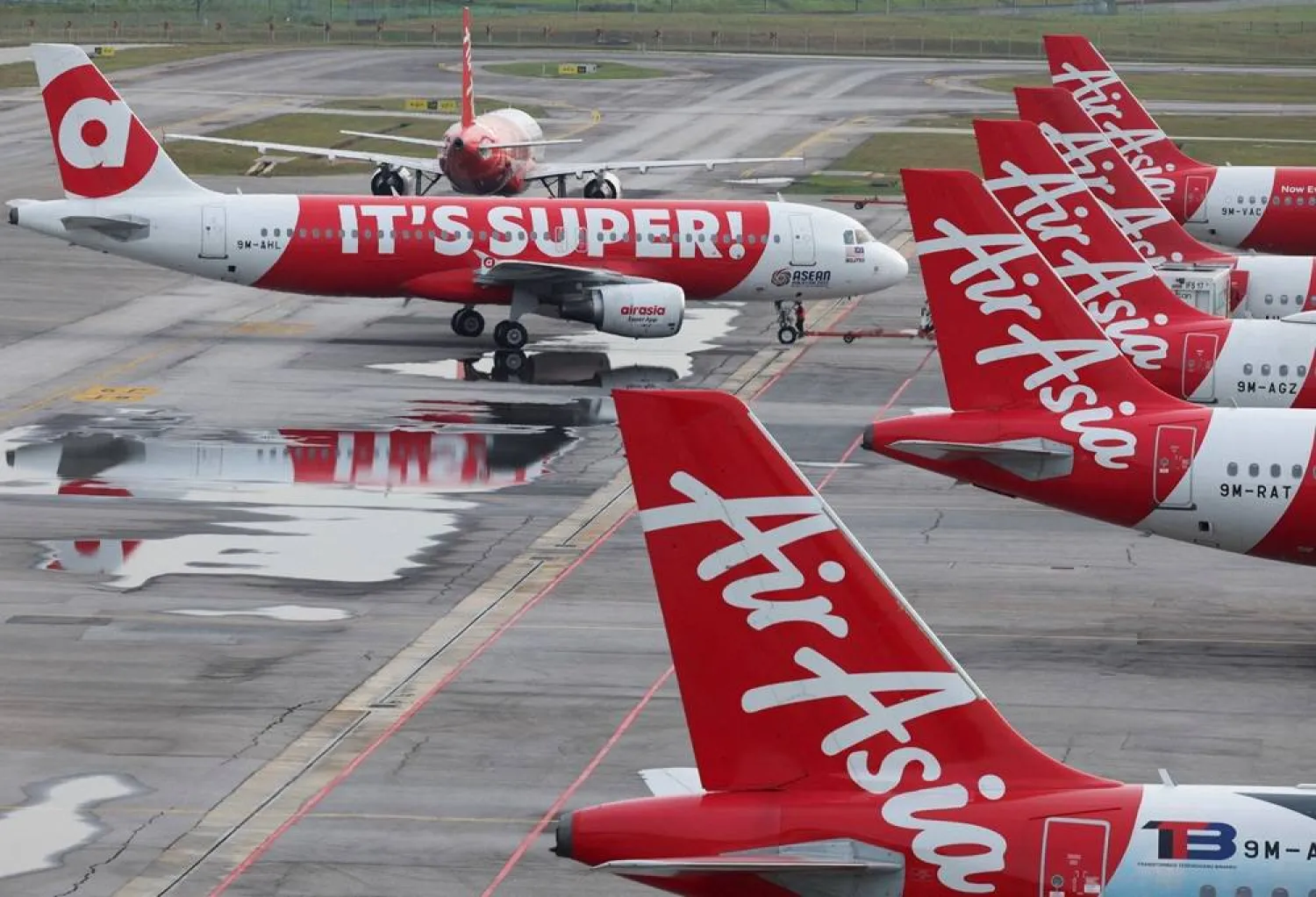
AirAsia planes stand on the tarmac at Kuala Lumpur International Airport Terminal 2 (KLIA2) in Sepang, Malaysia, January 21, 2026. (Reuters)
TT

Asian Airlines Trim Schedules and Carry Extra Fuel as Supplies Tighten

AirAsia planes stand on the tarmac at Kuala Lumpur International Airport Terminal 2 (KLIA2) in Sepang, Malaysia, January 21, 2026. (Reuters)

Airlines across Asia are cutting flights, carrying extra fuel from home airports and adding refueling stops as the Middle East conflict squeezes jet fuel supply in some countries, adding to pressure on an industry already hit by a sharp jump in fuel costs.

European carriers are bracing for similar disruption after Iran's closure of the Strait of Hormuz cut off nearly 21% of global seaborne jet fuel supply, according to Kpler.

Previous oil shocks mainly drove up prices, but this one is also constraining physical supply, forcing governments, airlines and airports to consider rationing.

"In my conversation with airlines, they are very concerned about what the future looks like, because we do not know when the war will end and we don't know when the supply chain, the feedstock, will come from the Gulf area," said Shukor Yusof, founder of aviation consultancy Endau Analytics.

Asia, Europe and Africa are most exposed, analysts say, because the US has ample domestic supplies.

Within Asia, the pain has so far been sharpest in lower-income, import-dependent markets such as Vietnam, Myanmar and Pakistan after China and Thailand halted jet fuel exports and South ‌Korea capped them at ‌last year’s levels.

Budget airline AirAsia X is now loading extra fuel in Malaysia before flying to Vietnamese ‌airports, ⁠CEO Bo Lingam told ⁠reporters on Monday.

"Not to say that they are not giving us fuel, but they limit the amount of fuel," he said of Vietnam.

JET FUEL RATIONING

Past temporary jet fuel shortages at airports due to shipment disruptions or contamination have usually led to rationing rather than complete outages.

Airlines have typically responded by loading extra fuel at home airports, adding refueling stops on longer routes or carrying less cargo.

For a more prolonged crisis, another solution is cutting flights, Ryanair CEO Michael O'Leary said last week when he expressed concerns the Middle Eastern conflict may not end this month.

"If there's a risk to 10% or 20% of the fuel supply in June or July or August, then we and other airlines will have to start looking at cancelling some flights or taking some capacity out," he told reporters.

Asia, which has a ⁠thinner supply cushion than Europe and is more dependent on Hormuz flows, has been hit more quickly.

Vietnam Airlines ‌has cut 23 domestic flights per week to conserve fuel, according to the country's aviation authority.

Airlines based ‌in Myanmar suspended domestic flights for part of March due to jet fuel shortages, its transport ministry said, and some of its carriers have also cut capacity in ‌April, according to aviation data provider Cirium.

Air India is making refueling stops in Kolkata on its return from Yangon to Delhi due to fuel ‌shortages at Yangon airport, according to a source familiar with the matter.

In the South Pacific, Tahiti International Airport has restricted refueling for international flights to quantities essential for flight operations due to the Middle Eastern crisis, a notice to pilots shows.

In Pakistan, pilots are being advised to carry maximum fuel from abroad.

That practice, known as "tankering", is costly because carrying extra fuel increases fuel burn.

"Some countries are in better shape than others," said Brendan Sobie, a Singapore-based independent aviation analyst. "Some may be limiting (fuel for) foreign airlines, which ‌then leads to the tankering. This could be proactive as some countries fear they could run out."

DEMAND DESTRUCTION

A more than doubling of jet fuel prices since the start of the Iran war has pushed some airlines ⁠to cut capacity, while others have hiked ⁠fares and imposed fuel surcharges.

In one of the starkest examples, Batik Air Malaysia has slashed domestic capacity by 36%, with CEO Chandran Rama Muthy describing the cuts as a necessary and proactive response to a "crisis-mode" environment.

"If we were to continue operating without making adjustments, it could further expose the company to operational and financial risk," he said.

Gulf carriers such as Emirates and Qatar Airways have been operating well below normal capacity due to the conflict, while other global airlines have also cut flights as fare increases needed to cover fuel costs deter price-sensitive travellers.

Even with flight cuts, airline demand is not falling fast enough to match the drop in jet fuel supply, analysts said.

At least 400,000 barrels per day of jet fuel that normally is produced in the Asia-Pacific region via crude that transits the Strait of Hormuz have been affected since the crisis started, according to Reuters' calculations.

"There is no easy way to replace the lost volumes, especially as Asian supply will start to tighten as refiners cut runs," said Alex Yap, senior oil products analyst at Energy Aspects.

Industry sources estimate flight cancellations have lowered April demand in Asia specifically by only about 50,000 to 100,000 barrels per day, suggesting deeper cuts may be needed.

"We're only just at the start of that cycle (of flight cuts) as demand from passengers seems to be resilient, but I think any oil-spike induced economic slowdown could hit demand in the second half of the year," said Cirium's Asia editor, Ellis Taylor.




Syria’s Baniyas Begins Loading Iraqi Oil Shipments for Re-export

Long convoys of Iraqi diesel-laden tanker trucks line up along the Tartus-Baniyas highway as they wait to unload their cargo at the Baniyas port refinery on the Mediterranean Sea, on April 15, 2026. (Photo by Bakr ALkasem / AFP)
TT

Syria’s Baniyas Begins Loading Iraqi Oil Shipments for Re-export

Long convoys of Iraqi diesel-laden tanker trucks line up along the Tartus-Baniyas highway as they wait to unload their cargo at the Baniyas port refinery on the Mediterranean Sea, on April 15, 2026. (Photo by Bakr ALkasem / AFP)

Syria began loading its first tanker carrying Iraqi oil on Wednesday at the Baniyas port refinery, according to state media.

With maritime traffic through the Strait of Hormuz disrupted, Iraq's exports came to a halt and oil storage tanks began filling up rapidly, forcing Iraqi authorities to largely suspend production.

At the beginning of April, Iraq announced it had started transporting oil by truck through Syria in preparation for re-export by boat.

"The loading of the first oil tanker is underway in Syria today, under the agreement reached with the Iraqi side to transport Iraqi oil to the Baniyas refinery and then to the oil terminal for shipment by sea," Syrian Petroleum Company deputy CEO Ahmed Qubbaji told reporters.

"The quantity that will be loaded onto the tanker is estimated at around 500,000 tons" and the loading operation will take at least three days, he said.

According to Qubbaji, the agreement allows Syria to take "the oil we need for power plants in order to generate electricity, while the surplus is exported.”

The Iraqi oil ministry said in early April that it had begun exporting oil by truck through Syria.


Riyadh Backs Seoul with 250 Million Barrels of Crude Oil

The screens showing the Korea Composite Stock Price Index (KOSPI), the foreign exchange rate between US dollar and South Korean won and the Korean Securities Dealers Automated Quotations (KOSDAQ) at a dealing room of Hana Bank, in Seoul, South Korea, Thursday, April 16, 2026. (AP Photo/Lee Jin-man)
TT

Riyadh Backs Seoul with 250 Million Barrels of Crude Oil

The screens showing the Korea Composite Stock Price Index (KOSPI), the foreign exchange rate between US dollar and South Korean won and the Korean Securities Dealers Automated Quotations (KOSDAQ) at a dealing room of Hana Bank, in Seoul, South Korea, Thursday, April 16, 2026. (AP Photo/Lee Jin-man)

South Korea has secured 273 million barrels of crude oil from the Middle East and Kazakhstan through the end of the year, with supplies routed outside the Strait of Hormuz, presidential chief of staff Kang Hoon-sik said on Wednesday.

Asia's fourth-largest economy has also secured 2.1 million metric tons of naphtha over the same period, Kang said at a press briefing following his visit as a special presidential envoy to Kazakhstan, Oman, Saudi Arabia and Qatar over the past week.

"In particular, the crude oil and naphtha secured this time will be sourced through ⁠alternative supply routes ⁠unrelated to closure of the Strait of Hormuz, and will therefore make a direct and tangible contribution to stabilizing domestic supply," Reuters quoted Kang as saying.

Saudi Arabia had agreed to ship about 50 million barrels of crude oil already allocated to South Korean companies, using alternative ports near the Red Sea in April and May, Kang said.

Riyadh had also pledged to prioritize South Korean companies in allocating and shipping 200 million barrels of crude oil between June and the end ⁠of the year, and promised to supply as much naphtha as possible through year-end, including 500,000 tons requested by South Korea's government, he said.

Kang said Kazakhstan would supply 18 million barrels of crude oil, while Oman has promised 5 million barrels of crude oil and 1.6 million tons of naphtha.

He said the secured crude oil would be sufficient to power the economy for more than three months under normal conditions based on last year’s usage, while the naphtha volumes were equivalent to about one month of imports.

Kang said the oil and naphtha would be sourced from alternative supply routes not affected by a potential closure of the Strait of Hormuz.

He described his trip as driven by the urgent need ⁠to secure key energy ⁠supplies amid what he called an economic emergency triggered by the conflict in the Middle East.

South Korea relied on the Strait of Hormuz for 61% of its crude oil imports and 54% of its naphtha imports last year, Kang said, adding the government could not afford to wait passively for the regional situation to improve.

President Lee Jae Myung conveyed deep concern over the prolonged Middle East conflict in letters sent to the leaders of the countries visited, expressing solidarity and calling for joint efforts to address the energy security crisis, Kang said.

South Korea also held discussions with oil producers including Saudi Arabia and Oman on cooperation in areas such as constructing bypass pipelines and building oil storage facilities outside the Strait of Hormuz to mitigate risks from a potential blockade.

With additional funding allocated to expand domestic storage facilities, Kang said joint stockpiling with major oil producers could be expanded, helping secure stable supplies.


UAE, Jordan Sign $2.3 billion Aqaba Rail Project Deal

UAE, Jordan Sign $2.3 billion Aqaba Rail Project Deal
TT

UAE, Jordan Sign $2.3 billion Aqaba Rail Project Deal

UAE, Jordan Sign $2.3 billion Aqaba Rail Project Deal

The United Arab Emirates and Jordan signed on Wednesday an agreement to launch a $2.3 billion rail project to Aqaba port and to create a joint company to build and operate it, the state news agencies in both countries reported.

The agreement covers the construction and operation of a 360-kilometre railway linking the mining areas of Al-Shidiya and Ghor Al-Safi in Jordan to its Aqaba port.

The project aims to transport 16 million metric tons of phosphate and potash annually, with a total investment value of $2.3 billion.

As part of the agreement, the UAE–Jordan Railway Company was launched as a joint venture between several Jordanian stakeholders and L’IMAD Holding Company, Abu Dhabi's newest sovereign wealth fund, the UAE 's state news agency said.

The project is the first step in building the Jordanian national railway network project to connect Aqaba with neighboring Arab countries, and to link the port with those in Syria and the Mediterranean, the Jordanian state news agency said.
