

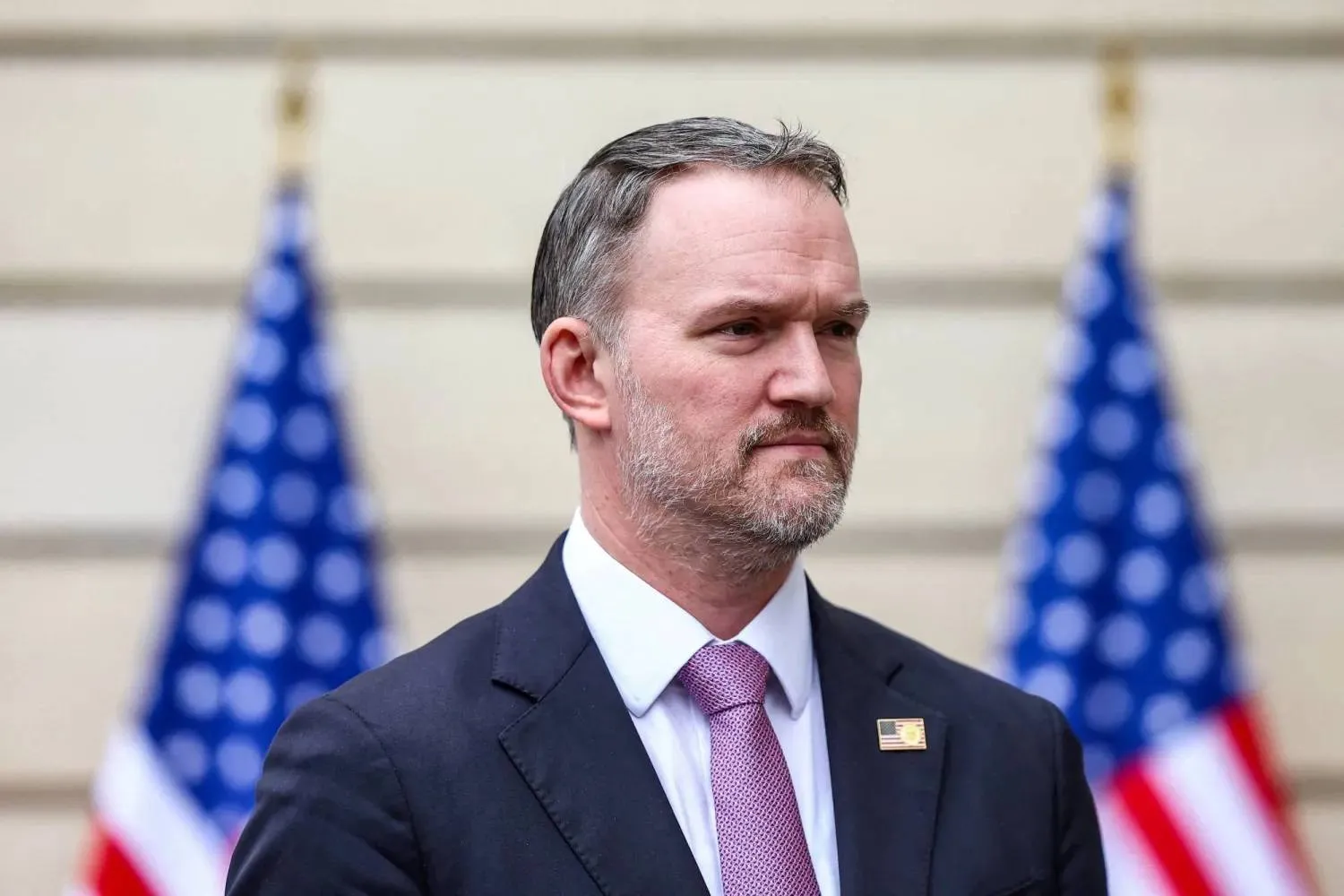

US Trade Representative: China Involvement in Iran Would Complicate Matters

US Trade Representative Jamieson Greer attends a press conference with US Treasury Secretary Scott Bessent (not pictured) after two days of meetings with a Chinese delegation, in Paris, France March 16, 2026. Reuters 
TT

US Trade Representative: China Involvement in Iran Would Complicate Matters

US Trade Representative Jamieson Greer attends a press conference with US Treasury Secretary Scott Bessent (not pictured) after two days of meetings with a Chinese delegation, in Paris, France March 16, 2026. Reuters 

US Trade Representative Jamieson Greer said on Friday that the ‌United States is trying to maintain a stable relationship with China, but if Beijing gets involved with Iran in a way that is counter to US interests, that would complicate matters.

“The underlying goals ⁠of our economies are so different. But there's a way where we can have some economic stability. If China is going to be involved in Iran in a way that's harmful to US interests, then that obviously complicates it, and that's China's responsibility to eliminate ‌that,” ⁠Greer said in an interview on CNBC.

Greer also said he expects US President Donald Trump to have a good meeting next month with Chinese President Xi Jinping. The trip ⁠comes just a year after Washington rolled out sweeping and at times erratic global tariffs.

“I think the ⁠thing to remember with China is, although we're trying very hard to have stability ⁠with China, particularly in trade and economics, not every challenge with them is resolved,” Greer said.

Meanwhile, the European Union and Washington are closing in on an agreement to coordinate ‌on producing and securing critical minerals, Bloomberg News reported on Friday.

The potential deal would include incentives such as minimum price guarantees that could favor non‑Chinese suppliers, the report said, citing an “action plan.”

The EU and US ⁠would also cooperate on standards, investments and joint projects, along with increased coordination on any supply disruptions by countries like China, the report added.

EU trade commissioner Maros Sefcovic said in March he had a “very ‌positive” ⁠meeting with Greer on the sidelines of a World Trade Organization ministerial meeting in Cameroon, where the two sides agreed to further advance work on critical ⁠minerals and also discussed tariffs.

The EU-US deal would cover “critical minerals along the entire value chain and life-cycle management, including exploration, extraction, ⁠processing, refining, recycling and recovery,” Bloomberg reported, citing a non-binding memorandum of understanding.

The US has been scrambling to get ⁠access to critical mineral reserves, especially rare earth supply chains currently dominated by Chinese players.



World Bank Chief: Middle East War to Cut Growth, Deliver Cascading Impact

FILE PHOTO: World Bank President Ajay Banga arrives for a signing ceremony with Thailand to host the 2026 International Monetary Fund and the World Bank annual meetings on the last day of this year's meeting, following last month's deadly earthquake, in Marrakech, Morocco, October 15, 2023. REUTERS/Susana Vera/File Photo
TT

World Bank Chief: Middle East War to Cut Growth, Deliver Cascading Impact

FILE PHOTO: World Bank President Ajay Banga arrives for a signing ceremony with Thailand to host the 2026 International Monetary Fund and the World Bank annual meetings on the last day of this year's meeting, following last month's deadly earthquake, in Marrakech, Morocco, October 15, 2023. REUTERS/Susana Vera/File Photo

The war in the Middle East will have a cascading impact on the global economy, even if a ceasefire announced by US President Donald Trump takes hold, World Bank President Ajay Banga told Reuters in an interview on Friday.

And the damage will be far deeper if the ceasefire fails and the conflict escalates, he said.

Banga on Tuesday said global growth could be lowered by 0.3 to 0.4 percentage point in a baseline scenario, with an early end to the war, and by as much as 1 percentage point if it endures. Inflation could increase by 200 to 300 basis points, with a much higher impact - of up to 0.9 percentage point - if the war continues, he said.

The World Bank's baseline estimate now projects growth in emerging markets and developing economies of 3.65% in 2026, compared to 4% in October, dropping as low as 2.6% in an adverse scenario with a longer-lasting war. ‌Inflation in those ‌countries was now forecast to hit 4.9% in 2026, up from the previous estimate of 3%. ‌The extreme ⁠scenario could see ⁠inflation rising as high as 6.7%, according to estimates viewed by Reuters.

The war, which has killed thousands of people across the Middle East, has sent the price of oil up by 50% while disrupting supplies of oil, gas, fertilizer, helium and other goods, as well as tourism and air travel.

The two-week ceasefire announced by Trump appears tenuous, with Israel and Iran continuing strikes. Iran said on Friday that blocked Iranian assets must be released and a ceasefire must take hold in Lebanon before US-Iran talks, scheduled for Saturday in Pakistan, can proceed. Trump said that US warships were being reloaded with ammunition in case the talks failed.

"The question really is, does this current peace and the negotiations that ⁠are going to be happening this weekend - will this lead to a lasting peace and ‌then a reopening of the Strait (of Hormuz)?" said Banga. "If it doesn't lead to ‌that, and if conflict were to break out again, would that have an even larger impact, or longer-term impact on energy infrastructure?"

Banga said the ‌world's largest development bank was already in discussions with some developing countries, including small island states with no natural energy resources, ‌about tapping funds from existing programs under "crisis response windows."

The World Bank's crisis toolkit allows countries to tap previously approved but not yet disbursed funds without additional board approvals, increasing flexibility.

But Banga said the bank was cautioning countries to avoid setting up energy subsidies that they could not afford, which would trigger even bigger problems in the future.

"I worry about making sure that they can come through this crisis, targeting what they need to do, but ‌not doing anything that further deteriorates that fiscal space," he said.

Many developing countries also have high debt levels and interest rates remain high, which constrains their ability to borrow money to ⁠fund measures to respond to ⁠the jump in energy costs and other goods caused by the war. The crisis has put a fresh spotlight on the need for countries to diversify energy supplies and boost self-sufficiency, Banga said. The World Bank last June ended a longstanding ban on funding nuclear energy projects as part of a push to meet rising electricity needs.

Nigeria, which had long faced problems, stood to benefit from a $20 billion investment made by the Dangote Group in refineries, which had actually increased output during the war, and was now supplying aviation fuel to neighboring countries.

"Nigeria should be breathing a sigh of relief. They've built up the ability to have energy security for themselves through that huge investment," he said. "It's actually a really good example of the right thing being done in terms of energy self-sufficiency for them, but also for their neighbors."

The World Bank is also working closely with Mozambique, another African country, to expand its energy production capabilities in both natural gas and hydropower.

The World Bank had many energy products in the pipeline, Banga said, noting that talks were under way with some countries looking to extend the life of their fleets of nuclear reactors, and others keen to move into nuclear power.

"If you don't get nuclear and hydro and geothermal going at scale, along with wind and solar, they will end up doing more with traditional fuels, and nobody really wants that," he said.


Egypt, Russia Hope to Speed up Construction of El Dabaa Nuclear Plant

The Egyptian and Russian delegations meet on Friday. (Egypt’s Ministry of Electricity and Renewable Energy)
TT

Egypt, Russia Hope to Speed up Construction of El Dabaa Nuclear Plant

The Egyptian and Russian delegations meet on Friday. (Egypt’s Ministry of Electricity and Renewable Energy)

Egypt and Russia are pushing to accelerate construction of the El Dabaa nuclear power plant and keep it on schedule.

Egypt’s Minister of Electricity and Renewable Energy Mahmoud Esmat stressed the need for closer coordination between Egyptian and Russian institutions to deliver the project.

Meeting a Russian State Duma delegation on Friday, he said El Dabaa was central to Egypt’s peaceful nuclear program to generate electricity.

The plant is being built in the northern Dabaa area under a 2015 agreement between Cairo and Moscow, with a cost of $25 billion financed through a concessional Russian state loan. Final construction agreements were signed in 2017.

Esmat held talks with a Russian parliamentary delegation led by Nikolai Shulginov, chairman of the State Duma Committee on Energy. Egypt’s Electricity Ministry said discussions focused on expanding cooperation in clean and renewable energy and reviewing progress at the El Dabaa project.

The delegation also visited the project site. Russia’s embassy in Cairo said the trip underscored the project’s strategic importance and reflected strong cooperation between the two countries in the peaceful use of nuclear energy.

Talks covered implementation progress, phase timelines, and preparations for transitioning between construction stages. The two sides also reviewed coordination between joint work teams and companies involved in the project.

El Dabaa will include four nuclear reactors with a combined capacity of 4,800 megawatts, each producing 1,200 megawatts. The first reactor is due to start operations in 2028, with the remaining units scheduled to follow by 2030, according to the Electricity Ministry.

Esmat said Egypt’s partnership with Russia and the two countries’ long-standing ties had supported progress at the site. He said the project was key to diversifying power generation, expanding reliance on clean and renewable energy, and advancing Egypt’s energy mix strategy.

Shulginov said the project goes beyond building a nuclear plant, aiming to establish a new advanced technological industry supported by infrastructure that strengthens Egypt’s energy security.

Egypt’s Electricity Ministry said the plant relies on advanced engineering solutions and cost-effective, reliable technologies that meet the highest safety and environmental standards.


US Inflation Surges 3.3% as Iran War Impact Bites

A person shops at a grocery store as inflation levels lead to a consumer price surge, in New York, New York, USA, 10 April 2026. (EPA)
TT

US Inflation Surges 3.3% as Iran War Impact Bites

A person shops at a grocery store as inflation levels lead to a consumer price surge, in New York, New York, USA, 10 April 2026. (EPA)

Inflation in the United States rose sharply in March, government data showed Wednesday, as higher energy prices due to the war in the Middle East hit Americans hard.

The nationwide sticker shock put pressure on President Donald Trump, who has ordered peace talks with Iran and faces mid-term elections in November.

The rate of inflation rose to 3.3 percent year-on-year in March, the US Bureau of Labor Statistics (BLS). By comparison, this same consumer price index (CPI) rose 2.4 percent year-on-year a month earlier.

Gasoline prices surged by 21.2 percent between February and March -- the largest monthly increase since the government began publishing a related index in 1967, the US Bureau of Labor Statistics (BLS) said.

Excluding volatile energy and food prices, the inflation rate rose 2.6 percent compared to 2.5 a month earlier.

Markets had anticipated the surge, according to the consensus published by MarketWatch.

The United States and Israel began bombing Iran on February 28 and Tehran retaliated by blocking traffic in the Strait of Hormuz, a waterway used to carry a fifth of the world's oil and gas deliveries.

Despite being the world's top producer of crude oil, the United States also felt the pain, as prices at the gas pump shot up.

A gallon (3.78 liters) of regular gasoline currently costs an average of $4.15 in the United States, compared to approximately $3 just before the war.

- More price pain ahead -

The Trump administration -- elected in part on a promise to quash inflation -- maintains that the war's economic disruptions will be temporary.

US Vice President JD Vance said Friday he hoped for a "positive" outcome as he departed Washington for US-Iran peace talks being held in Pakistan this weekend.

But experts predicted more economic pain ahead due to the war in Iran, especially for middle and lower-income households in the United States already squeezed by rising energy and airfare prices.

Heather Long, chief economist at Navy Federal Credit Union, said that inflation soared in March to the highest level in almost two years.

"This is only the beginning. Food prices, travel and shipping costs are all going up in April and will exacerbate the pain," she said.

"March CPI was as expected, so no surprises. But there is a huge increase in fuel prices, boosting inflation" Christopher Low of FHN Financial told AFP.

"And we got the news last night that the ceasefire is not being honored by either side, apparently," he said. "There's still very little traffic through the Strait of Hormuz."

When Trump returned to the White House in January 2025, inflation was falling, compared to a peak in the spring of 2022.

The war in Ukraine, which had started a few months earlier, had driven prices at the pump even higher than they are today.

The CPI index was rising by 2.3 percent year-over-year in April 2025 -- coinciding with the US president's announcement of a sharp increase in tariffs on imported goods.

Inflation started to creep up, though Washington refused to acknowledge this as a consequence of the tariff war.

Price growth slowed again late last year, largely thanks to gasoline prices, relatively moderate at the time.

During the Federal Reserve's most recent meeting in mid-March, Chairman Jerome Powell explained that the war risked delaying efforts to bring inflation under control in the United States.

The US central bank's target for inflation is two percent -- an objective it has not met in five years due to a succession of shocks to the economy: the Covid-19 pandemic, the war in Ukraine, and tariffs.