


World Bank Chief: Middle East War to Cut Growth, Deliver Cascading Impact

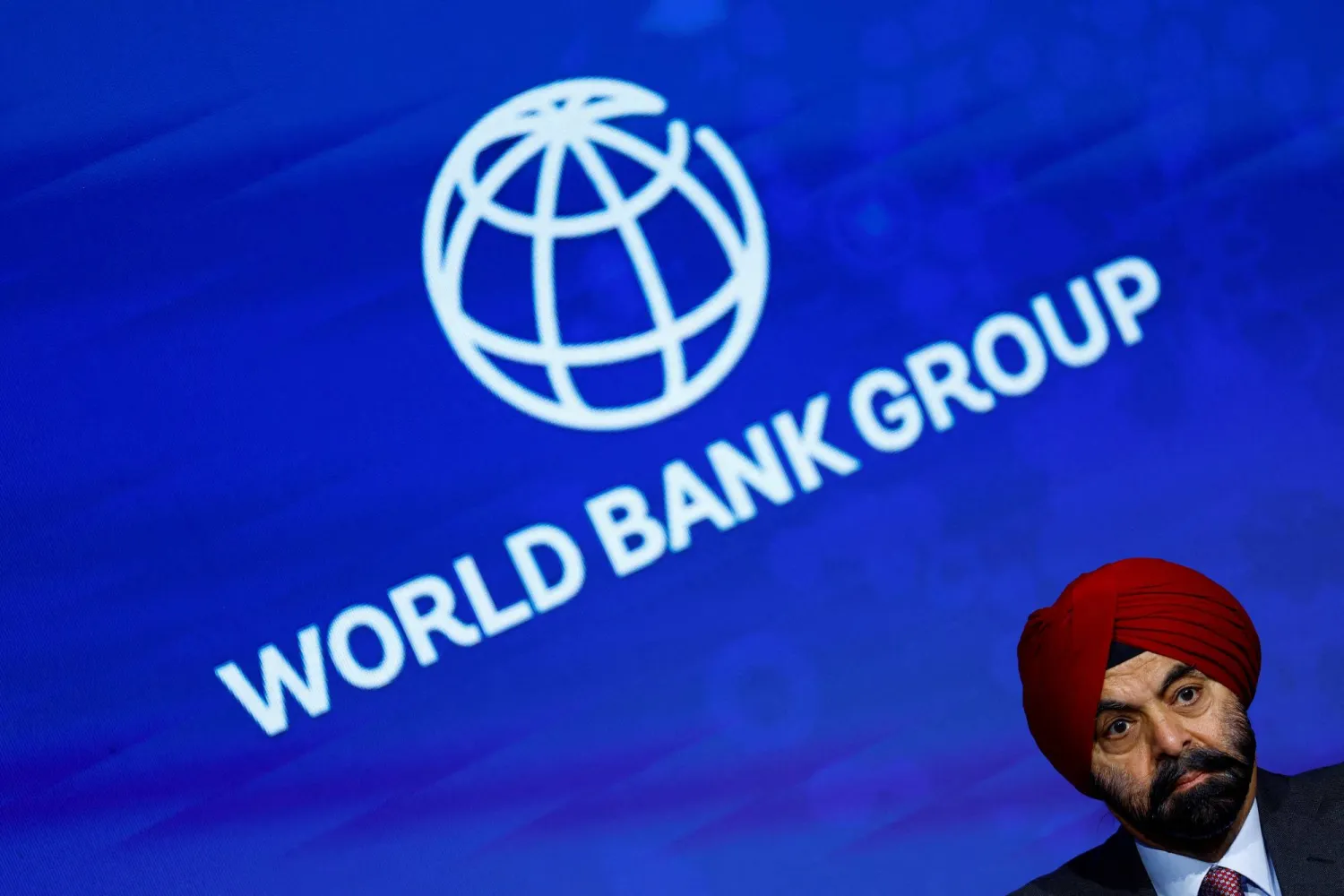
FILE PHOTO: World Bank President Ajay Banga arrives for a signing ceremony with Thailand to host the 2026 International Monetary Fund and the World Bank annual meetings on the last day of this year's meeting, following last month's deadly earthquake, in Marrakech, Morocco, October 15, 2023. REUTERS/Susana Vera/File Photo
TT

World Bank Chief: Middle East War to Cut Growth, Deliver Cascading Impact

FILE PHOTO: World Bank President Ajay Banga arrives for a signing ceremony with Thailand to host the 2026 International Monetary Fund and the World Bank annual meetings on the last day of this year's meeting, following last month's deadly earthquake, in Marrakech, Morocco, October 15, 2023. REUTERS/Susana Vera/File Photo

The war in the Middle East will have a cascading impact on the global economy, even if a ceasefire announced by US President Donald Trump takes hold, World Bank President Ajay Banga told Reuters in an interview on Friday.

And the damage will be far deeper if the ceasefire fails and the conflict escalates, he said.

Banga on Tuesday said global growth could be lowered by 0.3 to 0.4 percentage point in a baseline scenario, with an early end to the war, and by as much as 1 percentage point if it endures. Inflation could increase by 200 to 300 basis points, with a much higher impact - of up to 0.9 percentage point - if the war continues, he said.

The World Bank's baseline estimate now projects growth in emerging markets and developing economies of 3.65% in 2026, compared to 4% in October, dropping as low as 2.6% in an adverse scenario with a longer-lasting war. ‌Inflation in those ‌countries was now forecast to hit 4.9% in 2026, up from the previous estimate of 3%. ‌The extreme ⁠scenario could see ⁠inflation rising as high as 6.7%, according to estimates viewed by Reuters.

The war, which has killed thousands of people across the Middle East, has sent the price of oil up by 50% while disrupting supplies of oil, gas, fertilizer, helium and other goods, as well as tourism and air travel.

The two-week ceasefire announced by Trump appears tenuous, with Israel and Iran continuing strikes. Iran said on Friday that blocked Iranian assets must be released and a ceasefire must take hold in Lebanon before US-Iran talks, scheduled for Saturday in Pakistan, can proceed. Trump said that US warships were being reloaded with ammunition in case the talks failed.

"The question really is, does this current peace and the negotiations that ⁠are going to be happening this weekend - will this lead to a lasting peace and ‌then a reopening of the Strait (of Hormuz)?" said Banga. "If it doesn't lead to ‌that, and if conflict were to break out again, would that have an even larger impact, or longer-term impact on energy infrastructure?"

Banga said the ‌world's largest development bank was already in discussions with some developing countries, including small island states with no natural energy resources, ‌about tapping funds from existing programs under "crisis response windows."

The World Bank's crisis toolkit allows countries to tap previously approved but not yet disbursed funds without additional board approvals, increasing flexibility.

But Banga said the bank was cautioning countries to avoid setting up energy subsidies that they could not afford, which would trigger even bigger problems in the future.

"I worry about making sure that they can come through this crisis, targeting what they need to do, but ‌not doing anything that further deteriorates that fiscal space," he said.

Many developing countries also have high debt levels and interest rates remain high, which constrains their ability to borrow money to ⁠fund measures to respond to ⁠the jump in energy costs and other goods caused by the war. The crisis has put a fresh spotlight on the need for countries to diversify energy supplies and boost self-sufficiency, Banga said. The World Bank last June ended a longstanding ban on funding nuclear energy projects as part of a push to meet rising electricity needs.

Nigeria, which had long faced problems, stood to benefit from a $20 billion investment made by the Dangote Group in refineries, which had actually increased output during the war, and was now supplying aviation fuel to neighboring countries.

"Nigeria should be breathing a sigh of relief. They've built up the ability to have energy security for themselves through that huge investment," he said. "It's actually a really good example of the right thing being done in terms of energy self-sufficiency for them, but also for their neighbors."

The World Bank is also working closely with Mozambique, another African country, to expand its energy production capabilities in both natural gas and hydropower.

The World Bank had many energy products in the pipeline, Banga said, noting that talks were under way with some countries looking to extend the life of their fleets of nuclear reactors, and others keen to move into nuclear power.

"If you don't get nuclear and hydro and geothermal going at scale, along with wind and solar, they will end up doing more with traditional fuels, and nobody really wants that," he said.



Macron Arrives in Kenya Ahead of Africa Summit

French President Emmanuel Macron (L) shakes hands with Kenyan President William Ruto (R) during a reception at State House ahead of the Africa Forward: Africa- France Partnerships for Innovation and Growth Summit in Nairobi, on May 10, 2026. (AFP)
TT

Macron Arrives in Kenya Ahead of Africa Summit

French President Emmanuel Macron (L) shakes hands with Kenyan President William Ruto (R) during a reception at State House ahead of the Africa Forward: Africa- France Partnerships for Innovation and Growth Summit in Nairobi, on May 10, 2026. (AFP)

President Emmanuel Macron on Sunday met with his Kenyan counterpart William Ruto in Nairobi as part of an African visit aimed at renewing France's engagement with the continent after years of strained ties with former colonies.

Macron is to co-host a two-day summit starting on Monday, bringing together African leaders and business executives, as he seeks to cement his legacy one year before the end of his term.

The meeting will focus on economic development and cross-border investment, among other themes, the French presidency said, stressing that it will be the first such forum held in an English-speaking country.

Macron hopes to highlight France's renewed relationship with the continent as a "report card on his Africa policy", said one diplomat.

Anti-French sentiment runs high in some former African colonies as the continent becomes a renewed diplomatic battleground, with Russian and Chinese influence growing.

Once master of vast expanses of northern, central and western Africa, France has played a crucial role in the continent's post-colonial history, repeatedly intervening militarily since the early 1960s.

France has vowed to abandon the so-called "Francafrique" strategy, under which Paris sought to keep francophone Africa under its thumb through political collusion, exclusive access for French businesses and oblique financial deals, including graft.

Macron arrived in English-speaking Kenya from Egypt and is also due to travel to Ethiopia as part of his Africa tour.


China, US to Hold Trade Talks in South Korea Next Week

 Treasury Secretary Scott Bessent listens as President Donald Trump speaks at a charter school in The Villages, Fla., Friday, May 1, 2026. (AP)
Treasury Secretary Scott Bessent listens as President Donald Trump speaks at a charter school in The Villages, Fla., Friday, May 1, 2026. (AP)
TT

China, US to Hold Trade Talks in South Korea Next Week

 Treasury Secretary Scott Bessent listens as President Donald Trump speaks at a charter school in The Villages, Fla., Friday, May 1, 2026. (AP)
Treasury Secretary Scott Bessent listens as President Donald Trump speaks at a charter school in The Villages, Fla., Friday, May 1, 2026. (AP)

Senior Chinese and US officials will hold talks in South Korea next week, Beijing's commerce ministry and Washington's Treasury secretary said Sunday, ahead of an expected summit between leaders Xi Jinping and Donald Trump.

The Chinese commerce ministry said in a statement that Vice Premier He Lifeng, Beijing's top economic official, will attend "consultations on mutual economic and trade issues" on Tuesday and Wednesday.

US Treasury Secretary Scott Bessent said in a post on X: "On Wednesday, I will stop in Seoul for a discussion with Vice Premier He Lifeng of China, before continuing on to Beijing for the Leaders' Summit between President Trump and President Xi."

Trump is set to visit China for a high-stakes summit with Xi, with the two leaders expected to focus on easing tensions over trade and Taiwan, with the war in the Middle East looming large over talks.

While Washington and Beijing slapped tit-for-tat tariffs on each other's exports a year ago, Trump and Xi agreed on a year-long trade truce at their October meeting in South Korea.


Aramco CEO Warns 1 Billion Barrels Lost Will Slow Oil Market Recovery

President and CEO of Saudi's Aramco, Amin Nasser, speaks during the Future Investment Initiative (FII) in Riyadh, Saudi Arabia October 29, 2024. (Reuters)
TT

Aramco CEO Warns 1 Billion Barrels Lost Will Slow Oil Market Recovery

President and CEO of Saudi's Aramco, Amin Nasser, speaks during the Future Investment Initiative (FII) in Riyadh, Saudi Arabia October 29, 2024. (Reuters)

The world has lost about 1 billion barrels of oil over the past two months and energy markets will take time to stabilize even if ‌flows resume, ‌Saudi Aramco’s CEO said on ‌Sunday, ⁠as shipping disruptions ⁠choke traffic through the Strait of Hormuz.

"Our objective is simple: keep energy flowing, even when the system is under strain," Amin Nasser told Reuters in a statement after Aramco reported a 25% ⁠jump in net profit in ‌its first-quarter.

Global energy supplies ‌have been sharply squeezed by Iran’s blockade of ‌the Strait of Hormuz, which ‌has curtailed shipping and driven prices higher following the US-Israeli war.

"Reopening routes is not the same as normalizing a market that has ‌been deprived of about one billion barrels of oil," Nasser said, ⁠adding ⁠that years of underinvestment have compounded the strain on already-low global inventories.

Aramco has used its East-West Pipeline to bypass Hormuz and transport crude to the Red Sea, an asset Nasser described as a "critical lifeline" to mitigate the global supply crisis.

Despite shifts in shipping routes, Nasser reiterated that Asia remained a key priority for the company and was central to global demand.