

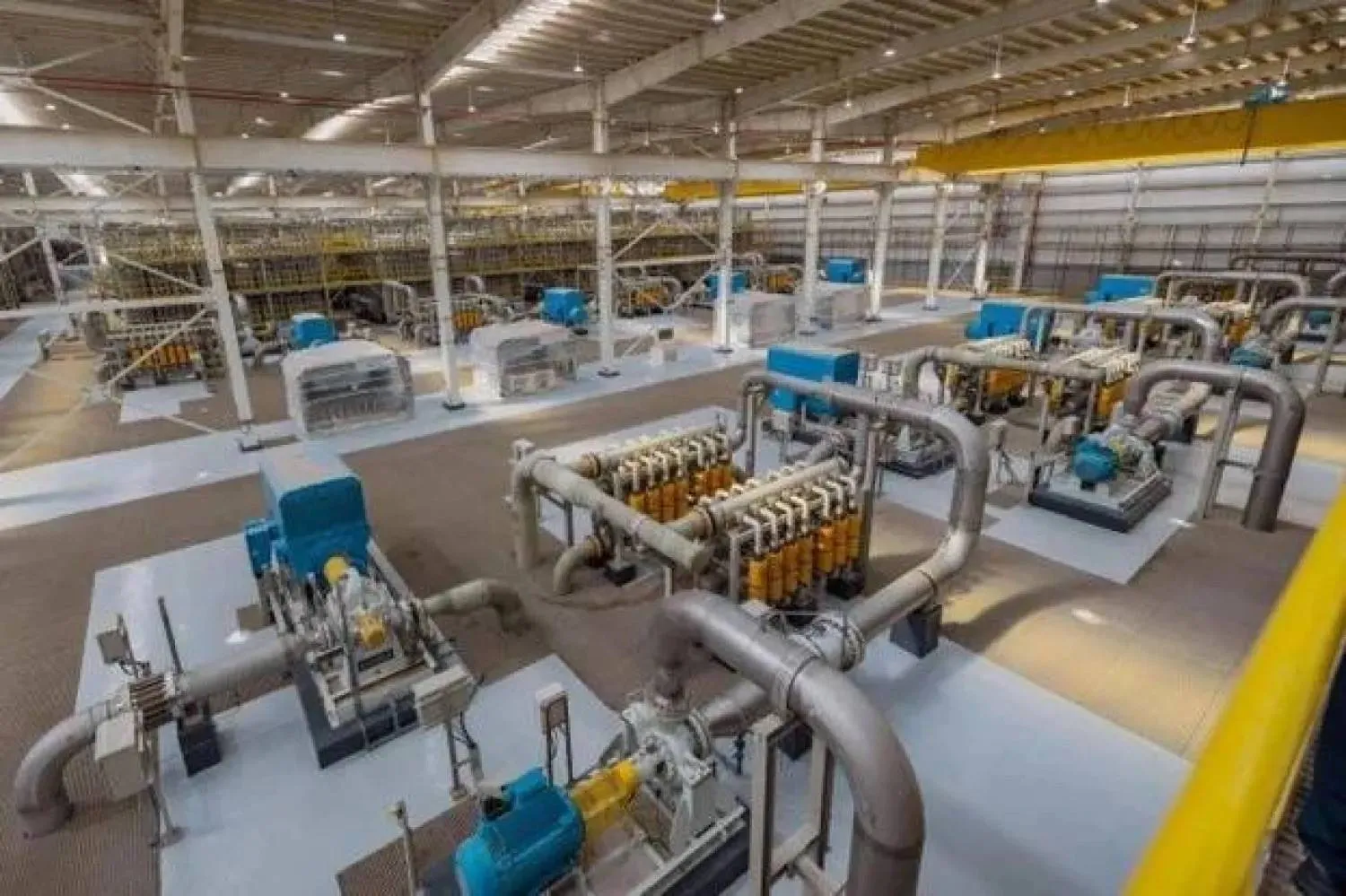

Saudi Arabia Boosts Water Efficiency with Over $26.7 Billion in Investments Since 2018

Shuaibah Desalination Plant (Saudi Water Authority)
TT

Saudi Arabia Boosts Water Efficiency with Over $26.7 Billion in Investments Since 2018

Shuaibah Desalination Plant (Saudi Water Authority)

Saudi Arabia has invested about SAR100 billion ($26.7 billion) in its water sector since 2018, as part of its National Water Strategy to improve efficiency and sustainability while expanding private sector participation in line with Vision 2030.

Deputy Minister for Water at the Ministry of Environment, Water and Agriculture Abdulaziz Al-Shaibani told Asharq Al-Awsat that increased public-private partnerships are driving a shift toward a more efficient operating model and easing pressure on the state budget.

He said private sector involvement has transferred capital costs for major projects, including desalination plants, transmission networks, storage facilities and wastewater treatment, while boosting value across the supply chain through water reuse and reducing reliance on non-renewable resources.

Lower operating costs have also strengthened the sector’s appeal to investors. Seawater desalination using reverse osmosis now costs about SAR0.74 per cubic meter, while groundwater desalination costs around SAR0.55, offering competitive returns for local and international investors.

Local content in privatization projects has reached about 70 percent, while Saudis account for 90 percent of operational jobs, highlighting the sector’s contribution to economic growth and employment.

Al-Shaibani said investment in research and development has helped reduce production costs and localize key technologies, including reverse osmosis membrane manufacturing, valued at SAR 1.14 billion ($304 million). This supports the development of domestic supply chains and increases economic value added.

According to data from the Saudi Water Partnership Company (SWPC), 51 privatization projects have been launched with total investments of about SAR56 billion ($14.9 billion), including operational projects and others under development or tender.

Private sector production capacity is expected to reach 2.6 million cubic meters per day by 2030 and rise to 8.18 million cubic meters per day by 2032. Water transmission capacity between cities is projected to reach 2.43 million cubic meters per day by 2029, while strategic storage capacity is expected to reach just over 7 million cubic meters.

Major projects include the Juranah Independent Strategic Water Reservoir in Makkah province, with a capacity of 2.5 million cubic meters, the Rayis-Rabigh Independent Water Transmission Project, and the Rabigh 3 Independent Water Plant, all developed under long-term contracts to ensure sustainability.

The Al-Khafji solar-powered desalination plant, one of the world’s leading projects of its kind, has reduced desalination costs by about 40 percent, supporting more efficient and sustainable production.



Iraq Says Has ‘Understandings’ to Bypass Hormuz Blockade

A worker rides a bicycle at the Zubair oil field in Basra, Iraq, April 6, 2026. (Reuters)
TT

Iraq Says Has ‘Understandings’ to Bypass Hormuz Blockade

A worker rides a bicycle at the Zubair oil field in Basra, Iraq, April 6, 2026. (Reuters)

Baghdad's oil ministry said Tuesday it has "understandings" with the United States and Iran to reduce the impact of the blockade of the Strait of Hormuz on Iraqi oil exports.

The ministry did not elaborate or say when these reported understandings were reached.

But Iran announced earlier this month -- before the fragile ceasefire was reached last Wednesday with the United States -- that it would allow Iraqi shipping to transit the key waterway.

Iraqi oil ministry spokesperson Saheb Bazoun told the Iraqi News Agency (INA) "there are understandings with the American and Iranian sides to circumvent the blockade imposed on the Strait of Hormuz, and with all parties to guarantee exports".

A founding member of the OPEC oil cartel, Iraq normally exports the majority of its crude through the strait, but like other exporters in the oil-rich region, it has been left scrambling for alternative routes.

Bazoun told INA that Iraq was continuing to use secondary export routes, including a pipeline to the Turkish port of Ceyhan and via Syria's Baniyas port.

Authorities announced earlier this month Iraq has begun exporting crude using tanker trucks through Syria, after resuming oil exports of 250,000 barrels per day through Ceyhan.

The Middle East war has wrought havoc on energy markets, especially after Iran tightened the screws on the Strait of Hormuz -- through which roughly a fifth of global oil and gas passes -- sharply slowing maritime traffic, and reportedly charging transit fees.

Despite the two-week ceasefire between the United States and Iran, and after a failed attempt to reach an agreement, Washington imposed a blockade on Iranian ports in the Strait of Hormuz, sending tremors through global energy markets.

Oil exports account for some 90 percent of Iraq's budget revenues, which plummeted more than 70 percent in March compared with February.


Gold Rises as Dollar Softens, Lower Oil Prices Ease Inflation Fears

Gold bracelets and necklaces on display for sale in a gold shop in the Grand Bazaar in Istanbul (AFP)
TT

Gold Rises as Dollar Softens, Lower Oil Prices Ease Inflation Fears

Gold bracelets and necklaces on display for sale in a gold shop in the Grand Bazaar in Istanbul (AFP)

Gold prices rose on Tuesday, supported by a softer dollar and easing inflation fears as oil prices dropped on hopes of further US-Iran peace talks.

Spot gold was up 0.8% at $4,775.20 per ounce, as of 0755 GMT. US gold futures for June delivery rose 0.7% to $4,798.40, Reuters reported.

Oil prices fell below $100 a barrel as signs of potential ⁠talks to end the ⁠US-Iran war eased concerns about supply risks stemming from the US blockade of Iranian ports.

Higher crude prices feed into inflation by raising transportation and production costs. While gold is treated as a hedge against inflation, higher interest rates weigh on the non-yielding metal's demand.

Markets appear to ⁠think that there's still time for a deal between the United States and Iran, said Ilya Spivak, head of global macro at Tastylive. Reuters reported on Tuesday that negotiating teams from the US and Iran could return to Islamabad this week, days after talks between the two countries ended in the Pakistani capital without a breakthrough.

The US dollar fell to its lowest level in more than a month on hopes for a diplomatic breakthrough, making the greenback-denominated ⁠gold more ⁠affordable for holders of other currencies.

"Near-term, a thin macro calendar might make US-Iran headlines the driving engine. That sets the stage for choppy price action for now," Spivak said, adding that gold could face resistance around $4,850.

Traders currently see a 31% chance of a 25-basis-point US rate cut this year, up from about 13% last week. Before the war, there were expectations of two cuts for this year.

Among other metals, spot silver rose 2.9% to $77.73 per ounce, platinum gained 0.8% to $2,086.15, and palladium was up 0.7% at $1,585.42.


China’s Exports Slowed in March While Imports Soared

A staff works in front of a fruit shop in Beijing, China, 14 April 2026. (EPA)
TT

China’s Exports Slowed in March While Imports Soared

A staff works in front of a fruit shop in Beijing, China, 14 April 2026. (EPA)

China's exports grew at a slower pace last month after starting the year with a surge, official data showed Tuesday, as the global economy reels from war in the Middle East.

The world's second-largest economy produced a record-breaking trade surplus last year at $1.2 trillion.

Booming overseas shipments appeared set to continue this year after jumping by more than a fifth in January and February combined.

However, China's exports grew just 2.5 percent on-year in March, according to data published Tuesday by the General Administration of Customs (GAC).

The slowdown was more pronounced than expected, with a Bloomberg survey of economists forecasting 8.6 percent growth.

Exports to the United States also plunged last month, hit by blistering tariffs launched by President Donald Trump.

Shipments to the United States tumbled 26.5 percent on-year to $29.4 billion in March, the customs data showed.

In a more positive sign, imports soared 27.8 percent, according to the figures. That was higher than a forecast of 14 percent growth by Bloomberg.

The readings come at an uncertain time for international trade, with energy costs skyrocketing as a result of war between the United States and Iran.

Analysts say China's diversified energy supply insulates it from immediate shocks, though any global economic downturn would weaken demand for its exports.

GAC deputy head Wang Jun acknowledged "many uncertainties and instabilities in the external environment", at a news conference Tuesday.

"The impact of international geopolitical conflicts on global industrial and supply chains is still evolving in a complex manner," Wang said.

- Slowing growth -

Zhiwei Zhang, president and chief economist at Pinpoint Asset Management, added that "growth to major export destinations slowed across the board".

"The uncertainty of global macro outlook driven by the conflict in the Middle East likely weighed on the demand side," he wrote in a note.

Meanwhile, China's surge in import figures last month was the result of higher energy costs, Zhang said.

"I think China's trade surplus will likely shrink this year," he said, adding that "the high energy price is likely more damaging for China's competitors, given the scale and the efficiency of China's manufacturing sector."

Beijing is due to release closely watched economic growth data for the first quarter of the year on Thursday.

Leaders are targeting overall growth this year of 4.5-5.0 percent -- the lowest in decades.

Analysts expect China's economy to have expanded at 4.8 percent in the first quarter, up from 4.5 percent in the final three months of 2025, according to the median forecast of an AFP survey.

Many economists argue that China must adopt a growth model with a greater role for consumer spending rather than traditional drivers including exports and infrastructure investment.

A years-long crisis in the property sector, once a crucial engine for activity, has weighed on growth and spooked consumers.