Russia’s LNG Exports up 8.6% in January to April, Data Showshttps://english.aawsat.com/business/5269785-russia%E2%80%99s-lng-exports-86-january-april-data-shows
Russia’s LNG Exports up 8.6% in January to April, Data Shows
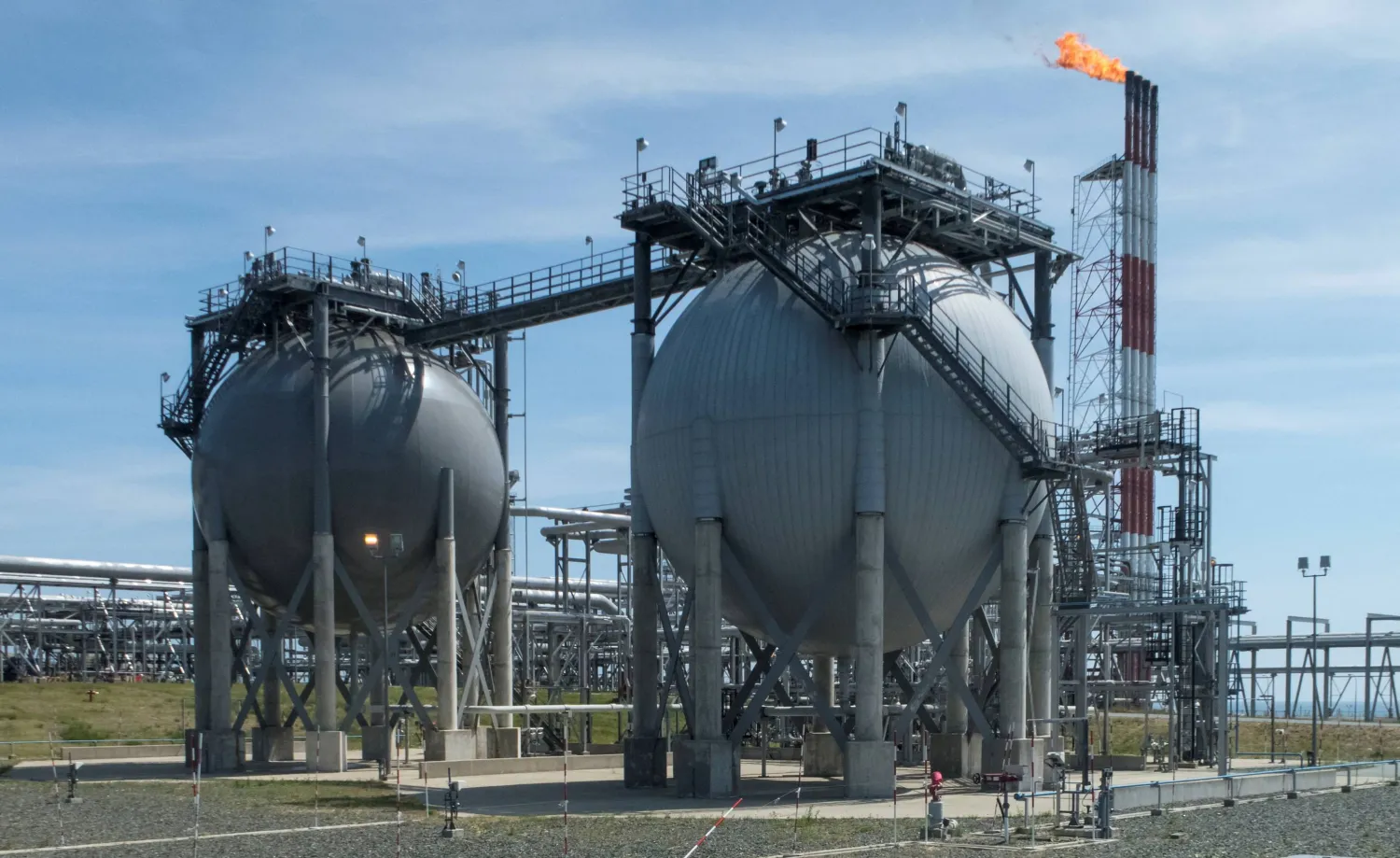
A general view of the liquefied natural gas plant operated by Sakhalin Energy at Prigorodnoye on the Pacific island of Sakhalin, Russia July 15, 2021. (Reuters)
TT
TT
Russia’s LNG Exports up 8.6% in January to April, Data Shows
A general view of the liquefied natural gas plant operated by Sakhalin Energy at Prigorodnoye on the Pacific island of Sakhalin, Russia July 15, 2021. (Reuters)
Russia's exports of liquefied natural gas rose 8.6% in January to April to 11.4 million metric tons from the same period last year due to supplies from the Arctic LNG 2 project, which reached 1 million tons in the first four months of the year, preliminary LSEG data showed on Tuesday.
US sanctions against Moscow over the Ukraine conflict have restrained Russian LNG exports, particularly from the Arctic LNG 2 plant, where operations have been hindered owing to difficulty securing buyers.
In April alone, total Russian exports of LNG rose 13.2% from a year ago to 2.92 million tons.
Data also showed that Russian LNG exports to Europe in January to April jumped 20.8% year-on-year to 6.4 million tons. In April, they rose to around 1.6 million tons from 1.2 million tons a year earlier.
In January, EU countries gave their final approval to ban Russian gas imports by late-2027.
Total exports from Novatek's Yamal LNG plant in the January to April period fell by 1.5% year-on-year to 6.5 million tons.
Asia-oriented Sakhalin-2, controlled by Gazprom, exported 3.7 million tons in the first four months of the year, up from 3.6 million tons during the same period last year.
Azerbaijan Promotes Caucasus Corridors to Link Saudi Logistics With Central Asiahttps://english.aawsat.com/business/5277382-azerbaijan-promotes-caucasus-corridors-link-saudi-logistics-central-asia
Azerbaijan Promotes Caucasus Corridors to Link Saudi Logistics With Central Asia
Azerbaijan's capital Baku with the city's famous architectural landmarks in the background (X)
As global markets search for logistical lifelines to secure supply chains and energy flows amid ongoing geopolitical disruptions, Azerbaijan is promoting major transport and logistics projects, foremost among them overland freight routes through the Caucasus and across the Caspian Sea, as a strategic safeguard for the future. These initiatives aim to create faster and more efficient shipping links while integrating the Gulf Cooperation Council states, particularly Saudi Arabia's logistics strategy, into a vital connectivity network stretching across the South Caucasus and deep into Central Asia.
Ahead of his country's Independence Day on May 28, Azerbaijan's Ambassador to Saudi Arabia Mutallim Mirzayev told Asharq Al-Awsat that Baku is leveraging its unique position as a strategic bridge to strengthen investment flows and trade, driven by a strong desire to deepen its comprehensive partnership with Riyadh and translate existing understandings into concrete projects on the ground. These include nearly 30 official agreements and important contracts covering the economy, trade, investment, and agriculture, in addition to a proposed joint investment fund. Mirzayev stressed that Azerbaijan is "uniquely positioned as a strategic bridge connecting Central Asia, the South Caucasus, and the Gulf region."
These logistics ambitions come at a time when Saudi-Azerbaijani relations are experiencing a peak in investment activity, with the two countries pursuing major strategic partnerships in both conventional and renewable energy sectors. In this regard, the ambassador praised the leading role played by Saudi companies in Azerbaijan, particularly ACWA Power, which he described as a vital partner driving the country's green energy transition, water management projects, and sustainable infrastructure development. He noted that cooperation is expanding rapidly, reflecting the peak level of investment activity between the two nations.
A key example is the Khizi-Absheron Wind Power Plant, officially inaugurated by Saudi Arabia's ACWA Power earlier this year. The project has a generation capacity of 240 megawatts and an investment value of $300 million. It is the first and largest fully foreign-funded renewable energy project in Azerbaijan and is expected to contribute significantly to the country's energy security.
In conventional energy, Saudi investments also maintain a significant presence through the participation of companies affiliated with the Kingdom's sovereign and development institutions in strategic oil and gas projects in Azerbaijan. These include contributions to the development of the giant Azeri-Chirag-Gunashli oil field, reinforcing the role of both countries in regional and international energy security.
Mutallim Mirzayev, Azerbaijan's ambassador to Saudi Arabia. (Asharq Al-Awsat)
Urban Momentum and the Joint Fund
Mirzayev praised Saudi Arabia's active, high-level participation in the 13th session of the World Urban Forum (WUF13), hosted recently in Baku. The forum featured leading Saudi initiatives and projects in urban development and sustainable housing, reflecting the growing depth of bilateral coordination.
The Azerbaijani ambassador noted that the forum successfully transformed Baku into a global platform for dialogue on the future of smart cities, modern urban planning, and climate resilience. He said these strategic principles are fully embedded in Azerbaijan's ongoing reconstruction and redevelopment plans, under which entire cities and villages are being rebuilt in the liberated territories.
Trade Momentum and the Joint Fund
Turning to economic cooperation, Mirzayev said efforts are advancing steadily to activate the proposal for a joint investment fund aimed at pooling capital and directing it toward priority sectors and shared economic objectives, including agriculture, food security, tourism, advanced technologies, and infrastructure, as well as strengthening trade in industry and advanced logistics services.
On people-to-people ties, he said tourism has become a key pillar of growth amid increasing visitor flows and growing interest among Saudi tourists in Azerbaijan as a distinctive cultural and tourism destination.
The official inauguration of the Khizi-Absheron Wind Power Plant, developed by ACWA Power, in January 2026. (X)
Vision 2030 and the Organization of Islamic Cooperation
"On the occasion of our Independence Day, I would like to express my sincere appreciation for the friendship, solidarity, and close cooperation between our two countries," Mirzayev said. He also praised the remarkable achievements and transformation witnessed in the Kingdom, noting that "the ambitious reforms and development initiatives implemented within the framework of Saudi Vision 2030 are making significant contributions to sustainable development, economic diversification, regional stability, and prosperity."
He added that Azerbaijan "highly values the Kingdom's principled support for Azerbaijan's sovereignty," while emphasizing that Baku attaches great importance to its relations with Saudi Arabia as one of the leading countries in the region. He reiterated Azerbaijan's future-oriented vision, highlighting the country's ongoing large-scale reconstruction and redevelopment efforts in the liberated territories, where entire cities and villages are being rebuilt in accordance with modern urban planning principles, smart city concepts, green energy, and sustainable development.
In the multilateral arena, Mirzayev revealed that Azerbaijan's upcoming chairmanship of the Organization of Islamic Cooperation summit will focus heavily on strengthening economic cooperation among member states, supporting climate action, science and innovation, youth empowerment, and sustainable development, all in the service of global stability.
He also reiterated that tourism has become an increasingly important pillar of bilateral relations, driven by the growing number of Saudi visitors traveling to Azerbaijan.
A view of Baku illuminated at night. (X)
The Geopolitics of the Middle Corridor and Shipping Alternatives
Azerbaijan's transport and logistics proposals are gaining strategic significance in economic circles. At the center of these plans is the Middle Corridor, officially known as the Trans-Caspian International Transport Route, which serves as a secure land-and-sea alternative connecting China with Central Asia, the Caucasus, Türkiye, and ultimately Europe. The corridor is particularly attractive because it can reduce cargo transit times to approximately 12 to 15 days, bypassing the constraints of traditional maritime shipping and the geopolitical complications associated with northern transport routes.
In the same logistics framework, the planned Zangazur Corridor, which would connect mainland Azerbaijan with the Nakhchivan Autonomous Republic and onward to Türkiye, represents a vital artery for regional economic integration. The corridor would establish direct and rapid road and rail connectivity and intersect with the Middle Corridor, creating an extensive logistics network stretching from the Turkic world and Central Asia to the ambitious transport systems being developed by the Gulf Cooperation Council states.
Shaping the Logistics Map
Regarding regional integration between the Gulf and Central Asia, Mirzayev emphasized that Azerbaijan's strategic location makes it a vital link connecting Central Asia, the South Caucasus, and the Gulf region. This geographical advantage is reinforced by modern transport infrastructure that enables Azerbaijan to facilitate trade, investment, and energy flows between the two regions in the face of global economic challenges.
The ambassador stressed that regional cooperation mechanisms are becoming increasingly important in addressing current global economic and geopolitical challenges, adding that Azerbaijan actively supports all initiatives aimed at strengthening integration, connectivity, and economic partnership between Central Asia and the Gulf region.
In this context, Mirzayev said major transport projects, particularly the Middle Corridor and the Zangazur Corridor, carry exceptional strategic weight for regional transportation, logistics services, international trade, and cross-border economic integration. Their ability to create faster, safer, and more efficient land and rail shipping links connecting Central Asia, the South Caucasus, and Türkiye with the Gulf region can strengthen global supply-chain security and open promising investment opportunities for all parties, including Saudi Arabia's logistics strategy as it seeks to diversify its gateways to the world.
Paris Mint to Issue 1st Solid-gold Coins in a Centuryhttps://english.aawsat.com/business/5277333-paris-mint-issue-1st-solid-gold-coins-century
Paris Mint to Issue 1st Solid-gold Coins in a Century
A worker holds a Marianne-Or gold coin bullion replica at La Monnaie de Paris in Paris on May 21, 2026. (Photo by SIMON WOHLFAHRT / AFP)
The Paris Mint said Tuesday that it would soon start selling solid-gold coins for investment, the first since it quit making Napoleons and Louis a century ago.
Four versions of the new Marianne coins will go on sale June 16, ranging from one-tenth of an ounce (3.1 grams) to a full ounce (31.1 grams).
One side will feature the symbolic Marianne face representing the French republic, while the other will show a map of the nation's territories, the Mint said.
They will compete on the global market with South African Krugerrands, Canadian Maple Leafs or American Gold Eagles.
The goal is to "democratize the gold market in France", the Mint's chief Marc Schwartz told journalists ahead of the launch, citing "investor demand" as prices have soared in recent years.
Most investors wanting to buy gold, considered a safe haven compared to other investments, usually opt for market-traded funds that track the metal's price, or buy shares in gold mining firms.
Gold and silver coins currently issued by the Mint are commemorative or collector items made of alloys with lower percentages of the precious metals.
But the new coins will be sold at market prices -- currently around $4,600 an ounce after surging more than 65 percent last year, AFP reported.
For investors who want to avoid the cost of storing and protecting gold in their homes, the Mint will offer a digital "e-Marianne" coin that it will hold until the day the owner wants to sell.
The Paris Mint, headquartered on the Right Bank of the Seine since 1775, did not say how many coins it expected to sell. Its revenues rose 1.7 percent last year to reach 197 million euros ($230 million).
Global Oil Price Gains 3% after US Military Strikes on Iranhttps://english.aawsat.com/business/5277307-global-oil-price-gains-3-after-us-military-strikes-iran
Global Oil Price Gains 3% after US Military Strikes on Iran
A giant crude oil tanker carrying two million barrels of Saudi oil arrives at a refinery off Chita, Japan, May 25, 2026 (Reuters)
Brent crude oil rose 3% on Tuesday after the US military carried out strikes in Iran, adding to uncertainty on whether a deal will be imminently reached to end the war and open up shipping flows through the Strait of Hormuz.
US Secretary of State Marco Rubio said on Tuesday that negotiating a deal with Iran could "take a few days," quashing hopes for an imminent end to the conflict a day after US forces conducted what Washington called defensive strikes in southern Iran.
"We are still waiting for more details on a potential deal," said Giovanni Staunovo at UBS. "Meanwhile we see renewed tensions in the Middle East, while flows through the Strait remain restricted."
Global benchmark Brent was up $3.04, or 3.2%, to $99.18 a barrel as of 0820 GMT, after settling 7% lower in the previous session. US West Texas Intermediate was down $4.07, or 4.2%, from Friday's close, at $92.53, Reuters reported.
There was no WTI settlement on Monday due to the US Memorial Day holiday.
"While differences between the parties have narrowed, any eventual peace deal would likely lead only to a gradual reopening, meaning the current tight supply outlook could take months to normalize," said Ole Hansen at Saxo Bank.
Tehran has effectively halted nearly all non-Iranian shipping into and out of the Gulf via the Strait of Hormuz since the war began, choking off about a fifth of global oil and liquefied natural gas flows.
The strikes happened as Iran's top negotiator and its foreign minister were in Doha for talks with Qatar's prime minister on a potential deal with the US to end the three-month-old war.
Both Washington and Tehran said they have made progress on a memorandum of understanding that would halt the war and give negotiators 60 days to reach a final deal.
Nikkei reported, citing a Middle East diplomatic source, that Iran would clear mines from the strait within a 30-day window under the agreement, after which vessels from all countries could navigate freely and safely, with Tehran also ending transit-fee collection.
Ship-tracking data showed that three LNG tankers passed through the Strait in recent days, heading to Pakistan, China and India, along with a supertanker carrying Iraqi crude to China that had been stranded for nearly three months.
US President Donald Trump on Monday repeated his demand that Iran hand over its enriched uranium so it could be destroyed.
"It's a sharp reminder that the deal could still collapse at the 11th hour, much like the five previous attempts before it," said Tony Sycamore, a market analyst at IG.
لم تشترك بعد
انشئ حساباً خاصاً بك لتحصل على أخبار مخصصة لك ولتتمتع بخاصية حفظ المقالات وتتلقى نشراتنا البريدية المتنوعة