


IBM CEO to Asharq Al-Awsat: Saudi Arabia Enters AI Implementation Phase

IBM: Saudi Arabia should use digital technologies to boost productivity and make them part of the workforce, not just an added technology layer.
TT

IBM CEO to Asharq Al-Awsat: Saudi Arabia Enters AI Implementation Phase

IBM: Saudi Arabia should use digital technologies to boost productivity and make them part of the workforce, not just an added technology layer.

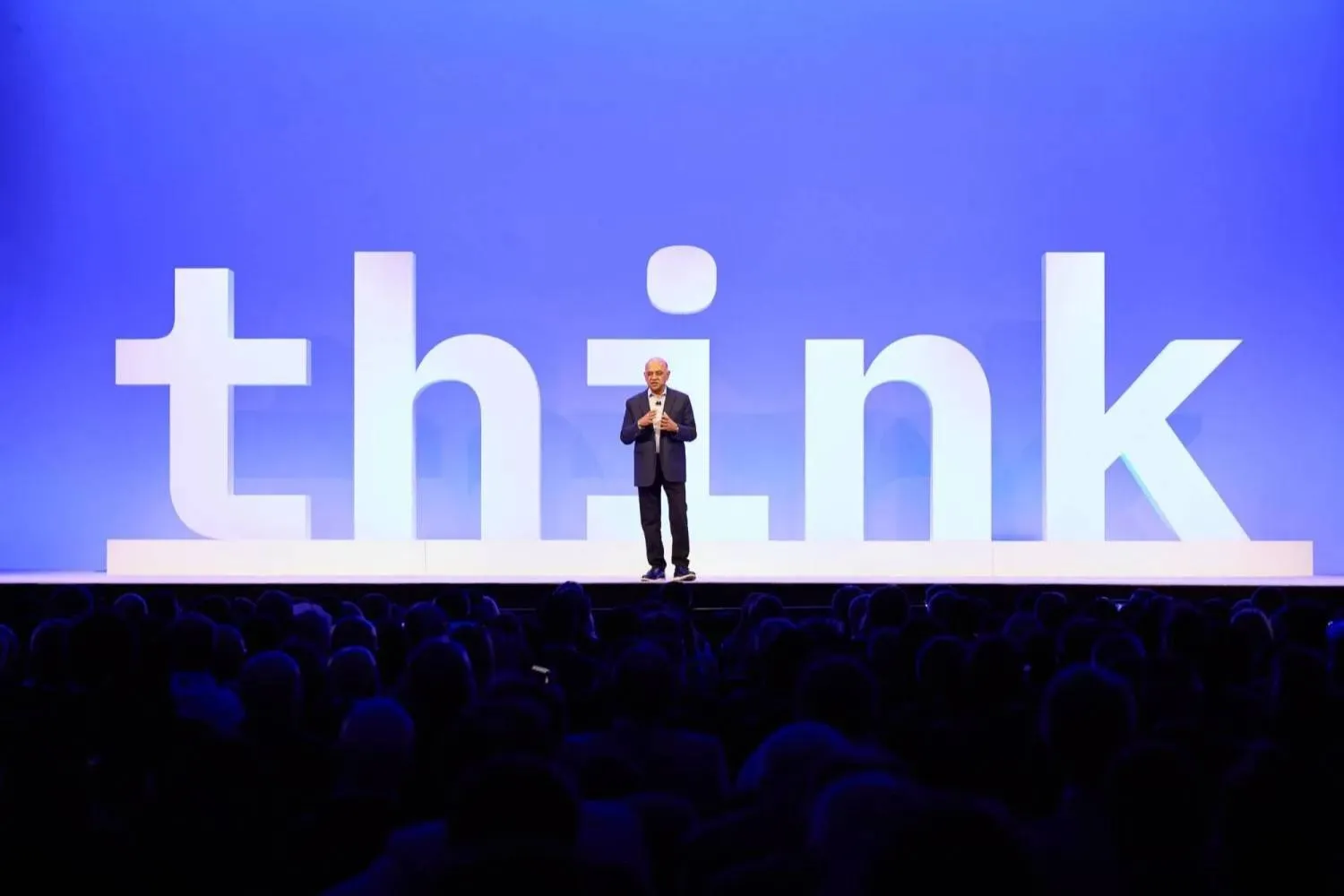
At IBM Think 2026 in Boston, IBM’s bet on Saudi Arabia went beyond expanding its role in AI infrastructure. The US technology company sought to position itself as a partner in a tougher phase, turning that investment into large-scale industrial and institutional execution.

That message came through in remarks by IBM Chief Executive Arvind Krishna to Asharq Al-Awsat. Speaking about the kingdom and the challenge it now faces, Krishna said infrastructure is not the problem in itself, adding that what needs to be done on that front is already largely clear.

It is now closer to a matter of spending and execution than a strategic dilemma.

But Krishna quickly shifted to what he sees as the more important question: how these technologies can improve citizens’ lives and help new industries emerge faster.

Krishna linked Saudi Arabia’s AI path to broader economic and operational needs. He said the kingdom, given its population size and development ambitions, needs digital tools that raise operational capacity and productivity. Digital technologies and AI, he said, should become “part of the workforce” and help lift productivity over the long term.

Beyond infrastructure

To make his point, Krishna did not use a purely technical example. He turned instead to a Saudi case tied to Hajj, tourism, and related services.

He said that if Saudi Arabia wants to receive tens of millions of visitors, it cannot simply bring in millions more workers to run hospitality, logistics, and services.

Digitalization and AI must become part of the solution, he said, allowing those sectors to scale within five years rather than twenty.

The discussion, in other words, moved beyond energy and major government projects. It extended into services, the daily economy, and how they can grow faster. Krishna said he sees little disagreement over the kingdom’s vision.

The challenge now, he added, is the cultural and operational adoption of technology across industries.

A new operating model

That Saudi reading fit the broader message Krishna pressed throughout the conference.

In his keynote, he presented AI not as a tool to improve certain functions or speed up tasks, but as the start of a new “operating model” for institutions.

The question, he said, is no longer about budget size or computing investment. It is about how deeply AI is embedded in business operations, and whether it becomes part of the institution itself or remains on the margins.

Krishna supported that argument with figures meant to show that the debate has moved beyond promises. He spoke of the potential to achieve productivity gains of around 40% by 2030.

He said more than two-thirds of organizations plan to reinvest those gains in innovation and growth, rather than treating them only as cost cuts.

He also said IBM itself has achieved $4.5 billion in annual productivity gains from using AI and automation inside its own operations.

With that message, IBM seemed to tell the market that AI is no longer just a technology upgrade or a new tool. It is becoming a business model issue.

Redesigning the enterprise

In an “Ask Me Anything” session, Krishna compared many current AI uses to the “light bulb” phase of the electricity era. They are useful and convenient, he said, but they do not fundamentally change how a company operates.

Speaking to Asharq Al-Awsat, he said real transformation begins when AI is used to rebuild processes from end to end, across procurement, human resources, accounts payable, compliance, and other functions.

Only then does the real impact appear, and productivity in some areas can rise sharply.

IBM is no longer framing AI as an assistant for some employees. It is presenting it as an operating layer that must move into the heart of the institution.

The Saudi market moves to scale

IBM’s view of the Saudi market follows the same logic.

In a separate interview with Asharq Al-Awsat, Ayman AlRashed, IBM’s regional vice president in Saudi Arabia, said companies in the kingdom are moving from “isolated experiments” to “deployment at scale.” AI, he said, is no longer a side addition, but “a core part of how companies operate and compete.”

AlRashed said computing power is no longer the main bottleneck. The bigger challenges are now “AI-ready data, governance, and enterprise execution.”

He said the sectors closest to moving AI from pilots to large-scale production are banking and financial services, telecommunications, energy, and government. Progress in those sectors, he said, depends on data maturity, clear regulatory frameworks, and operational scale.

AlRashed added that the sovereignty debate in Saudi Arabia is no longer limited to where data is stored. It now includes how workloads are governed while running, especially as AI moves into more sensitive and regulated environments.

Saudi clients, he said, are asking sharper questions about return on investment, ranging from cost savings and higher productivity to lower risk and measurable outcomes, rather than merely focusing on launching new pilots.

In that sense, IBM’s local reading echoed Krishna’s message on stage in Boston. The Saudi market lacks neither ambition nor infrastructure. It is entering a phase in which AI will be measured by its ability to deliver real operational impact within institutions.

Sovereignty as operating power

Other parts of IBM’s message made its Saudi positioning more coherent.

This year, the company presented hybrid infrastructure, digital sovereignty, live data, automation, and governance as connected elements, not separate products.

Krishna repeatedly said countries and institutions need infrastructure they can control, systems that cannot be shut down, tampered with, or exposed to geopolitical risk, including disruptions to undersea cables.

In Saudi Arabia, that message carries added weight. Sovereignty over infrastructure is not an end in itself. It is part of the ability to run AI across strategic sectors with flexibility and stability over the long term.

Aramco takes the stage

Saudi Aramco’s Senior Vice President for Digital and Information Technology, Sami Al-Ajmi, appeared on the opening stage at IBM Think 2026 as the practical example IBM wanted to highlight.

IBM did not put Aramco in the spotlight simply to present it as a major client or longtime partner. It used Aramco as proof that the move from pilots to industrial execution is no longer theoretical.

Krishna recalled that the relationship between the two companies dates back to 1947, when IBM helped install Aramco’s first information processing system, the first of its kind in Saudi Arabia. But the conference was not focused only on that history. It was focused on what the relationship looks like today.

Al-Ajmi said the relationship is no longer one between a vendor and a buyer. It has become “a strategic alliance around joint innovation.” He said IBM’s opening in Saudi Arabia brought the company closer to Aramco and helped “localize some expertise.”

He summed up the shift in a phrase that captured IBM’s message: “Eighty years ago we were buying machines from IBM, today we are working together to build the future of digital technologies.”

In that sense, IBM is no longer presenting itself only as a technology seller. It is presenting itself as a partner that wants to help build the kingdom’s next industrial AI use cases.

From pilots to the field

The strongest part of Al-Ajmi’s remarks was his definition of what Aramco wants from AI.

He said the company is “not interested in proofs of concept or early experiments.” It wants to “move ideas from the lab into the field.”

That statement placed Aramco at the center of IBM’s message this year. The next phase, IBM argues, will not be won by the number of experiments a company launches. It will be won by the ability to build a real and operational AI model.

Al-Ajmi said the two sides can “close the loop from idea to impact” by identifying real problems, designing solutions, testing them, and scaling them when they work.

His figures gave weight to that argument. Aramco generates nearly 10 billion data points a day from its assets, he said, describing data as “the fuel of the AI journey.”

He also said Aramco has trained more than 6,000 AI specialists, speeding up idea generation and deployment and bringing the technology closer to field operations.

Al-Ajmi said digital technology initiatives created $5.2 billion in value last year, with “more than 50%” of that coming from AI deployments.

With those numbers, Aramco was not talking about AI’s theoretical promise. It was talking about direct financial and operational impact.

AI and energy

Al-Ajmi added another important dimension. AI, he said, is changing the energy sector in two ways at once. It raises efficiency and reliability while lowering costs, but it also increases energy demand.

He pointed to practical applications within Aramco, including petrophysical models that address rock formations and fluids, enhancing reserve value, reducing drilling time, and lowering costs. He also cited global optimization tools that provide a full view of assets and help improve refinery and petrochemical margins, an “engineering adviser” that supports engineers in the field, and AI applications in finance and supply chains.

AI at Aramco, in other words, is no longer a limited office tool or a digital assistant. It is spreading across the value chain.

IBM’s Saudi bet

In Boston, IBM was not making a conventional technology pitch to Saudi Arabia. It was offering a full narrative.

Infrastructure matters, but the real challenge begins after it is built. The vision exists, but adoption and execution will decide the outcome. AI will not prove its value in the kingdom through demonstrations, but by entering energy, tourism, services, government, and finance as part of how those sectors operate.

IBM’s message from Boston was not that Saudi Arabia simply needs more computing power. It is that the kingdom is entering a phase in which AI will be judged by its ability to change how institutions and industries operate on the ground.



Middle East War Reshaping National Energy Strategies, Says IEA

 An empty fuel station, as India faces rising oil prices following the closure of the Strait of Hormuz amid the US-Israeli conflict with Iran, in Halvad, Gujarat, India, May 22, 2026. (Reuters)
An empty fuel station, as India faces rising oil prices following the closure of the Strait of Hormuz amid the US-Israeli conflict with Iran, in Halvad, Gujarat, India, May 22, 2026. (Reuters)
TT

Middle East War Reshaping National Energy Strategies, Says IEA

 An empty fuel station, as India faces rising oil prices following the closure of the Strait of Hormuz amid the US-Israeli conflict with Iran, in Halvad, Gujarat, India, May 22, 2026. (Reuters)
An empty fuel station, as India faces rising oil prices following the closure of the Strait of Hormuz amid the US-Israeli conflict with Iran, in Halvad, Gujarat, India, May 22, 2026. (Reuters)

The Middle East war is pushing countries to open new supply routes and turn to domestic resources to tide over the world's biggest energy crisis, the International Energy Agency said Thursday.

"We are in the midst of the largest energy security crisis the world has ever faced -- and I believe this will reshape investment strategies globally, with parallels to the major changes the energy world witnessed after the oil shocks of the 1970s," said IEA executive director Fatih Birol

"We are already seeing intensified efforts by both producer and consumer countries to diversify trade routes and energy sources -- such as advancing new pipelines and other supply infrastructure, on the one hand, and turning more to domestically available resources, on the other," he added in the World Energy Investment report by the energy agency of the Organization for Economic Co-operation and Development (OECD).

The IEA estimates that global energy investment will reach $3.4 trillion in 2026, slightly higher than the previous year, with around $2.2 trillion devoted to power grids, storage, low-emission fuels, nuclear, renewables, energy efficiency and electrification.

Alongside this, around $1.2 trillion is expected to be invested in oil, natural gas and coal.

It nevertheless expects oil investment to decline for the third straight year in 2026, falling below $500 billion despite rising crude prices.

This is due to uncertainty over how long higher prices will last, project lead times, supply constraints and the tightening offshore rigs market, which are limiting short-term investment outside the Middle East.

By contrast, investment in natural gas is "projected to rise to $330 billion, the highest level in a decade, supported by a wave of new LNG export projects, particularly in the United States and Qatar," IEA said.

At the same time, oil-importing countries are turning to energy sources available domestically, notably renewables, nuclear and coal, the report said.

The IEA estimates that investment in renewables should reach around $665 billion in 2026, including $365 billion for solar alone.

Investment in nuclear energy and is set to exceed $80 billion annually while investment in coal should reach $180 billion -- the highest in 10 years, it said.

China alone will account for nearly 70 percent of global coal supply spending, and some Asian countries may seek to extend the operation of their existing coal-fired power plants in order to strengthen their energy security.

The IEA said investment in electricity supply and infrastructure is expected to reach nearly $1.6 trillion in 2026, including around $550 billion for power grids, while investment in battery storage should exceed $100 billion.


ECB Chief Economist Sees Persistent Impact on Inflation from Iran War

The Euro currency symbol is seen prior to a press conference after an ECB's governing council meeting in Frankfurt, Germany, Dec. 18, 2025. (AP)
TT

ECB Chief Economist Sees Persistent Impact on Inflation from Iran War

The Euro currency symbol is seen prior to a press conference after an ECB's governing council meeting in Frankfurt, Germany, Dec. 18, 2025. (AP)

The energy shock caused by the Middle East conflict will likely have a persistent impact on inflation even if there is a quick solution to the war, the European Central Bank's chief economist, Philip Lane, said on Thursday.

While oil prices historically tended to revert to original levels after a burst of increases, the current episode may be different as energy costs may stay elevated with countries restocking inventory or diversifying their energy mix, he said.

"We had ‌an overnight, fairly ‌quick and big decline in global oil ‌supply, ⁠which has been ⁠masked until now by inventories," Lane said at a conference hosted by the BOJ and its think tank in Tokyo.

"Even if the initial energy shock starts to reverse, the second round (effects) will be with us for a while," he said.

With the energy shock pushing up prices, financial markets have fully priced in ⁠two hikes in the ECB's 2% deposit ‌rate and see a roughly 50% ‌chance of a third move over the next year. Economists are more ‌cautious and see just two hikes, followed by a cut ‌in mid-2027, a Reuters poll showed.

Lane said there could be some policy lessons from past energy shocks, such as that rising energy costs could push up inflation abruptly and cause "all sorts of non-linear" mechanisms ‌that broaden price hikes.

"But it's not the same non-linearity we had four years ago," when ⁠supply disruptions ⁠from the Ukraine war and strong demand from the COVID re-opening pushed up inflation, he said.

Central banks must acknowledge any substantial shocks and their potential impact on inflation, but avoid overreacting in setting monetary policy, Lane said.

"You have to be skillful in terms of looking at monetary transmission, consumer confidence and all these different mechanisms," he said.

While some inflationary pressures from a supply shock do calm down over time, it was important for central banks to make sure "there's no persistent belief in the population or among price-setting sectors that inflation is going to be too high for too long," he said.


Dollar Firms to One-Week High as Gulf Tensions Flare, Yen Nears Intervention Zone

US dollar banknotes are seen in this illustration taken March 24, 2026. (Reuters)
TT

Dollar Firms to One-Week High as Gulf Tensions Flare, Yen Nears Intervention Zone

US dollar banknotes are seen in this illustration taken March 24, 2026. (Reuters)

The dollar firmed to a one-week high on Thursday after Middle East tensions ratcheted up following fresh US strikes on Iran, while the yen softened toward a level that triggered central bank intervention last month.

Iran's Revolutionary Guards said they targeted a US airbase after what they described as an early morning US attack near Bandar Abbas airport, Tasnim news agency reported, while Kuwait's army said its air defenses were intercepting hostile ‌missile and ‌drone threats.

That followed news that the US military ‌carried ⁠out new strikes targeting ⁠an Iranian drone operation that it said posed a threat to US forces and commercial shipping in the Strait of Hormuz.

Oil prices rebounded and the safe-haven dollar steadied as hopes of a swift resolution to the war faded, with investors now increasingly expecting the greenback to break higher as the Federal Reserve shifts its focus to battling inflation amid elevated energy prices.

"Geopolitics and ⁠the subsequent inflation risks remain a key concern," Alex ‌Saunders, Citi's head of global quant ‌macro strategy, wrote. "We continue to see a trim in the USD underweight."

The euro was 0.2% ‌lower at $1.1600, while the pound was down nearly 0.3% at $1.3392.

The risk-sensitive ‌Australian dollar weakened 0.4% to $0.7111to a one-week low, and the New Zealand dollar was down 0.3% at $0.58831.

The dollar index, which measures the greenback's strength against a basket of six major peers, strengthened 0.17% to 99.464, near its highest level since ‌May 21.

Markets will now look ahead to today's release of the Fed's preferred inflation gauge, the core PCE ⁠deflator, which ⁠will help shape the broader interest rate outlook.

The yen weakened to as far as 159.610 per dollar on Thursday, the lowest since April 30 and within sight of the 160 level that triggered intervention by Japanese authorities last month.

That intervention bought policymakers some breathing room, but questions linger over its lasting impact, said Tony Sycamore, market analyst at IG.

"The broader question is whether it was worth it for what essentially amounts to just a single month's relief. And furthermore, will authorities have the stomach to write a similar-sized cheque if the 160 level is breached again in the coming sessions?" he said.

Markets are pricing a roughly 70% chance of a quarter-point interest rate rise at the BOJ's June 15–16 policy meeting, LSEG data showed.