


Gold Gains for 3rd Day on US-Iran Peace Deal Optimism

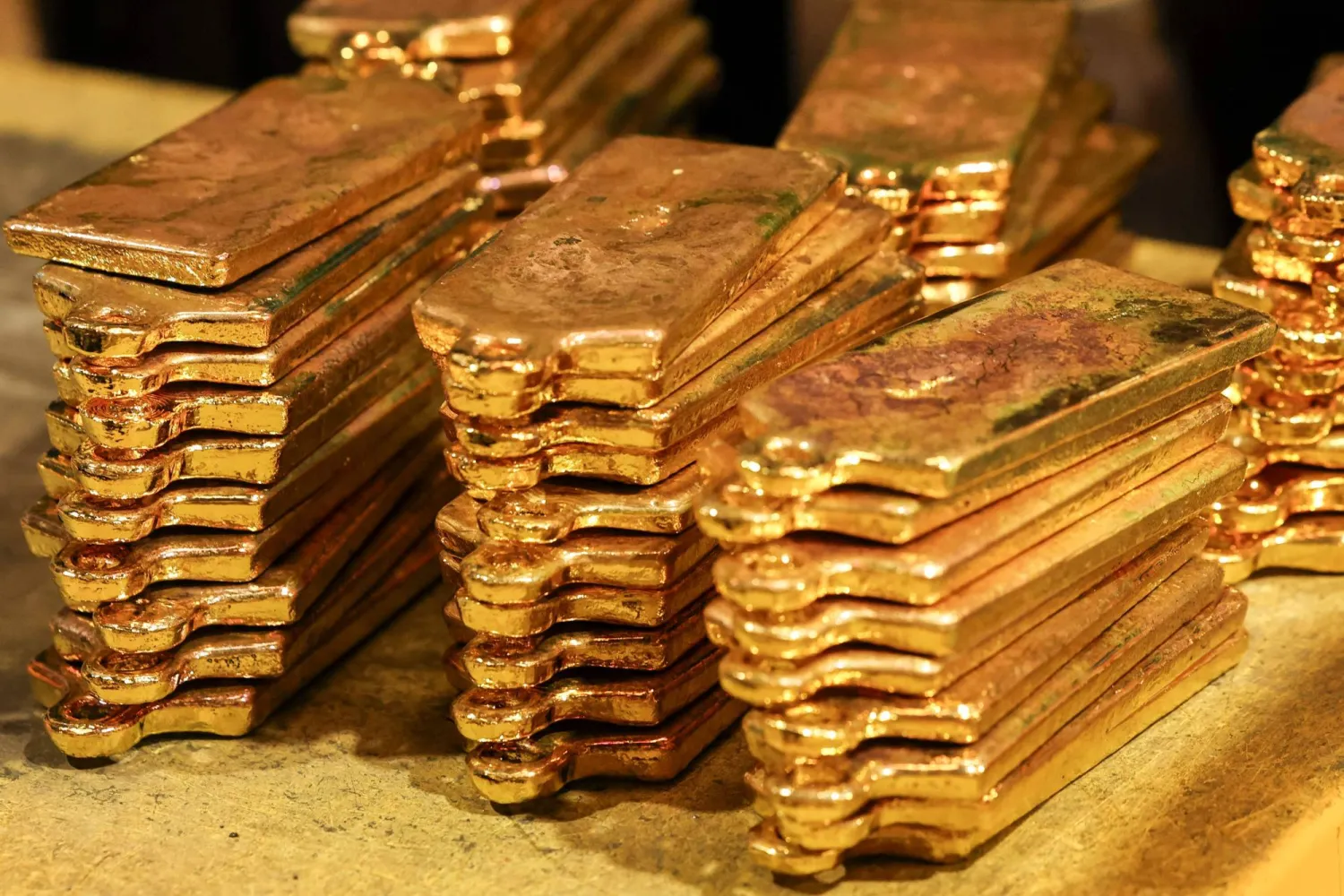
Gold bars after being removed from their molds at a refinery smelter in Sydney (AFP)
TT

Gold Gains for 3rd Day on US-Iran Peace Deal Optimism

Gold bars after being removed from their molds at a refinery smelter in Sydney (AFP)

Gold prices rose for a third consecutive session on Thursday, supported by a softer dollar as hopes of a US-Iran deal eased concerns over inflation and prolonged high interest rates.

Spot gold was up 1% at $4,738.86 per ounce, as of 0728 GMT, after rising about 3% on Wednesday to hit its highest point since April 27. US gold futures for June delivery rose 1.2% to $4,748.50, Reuters reported.

US President Donald Trump ⁠predicted a swift ⁠end to the war with Iran as Tehran considered a US peace proposal that sources said would formally end the conflict while leaving unresolved key US demands that Iran suspend its nuclear program and reopen the Strait of Hormuz.

"Gold is edging higher today, supported by a subdued dollar and retreating oil prices ⁠as the existing ceasefire holds, albeit tentatively, and hopes grow for a more durable long-term agreement between Washington and Tehran," said Tim Waterer, chief market analyst at KCM Trade.

The dollar hovered near a more than three-month low hit in the previous session, making bullion less expensive for holders of other currencies.

Benchmark 10-year US Treasury yields have eased 0.6% so far this week, reducing the opportunity cost of holding gold.

Oil prices fell below $100 a barrel as optimism grew about a possible end to the war in ⁠the Middle ⁠East.

Gold prices have fallen more than 10% since the war began in late February, pressured by higher oil prices. Elevated crude oil prices can stoke inflation, increasing the likelihood of higher interest rates. While gold is seen as an inflation hedge, high interest rates tend to weigh on the non-yielding asset.

Investors now await the monthly US employment report on Friday to see if the US economy remains resilient enough to keep the Federal Reserve's monetary policy on hold.

Spot silver rose 2.6% to $79.31 per ounce, platinum was up 1% at $2,081.68, and palladium gained 1.3% to $1,556.79.



Shell's Profit Beats Expectations at $6.9 Billion

(FILES) The Shell logo is pictured above a Shell petrol station in London on January 30, 2026. (Photo by HENRY NICHOLLS / AFP)
TT

Shell's Profit Beats Expectations at $6.9 Billion

(FILES) The Shell logo is pictured above a Shell petrol station in London on January 30, 2026. (Photo by HENRY NICHOLLS / AFP)

Shell's first-quarter profit beat estimates and hit its highest in two years at $6.9 billion on Thursday, boosted by gains linked to the Middle East war, leading the company to raise the dividend by 5%.

At the same time, it slowed its quarterly share buyback program to $3 billion from $3.5 billion to help divert cash to its balance sheet as a short-term liquidity squeeze after war-related energy supply disruption increased its debt.

"It really reflects that confidence we have in the long term cash ⁠flows of the ⁠company," Shell's Chief Financial Officer Sinead Gorman said on a call with reporters of the dividend hike. She added she still felt Shell shares were undervalued.

Turning to the buybacks, she said she had reduced them to allocate cash to the balance sheet.

Shell's shares were down 2.2% in early trading, broadly in line with other oil majors' shares as ⁠benchmark global oil prices have retreated from peaks well above $100 a barrel, Reuters reported.

First-quarter adjusted earnings, Shell's definition of net profit, rose to $6.92 billion, beating an analyst consensus of $6.36 billion in a company-provided poll and up from $5.58 billion a year earlier.

Profits at its chemicals and products unit, which includes refining and its oil trading desk, were $1.93 billion, beating expectations of $1.24 billion and up from $0.45 billion last year.

This echoes big oil trading profits at its European peers BP and TotalEnergies that also take speculative bets on moving prices in contrast with their more cautious US rivals.

Shell's oil and gas output fell 4% compared with the previous quarter, mainly due ⁠to outages in ⁠Qatar where part of its Pearl gas-to-liquids plant was damaged in the Middle Eastern conflict that began at the end of February. Full repairs might take about a year, Shell has said.

Shell's gearing, or debt to equity ratio including leases, rose to 23.2% from 20.7% at end-2025. Shell had flagged higher debt due to managing war-related price and supply disruptions and volatility.

Gorman told reporters she was very happy with Shell's balance sheet.

Its cash flow from operating activities at $6.1 billion was hit by large swings in inventory values, pushing working capital - a liquidity measure of current assets minus liabilities - to minus $11.2 billion.

Shell expects working capital movements to reverse over time provided oil and gas prices ease.


Australia to Force Gas Giants to Reserve Fuel for Domestic Use

An LNG tanker berthed at the Karratha gas plant loading terminal in Western Australia. Handout / WOODSIDE ENERGY LTD/AFP
TT

Australia to Force Gas Giants to Reserve Fuel for Domestic Use

An LNG tanker berthed at the Karratha gas plant loading terminal in Western Australia. Handout / WOODSIDE ENERGY LTD/AFP

Australia will look to stave off energy shortages by forcing major gas companies to reserve 20 percent of their exports for domestic use, Energy Minister Chris Bowen said Thursday.

The country is one of the world's largest exporters of liquefied natural gas (LNG), a key fuel source in hot demand as war in the Middle East upends global energy markets.

In a bid to shield the nation from "global price volatility", Australia's largest gas firms will be forced to ring fence fuel for the domestic market -- equivalent to 20 percent of their exports.

"We've been acting to shield Australians from global energy shocks by investing in reliable, sovereign renewables and keeping more of the gas we need onshore," Bowen told reporters.

Australia is a major supplier of LNG throughout Asia, where prices have soared since the United States and Israel launched strikes on Iran at the end of February.

Around 40 percent of Japan's LNG comes from Australia, according to the Asia Natural Gas and Energy Association.

Australia is Singapore's largest source of LNG, supplying more than 30 percent of its needs, according to government figures.

Bowen sought to soothe any concerns that the decision could hurt trading partners.

- 'Reliable' partner -

"We will not disturb any existing contracts.

"We have consulted closely with trading partners to ensure that it's well understood around the world that Australia will always be a reliable supplier of energy."

The government would pass laws to have the reservation scheme in place from July 2027, Bowen said.

Geographically isolated and with only two oil refineries, Australia is heavily exposed to disruptions to global fuel supplies.

With Iran halting a fifth of world fuel shipments through its effective closure of the crucial Strait of Hormuz, Australia has moved to shore-up its fuel security.

Prime Minister Anthony Albanese announced Wednesday that Australia would establish a national fuel stockpile of one billion liters.

Australia's major gas companies -- including Shell, Chevron and Woodside -- reap huge profits selling LNG overseas.

Critics have been piling pressure on the government to drastically increase taxes on these exports -- an idea that Canberra shot down last week.

World oil prices dived on Wednesday after US President Donald Trump raised hopes of an end to the Iran war.


French Utility Engie Not Changing Middle East Strategy Despite Disruptions

(FILES) This photograph shows the "Tour First" also known as "Tour CB31", headquarters to French multinational energy group Engie, in the La Defense business district in Courbevoie, western suburb of Paris, on March 25, 2025. (Photo by JOEL SAGET / AFP)
TT

French Utility Engie Not Changing Middle East Strategy Despite Disruptions

(FILES) This photograph shows the "Tour First" also known as "Tour CB31", headquarters to French multinational energy group Engie, in the La Defense business district in Courbevoie, western suburb of Paris, on March 25, 2025. (Photo by JOEL SAGET / AFP)

French utility Engie is still looking to grow and develop its profile of energy assets in the Middle East despite the disruptions ⁠from the Iran War, Engie's ⁠finance chief Pierre-Francois Riolacci told reporters on Thursday.

"We don't see ⁠any questioning of our development plan in the Middle East at all. It's not necessarily the largest region, but it still is part ⁠of ⁠our plans, and we do not see the crisis prompting us to revise our strategy," Riolacci said.

Engie met expectations as it reported a drop in first-quarter earnings on Thursday after warmer weather lowered domestic gas sales and deliveries.

The company, which produces, transports and sells gas and electricity, said earnings before interest ⁠and tax (EBIT) excluding nuclear, ⁠were 3.4 billion euros ($4 billion), down 8.4% from a year earlier.

That matched the consensus forecast of 3.4 billion euros from analyst estimates compiled ⁠by LSEG.

Engie also confirmed a media report this week that said onshore wind project development had slowed in the United States, but it added that solar and battery sector development continues.

"Some permits are being revoked for onshore wind power. It's clear ⁠that ⁠obtaining the necessary authorizations is indeed difficult," Riolacci told reporters.

"Even when permitting isn't required on federal lands, we still face challenges getting approval from agencies."
