


Egypt, Türkiye Boost Cooperation Through Air Travel, Tourism

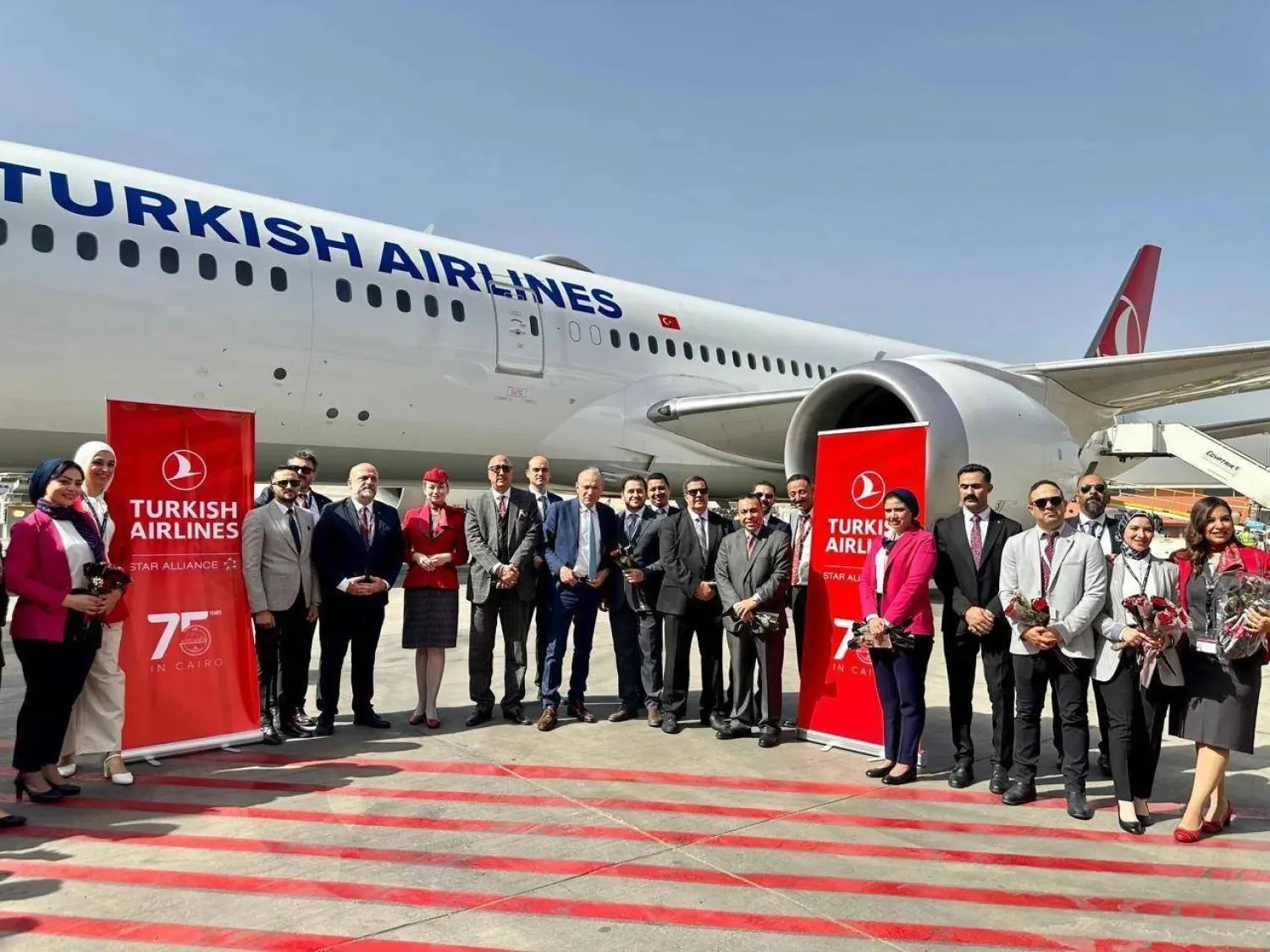
Turkish Airlines’ celebration on Friday marking 75 years since its first flights to Cairo. (Egyptian Ministry of Civil Aviation)
TT

Egypt, Türkiye Boost Cooperation Through Air Travel, Tourism

Turkish Airlines’ celebration on Friday marking 75 years since its first flights to Cairo. (Egyptian Ministry of Civil Aviation)

Egypt and Türkiye are strengthening their cooperation and “strategic partnership” by boosting air traffic and tourism as the two countries mark 75 years since the first flight between them.

Egyptian Minister of Civil Aviation Sameh el-Hefny said on Friday that the celebration sent “a positive message reflecting the depth of the historic and strategic relations between Egypt and Türkiye.”

He said the ties were seeing “remarkable development”, opening broader prospects for more partnerships in civil aviation, expanding operations and exchanging expertise in a way that serves the two countries’ shared economic interests.

Egyptian-Turkish relations have grown over recent years, witnessing a significant improvement, exchanges of presidential visits and the expansion of economic activities.

The minister of civil aviation took part on Friday in a celebration organized by Turkish Airlines to mark 75 years since the launch of its first flights to Cairo. The event was attended by Türkiye’s ambassador to Egypt, Salih Mutlu Sen, and aviation sector leaders from both countries.

According to a statement by the Egyptian government, the occasion comes amid the remarkable recent development witnessed by Egyptian-Turkish relations, reflecting continued coordination and a shared will to expand areas of cooperation, particularly in air transport, tourism and investment, which are key pillars for supporting regional integration and achieving sustainable development.

El-Hefny said the Turkish national carrier’s continued operation in the Egyptian market for more than seven decades “is clear testimony to the strength of bilateral relations and mutual confidence in opportunities for growth and expansion.”

The civil aviation sector is a vital track for supporting Egyptian-Turkish relations because of the opportunities it provides to boost tourism and trade, he added.

The Ministry of Civil Aviation attaches great importance to strengthening cooperation with various international airlines, in line with the Egyptian state’s vision to attract more air traffic and expand its network of links with regional and international markets, helping consolidate Egypt’s position as a key civil aviation hub in the region, he stressed.

Egypt relies on tourism as one of its most important sources of national income. The government announced last week that “monthly growth in the tourism sector has reached 20 percent since the beginning of the current year compared with the same period last year, 2025.”

The Ministry of Tourism and Antiquities also said at the time that “2025 ended with notable growth in tourism movement, reaching 21 percent compared with 2024.”

Karam Saeed, an expert on regional affairs and deputy editor-in-chief of Democracy Magazine, said the celebration marking 75 years since the first flight, preceded by celebrations of 100 years since the establishment of diplomatic relations between Egypt and Türkiye, as well as the convening of the Higher Strategic Council, were important indicators at carefully chosen times.

“Türkiye is one of the countries with abundant production of aircraft fuel, and I believe this cooperation is not separate from Egypt’s desire to benefit from this,” he told Asharq Al-Awsat.

“Türkiye may lose part of Gulf tourism because of the repercussions of the Iranian war, and therefore the Egyptian market represents an important alternative or tributary to compensate for a potential decline in Gulf and Iranian tourism to Türkiye,” he added.

Egypt and Türkiye are promising markets for tourism exchanges because of their historic and cultural proximity, he went on to say. Egypt is a suitable destination for Turkish tourists, while Türkiye offers an attractive climate for Egyptian tourists, in addition to the use of flights for commercial purposes.

The Turkish ambassador to Cairo said on Friday that “Turkish Airlines’ continued presence in the Egyptian market throughout these years reflects the strength and solidity of relations between the two countries, and demonstrates the great confidence enjoyed by the Egyptian market as one of the most important strategic markets for the Turkish national carrier in the region.”

He explained that Turkish Airlines’ journey in the Egyptian market has seen notable growth since the launch of its first flights to Cairo on May 14, 1951, at a rate of two flights per week, reaching today about 32 weekly flights from Cairo, in addition to a daily flight to Egypt’s top tourist destination, reflecting growing demand for travel between the two countries.

Turkish President Recep Tayyip Erdogan visited Cairo last February and witnessed the signing of several agreements in various fields.

During a joint press conference, his Egyptian counterpart, Abdel Fattah al-Sisi, said: “There is a convergence of views on various regional and international issues between Egypt and Türkiye.”




Saudi Airports Handle 141 Million Passengers in 2025 as Aircraft Fleet Expands

Travelers move through stanchion lines at the departure terminal of King Khalid International Airport in Riyadh. (AFP)
TT

Saudi Airports Handle 141 Million Passengers in 2025 as Aircraft Fleet Expands

Travelers move through stanchion lines at the departure terminal of King Khalid International Airport in Riyadh. (AFP)

Saudi Arabia’s airports handled 140.9 million passengers in 2025, marking another year of strong growth for the Kingdom’s aviation sector as the national aircraft fleet expanded by 33.8%, according to data released by the General Authority for Statistics.

The number of passengers traveling through Saudi airports rose 9.6% from 2024, reflecting the Kingdom’s accelerating push to strengthen its position as a regional travel hub and global aviation gateway.

International traffic accounted for 75.8 million passengers, up 9.4% year-on-year, while domestic passenger traffic increased 9.8% to 65.1 million. On average, Saudi airports handled around 207,700 international passengers and 178,600 domestic passengers a day.

King Abdulaziz International Airport in Jeddah remained the Kingdom’s busiest airport, handling 53.5 million passengers during the year, an increase of 9.0% from 2024. King Khalid International Airport in Riyadh followed with 40.8 million passengers, up 8.7%, while King Fahd International Airport in Dammam handled 13.7 million passengers, posting annual growth of 7.0%.

The increase in passenger traffic was accompanied by a rise in flight activity across the Kingdom’s airports. Total arriving and departing flights climbed 8.3% year-on-year to 979,800 flights in 2025, including 506,300 domestic flights, up 6.8%, and 473,500 international flights, up 9.9%.

King Abdulaziz International Airport also recorded the highest number of aircraft movements with 314,400 flights, followed by King Khalid International Airport with 296,800 flights and King Fahd International Airport with 108,500 flights.

Saudi Arabia’s aviation fleet recorded one of the strongest areas of growth during the year, with the total number of commercial and general aviation aircraft rising to 483 from the previous year’s level. The fleet included 266 commercial aircraft and 217 aircraft dedicated to general aviation.

Aircraft with capacities ranging from 151 to 250 seats accounted for the largest share of the commercial fleet at 120 aircraft, while the sector continued to modernize its operations, with 99 aircraft less than five years old.

The Kingdom also expanded its global air connectivity during 2025, with Saudi airports linked to 66 countries worldwide, up 1.5% from a year earlier. The total number of domestic and international destinations connected to the Kingdom rose 2.3% to 176 destinations.

Saudi Arabia ranked 18th globally in the 2025 Air Connectivity Index, underscoring the sector’s growing international reach.

Saudia accounted for the largest share of flights operating in Saudi airspace at 25.5%, followed by low-cost carrier flynas at 13.3% and flyadeal at 8.6%.

Air cargo volumes handled through Saudi airports totaled 1.18 million metric tons in 2025, with imports accounting for the largest share at 695,600 tons. Transit cargo reached nearly 420,100 tons, while exports exceeded 69,700 tons.

March recorded the highest monthly cargo throughput of the year, with more than 113,400 tons handled during the month.

The Kingdom also continued to expand logistics infrastructure at its main airports to support cargo growth and broader supply chain ambitions. King Fahd International Airport operated nine cargo facilities, while King Khalid International Airport had eight facilities and King Abdulaziz International Airport operated four integrated cargo facilities.

The expansion forms part of Saudi Arabia’s strategy to position itself as a global logistics hub linking Asia, Africa and Europe.


Supertanker with Iraqi Oil Heads for Vietnam After Hold-up in US Blockade

Tankers are seen off the coast of the Fujairah, as Iran vows to close the Strait of Hormuz, amid the US-Israel conflict with Iran, in Fujairah, United Arab Emirates, March 3, 2026. (Reuters)
TT

Supertanker with Iraqi Oil Heads for Vietnam After Hold-up in US Blockade

Tankers are seen off the coast of the Fujairah, as Iran vows to close the Strait of Hormuz, amid the US-Israel conflict with Iran, in Fujairah, United Arab Emirates, March 3, 2026. (Reuters)

Supertanker Agios Fanourios I is heading for Vietnam to discharge its Iraqi crude oil cargo after it was held by the US Navy for five days in the Gulf of Oman, the vessel's manager said on Monday.

The Maltese-flagged Very Large Crude Carrier sailed out of the Strait of Hormuz on May 10 and was sailing in the Gulf of Oman before making a ‌U-turn on ‌May 11.

It resumed its journey ‌toward ⁠Vietnam on May 16 ⁠and is expected to arrive at the Nghi Son refinery on May 30, LSEG shipping data showed.

A VLCC can carry a maximum of two million barrels of oil.

A source at the vessel's Athens-based manager Eastern Mediterranean Maritime, who spoke on condition of ⁠anonymity, confirmed that the tanker was sailing ‌on to Vietnam after ‌it had received US Navy approval.

The US military's Central Command ‌said last week that the vessel was redirected as ‌part of ongoing enforcement of the blockade against Iran.

At least two other crude tankers sailed from the strait last week, but overall crude traffic through the strait has ‌remained limited.

Before the war on Iran began, the Strait of Hormuz was the conduit ⁠for 20% ⁠of the world's energy supplies, equating to 125 to 140 daily passages.

"Shipping confidence around Hormuz is still very weak," ship broker Clarksons said in a note on Monday.

A further 12 ships crossed the strait in the past 24 hours, including two liquefied petroleum gas tankers bound for India, according to satellite analysis from data analytics specialists SynMax.

A separate LPG tanker was sailing through the strait on Monday also bound for India, data on the MarineTraffic platform showed.


Asian Markets Cautious, Oil Dips after Trump Holds Off on Iran Attack

Vessels are seen anchored in the Strait of Hormuz, off the port city of Khasab on Oman's northern Musandam Peninsula on May 17, 2026. AFP
TT

Asian Markets Cautious, Oil Dips after Trump Holds Off on Iran Attack

Vessels are seen anchored in the Strait of Hormuz, off the port city of Khasab on Oman's northern Musandam Peninsula on May 17, 2026. AFP

Asian markets were mixed Tuesday as oil prices eased on hopes of a US-Iran deal, though elevated crude levels capped investor appetite for risk.

Energy markets held center stage after US President Donald Trump signaled "serious negotiations" with Tehran and called off planned strikes, boosting optimism that tensions could.

The war the United States and Israel launched February 28 has led to an effective blockade of the Strait of Hormuz, through which around 20 percent of global oil exports passed in peacetime.

The leaders of Qatar, Saudi Arabia and the United Arab Emirates asked him "to hold off on our planned Military attack of the Islamic Republic of Iran, which was scheduled for tomorrow, in that serious negotiations are now taking place", Trump wrote on his Truth Social platform.

But Trump added that he instructed the US military to be "prepared to go forward with a full, large scale assault of Iran, on a moment's notice, in the event that an acceptable Deal is not reached".

Speaking later at a White House event, Trump said there had been a "very positive development" and that Arab allies said a deal was near that would leave Iran without nuclear weapons, which Tehran denies pursuing.

"There seems to be a very good chance that they can work something out. If we can do that without bombing the hell out of them, I'd be very happy," Trump said.

However, he also warned the United States was prepared to launch a "full, large-scale assault" if negotiations collapse, underscoring the fragility of the situation.

Oil dipped on the prospect of diplomacy, but the move offered only limited relief after weeks of volatility driven by the Middle East conflict.

International benchmark Brent was hovering around $109 while West Texas Intermediate at $107.

Equity performance wavered.

Tokyo's Nikkei 225 opened lower, with local jitters offset by local resilience. Japan's gross domestic product expanded 0.5 percent in the first quarter, exceeding market forecasts of 0.4 percent.

Seoul's Kospi slid by more than four percent, with tech stocks losing ground after taking their lead from Wall Street. Shanghai, Taipei and Jakarta also slid.

Hong Kong, Sydney and Wellington were ahead.

Safe-haven demand was higher, with both gold and silver edging up, suggesting investors remain wary.

All eyes are on Wednesday's quarterly results from US chip titan Nvidia, which will be scrutinized as investors question whether huge spending on AI data centers is justified by potential returns.