

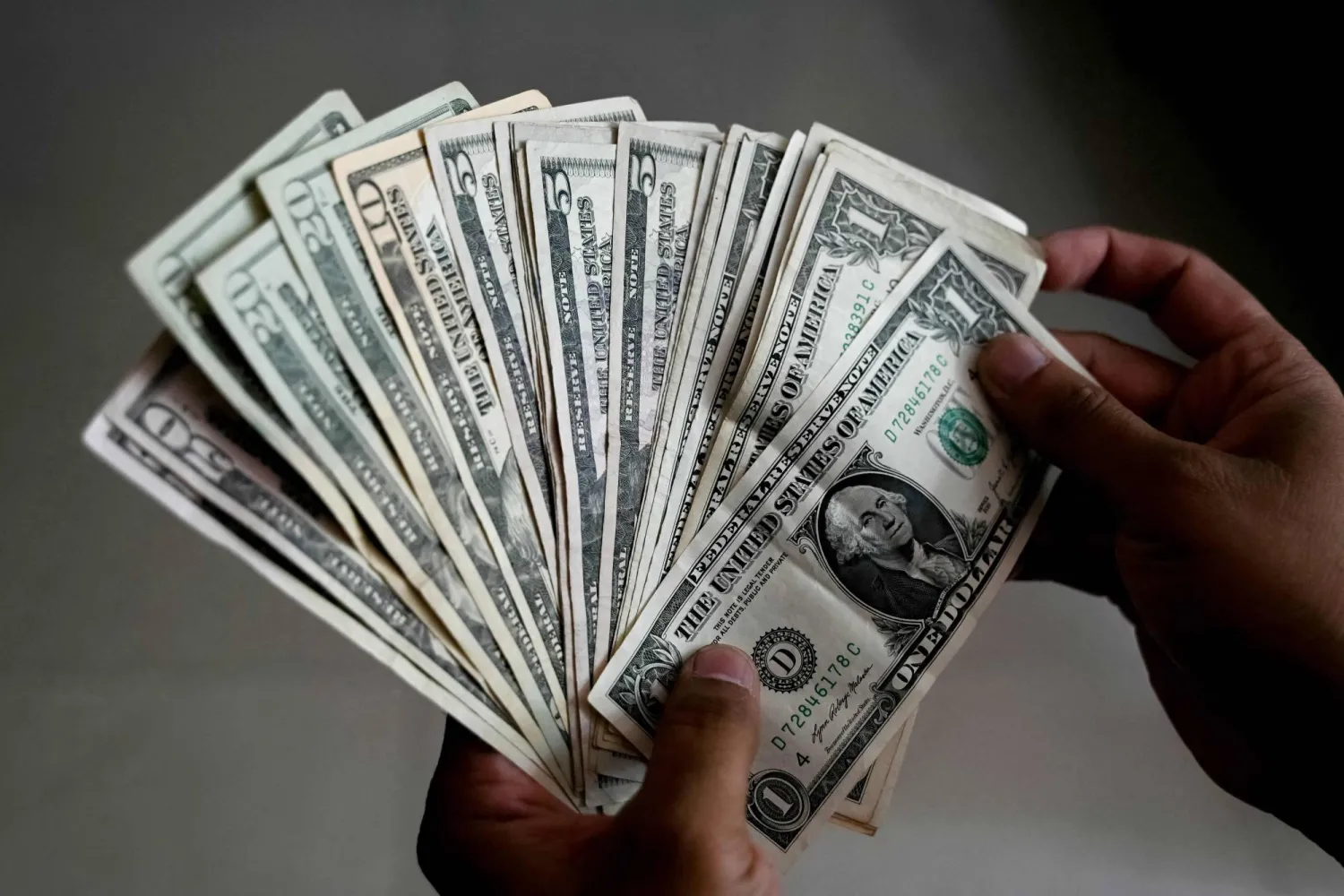

Dollar Steady Near Six-Week Highs on Rate-Hike Bets, War Uncertainty

 A man counts US dollar currency notes at a foreign exchange office in Hyderabad on May 16, 2026. (AFP)
A man counts US dollar currency notes at a foreign exchange office in Hyderabad on May 16, 2026. (AFP)
TT

Dollar Steady Near Six-Week Highs on Rate-Hike Bets, War Uncertainty

 A man counts US dollar currency notes at a foreign exchange office in Hyderabad on May 16, 2026. (AFP)
A man counts US dollar currency notes at a foreign exchange office in Hyderabad on May 16, 2026. (AFP)

The US dollar was steady near a six-week high on Wednesday as investors come to terms with the possible need for higher interest rates to tackle inflation due to the Iran war, pushing the Japanese yen back into the intervention zone.

The uncertainty over when the Middle East war may end has weighed on sentiment, fanned inflation fears and triggered a global bond selloff, with the yield on the US 30-year Treasury bond hitting its highest level since 2007.

President Donald Trump said the United States may need to strike Iran again, but suggested Iran wants a deal to end the war that has roiled markets and sent energy prices soaring.

The euro last bought $1.16025, having touched its lowest level since ‌April 8 in ‌the previous session. The British pound was at $1.34, not far from a ‌six-week ⁠low it touched earlier ⁠this week.

The Australian dollar, often seen as a barometer for risk sentiment, was subdued at $0.7105, while the New Zealand dollar fetched $0.5834. Both were near five-week lows.

Against a basket of currencies, the dollar was steady at 99.306. The index is up more than 1% in May due to safe-haven demand and markets pricing in chances of the Federal Reserve hiking interest rates by the end of the year.

Traders are now pricing in an over 50% chance of a hike in December, CME FedWatch showed, in a sharp reversal from two rate cuts expected before ⁠the war. Investor focus will be on the minutes of the Fed's last ‌meeting due later in the day.

Carol Kong, currency strategist ‌at Commonwealth Bank of Australia, expects the minutes to be hawkish, pushing the dollar up further, noting that more Fed ‌policymakers have warned about high US inflation since the last Fed meeting in April.

"We continue to expect ‌the FOMC to start a tightening cycle in December," Kong said.

The fragile ceasefire agreed in April has mostly held, although markets remain worried as the Strait of Hormuz - a key route for global supplies of oil and other commodities - is still effectively closed.

Brent crude futures were at $110.46 per barrel, well above the levels before the war started at the end ‌of February.

The hawkish repricing of higher rates has cast a long shadow on struggling emerging-market currencies. The Indian rupee and Indonesian rupiah sank further on ⁠Wednesday to record lows.

YEN ⁠VIGIL RETURNS

The dollar's rise has pushed the yen back near the 160-per-dollar level that led to Japanese officials last month launching their first currency market intervention in nearly two years.

Tokyo had stepped in to stem the yen's slide in several bouts of intervention at the end of April and early May, sources told Reuters, but the yen's strength did not last long.

It was last a touch firmer at 158.93 per dollar as investors digested comments from US Treasury Secretary Scott Bessent that may help clear political hurdles for the Bank of Japan to hike rates next month.

Bessent told Reuters on Tuesday he was confident BOJ Governor Kazuo Ueda would do "what he needs to do" if granted sufficient independence by Japan's government, signaling Washington's desire for further rate hikes by the central bank.

"Near term, excessive volatility is key while 160/161 remains the line to watch," said Christopher Wong, currency strategist at OCBC.

"Intervention risk should make markets more cautious about chasing dollar/yen higher, but unless US Treasury yields and the broad USD soften, official action may only temporarily slow the move rather than reverse it," he said.




SpaceX Reveals Plans for What Could be Biggest-ever Initial Public Offering

FILE PHOTO: Elon Musk walks to attend the trial in his lawsuit over OpenAI for-profit conversion at a federal courthouse, in Oakland, California, US, April 29, 2026. REUTERS/Manuel Orbegozo/File Photo
TT

SpaceX Reveals Plans for What Could be Biggest-ever Initial Public Offering

FILE PHOTO: Elon Musk walks to attend the trial in his lawsuit over OpenAI for-profit conversion at a federal courthouse, in Oakland, California, US, April 29, 2026. REUTERS/Manuel Orbegozo/File Photo

Elon Musk announced plans Wednesday for one of the biggest stock sales ever by taking public a space company that is currently losing billions of dollars a year.

A filing shows that his SpaceX lost $2.6 billion from operations last year on $18.7 billion in revenue, and the losses kept piling up at the start of this year, too.

The prospectus did not put a dollar figure on the amount Musk hopes to raise, but various reports have put it at $75 billion or so.

SpaceX, formally known as Space Exploration Technologies Corp., has said the money will help finance projects to put people on the moon and Mars in its quest to make humans an intergalactic species as they face existential threats that could wipe out civilization.

“We do not want humans to have the same fate as dinosaurs,” the filing states.

The prospectus reads in part like a Hollywood fantasy version of the future, detailing in one section how part of Musk’s compensation will be granted only if he maintains “a permanent human colony on Mars with at least one million inhabitants.”

Short of that, the stock sale alone could make Musk, a major owner who founded SpaceX in 2002, the world’s first trillionaire. Forbes currently puts his net worth at $839 billion.

In addition to making reusable rockets to hurl astronauts into orbit, SpaceX has other businesses, some successful, some struggling — and with plenty of questions marks.

The document shows that Starlink, the world’s largest satellite communications company, is a big source of cash for the company, generating $4.4 billion in operating income last year. The business uses 10,000 satellites in low orbit to provide internet service to 10 million people in 150 countries and territories.

Among the struggling businesses are two Musk units that were recently acquired by SpaceX — his social media platform X, formerly Twitter, and his artificial intelligence business, xAI.

Those purchases were blasted by some SpaceX investors as bailouts because they are big money losers.

The prospectus said its AI business lost $6.4 billion in operations last year.

The original SpaceX business, making rockets and staging launches, has been helped by massive government contracts, which raises questions that could come back to haunt the company. Given Musk’s close relation to the Trump administration, government ethics lawyers and watchdogs have asked if he has gotten special treatment to win taxpayer money and whether that good luck will run out once President Donald Trump is out office.

SpaceX has won contracts worth $6 billion from NASA and the Defense Department and other government agencies in the past five years, according to USAspending.gov. The company noted in its filing that a fifth of its revenue last year was from the federal government, The Associated Press reported.

Musk was the biggest donor to Trump’s presidential campaign and is still a big backer despite their sometimes rocky relationship after his stewardship of the government cost-cutting effort called DOGE early last year.

Like many corporate CEOs, Musk’s compensation will go far beyond his annual salary, which was $54,080 in 2025 and has remained unchanged since 2019, according to the filing.

The prospectus says stock grants for him would be sliced into 15 nearly equal amounts — 67 million shares each — and would vest only as the company achieves preset market cap goals. In addition to the Martian colony, SpaceX’s stock market value would have to reach $7.5 trillion for him to receive the full award.

He would get even more stock awards if SpaceX manages to get giant data centers the size of football fields in space.

The document shows Musk will be able to exert big control over the business.

It says he and certain other shareholders will receive shares in a special class of stock that gives them 10 votes for each share they hold. Those shareholders will be able, among other things, to elect a majority of the company’s board of directors.

“This will limit or preclude your ability to influence corporate matters and the election of our directors,” SpaceX said in a warning to prospective investors.

SpaceX will be able to pitch the offering to investors — in what’s known in Wall Street parlance as a “road show” — 15 days after making its prospectus public. In this case, that works out to June 4.


Gold Eases on Higher Yields, Firm Dollar; US-Iran Talks in Focus

Gold bracelets displayed at a jewelry store in Varanasi, India (AFP)
TT

Gold Eases on Higher Yields, Firm Dollar; US-Iran Talks in Focus

Gold bracelets displayed at a jewelry store in Varanasi, India (AFP)

Gold edged lower on Thursday as higher Treasury yields and a firm dollar weighed on the metal, while hopes of a resolution to the US-Iran conflict limited losses.

Spot gold was down 0.3% at $4,528.03 per ounce, as of 0611 GMT. Bullion had gained more than 1% on Wednesday after falling to its lowest level since March 30 earlier in the day.

US ‌gold futures for ‌June delivery fell 0.1% at $4,528.90.

The dollar rose ‌0.1%, ⁠making greenback-priced bullion expensive ⁠for other currency holders.

"Inflation expectation, rising yields, and stronger dollar are the headwinds keeping gold prices under pressure. And these factors will continue to remain in place until we get clarity on how long the conflict is going to persist," said ANZ analyst Soni Kumari.

Gold has fallen more than 14% since the war began in late February, as ⁠the non-yielding metal tends to decline on expectations of ‌higher interest rates.

Iran said it ‌was reviewing Washington's latest position on ending the war after US President Donald ‌Trump suggested he was prepared to wait a few days to "get ‌the right answers" from Tehran, Reuters reported.

The yield on the US 10-year Treasury bond was up 1 basis point at 4.578%, resuming its climb after snapping a three-day streak of declines.

Markets are increasingly pricing in possibilities of the Federal Reserve ‌tightening monetary policy this year, with a 39% chance of a 25 basis-point hike expected in December, ⁠per CME Group's ⁠FedWatch tool.

"The overall trend of 10-year US Treasury yield, since the start of early March, is still in a medium-term uptrend phase. Hence, gold bulls may not be so aggressive in beating up prices at this juncture," said Kelvin Wong, a senior market analyst at OANDA.

Minutes of the Fed's April meeting showed a majority of policymakers felt "some policy firming would likely become appropriate" if inflation stays persistently above the central bank's 2% target.

Gold is expected to remain weak in the upcoming sessions, with resistance seen at $4,645 levels and support at $4,456 levels, said Wong.

Spot silver was down 1.1% at $75.19 per ounce, platinum lost 0.9% to $1,933.13, and palladium fell 0.8% to $1,359.20


Saudi Arabia Requires Shipping Companies to Let Consumers Inspect Packages Before Accepting Delivery

An employee of the General Authority for Transport inspects postal parcel warehouses (SPA). 
TT

Saudi Arabia Requires Shipping Companies to Let Consumers Inspect Packages Before Accepting Delivery

An employee of the General Authority for Transport inspects postal parcel warehouses (SPA). 

Saudi Arabia’s Ministry of Commerce issued an official directive requiring all private-sector shipping and delivery companies to allow consumers to open packages, inspect their contents, and examine them in the presence of the delivery representative before completing final delivery or providing the verification code.

According to information obtained by Asharq Al-Awsat, the move is aimed at increasing transparency, strengthening consumer protection, and putting an end to inconsistent practices, and comes as Saudi Arabia’s e-commerce sector experiences record growth.

Active commercial registrations in the sector grew by 9 percent during the first quarter of this year, surpassing 45,600 commercial registrations, in line with the key objectives of the National Transformation Program supporting Vision 2030.

This advanced measure adopted by the Saudi Ministry of Commerce forms part of a broader global legal and legislative movement aimed at addressing the trust gap in the e-commerce environment, particularly during what is legally referred to as the “inspection before acceptance” stage. International practices — including the Vienna Convention on Contracts for the International Sale of Goods and civil laws in countries such as Germany and France — generally hold that a buyer is not legally obligated to accept goods or make final payment until given a “reasonable opportunity to inspect” them.

The measure is also expected to resolve one of the biggest legal disputes in shipping: establishing the “condition of the product at the moment of delivery,” thereby preventing the shifting of responsibility among the retailer, the shipping company, and the consumer.

The official spokesperson for the Ministry of Commerce, Abdulrahman Al-Hussein, recently addressed the issue in a video statement, settling the debate by stressing the importance of not providing the shipment code to the delivery representative before inspecting the package. He explained that the code constitutes an official acknowledgment by the consumer that all purchased items were received properly and met standards of safety and quality.

Al-Hussein emphasized that if a product is defective or does not match the agreed specifications, the consumer has the right to refuse delivery, underscoring the importance of safeguarding rights and obligations in e-commerce transactions.

According to the information obtained, the Ministry of Commerce notified all private-sector companies that customers must be allowed to open shipments and inspect their contents in front of the delivery representative before being asked to provide the product delivery verification code.

In recent months, consumers have increasingly called for tighter regulation of package delivery procedures, particularly following repeated cases involving shipments that did not match orders, arrived damaged, or were missing items. This prompted authorities to stress the necessity of allowing customers to verify shipments before completing delivery, thereby strengthening confidence in the e-commerce market and protecting the rights of all parties.

Growth of E-Commerce

Strengthening the e-commerce business ecosystem is one of the objectives of the National Transformation Program in support of Vision 2030, given the sector’s importance and its role in boosting the national economy. Saudi Arabia ranks among the world’s top 10 fastest-growing countries in this sector.

During the first quarter of this year, the e-commerce sector recorded 9 percent growth in active commercial registrations, exceeding 45,600 registrations by the end of the quarter, compared with 41,800 during the same period in 2025.

Riyadh accounted for the highest number of these registrations, with more than 20,000, followed by Makkah Province with 11,500. The Eastern Province came next with approximately 6,800 commercial registrations.