


Kremlin: Saudi Arabia Named Guest of Honor at St. Petersburg Economic Forum

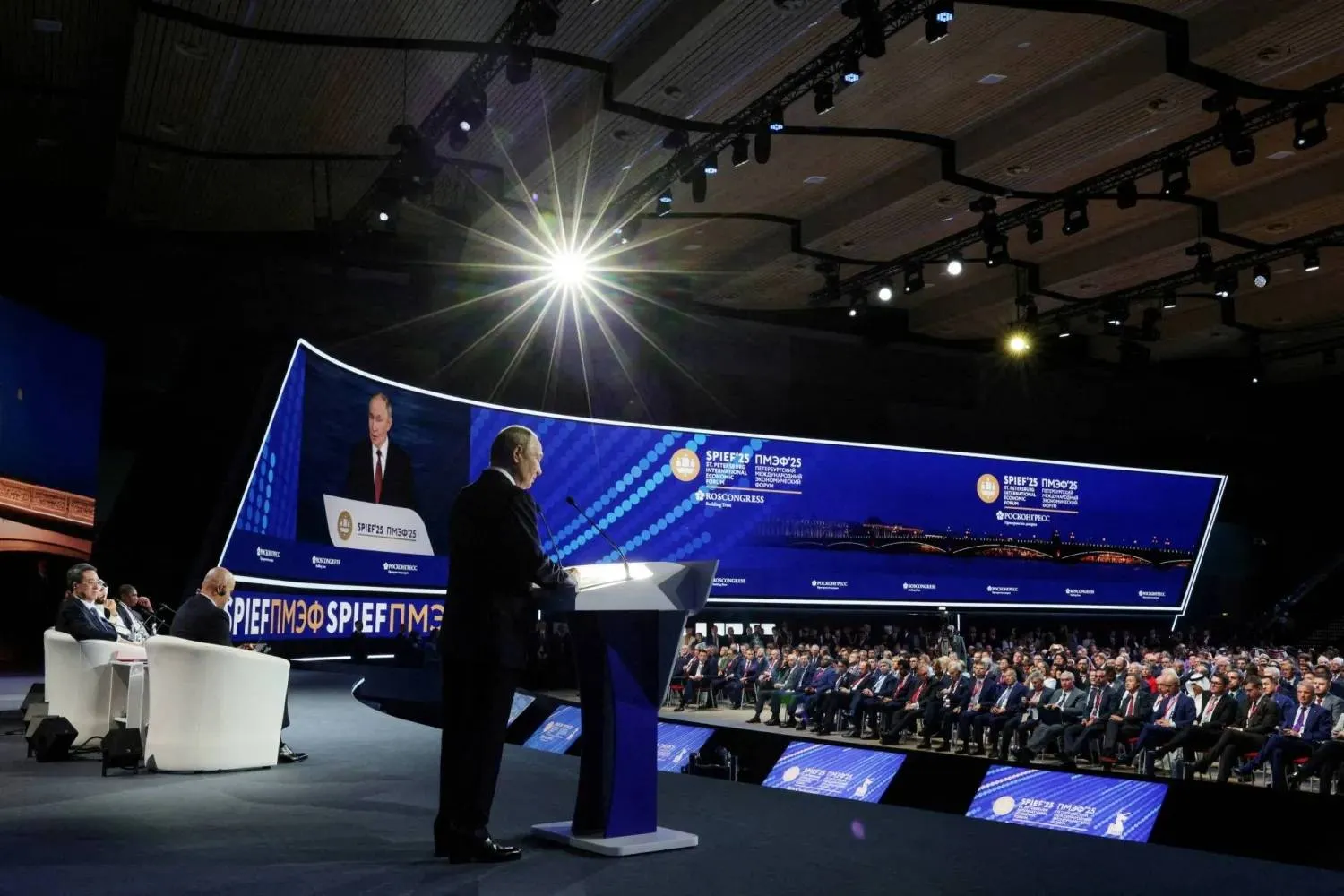
Russian President Vladimir Putin delivers a speech during a plenary session of last year’s St. Petersburg International Economic Forum. (Reuters)
TT

Kremlin: Saudi Arabia Named Guest of Honor at St. Petersburg Economic Forum

Russian President Vladimir Putin delivers a speech during a plenary session of last year’s St. Petersburg International Economic Forum. (Reuters)

The Kremlin said Saudi Arabia will be featured as the “guest of honor” at the 29th St. Petersburg International Economic Forum, SPIEF, in 2026, which opens this week.

The Russian presidency said Saudi Energy Minister Prince Abdulaziz bin Salman will lead a high-level delegation of major national institutions and companies, headed by Saudi Aramco.

The announcement coincided with talks in Moscow between Russian Foreign Minister Sergei Lavrov and Saudi Foreign Minister Prince Faisal bin Farhan.

Lavrov said Saudi Arabia’s selection as the guest country for 2026 carried major historical symbolism, coinciding with the 100th anniversary of diplomatic relations between the two countries.

He praised Saudi Arabia’s strong participation in the 2025 forum, also led by Prince Abdulaziz, which included productive talks with Russian Deputy Prime Minister Alexander Novak.

Through its national pavilion, the Kingdom will showcase its investment, export, and tourism potential, hold business talks, and present a rich cultural program.

Anton Kobyakov, an adviser to the Russian president, said the participation would inject new momentum into the strategic partnership between Moscow and Riyadh across energy, industry, transport, finance, and high technology.

Saudi Arabia now joins other Global South countries that have previously received the honorary status, including Qatar, Egypt, the United Arab Emirates, Oman, and Bahrain.

Founded in 1997, the St. Petersburg forum is Russia’s leading annual economic conference.

It brings together heads of state, finance ministers, and chief executives from Russian and international companies to discuss challenges facing emerging markets and the global economy.

The forum draws more than 10,000 participants each year from about 100 countries. In 2025, it posted a record turnout of 24,200 participants from 144 countries and saw agreements worth 6.48 trillion rubles ($89 billion) signed.

Russian President Vladimir Putin has regularly attended the forum’s plenary sessions since 2005, except from 2008 to 2011, when Dmitry Medvedev attended.

This year’s list of official partners and sponsors includes more than 100 major companies and institutions, led by key partners Rosatom and VEB.RF, along with banking and energy players, including Sberbank, Gazprom, and Novatek.



UAE Central Bank to Inspect Egyptian Bank's Branches after US Sanctions

UAE central bank - WAM
TT

UAE Central Bank to Inspect Egyptian Bank's Branches after US Sanctions

UAE central bank - WAM

The UAE central bank said Saturday it would inspect a major state-owned Egyptian bank's branches, after Washington said it would cut off the institution's operations in the Gulf state from the US financial system.

"For Banque Misr branches in the UAE, the Central Bank has decided to conduct a special and urgent examination that includes a forensic/in-depth lookback covering the period referred to in the statement issued by the US authorities," it said in a statement.

The Treasury Department's action will only take effect after a month-long public comment period.

The UAE Central Bank also said that it is currently studying the available options regarding the status of the bank in the event it is decided to impose the special measure against it after completing the procedures in accordance with US laws.

"The appropriate decision in this regard will be taken in due course, taking into consideration the obligations of the bank towards its customers in the UAE."


Insurance Operations Lift Saudi Sector Profits 24.3% to Nearly $500 Million

Cars drive along a street in Riyadh. (Reuters)
TT

Insurance Operations Lift Saudi Sector Profits 24.3% to Nearly $500 Million

Cars drive along a street in Riyadh. (Reuters)

Saudi Arabia's insurance sector has entered a new phase of growth, driven by improved insurance service results, greater operational efficiency, and stronger claims and risk management. This has translated into higher profits for listed companies, which rose by about 24.3 percent in the first half of 2026 to 1.87 billion riyals ($498.6 million).

The increase signals an improved ability across the sector to convert growth in business activity and premiums into more sustainable profitability.

The performance comes as demand for insurance products in the Kingdom continues to grow, driven by the expansion of health and motor insurance, alongside rising needs arising from projects, infrastructure, and new economic activities. Higher insurance and reinsurance revenues, combined with investment returns and the performance of major companies, contributed to strengthening the sector's overall results.

A review of company results shows a clear disparity in performance. Seventeen companies recorded profits during the period, 11 of which reported growth in net profit, while nine companies posted losses.

Bupa Arabia topped the sector in profitability, reporting profits of 694.08 million riyals, up 4.14 percent from the same period last year, when it earned about 666.49 million riyals. The increase was supported by higher net insurance service results and growth in operations, along with an increase in net investment results and other income.

Tawuniya ranked second, reporting net profit of 609.85 million riyals despite a notable 16.36 percent decline from the more than 729.11 million riyals it earned in the corresponding period of 2025. The company attributed the decline to lower net insurance results and higher insurance service expenses, following the recognition of large claims in its engineering and energy lines.

Al Rajhi Takaful ranked third among the sector's most profitable companies, with profits reaching 207.84 million riyals, a modest 2.7 percent increase from approximately 202.37 million riyals in the same period a year earlier. The increase was driven by higher insurance revenues from motor, medical, and general insurance activities, as well as higher net investment results and returns from its investment portfolio.

In the second quarter alone, profits across the sector reached 923.43 million riyals, up 24.87 percent from 739.5 million riyals in the same quarter of 2025. Sixteen companies in the sector reported net profits in the second quarter of 2026, with 11 of them recording higher profits than in the corresponding quarter of 2025. The remaining companies posted quarterly losses.

Not a Passing Figure

Commenting on the sector's results, financial and economic expert Dr. Suleiman Al-Humaid Al-Khalidi, a member of the Saudi Economic Association, told Asharq Al-Awsat that the 24.3 percent increase in the net profits of Saudi insurance companies to about 1.87 billion riyals in the first half of 2026 “is not a passing figure.” Rather, he said, it reflects an important shift in the sector's performance, driven by three main factors.

He explained that the first factor was improved insurance service results, supported by premium growth, better pricing, and improved risk management. The second was greater efficiency in managing claims and costs, which he described as a key factor in the sector's shift from focusing on revenue growth to achieving more sustainable underwriting profitability.

The third factor, he added, was the contribution of investment portfolios to overall results, particularly amid the investment environment from which financial institutions had benefited in the preceding period. He stressed that the 24.3 percent profit growth should not be viewed as uniform across all companies, as the larger companies have a clear impact on the sector's overall results because of the size of their operations.

He noted that the most important indicator in the first-half results was that the improvement had become largely tied to the quality of the insurance operations themselves, rather than solely to investment returns or non-operating items. This, he said, reflects an evolution in the nature of the growth taking place in the sector.

Al-Khalidi expects the positive trend in the performance of insurance companies to continue through the second half of 2026, albeit at a more moderate pace than in the first half. He pointed to several supporting factors, foremost among them continued growth in health and motor insurance, as well as insurance for projects and infrastructure.

He noted that the expansion of the Saudi economy and the increase in assets and economic activities requiring insurance coverage are creating room for demand to grow and for new products to be developed in the market, including areas that have not previously achieved sufficient penetration, such as life insurance and private property insurance.

At the same time, Al-Khalidi identified three main challenges that warrant monitoring: rising claims, particularly in health insurance; pricing competition; and fluctuations in investment returns. He said the real winner in the next phase would not necessarily be the company achieving the greatest growth in premiums, but rather the one able to achieve the more difficult balance of increasing premiums while improving insurance results, controlling claims and expenses, and generating stable investment returns.

He stressed that the Saudi insurance sector is entering a different phase, in which the focus is no longer limited to market growth but has shifted toward converting that growth into sustainable profitability and improving the quality of capital and returns. This makes the second-half results of 2026 an important test of whether this transformation is sustainable.

3 Challenges

Al-Khalidi noted that there are three challenges that should be monitored: rising claims, particularly in health insurance; pricing competition; and fluctuations in investment returns. He added that the real winner in the next phase would not necessarily be the company achieving the greatest growth in premiums, but the company capable of achieving the more difficult balance of premium growth, improved insurance results, disciplined claims and expenses, and stable investment returns.

He noted that the Saudi insurance sector is entering a different phase, and that the focus is no longer simply on market growth but on turning that growth into sustainable profitability and achieving higher-quality capital and returns. This makes the second-half results of 2026 particularly important in assessing the sustainability of this transformation.


Iraq: Foreign Reserves Remain at Safe Levels

Al-Shorja wholesale market in central Baghdad, Iraq. (Reuters)
TT

Iraq: Foreign Reserves Remain at Safe Levels

Al-Shorja wholesale market in central Baghdad, Iraq. (Reuters)

Mudhhir Mohammed Saleh, financial adviser to the Iraqi prime minister, said Saturday that Iraq's foreign reserves remain at relatively safe levels, stressing the importance of monitoring the trend and maintaining a safety margin.

The Iraqi News Agency quoted Saleh as saying that “the International Monetary Fund estimated Iraq's total reserves at around $79.2 billion for 2026, according to its estimates published in 2025, equivalent to about 9.6 months of imports of goods and services.” He said Iraq's foreign reserves are currently close to this level.

He added that “covering more than six months of imports is considered a relatively safe level according to the reserve adequacy indicator,” noting that “the decline recorded in reserves this year calls for greater caution and monitoring, not because they have reached a critical level, but out of concern that a continued downward trend could reduce the safety margin in the future.”

Saleh explained that “foreign reserves play a pivotal role in supporting the stability of the Iraqi dinar's exchange rate and represent the main line of defense against pressure on the currency, through the central bank's ability to provide dollars and meet legitimate demand for them, thereby helping protect macroeconomic stability and growth.”

He noted that “heavy reliance on oil revenues remains one of the main sources of risk, as any decline in oil revenues leads to lower government revenues and foreign currency inflows, which could increase pressure on reserves and exchange-rate stability.”

Saleh continued that “the sustainable solution lies in controlling government spending, particularly current expenditures, and developing non-oil revenues, alongside using monetary policy tools to manage liquidity and maintain monetary stability.”