


Gov’t Action Cools Saudi Property Prices, Inflation Turns Negative

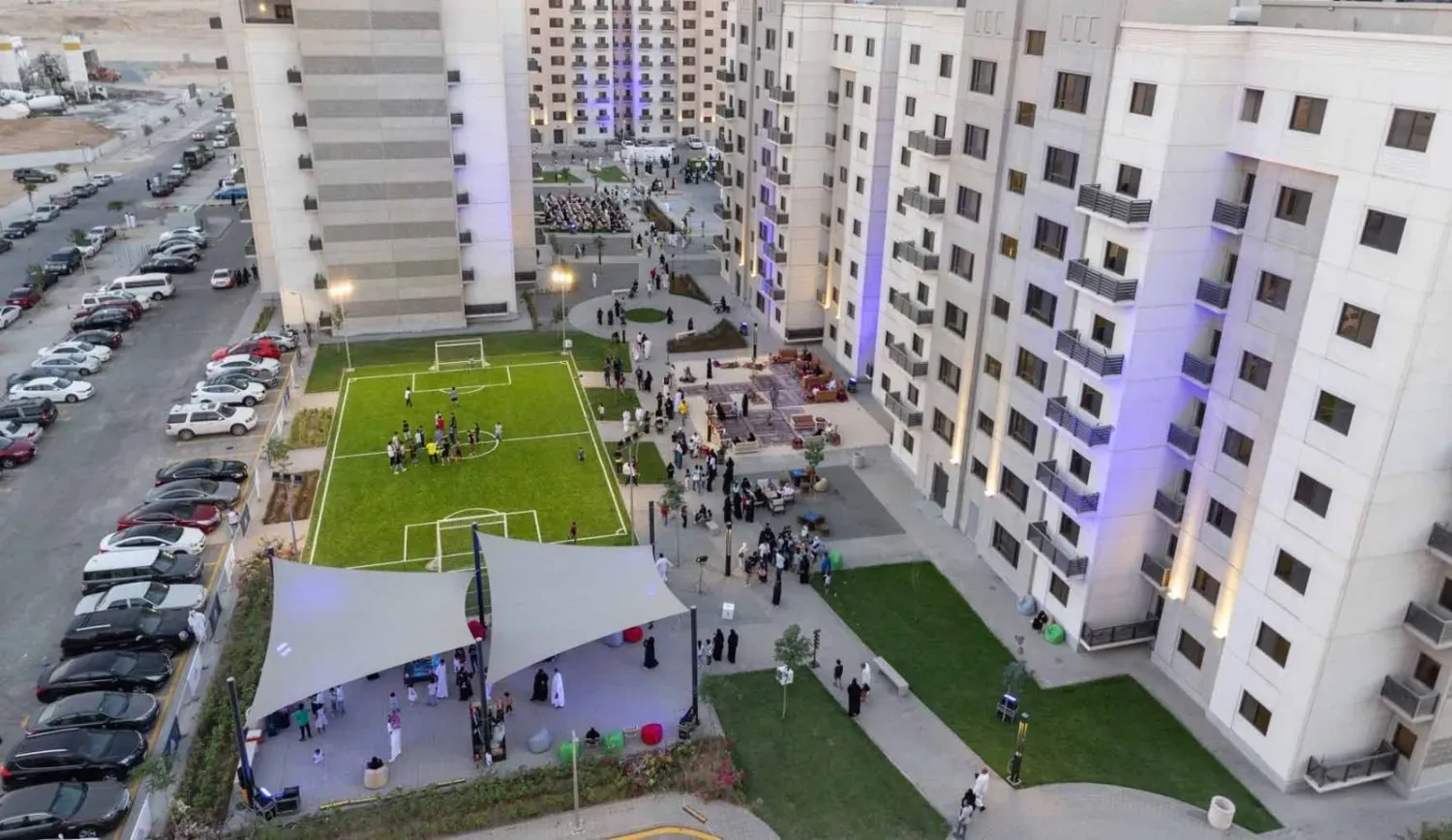
 A National Housing Company project in Jeddah (Company handout)
A National Housing Company project in Jeddah (Company handout)
TT

Gov’t Action Cools Saudi Property Prices, Inflation Turns Negative

 A National Housing Company project in Jeddah (Company handout)
A National Housing Company project in Jeddah (Company handout)

Saudi Arabia’s real estate market is showing clear signs that inflationary pressures are easing, after a package of government measures aimed at increasing supply, curbing land hoarding and rebalancing supply and demand.

The shift reflects the Kingdom’s efforts to reshape the real estate sector and strengthen its stability under Vision 2030.

After uneven price increases following the COVID-19 pandemic, real estate inflation in Saudi Arabia fell to negative 0.7% in the fourth quarter of 2025 from 3.6% a year earlier, according to the annual Vision 2030 report. The decline was supported by government measures aimed at improving market efficiency.

The trend continued in the first quarter of this year. The latest data from the General Authority for Statistics showed the real estate price index fell 1.6% year on year, driven by a 3.6% decline in residential prices. Commercial real estate prices, however, rose 3.4%.

Structural reforms restore balance

The price correction came alongside a series of government interventions aimed at addressing market imbalances, especially limited supply and speculation. In a major move to cool prices in the capital, the government allowed sale, purchase and development in four areas north of Riyadh covering more than 81 square kilometers.

The plan aims to provide citizens with up to 40,000 land plots a year over the next five years, at target prices of no more than 1,500 riyals per square meter.

Khaled Al-Mobid, chief executive of Menassat Realty Co., told Asharq Al-Awsat that the latest reforms had moved the market away from rapid and disorderly price growth toward a more balanced and sustainable phase.

He said increased supply, rent regulation and limits on unproductive landholding had begun to affect market behavior, especially in cities with strong demand. Fees on vacant land and properties, he added, had pushed inactive owners to develop, sell or lease their assets, helping curb speculation and improve the use of real estate assets.

Real estate expert Ahmed Faqih told Asharq Al-Awsat that the government decisions came “in the form of carefully studied doses of treatment” after a deep assessment of the market’s components.

He said housing carries the greatest weight in the inflation index, meaning that cooling the sector feeds directly into broader inflation levels. He expected the impact of the decisions to become clearer over the next 12 to 18 months, adding that this had already begun through the curbing of unreal demand and the increase in actual supply.

Pressure tightens on white land

At the same time, the government stepped up measures against undeveloped land by raising annual fees on white land to 10% from 2.5%.

Vacant properties were also included for the first time in the fee system, covering land and buildings of more than 5,000 square meters. The aim is to reduce the appeal of hoarding and push more units into the market.

Faqih said speculation had been concentrated mainly in land within peripheral development plans, especially in Riyadh. Raising white land fees, along with clear government signals that land was no longer a tool for speculation but for development, marked a turning point in the behavior of investors and speculators, he said.

He added that fees on vacant properties would also help curb speculation in residential products, especially apartments, by encouraging owners to use idle assets rather than keeping them off the market.

In another step to regulate transactions, the real estate market began responding to the Ministry of Municipalities and Housing’s official approval of executive regulations for annual fees on vacant properties.

The regulations allow fees of up to 5% of the value of an unused building within the approved urban boundary. The measure is designed to improve the use of real estate assets and stimulate supply growth inside cities.

Rent freeze

Regulatory policies also extended to the rental market. The Saudi Cabinet approved a five-year freeze on annual rent increases within Riyadh, covering both existing and new contracts, to support stability in the residential and commercial markets.

Al-Mobid said the decision changed investor behavior by shifting attention toward development, operation and sustainable returns rather than waiting for artificial price increases.

He said the rent freeze in Riyadh sent a clear message that the market was moving toward controlling inflation and achieving a better balance between landlords and tenants.

Faqih said the latest regulatory decisions would lead developers and investors to reposition themselves in the market by directing investment toward increasing supply and using the opportunities created by the current regulatory changes.

On the regulatory and digital fronts, the market has made tangible gains in infrastructure. Units listed in the real estate registry exceeded 4 million properties by the end of 2025, while more than 1.2 million upgraded real estate deeds were issued.

More than 3.2 million lease contracts were documented through the Ejar platform, and the number of licensed brokers rose to more than 106,000.

Al-Mobid said the figures reflected a sharp improvement in transparency and a decline in individual discretion because of clearer data. Faqih said Saudi Arabia’s rise of 11 places in international real estate transparency indicators strengthened the sector’s ability to attract foreign capital.

Supply steers the market

On the financing side, the 2025 Vision 2030 report showed continued growth in the individual real estate finance portfolio. Total outstanding individual real estate loans rose to 904 billion riyals, or $241.1 billion, by the end of 2025, from about 420 billion riyals, or $112 billion, in 2020.

Despite the sharp increase in financing, Al-Mobid said the market was no longer driven by financing alone. It had become more influenced by supply, regulations and product quality, he said. That helps explain why residential prices declined even as lending expanded.

Faqih agreed, saying financing had previously pushed up prices because buyers had limited options. The current increase in supply, he said, had helped create a more balanced and fair relationship between supply and demand.

Stable outlook and international appeal

These broad structural shifts helped raise the number of Saudi families who owned their homes to more than 851,000 by the end of 2025, from about 63,000 in 2019.

Looking ahead, Al-Mobid expected the Saudi real estate market to enter a phase of long-term stability based on maturity and data, rather than a temporary correction. He also said values could continue to decline for products whose prices had exceeded fair levels.

Faqih said the new system had created an “innovative investment map” in which real estate investment tools had changed radically, positioning the Saudi market as one of the leading regional and international destinations for sustainable strategic investment.



Oil Slips $4 as US, Iran Reach Peace Deal to Reopen Strait of Hormuz

A pump jack operates near a crude oil reserve in the Permian Basin oil field near Midland, Texas, US, February 18, 2025. (Reuters)
TT

Oil Slips $4 as US, Iran Reach Peace Deal to Reopen Strait of Hormuz

A pump jack operates near a crude oil reserve in the Permian Basin oil field near Midland, Texas, US, February 18, 2025. (Reuters)

Oil prices slipped to their lowest since March on Monday after US President Donald Trump and Iran's deputy foreign minister said they had reached an initial deal to end the war and to resume traffic through the Strait of Hormuz.

Brent crude futures fell $4.08, or 4.7%, to $83.25 a barrel by 0415 GMT and US West Texas Intermediate was at $80.53, down $4.35, or 5.1%. Both contracts fell to their lowest levels since March 10 on Monday after tumbling more than 3% on Friday.

The US and Iran ‌will sign a ‌memorandum of understanding in Switzerland on Friday, said the prime ‌minister ⁠of Pakistan, whose country ⁠has served as a mediator. Trump said on Sunday that the Strait of Hormuz would be open "toll free" and that a US naval blockade of Iranian ports would also end.

Iran's semi-official Mehr news agency said the draft deal called for reopening the Strait of Hormuz within 30 days under Iranian arrangements.

"The geopolitical risk premium that had been built into crude is now being unwound quite aggressively as traders price in the prospect of restored oil ⁠flows," said Tim Waterer, chief market analyst at KCM Trade.

The ‌world has lost millions of barrels of oil ‌and gas supply since the war closed the Strait of Hormuz, a chokepoint for a fifth of ‌the world's oil and liquefied natural gas supplies, for more than three months.

Investors ‌are also watching cautiously how quickly Middle Eastern producers can resume oil production and exports following damage from the war and whether more ships will enter the region.

"While these uncertainties suggest upside risks to our forecast for Brent oil futures to reach $80/bbl by the end of the year, it's worth ‌noting that oil flows through the Strait of Hormuz just needs to reach 60-70% of pre-war levels to return oil markets ⁠to pre-war oversupply ⁠expectations," Vivek Dhar, a commodities strategist at Commonwealth Bank of Australia, said in a note.

Iran's deputy foreign minister, Kazem Gharibabadi, said a more expansive agreement would be negotiated during a 60-day ceasefire period.

E4 nations, which include the UK, France, Germany and Italy, said on Sunday the countries were prepared to lift sanctions on Iran in response to steps on its nuclear program.

"Beyond the immediate price reaction, attention will now shift toward the pace of actual supply normalization and compliance with the agreement," said Priyanka Sachdeva, senior market analyst at Phillip Nova.

"While the conflict may have come to an end and oil flows through the Strait of Hormuz may gradually return to normal, the damage already done cannot be reversed overnight. This includes not only any physical damage to oil infrastructure but also the economic strain endured by oil importing economies that have faced elevated energy costs for months."


Riyadh Air Launches First Domestic Service to Jeddah

The launch marks a key step in the carrier's strategy to expand its destination network from the Saudi capital. SPA
TT

Riyadh Air Launches First Domestic Service to Jeddah

The launch marks a key step in the carrier's strategy to expand its destination network from the Saudi capital. SPA

Riyadh Air, Saudi Arabia's new national carrier, launched on Sunday its first domestic flight from Riyadh to King Abdulaziz International Airport in Jeddah.

The move is part of Riyadh Air's plans to expand its domestic network through daily flights between Riyadh and Jeddah and strengthen connectivity between major destinations across the Kingdom.

The inaugural flight arrived from King Khalid International Airport in Riyadh with Minister of Hajj and Umrah Tawfig Al-Rabiah, President of the General Authority of Civil Aviation Abdulaziz Al-Duailej, Riyadh Air board member Raid Ismail, and several aviation-sector leaders on board.

They were received by Chairman of the Board of Directors of Jeddah Airports Company (JEDCO) Raed Al-Mudaiheem, JEDCO CEO Mazen Johar, and representatives of government and security agencies operating at the airport.

The launch marks a key step in the carrier's strategy to expand its destination network from the Saudi capital. The inaugural flight departed King Khalid International Airport (RUH) at 9:00 a.m. and landed at King Abdulaziz International Airport (JED) at 10:50 a.m.

Riyadh Air launched the route with two daily flights. Frequencies will increase to three daily flights from June 18 and four daily flights from July 2.

The route is being launched amid strong demand growth. According to aviation analytics firm OAG, the Riyadh-Jeddah route ranked as the world's fifth-busiest domestic air route in 2025, with 9.8 million seats.

By operating the service, Riyadh Air supports national strategies by providing additional seat capacity that contributes to the growth of the Kingdom's tourism, business, and economic sectors.

Riyadh Air CEO Tony Douglas said the launch of flights to Jeddah marks an important milestone in the airline's journey toward building a broad network connecting Saudi Arabia with the world. He noted that the route serves a large segment of business and leisure travelers and supports the goals of Saudi Vision 2030 to develop the aviation sector and strengthen air connectivity.

JEDCO CEO Mazen Johar said the new service reflects integration among the components of the Kingdom's aviation ecosystem and contributes to expanding travel options and enhancing passenger services. He added that King Abdulaziz International Airport served more than 14.8 million passengers through nearly 84,000 flights during the first quarter of 2026, reflecting continued growth in operational activity.

The new flights support Riyadh Air's goal of reaching more than 100 destinations worldwide. The route also facilitates business travel, tourism, and Hajj and Umrah traffic while reinforcing Riyadh's position as a major international air-connectivity hub.


Saudi Housing Surpasses One Million Contracts as 70% Homeownership Target Nears

Construction work in the 'Shams Al-Diyar' project, part of the housing program in Riyadh (SPA)
TT

Saudi Housing Surpasses One Million Contracts as 70% Homeownership Target Nears

Construction work in the 'Shams Al-Diyar' project, part of the housing program in Riyadh (SPA)

Saudi Arabia continues to reshape its real estate sector at a rapid pace, achieving structural advances that have placed quality of life at the heart of urban development. The enabling of nearly 33,000 Saudi families to obtain their first home during the first quarter of 2026 underscores the efficiency of the regulatory framework in advancing the goals of Vision 2030 and moving toward its target of raising homeownership to 70 percent.

This momentum, which lifted the homeownership rate to 66.24 percent by the end of 2025, coincides with the Real Estate Development Fund and the Sakani program surpassing the milestone of one million subsidized contracts, reflecting a profound transformation in the structure of the market and greater integration across its financing and regulatory components.

Integrated Regulatory Environment

In an analysis of first-quarter 2026 figures, Mohammed Al-Rassasmah, spokesperson for the Ministry of Municipalities and Housing, told Asharq Al-Awsat that enabling 32,983 Saudi families to own their first home in just three months reflects the integration of the housing ecosystem across its various components, from developing the regulatory and legislative environment to expanding housing options and providing financing solutions and partnerships with the private sector.

Al-Rassasmah explained that the carefully planned expansion of housing projects and the diversification of real estate products have helped meet the needs of different segments of Saudi families. He pointed to the decisive role played by digital transformation in improving procedural efficiency and accelerating access to suitable housing solutions for beneficiaries.

He noted that this achievement builds on what Minister of Municipalities and Housing Majed Al-Hogail announced at the beginning of this year regarding the homeownership rate among Saudi families exceeding 66.24 percent by the end of 2025, demonstrating the success of the housing system in expanding ownership opportunities across the Kingdom.

Partnership With the Private Sector

Within this development path, Al-Rassasmah said partnerships with the private sector represent one of the key enablers of growth in the housing sector, contributing directly to increased real estate supply and faster development.

He added that real estate developers now offer a diverse range of housing products that meet families' aspirations, while the ministry continues to improve the investment environment and promote competitiveness.

He noted that the sector's transformation is no longer limited to developing individual housing units but now extends to creating integrated urban communities that provide services, facilities, infrastructure, and quality-of-life opportunities. This, he said, enhances the attractiveness of cities and improves the efficiency of long-term economic development.

Headquarters of the Real Estate Development Fund in Riyadh (Fund's website)

Off-Plan Sales Projects

Regarding off-plan sales projects, Al-Rassasmah said they have become one of the most important tools supporting increased housing supply and accelerating real estate development in recent years.

He explained that these projects have enabled the implementation of larger and more diverse developments, providing broader opportunities for ownership.

He stressed that the strict regulatory and oversight framework imposed by the ministry has enhanced the credibility of such projects and protected buyers' rights, increasing confidence in the market and significantly boosting demand. As a result, they have become one of the most reliable pathways supporting first-home ownership.

Long-Term Strategic Vision

The ministry's spokesperson also stressed that the ministry approaches housing demand from a long-term strategic perspective focused on increasing supply and improving the efficiency of the real estate market through empowering developers, developing land and master plans, stimulating investment flows, and expanding housing projects in areas experiencing high demand.

He explained that increasing supply and diversifying housing options contribute positively to market balance and help provide more suitable solutions for beneficiaries, alongside the ministry's ongoing efforts to enhance transparency, develop real estate indicators, and improve market efficiency to ensure it remains attractive and stable.

Al-Rassasmah concluded by describing mortgage finance as one of the key pillars behind the rise in homeownership rates in recent years through the provision of diverse and accessible financing solutions that have strengthened the purchasing power of Saudi families.

He noted that 23,222 families benefited from housing support services during the first quarter of this year alone, and added that cooperation among the housing ecosystem, financing institutions, and the Real Estate Development Fund helped push the number of subsidized contracts beyond 1.02 million by the end of last March.

According to Al-Rassasmah, the transformation currently taking place in the sector reflects a comprehensive structural shift that supports the sustainability of the real estate market and enhances citizens' quality of life in line with national ambitions.