


Asian Stocks Take another Hit from AI, Mideast Worries

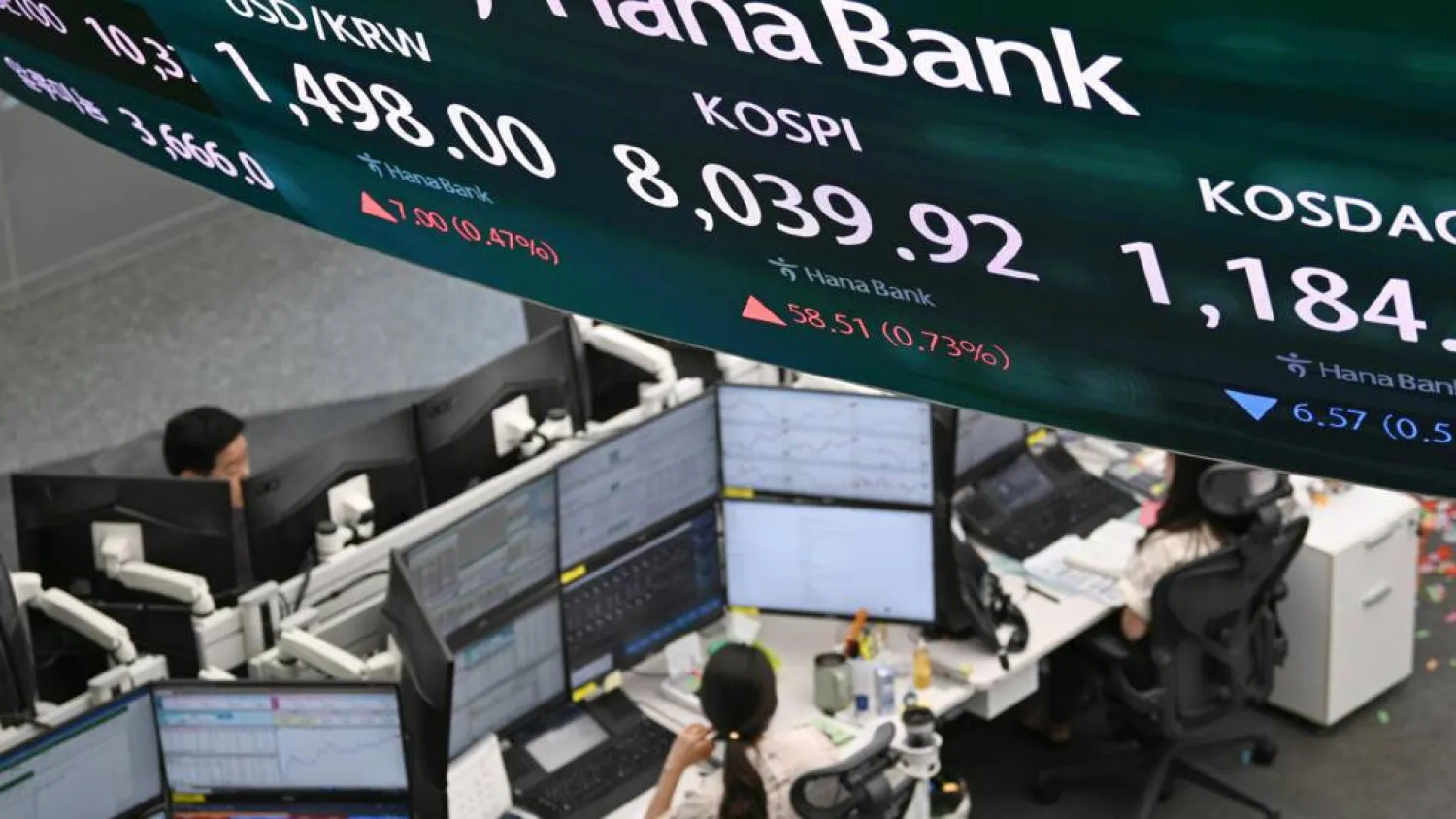
Seoul's Kospi, which has hit multiple records this year as it led Asian markets higher, tumbled Friday. Jung Yeon-je/ AFP
TT

Asian Stocks Take another Hit from AI, Mideast Worries

Seoul's Kospi, which has hit multiple records this year as it led Asian markets higher, tumbled Friday. Jung Yeon-je/ AFP

Asian equities went into reverse Friday on continued worries about the AI trade after disappointing forecasts from chip titan Broadcom, while investors were also keeping a wary eye on stuttering Middle East peace efforts.

After leading several markets to record highs this year, technology firms are facing selling pressure on concerns that the eye-watering sums pumped into artificial intelligence may have been overdone and stock valuations are too high.

Broadcom on Wednesday sparked concern among traders who have piled into all things AI when its revenue forecast for the third quarter came in below expectations, sparking a sell-off in Wall Street's Nasdaq as dealers took profits and rotated into other sectors.

And the losses have bled through to Asia, where tech-heavy Seoul and Tokyo -- which have led the region's surge this year -- sank from record highs.

South Korean stocks tanked almost seven percent at one point Friday, having dropped 1.8 percent the day before. The Nikkei in Tokyo was off more than one percent, matching Thursday's retreat.

The losses come as investors contemplate a coming IPO by Elon Musk's SpaceX, which is aiming to raise $75 billion in the biggest initial public offering ever. The company said in a regulatory filing that it would offer more than 550 million shares at $135 each next week, which could value the company at $1.8 trillion.

There were also losses in Hong Kong, Sydney, Singapore and Taipei, though Shanghai, Wellington and Manila edged up.

Jakarta extended losses amid building fears about the state of the Indonesian economy and the rupiah, which have been hammered by surging oil prices.

"Broadcom's revenue miss sparked profit-taking across the semiconductor sector and gave investors a reason to pause after the recent AI-driven rally," said City Index's Fiona Cincotta.

"Broadcom's results suggest investor expectations may have run ahead of fundamentals."

The latest AI wobble came as investors grew nervous about grinding efforts to end the Middle East crisis.

The head of militant group Hezbollah on Thursday rejected a conditional truce announced by Lebanon and Israel, demanding a comprehensive ceasefire and full Israeli withdrawal from its northern neighbor.

Naim Qassem's message came after the two sides agreed to a conditional ceasefire that Lebanon's president called the "last chance" for a durable end to the fighting.

Talks between Iran and the United States also appeared to be going nowhere, with Iran reporting "no tangible progress", even as President Donald Trump again voiced optimism, telling reporters a deal "could happen... over the weekend".

Still, oil prices held their recent losses amid lingering optimism a deal will be struck and the Strait of Hormuz -- through which a fifth of global oil usually passes -- will reopen.

Official US jobs data due later in the day are also in focus following forecast-topping private data that indicated the economy remained healthy and fanned bets on the Federal Reserve hiking interest rates.



Saudi-Jordanian Business Council Recommends Boosting Economic Cooperation

File photo of the Saudi flag/AAWSAT
TT

Saudi-Jordanian Business Council Recommends Boosting Economic Cooperation

File photo of the Saudi flag/AAWSAT

Meetings of the Joint Saudi-Jordanian Business Council were held in Jordan’s capital, Amman, to strengthen bilateral partnerships, promote joint projects, and address obstacles to trade and investment flows, SPA reported.

The council’s sectoral committees recommended a package of practical measures and initiatives to strengthen economic and investment cooperation, boost bilateral trade, and facilitate the movement of investors, businesspeople, and goods between the two countries.


Japan Seeks Record $55.6 bln Defense Budget, with AI Focus, Says Ministry

This photo shows an exterior view of the Defense Ministry of Japan with its sign at the main entrance in Tokyo on Sept. 17, 2021. (AP Photo/Hiro Komae, File)
TT

Japan Seeks Record $55.6 bln Defense Budget, with AI Focus, Says Ministry

This photo shows an exterior view of the Defense Ministry of Japan with its sign at the main entrance in Tokyo on Sept. 17, 2021. (AP Photo/Hiro Komae, File)

Japan's defense ministry requested a record budget of 8.9 trillion yen ($55.6 billion) on Monday as Tokyo looks to artificial intelligence to speed up decision-making in the face of a tense security environment.

But the final budget reportedly could reach 10 trillion yen as Tokyo undergoes a sweeping upgrade of its defense in order to navigate growing tension with neighbors such as China, North Korea and Russia.


Turkish Economy Grows Less-Than-Forecast 2.3% in Q2 as Domestic Demand Shrinks

24 August 2026, Türkiye, Istanbul: Pigeons take flight at sunset as people sit along the waterfront in Istanbul. (dpa)
TT

Turkish Economy Grows Less-Than-Forecast 2.3% in Q2 as Domestic Demand Shrinks

24 August 2026, Türkiye, Istanbul: Pigeons take flight at sunset as people sit along the waterfront in Istanbul. (dpa)

Türkiye’s economy expanded 2.3% year-on-year in the second quarter, data showed on Monday, below forecasts as domestic demand shrank amid tight monetary policy and the Iran war impact. 

In a Reuters poll, economic growth was estimated to have risen by 2.9% in the second quarter and was forecast to expand by ‌3.05% in 2026. ‌It was the fourth consecutive quarter of slower ‌growth. 

Treasury ⁠and Finance Minister ⁠Mehmet Simsek said that growth would rise after the "balanced" second-quarter growth. 

"Thanks to progress in the disinflation process and more supportive global conditions, we expect growth to gradually increase in the coming period," Simsek said in a statement after the data. 

Second-quarter gross domestic product grew 1.1% from the previous quarter on a seasonally and calendar-adjusted basis, the Turkish ⁠Statistical Institute data showed. 

The strongest growth by ‌activity was shown by agriculture, forestry ‌and fishing, which expanded 13.3%, while information and communication grew 8.6%, the data ‌showed. 

Haluk Burumcekci from Burumcekci Research and Consultancy said there was ‌an "increasingly evident loss of momentum in domestic demand", adding that the "positive contribution from net external demand after six quarters suggests that the first signs of the 'rebalancing among demand components,' one of the key objectives of the economic ‌program, have begun to emerge". 

External demand contributed 0.6 percentage points to second quarter growth, while domestic ⁠demand shrank ⁠1.3% quarter-on-quarter, economists said, noting that this was a disinflationary development. 

Turkish annual consumer price inflation stood at 31.75% in July, underscoring the challenges for the central bank, which has held rates at 37% in the last four policy meetings as it monitors Iran war fallout. 

While tight monetary and fiscal policies implemented to balance domestic demand and combat high inflation put pressure on economic growth, the economy grew by 2.6% in the first quarter, according to revised figures. 

Growth in 2025 was revised to 3.7% from 3.6%. 

The government's current medium-term program projected growth of 3.8% in 2026. A new medium-term program will be announced on September 7.