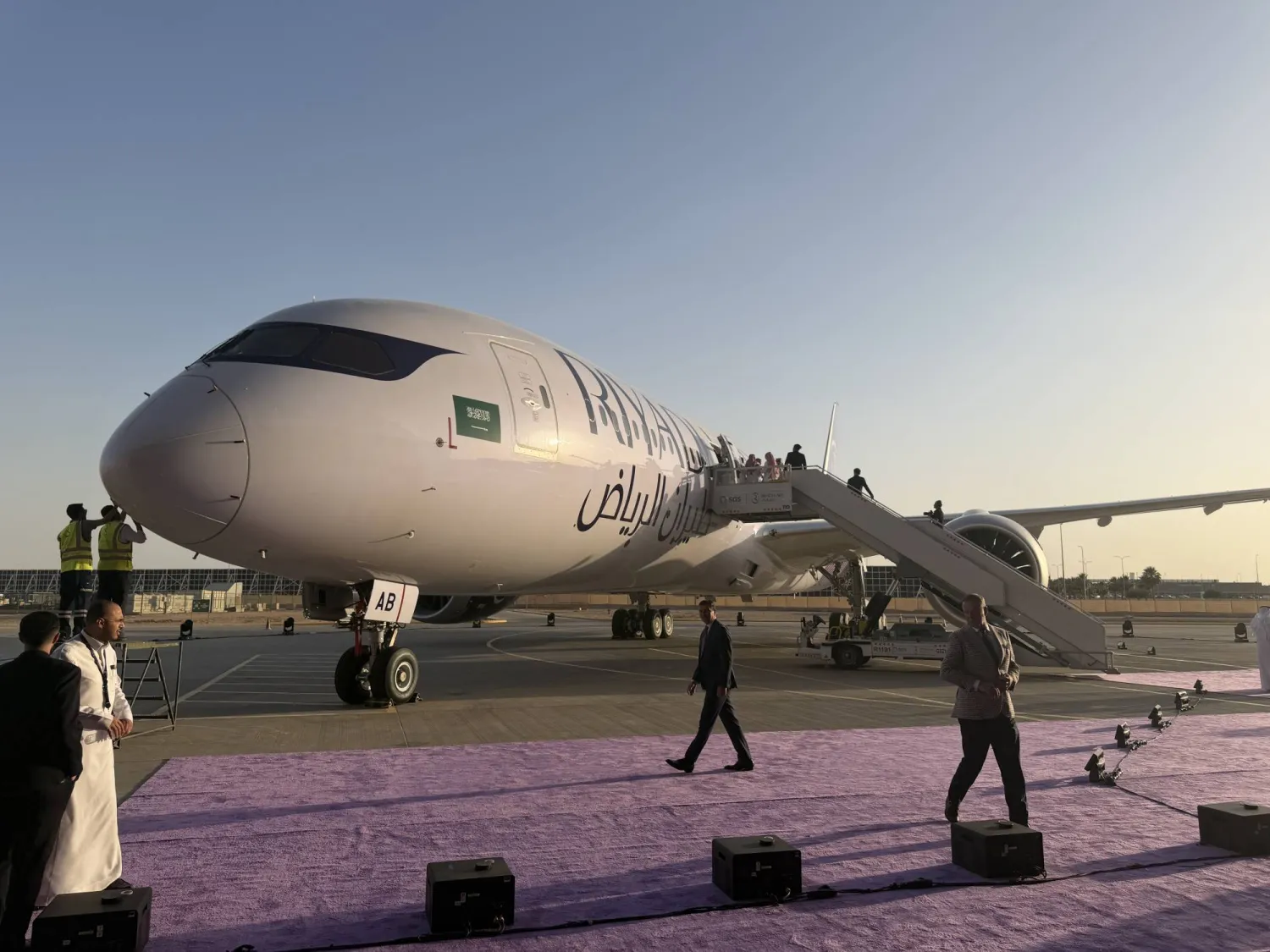
Riyadh Air Launches Five New Destinations, Moves Up Inaugural London Flight

Boeing 787 Dreamliner aircraft (Asharq Al-Awsat)
TT

Riyadh Air Launches Five New Destinations, Moves Up Inaugural London Flight

Boeing 787 Dreamliner aircraft (Asharq Al-Awsat)

Riyadh Air, a Public Investment Fund company, has announced the launch of five new destinations - Cairo, Dubai, Jeddah, Madrid, and Manchester - as the first three Boeing 787-9 Dreamliner aircraft in its modern fleet have arrived.

The carrier said the new destinations are part of its expansion plans to strengthen air connectivity between Riyadh and several of the world’s prominent economic, tourism, and cultural hubs, adding that more destinations will join its network in the coming weeks.

The announcement continues Riyadh Air’s operational progress, with its third new aircraft arriving in the Kingdom on Sunday, strengthening its operational readiness and supporting its target of connecting Riyadh to more than 100 destinations worldwide by 2030.

Flights to Jeddah are scheduled to begin June 14, followed by Dubai on June 18 and Cairo on June 25. Flights to Madrid will start on July 17, and Manchester on July 23.

Riyadh Air also announced that it has moved up its inaugural London flight from July 1 to June 10, in conjunction with the early delivery of its new aircraft.

Riyadh Air’s modern fleet features cabins equipped with the latest technologies and enhanced onboard experiences, along with a range of hospitality services designed to the highest international standards, providing passengers with a complete travel experience.


Oil Prices Climb More Than $3 After Israeli Strikes on Lebanon

A man fills up his vehicle at a gas station in Brooklyn on June 01, 2026 in New York City. (Getty Images/AFP)
TT

Oil Prices Climb More Than $3 After Israeli Strikes on Lebanon

A man fills up his vehicle at a gas station in Brooklyn on June 01, 2026 in New York City. (Getty Images/AFP)

Brent oil prices jumped more than $3 a barrel on Monday, initially spooked by Israel's launch of renewed strikes on Lebanon a day earlier, but also gaining further steam after sounds of explosions were heard in Iran.

Sounds of blasts were heard - in Tehran, Tabriz and Isfahan, local media reported early on Monday, eroding hopes for an imminent end to the wider war and a restart to ‌crude flows through ‌the Strait of Hormuz.

Brent crude futures rose $3.20 or 3.39% ‌to $96.24 ⁠a barrel while US ⁠crude futures were up $2.87 or 3.17% at $93.41 per barrel as of 0333 GMT.

Those gains erased Friday's losses, when prices fell on hopes of a de-escalation in the US-Iran conflict, which has seen oil prices rise over 50% since March.

Though Iran on Sunday fired a salvo of missiles at Israeli targets in retaliation, US President Donald Trump insisted that an agreement to end the wider war ⁠remains well within reach.

Trump also reportedly told Israeli Prime Minister ‌Benjamin Netanyahu to refrain from further attacks.

"It’s not ‌going to have any impact on the deal," Trump told the Financial Times. "I call ‌the shots. I call all the shots. He doesn’t call the shots."

Iran ‌has made a ceasefire with Lebanon a condition for a peace deal with Washington.

Israel invaded Lebanon in March after Iran-backed Hezbollah fired rockets and drones across the border. Lebanon and Israel said on June 3 that they had agreed to a ceasefire following negotiations ‌in Washington.

The two countries had previously agreed to a cessation of hostilities in April, but violence continued.

The wider ⁠war has been ⁠stalemated since the US and Israel paused their attacks on Iran in early April, with Tehran blocking most shipping through the Strait of Hormuz, the main transit route for one-fifth of the world's oil. Washington has imposed its own blockade of Iranian ports.

Amid the resulting supply crisis, OPEC+ on Sunday agreed its fourth increase in oil output in four months.


OPEC+ Decides on Fourth Oil Quota Hike Since Hormuz Closure

Vessels are anchored in the Strait of Hormuz as seen from Musandam, Oman, June 3, 2026. (Reuters)
TT

OPEC+ Decides on Fourth Oil Quota Hike Since Hormuz Closure

Vessels are anchored in the Strait of Hormuz as seen from Musandam, Oman, June 3, 2026. (Reuters)

OPEC+ agreed on Sunday a fourth increase in its oil output targets in as many months, even though the US war with Iran is still preventing several of the group's members from pumping more.

The war has cut oil flows via the Strait of Hormuz, creating the world's biggest-ever supply crisis as key OPEC+ members including Saudi Arabia have been unable to supply customers in full since the end of February.

Seven core members of OPEC+, which ‌groups ⁠OPEC and allied producers ⁠including Russia, have increased their output quotas from April to June by almost 600,000 barrels per day.

In reality, the group's production has collapsed due to export cuts by Gulf members, averaging 33.19 million bpd in April compared with 42.77 million in February, according to OPEC figures.

On Sunday, the seven members decided to increase targets by 188,000 bpd from July, OPEC said in a statement.

This is the same as the June hike, which was adjusted down from monthly increases ⁠of 206,000 bpd in May and April to take into ‌account the United Arab Emirates’ exit. The UAE left OPEC after almost 60 years.

On Friday, oil prices fell to around $93 a barrel as traders gained confidence that renewed conflict between the US and Iran was growing less likely. Prices were close to $72 before the war began.

The seven countries are ‌increasing production as part of the gradual unwinding of a 1.65 million bpd production cut that the group, which at the time ⁠included UAE, agreed ⁠in 2023.

The seven of 21 OPEC+ members who met on Sunday are Saudi Arabia, Iraq, Kuwait, Algeria, Kazakhstan, Russia, and Oman. In recent years, only the seven plus the UAE when it was a member have been involved in the group's output policy decisions.


China’s Central Bank Extends Gold Buying Spree for 19th Month in May

Gold items are displayed at a jewellery shop in downtown Kuwait City on June 6, 2026. (AFP)
TT

China’s Central Bank Extends Gold Buying Spree for 19th Month in May

Gold items are displayed at a jewellery shop in downtown Kuwait City on June 6, 2026. (AFP)

China's central bank increased up its gold reserves for a 19th month in May, data from the People's Bank of China showed on Sunday.

The country's gold reserves rose to 74.96 million ‌fine troy ‌ounces by the ‌end ⁠of May, versus the ⁠previous month's 74.64 million ounces

China's gold reserves were valued at $340.75 billion by the end of last month, down ⁠from $344.17 billion the ‌month prior, ‌according to the PBOC data.

Spot gold prices logged ‌a third straight month of decline in May as peace talks between the United ‌States and Iran failing to yield results.

Inflation ⁠risks ⁠following rising oil prices kept the "higher-for-longer" interest rate theme alive, with the dollar remaining elevated.

Gold continued to decline in June and was most recently traded at near $4,330 an ounce.